
For poet Chase Twichell, Zen practice and writing have long been deeply intertwined. “Zen is said to be a ‘mind-to-mind transmission,’” she told the Poetry Foundation. “The best poems are exactly that: They leap from one mind to another without stopping to explain exactly how they did it. . . . In our culture, out of necessity, we’re used to living in a mostly literal mind, and poetry demands that we enter it with another kind of mind.”
Her latest collection, The World It Was, offers one such opportunity to access another kind of mind—one carefully attuned to grief, transience, and environmental destruction. Composed in the wake of the Covid pandemic, the collection consists of restrained, nearly skeletal elegies—for her late husband, for her aging body, and for the Earth itself—that look directly at suffering and ask how to live in the face of seemingly all-pervasive loss (or, as the book’s description states, “being fully alive inside the brief body and the dying world”).
Though this question is of course unanswerable, the poetic worlds that Twichell builds suggest that attention plays a key role in figuring out a way forward. “Zen and poetry have both taught me that the quality of attention we pay to the world is crucial,” Twichell said in a 2016 interview. “Of course there are many ways to make people see the damage we’ve done, and poetry is only one of them. But to me, it’s the arrow that most deeply pierces my consciousness.” The World It Was presents sixty-seven such arrows: invitations to embody a different kind of mind, and, in the process, relearn what it means to exist fully in a world defined by impermanence.
–Sarah Fleming, senior editor
The World It Was
I was a kid transfixed by
the endlessly mutating
gloomy rooms among the trees,
and I wandered far.
At seventeen, I married thunder
and wind and snow. I took vows.
I pledged to be only half human,
so only half guilty of our crimes
against Earth and all its beings.
Wherever I am, I visit Earth’s memorial.
Sometimes I leave a few words
in the dirt on a car.
The memorial surrounds us.
Earth’s body is also its grave.
Death’s Hors d’Oeuvres
A school of dead gray fish drifts
across my vision—floaters.
No names come when I call.
Is this what old age will be like?
No, this is old age now.
I like to take little sips of the horror,
morsels of poisoned meat,
each taste a foretaste.
I’m preparing for future pain,
not this pain.
That’s the lie I tell myself.
I Can’t Make Sense of It
In one of these many centuries,
my words fell briefly through the air.
A flurry, among many flurries.
I can’t make sense of it:
the word-bearing trees
grew older, bore less and less fruit.
Birds carrying the twigs of poems
still fly in from time to time
but they don’t nest here anymore.
Flower of False Starts
It’s a strange flower,
the flower of false starts.
I dress in its withered petals.
Each knob on the stem
is the scar of a flower
that never fully bloomed.
Or it bloomed, but the flower
was not the flower I dreamed.
It’s almost all stem now.
Withered petals—pretty dress.
The flower is nearing
the end of its life.
Each poem leaves a scar.
Solitaire
When Russell was dying
I sat beside his bed
playing solitaire on my phone,
practicing his not being there.
I liked the way the cards came
in quick cold cascades of numbers,
clusters of luck,
and I could visit that bright flow
day or night.
I liked the way the game was
always starting over, always
not quite daybreak on the screen,
the longest time until dark.
♦
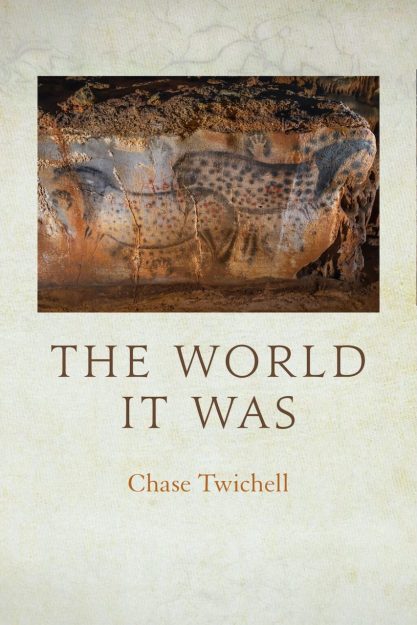
“The World It Was,” “Death’s Hors d’Oeuvres,” “I Can’t Make Sense of It,” “Flower of False Starts,” and “Solitaire” from The World It Was, copyright 2026 by Chase Twichell, used by permission of Copper Canyon Press.

Thank you for subscribing to Tricycle! As a nonprofit, we depend on readers like you to keep Buddhist teachings and practices widely available.