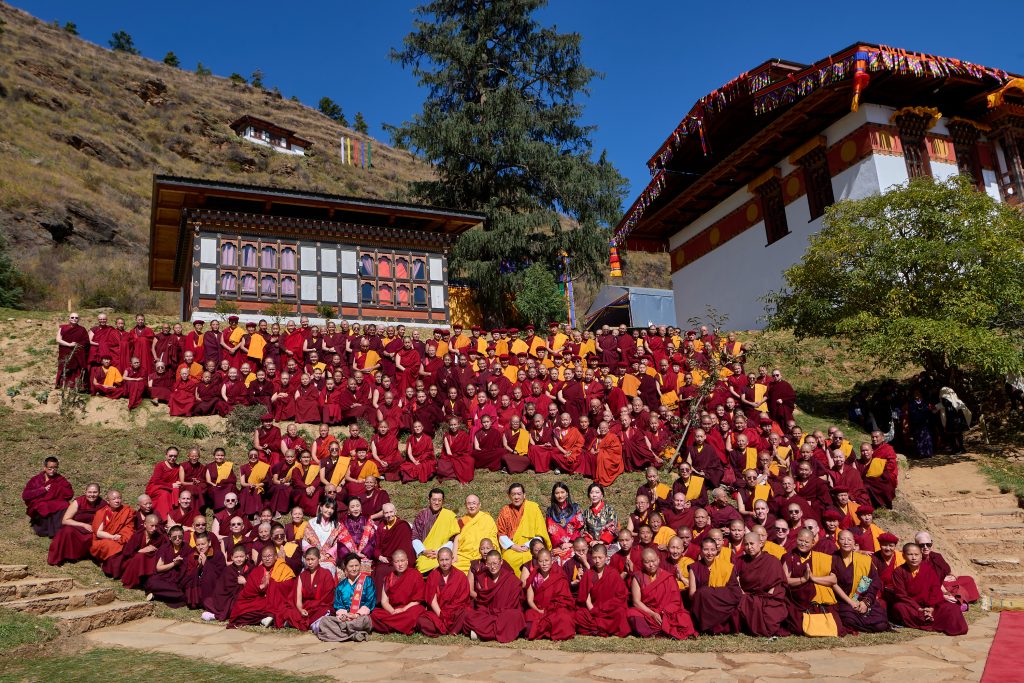
The concept of impermanence, a central pillar in Buddhist practice, is beautifully illustrated in the journey of the Tibetan Buddhist nuns over the last thirty years. Indeed, many valuable changes have subtly unfolded over that time: First and foremost, there has been wider access to education, which had been a key factor in enabling nuns to study Buddhist philosophy in the 1990s and then to engage in debate practice, culminating in a course of study with the geshema diploma, awarded for the first time to twenty Gelugpa nuns in December 2016 by His Holiness the Dalai Lama. Wider education access also resulted in the many khenmos who graduated from both the Kagyupa and Sakyapa traditions around the same time.
However, one important thing was missing for nuns of the Tibetan tradition, since until very recently they were still allowed to take only novice nun (Tib.: getsulma) vows and did not have access to full ordination with bhikshuni (Skt.: fully ordained Buddhist nun; Tib.: gelongma) vows, the highest level of vows in the Buddhist monastic tradition. Yet, in his time, the Buddha had authorized and conferred full ordination to nuns. In an article written by American Tibetan Buddhist nun Thubten Chodron, she recounts how, according to His Holiness the Dalai lama, in the late 8th century, the great Indian abbot Santaraksita brought bhikshus (Skt.: fully ordained male Buddhist monks) to Tibet to give the bhikshu ordination, but he did not bring bhikshunis, and thus the bhikshuni ordination was not given in Tibet. And it was this missing link that confined Tibetan Vajrayana nuns to novice vows for centuries. The only solution for them was to travel to Taiwan, China, or Korea to receive ordination according to the Dharmagupta lineage, which was a source of great complexity and financial problems for nuns.
At a 2007 Hamburg conference, researchers and religious leaders alike made their cases for the full ordination of Tibetan nuns through a single assembly of bhikshus. As Tenzin Palmo, a bhikshuni in the Drukpa Kagyu lineage of the Kagyu school of Tibetan Buddhism, directly said in her opening address:
“The Lord Buddha himself decreed the full ordination for nuns. He did not say that nuns should only receive a sramanerika ordination. Whatever the controversy over his reasons for his initial hesitation, the bhikshunis were definitely bhikshunis, so we are merely following the Buddha’s own intention. In addition, for a country or nation to be considered as a truly Buddhist Middle Country, there must be the fourfold sangha of bhikshu, bhikshuni, upasaka, [and] upasika.”
Talking to Vicki Mackenzie for Tricycle: The Buddhist Review in 2024, Palmo reiterated her frustrations over the lack of support from the larger institutions of Tibetan Buddhism for the ordination of women: “They are sticking to their guns: we have to wait for the Buddha Maitreya to arrive for him to confer it.” And yet in 2022, it appears that Bhutan decided to speed things up, so that the nuns do not have to wait for the advent of Maitreya to be fully ordained.
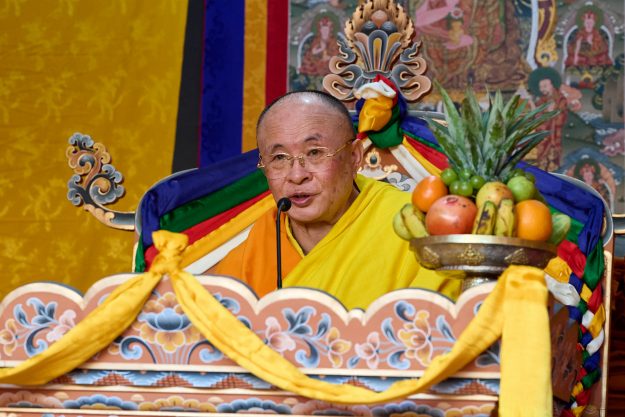
In June 2022, at the request of the Royal Family of Bhutan, Je Khenpo, the spiritual head of Bhutan and renowned vinaya expert, first offered the gelongma ordination to 144 nuns, mainly from Bhutan. It was organized by the Bhutan Nuns Foundation. For Je Khenpo, it was the right time and the right thing to do even if voices spoke out against the initiative.
Following the success of this ordination and thanks to the inspiration of the first gelongmas, requests from all over the world were quickly made to Bhutan Nuns Foundation for a second wave of ordination.
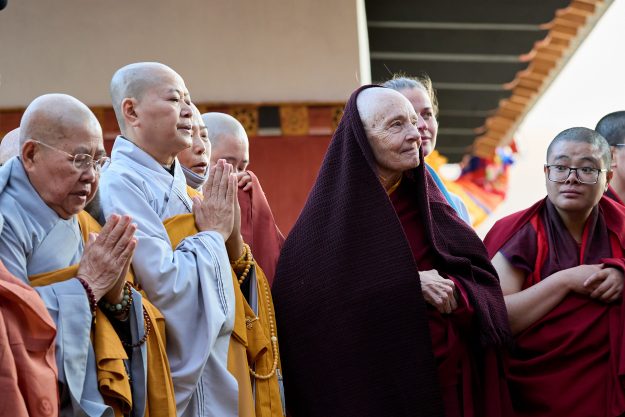
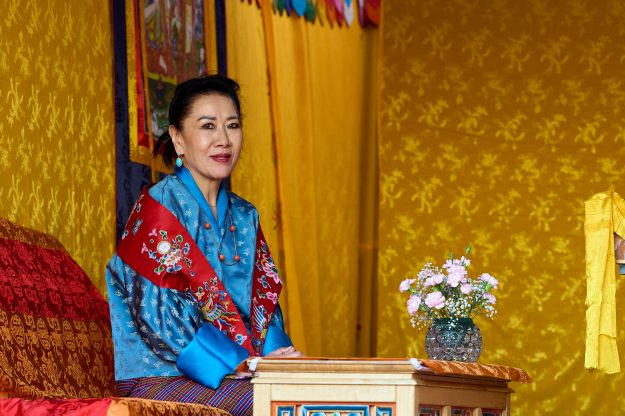
It took three years to organize it, and, on November 14, 2025, under a magnificent sun and in the inspiring location of the Bhutan Nuns Foundation Training and Resource Center in Thimphu, 265 nuns were welcomed to receive the full ordination. Among them, 128 came from such different places as India, Nepal, Europe, the US, Australia, Hong Kong, Vietnam, and Indonesia. On this day, Her Majesty the Queen Mother, Gyalyum Tshering Yangdoen Wangchuck, Royal Patron of BNF, together with His Holiness Je Khenpo, granted an audience to all the prospective gelongmas during which namjars (ceremonial shawls) and lhungzey (alms bowl) were offered to the nuns. Je Khenpo welcomed the international gathering of nuns and, at this occasion, shared his wisdom on the profound significance of gelongma ordination in the spiritual path of a nun.
Amidst a mix of colorful robes, great joy, and emotion, several bhikshunis from Korean and Vietnamese traditions joined the trip to make offerings to the future gelongmas under the loving gaze of Jetsunma Tenzin Palmo, who could not miss this event. In the evening, the first group of nuns arrived—a total of forty-five candidates trained in the temple, with the amazing help of the Khenpos in charge of helping for the ordination, with both great seriousness and joy.
On November 15, His Majesty the Fourth King of Bhutan, His Majesty the Fifth King of Bhutan, the Gyaltsuen, and many members of the Royal Family came to grace the opening ceremony. It was a wonderful occasion for all the attendants to commemorate the seventieth birth anniversary of the Fourth King of Bhutan and a unique opportunity for the nuns to exchange a few words with members of the royal family. In the afternoon, Je Khenpo conferred gelongma ordination upon the first group of nuns, marking a historic and deeply meaningful beginning to this sacred ceremony. The ordination continued over the next four days.
Gelongma Ngawang Dolma, from Germany, explains: “During the gelongma ceremony, I could not stop my tears from falling. I was deeply moved by the fact that, at last, I was becoming a complete nun. I felt a sense of wholeness, an immense gratitude, and a pure joy. Even now, my eyes fill with tears when recalling this moment.” With great seriousness, she concludes: “Now I feel a deep responsibility to be an inspiration for the future nuns; it is our responsibility to uphold the gelongma vows with integrity and understanding, we will be examples for the younger nuns.”
Gelongma Sonam Wangmo, from Malaysia, feels very fortunate to be fully ordained. In a mischievous smile, she quotes some nuns who expressed that now they don’t regret anything even if they would die. She told them that instead of thinking of dying, “they should think of living even longer so that they will be able to disseminate and spread this lineage to others.”
Gelongma Deckyi Wangmo, from France, felt a great upheaval inside, as if a source had awakened within her. She felt the presence of Buddha within her, and a deep devotion overwhelmed her. And since then, she no longer sees things in the same way; her motivation is even stronger.
After the ordination of a final group of nuns on November 19, all of the gelongmas joined the closing ceremony after a procession around the temple, where they received their first alms, notably from the Queen Mother, whose guidance and support have always been the driving force behind BNF’s work. Then, the BNF team and all the gelongmas made traditional mandala offerings and long-life prayers to Je Khenpo and the Queen Mother, followed by all the gelongmas offering khatags to Je Khenpo, again with lots of respect and joy in their eyes.
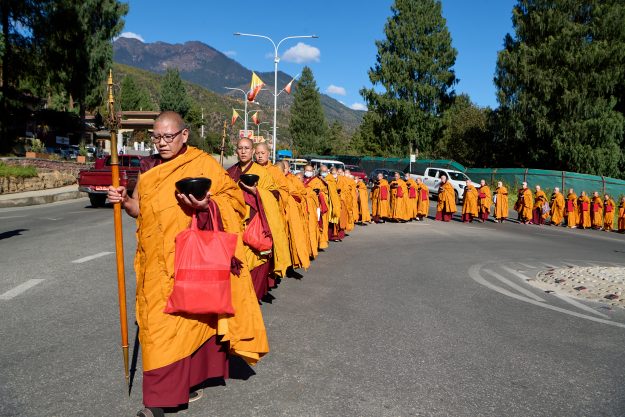
The following day, November 20, was one of the most moving moments of these seven days, with the alms round through the streets of Thimphu, an ancient practice rarely witnessed in modern times. The alms round symbolizes humility, gratitude, and the deep interdependence between the monastic sangha and the lay community, a practice dating back to the time of the Buddha. The Fifth King and the Gyaltsuen insisted on offering the first alms to the newly ordained gelongmas, honoring the ceremony with their presence. “It was deeply touching to see the faith and rejoicing of the Bhutanese laypeople when we went on alms round—some women had tears in their eyes, older people gave with such devotion, and children were overjoyed to push sweets into our bowls and share in the merits of the event,” said Ayya Yeshe, an Australian nun. “It was beyond anything I had imagined, deeply moving and indescribably beautiful,” added a German nun.
With full vows of gelongmas, nuns will be able to participate equally in the monastic community, helping reestablish the complete fourfold sangha, as described in early Buddhist teachings. Jetsunma Tenzin Palmo, who has been working alongside nuns for so long and who had to travel to Hong Kong in 1973 to receive full ordination, came this time with fifty-three of her nuns from Dongyu Gatsal Ling nunnery in India. She can fully rejoice at these advances for women’s Buddhism, knowing that Je Khenpo will never be criticized for his initiative, given his renown and high status as a Tibetan lama. Similarly, the fact that Tai Situ Rinpoche, a very respected high lama in the Karma Kagyu tradition, sent nuns from his monastery to receive full ordination is a very encouraging sign for the future, a message sent to all the lamas.
We finally may ask ourselves if the Tibetan way—making big changes slowly—is not a kind of chance for nuns of the Tibetan tradition. Says Jetsunma Tenzin Palmo: “Thirty years ago, the timing was wrong, the nunneries were poorly run, and the nuns had very little confidence and wouldn’t have been able to study the vinaya texts, conduct all the rituals. . . .” Now it seems to be the right time. With the full ordination conferred in Bhutan, “the door has opened a little crack so more nuns can step up and say this is what we want to do.”
“The door has opened a little crack so more nuns can step up and say this is what we want to do.”
Even though Tibetans did not react so much after this ordination, we nevertheless heard that many lamas and monks were very supportive and that many nuns in Dharamsala (India) also expressed their heartfelt wish to take full ordination in the future.
All the nuns who received ordination are now cultivating a strong sense of responsibility, with the dedication to take the precepts seriously. “Yet this is not the end, it is the beginning. These newly ordained sisters will have to support each other, leaving no one behind, and ensuring that this sacred lineage remains alive, vibrant, and accessible for generations to come,” said Tashi Zangmo, the executive director of Bhutan Nuns Foundation, wishing for them a fulfilling spiritual journey as bhikshunis and expressing hope that, twelve years from now, they will be able to ordain new bhikshunis and help uphold the purity and sacredness of this precious lineage. Indeed, after keeping their vows for twelve years, bhikshunis will be able to be qualified to confer the full ordination to all devoted novice sisters.
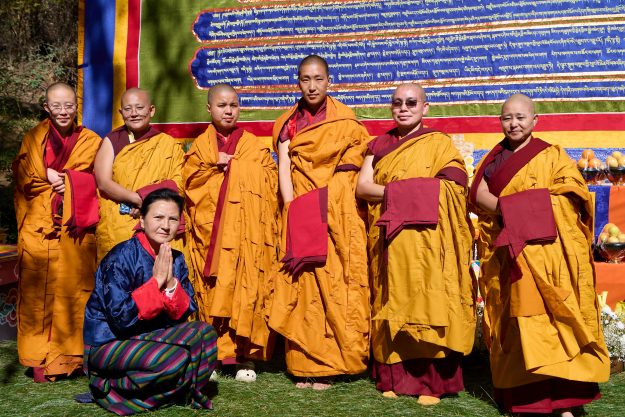
After this amazing Bhutanese experience, we are full of gratitude for all people who pushed for reintroducing gelongma vows and finally made the change happen. Above all, motivation seems to be the major ingredient for change. Tibetan Buddhist nuns are beautifully endowed with it and will stay an endless source of inspiration in our daily life and for our practice.

Thank you for subscribing to Tricycle! As a nonprofit, we depend on readers like you to keep Buddhist teachings and practices widely available.