
Wisdom, which helps us make reasonably good life choices, enabling us to live reasonably good lives, can’t be secret or esoteric. It must reside in what is common and ordinary; otherwise, what hope would any of us have of living well? It would be beyond us—special, hidden away, reserved for the few. No. The last word can’t be far off. And, indeed, Zen (pinyin: Chán) teachers in ancient China used folk songs, stories, and colloquial language, taking up whatever was handy, to open the Way and reveal our common inheritance, our true birthright of enlightenment.
Still, if it is so ordinary and common, why must we work so hard to awaken to it? If it is common knowledge, why do we need so many reminders, so many repetitions to “get it.” How many times must Dorothy say, “There’s no place like home” before it sinks in?
Chao-chou (J. Joshu; 778–897), one of the most mature of all Zen teachers, once was asked about the highest teaching of the buddhadharma, the essence of the path the Buddha taught. That dialog is Gateless Barrier’s case 37—“Chao-chou’s Oak Tree in the Front Garden,” (or front yard or courtyard—depending on the translation). This little koan offers us a personal opportunity to experience [the] highest wisdom for ourselves. Here’s the case:
A monk asked Chao-chou, “What is the meaning of Bodhidharma’s coming from the West?”
Chao-chou said, “The oak tree in the front garden.”
Wu-men’s commentary:
If you can see intimately into the essence of Chao-chou’s response, there is no Shakyamuni in the past and no Maitreya in the future.
Wu-men’s verse:
Words do not convey the fact;
Phrases do not embody the spirit of the mind.
Attached to words, your life is lost;
Blocked by phrases, you are bewildered.
The question “Why did Bodhidharma come from the West?” is a Zen cipher for “What is the highest teaching of the buddhadharma?” Or, “What is the point of Zen?” It questions why Bodhidharma, an Indian ex-prince, despite being already elderly, chose to make what was then a notoriously dangerous ocean crossing from Southern India to China. In short, what was so important that Bodhidharma was willing to risk his life to share it? The monk is not simply tossing off a Zen cliché. He’s asking, “What is worth risking one’s very life to realize, to understand?” He may be asking sincerely, truly seeking to know, or he might be challenging the great Chao-chou—“Let’s see what the Old Boss does with this!” In either case, Chao-chou’s response is immediate and superb—“The oak tree in the front garden.”
Before going further, let me share a personal anecdote. Some years ago, I was having lunch with Aitken Roshi in an Italian restaurant in Honolulu, when I asked him something similar to what the monk asked Chao-chou. I wasn’t trying to be clever, to initiate some kind of Zen encounter dialogue, or to attempt some kind of Zen challenge. It was a sincere question. I’d been practicing Zen for a long time by then, already over twenty years, and had traveled quite a distance from Upstate New York to Hawaii, to have a chance to practice with Aitken Roshi. I’d lived through the struggles, turmoils, failures, and issues that had marked Zen Buddhism’s initial settling into the West. What I asked was rather simple: “Roshi, this Zen thing; what’s the point? Why do we do it?” He answered immediately, saying, “Happiness.” Then he put down his fork and sat quietly for a moment. Then he looked at me again and said, “No. Many people in this world are happy. Absorbed in their work, in their families, or hobbies, they’re happy. But, if impermanence has bitten too deeply, and a yearning for something more, a way to be at peace in the face of impermanence has taken root, then Zen can show you the Way to happiness.” I very much appreciated his thoughtfulness and care in catching himself, really looking at my simple question, and not remaining content to simply mouth a handy Zen cliché.
If, like the prince Siddhartha Gautama, we, too, have met with impermanence and left home seeking an answer, seeking genuine happiness, then, Zen, Aitken Roshi was saying, can show us the Way, the way to a smile in the face of it all. Did gruff old Bodhidharma, then, have a soft heart, and make that risky journey because he simply wanted us to be happy? Truly happy? Our times are complex and troubled. Do we even have the right to be happy when so many are suffering? When greed, anger, and ignorance are running rampant? When injustice, climate change, fascism, misogyny, and racism are in our faces?
Keen awareness of impermanence and its terrors was the essence of the Buddha’s life-koan, leading him to abandon his privileged life and sheltered home. What is the highest truth, the one that brought that smile to the Buddha’s lips in the face of his terrifying recognition? (A question for those who think Buddhism is pessimistic: what do you make of the Buddha’s smile?) Can we, too, find this same liberating truth, this … happiness? Do we dare? Happiness, in the face of personal, cultural, national, and global difficulties can seem so radical as to be beyond belief—even a cop-out. And, yet, what’s wrong with joy?
If the monk in this koan is sincere, he seems to have been as bothered by the facts of life as the Buddha had been some 1,500 or so years earlier, as we ourselves might be now, some 1,200 years after the monk and Chao-chou. It is the grim reaper’s threatening, toothy, skeletal smile, not the Buddha’s inwardly joyous one that lies behind his question: What is Zen really about? What does it offer me? What is the highest, purest, truest, deepest teaching of the buddhadharma? Why did that old red-bearded Indian (some sources say Persian) barbarian, Bodhidharma, journey boldly over the sea to China from the West? What did he bring that was so important?
In Book of Serenity (C. Congrong lu, J. Shoyoroku) a monk asked Qingyuan (J. Seigen), “What is the essence of Buddhism?” Qingyuan answered, “What is the price of rice in Luling?” If it’s so simple, why did Bodhidharma risk that dangerous journey? Ships sank attempting that crossing and travelers drowned. Yet Bodhidharma, knowing this, was willing, nonetheless, to get on board and risk his life to bring to China what was, in time, to become Zen Buddhism. And by the way, once he arrived in China from India, he wasn’t welcomed with open arms, either. It was rougher than that. According to legend, some of the Buddhist teachers there felt so threatened by his new Zen “thing,” they tried to poison him. What was the big deal?
By the time Bodhidharma arrived in China (around the year 500), Buddhism had already been there for several hundred years. Mindfulness, meditation, chanting, sutra study, devotional practices, a dedication to accumulating merit by doing good deeds (like building temples, supporting monastics, and releasing animals destined for slaughter) were well-established. Why did Bodhidharma and his teaching cause such a ruckus? What IS the highest, deepest truth of the buddhadharma? What was it that made what Bodhidharma and his heirs taught so radical (both in its ordinary and in its primal sense of “going to the root”) even dangerous to the social order, that Hui-k’o, his first heir, was murdered by the governor of the province for teaching it? And, if it is so radical, how could it bring happiness to ordinary folks, people like you and me? Wouldn’t we, too, have to be radical, unrestrained, even outrageous to “get” it? Why, as ordinary as we are, can and do we practice this revolutionary path of “the highest teaching”?
For koan students, dokusan—“going alone” to face the teacher and the koan, (and ultimately ourselves)—can be challenging, even stressful. Don’t we already have enough stress in our lives? Mightn’t it make sense to find an easier, less demanding path? Then again, less challenging paths might also be less rewarding. As conventional wisdom has it, nothing worthwhile is attained without perseverance, courage, and effort. Zen stories offer a clear and inspiring—even daunting—record of the efforts of those who came before us and worked hard to free themselves of their “mind-forged manacles.” (William Blake, “London,” Songs of Experience.)
One of the most central of such founding stories is that of Bodhidharma’s main heir, Hui-k’o, a monk who, after years of meditation and study, became desperate to personally realize [the] highest Truth. Hearing of Bodhidharma, this teacher newly arrived from India, the land of the Buddha, he braved a mountain in winter to beg for his help. And was rebuffed. Told that he wasn’t sincere or committed or strong enough; that the Great Way was too hard for the likes of him, legend has it that he cut off his arm to prove his resolve. While in reality his arm was probably lost in an encounter with bandits, the legend serves its purpose, signaling that this “highest teaching” is worth something.
What is this highest teaching of the buddhadharma, this vital something that motivated Bodhidharma to risk his life, and Hui-k’o to cut off his arm? And how, some 500 years after Bodhidharma, did it become something as simple (and confounding) as, “The oak tree in the front garden”? This is why Bodhidharma crossed the sea from India to China? This is what Hui-k’o cut off his arm to get? Is Chao-chou saying that compassion is the highest teaching; that Bodhidharma was so compassionate, he came for the sake of even this tree? That the highest meaning of the buddhadharma—the teaching of the Buddha—is compassion for all things, including even trees and plants? Is he saying, more radically yet, “This oak tree is Buddha! All things are Buddha! Look! Look!”?
Alas, if we settle for any of that, good as it might be, we’ve wandered from the garden into the weeds. These are all concepts, good ones, but concepts nonetheless, and, like all concepts, they’re doomed to deconstruct when the chips are down. Hui-k’o would have been a fool to cut off his arm for such comforting pleasantries. Bodhidharma could have written any of that down on a piece of paper, and sent it to China in a letter, without risking his life. Why didn’t he? Why did he risk his life? Why’d he choose to attempt that dangerous ocean crossing? And what does any of it have to do with an oak tree in the front garden? Or with our own happiness, right now?
The question of the meaning of Bodhidharma’s coming from the West would have been an intimate one by Chao-chou’s time. The awakening made possible by Zen practice during the T’ang era, the so-called “Golden Age of Zen,” owed its life to the pioneering efforts of Bodhidharma and Hui-k’o. While the Buddha initially opened the Path, Bodhidharma brought it to life. Trimming away the philosophical leaves and branches of Indian Buddhism, he offered Chinese Buddhists the core, the root, the practice of awakening itself, which is what eventually became known as “Chan” in China, and later, in Japan, as “Zen,” both names derived from the Sanskrit word, dhyana, meaning “meditation.”
Zen tradition frames Bodhidharma’s essential teaching like this: “Without dependence on special texts, words, or letters, pointing directly to Mind itself, becoming Buddha, just as you are.” Additionally, for Chinese Buddhists, while “the West” meant India, the home of the Buddha and so the Buddhist Holy Land, it also implied the Western Paradise of Amitabha Buddha, Buddha of Boundless Light. So, the question also asks, “Why did Bodhidharma, emanation of Avalokitesvara, Bodhisattva of Compassion, descend from the Western Paradise and come down to China with its wars, intrigues, and political tangles? What was so important that he was moved to leave heaven and descend to our mundane world?”
The first case of Blue Cliff Record sets it up. Emperor Wu, having asked the newly arrived Bodhidharma for the highest teaching, was told it was, “Vast emptiness. Nothing to be called holy.” Confused by that he asked, “Who are you? (i.e., “Aren’t you a holy man?”) Bodhidharma’s answer—“I don’t know”—drew another blank from the dumfounded sovereign. Seeing how things stood, Bodhidharma left the Emperor slack-jawed, crossed the Yangtse River, went up into a cave in the mountain above Shaolin monastery, where he settled down to nine years of wall-gazing zazen. The koan’s conclusion says:
Later the Emperor brought this up to the Prince Chih, who asked, “Does your Majesty know who this man is?” The Emperor said, “I don’t know.” Prince Chih said, “He is the Bodhisattva Avalokitesvara transmitting the Buddha Mind Seal.”
What is the highest teaching? What is fundamental, not just to our practice but to our lives? Don’t we yearn to realize what is most meaningful in our all-too-brief time here? The Emperor Wu did, but Bodhidharma’s response left him baffled. Some four hundred years or so after this initial encounter, Chao-chou was asked this same question—“What is the highest teaching of the buddhadharma?” couched as, “Why did Bodhidharma come from the West?” and his answer – “The oak tree in the garden”—also leaves many baffled. How does speaking of a tree answer the question of the meaning of our life, yours and mine? How does it reveal the deepest possible reason for Bodhidharma’s journey over the sea?
As mentioned earlier, Chao-chou had his first realization at the age of nineteen, and, at fifty-six, a profoundly complete satori. After that, he traveled for another twenty-five years checking his understanding against the teachers of his time, and not until the age of eighty did he finally settle down and begin to teach—which he continued doing until his death at one hundred and twenty. Chao-chou did not rely on the stick or the shout. His revelatory words were so quiet and subtle, coming in under the radar, you’d hardly know he’d already presented IT fully—and moved on. Other great teachers were awed. The word on Chao-chou was that “His lips flash light.” Zen master Dogen, who is very sparing in his praise of the old teachers, called Chao-chou, “the Ancient Buddha.” This is beyond Zen, beyond Buddhism. High praise, indeed!
Wu-men’s commentary on the case of the oak tree says, “If you can see intimately into the essence of Chao-chou’s response, there is no Shakyamuni in the past, and no Maitreya in the future.” What is “intimately”? How intimate is it? Thoughts about Buddhism and its meaning, including thoughts about Chao-chou’s response, are not intimate. Like all philosophy, all concepts, they remain outside the gate, unable to resolve our fundamental dilemma: how to live compassionately, peacefully, happily—which does not mean always smiling, always “haha” happy whatever is going on—in the face of the challenges, joys and sorrows, laughter and tears of an impermanent life.
Why will there be no Shakyamuni in the past, no Maitreya in the future? Shakyamuni, the actual, historical Buddha lived 2,500 or so, years ago. Maitreya is the next fully realized Buddha, who, Buddhist tradition asserts, is destined to be born here on this Earth in the distant future. Won’t it be lonely, not to mention risky, to continue on without such wise and compassionate guides? Where’d they go, anyway? And why? What happened to both the past and the future? Truly, what is intimately? Wu-men sets us straight with his verse to the case:
Words do not convey the fact;
Language is not an expedient.
Attached to words, your life is lost;
Blocked by phrases, you are bewildered.
“Words do not convey the fact.” What is the fact? While words are, or can be “Just This!” which is no expedient, the word “water” allays no one’s thirst, the word “rice” eases no hunger, the word “tree” offers no shade. Attached to words our actual life is lost. When a cup is a thing called “cup,” do we feel its rough or smooth glaze, see its subtle colors, experience its heft in our body as we hold it? Or are we off wandering in our heads, thinking of bills to be paid, clothes to be put in the dryer, the arborist coming to trim the oak tree in the front yard? The tea we drink is wet, but do we appreciate its flavor? Where does that flavor come from? Is it “in” the tea leaves—or in us? If so, where is this “in”? Identifying with thoughts, eating from the Tree of the Knowledge of Good and Evil, I am trapped “in here” and you, and everyone, and everything else stuck “out there.” Splitting the world, the Garden withers. But Chao-chou’s oak is rooted in the Original Garden. Awakening to it, we re-enter the placeless Place we’ve never truly left.
To be blocked by phrases, stuck on a koan, may not be so bad. Because we are stuck, because we have come to the end of logic we have a chance to step beyond the too-small fishbowl of our overly mentalized lives. Because we are bewildered, and know that we are bewildered, we can sit down, cross our legs, count one, two, three up to ten, experience this breath, commit single-mindedly to this koan, and keep going, going until we, and the oak, and all things, and all no-things fall away and just—oak tree in the front garden.
The oak tree koan took on a life of its own in the Zen circles of Chao-chou’s time, and later as well. It’s said that a monk hearing of it, asked Chao-chou, “Has the oak tree buddha-nature?”
Chao-chou answered, “It has.” The monk then asked, “When does the oak attain Buddhahood?” Chao-chou said, “When the great universe collapses.” The monk then asked, “When does the great universe collapse?” Chao-chou said, “When the oak tree attains Buddhahood.” When Zen’s “Chicken Little” finds that her sky is falling, she is overcome—with laughter!
After Chao-chou’s death, Zen master Fa-yen (J. Hogen; 855–958), came to one of Chao-chou’s heirs, Hui-chiao (J. Ekaku) and asked, “I heard that your late master had a saying, “The oak tree in the front garden.” Is that correct?” Hui-chiao said, “No.” Fa-yen said, “Everyone says that a monk asked him the meaning of Bodhidharma’s coming from the West and he answered, ‘The oak tree in the front garden.’” But, Hui-chiao, supposedly with a degree of ire, too, replied, “He didn’t say it. Don’t slander him!” Some of the old teachers, it’s said, held this dialog to be as great a koan as that of the oak tree itself. Luckily for us, Wu-men has already kindly cut to the chase. He says it straight out—attached to words our life is lost, blocked by phrases we are bewildered. What, then, is the primal fact, the one that words don’t—indeed, can’t—convey? How will you present it? Once again we come to the last word, beyond which lies … a smile.
Allowing the oak tree koan to rob us of all we cling to, even ourselves, we let our acorns fall as they may. Zen Master Dogen remains our touchstone: “When the self moves forward to become one with the ten thousand things, it is called delusion. When the ten thousand things step forward to realize themselves as the Self, it is termed realization, awakening, or intimacy.” (“Genjokoan,” “Actualizing the Fundamental Point,” in Shobogenzo—Eye of the Treasury of the True Dharma.)
Allowing the oak tree koan to rob us of all we cling to, even ourselves, we let our acorns fall as they may.
Blake wrote “The fool sees not the same tree that the wise man sees. (“Proverbs of Hell,” The Marriage of Heaven and Hell.) Zen might give this a twist and say that the fool’s view might be even better than the wise man’s. A wise man can be caught up in his own wonderful wisdom, while a fool might have nothing at all in mind. Who sees more truly? Regardless, Blake has his point. His wise man looks at a tree and sees a magnificent being seamlessly woven into the fabric of life, selflessly offering gifts of oxygen and food, of shelter, shade, and green, shimmering beauty—an awesome living miracle. Blake’s fool might look at the same tree and see nothing more than a pile of lumber worth so much money, an ornament for the lawn, or simply an impediment to his view. Sadly, the Amazon rainforest can tell us all we want to know about Blake’s fool, as can threatened old-growth trees around the world.
In 2006 my wife, Rose, and I, along with Sunyana Graef Roshi of the Vermont Zen Center and her sangha, went on pilgrimage to Zen sites in China. We visited Chao-chou’s Bai-lin (Cypress Grove) monastery, where we actually saw the living oak or cypress tree in the front garden (or one grown from a cutting of it). There it stood, waving branches and leaves in the breeze. Was this really why Bodhidharma came from the West? How do we make Chao-chou’s answer our own? How do we live intimately? What does that even mean?
There is this to help us—for the dialog continues. After the initial words of encounter—“What is the meaning of Bodhidharma’s coming from the West?”—and Chao-chou’s response, “The oak tree in the front garden”—tradition holds that the monk pressed further: “Master, please don’t teach using an object.” In short, “What’s an oak tree got to do with it? Please, don’t pawn off my earnest inquiry onto a thing, in fact, on this thing.” Chao-chou answers saying, “I’m not teaching using an object.” “So what is the meaning of Bodhidharma’s coming from the West?” the monk again asks. To which Chao-chou responds, “The oak tree in the front garden.” Roshi John Daido Loori comments: “Chao-chou’s Zen cuts off the myriad streams and stuns the mind. There is no place to take hold of it. The oak tree is not to be found in the world of phenomena, nor can it be found in the world of emptiness. Then where shall we search for it?” (With edits from The True Dharma Eye: Zen Master Dogen’s Three Hundred Koans: with Commentary and Verse by John Daido Loori.)
Each day, just before the first period of formal zazen, Zen students hold up their rakusu (Zen’s miniaturized Buddha-robe) and recite the following verse before unfolding and putting it on. The verse goes:
Wondrous is the robe of liberation,
A treasure beyond form and emptiness.
Wearing it I will unfold Buddha’s teaching
For the benefit of all sentient beings.
Like the oak tree it, too, is beyond form and emptiness. Where is that?
Despite our difficulties, indeed, perhaps because of them, Chao-chou’s oak stands ready right now to help us find Zen’s deeply rooted path to happiness. I remain ever deeply grateful to Aitken Roshi who, as a quietly insightful Chao-chou of our time, kindly took a moment to point out the old, old road to happiness to me those many years ago.
◆
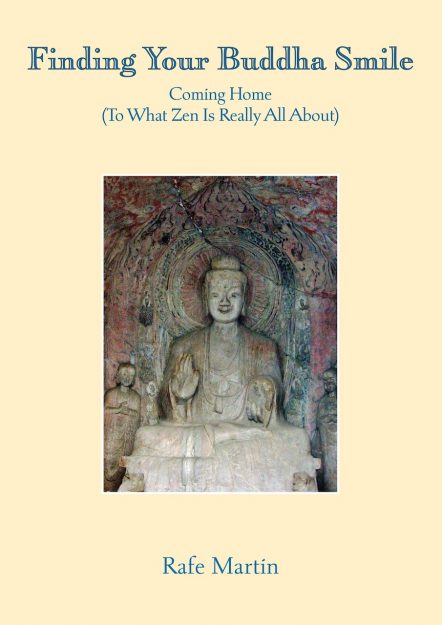
Excerpted with permission from Finding Your Buddha Smile: Coming Home to What Zen is Really All About, by Rafe Martin Roshi (Sumeru Books, 2025).

Thank you for subscribing to Tricycle! As a nonprofit, we depend on readers like you to keep Buddhist teachings and practices widely available.