
A Tibetan friend told me once that he hated death certificates. He was not really sure why. He was a Tibetan medical doctor and a Buddhist monk, and we were talking about the differences between Tibetan and Western views on death and dying. It wasn’t easy to talk about because some of our attitudes were so deeply held that we were almost unaware of them. We talked in circles for a while, but eventually he realized that what he hated about death certificates was the part where you state the cause of death. The idea of death as something with causes bothered him because it implied a worldview in which death is something outside of life. It implied that life naturally keeps going and going until something like cancer or a heart attack comes along to stop it. From his point of view, death was not extrinsic to life; it was intrinsic to life. The cause of death, in this worldview, was life.
The idea of death being either part of the natural unfolding of life or something that interrupts the natural progression of life is part of deep culture. It is one of the foundational beliefs that influence almost every other belief in the worldview of these cultures. My friend’s remark and our realization of why he was troubled by the idea of death being something with causes made me think about two stories from the dominant religious traditions in each culture: the story of Lazarus and the story of the mustard seed.
When I see someone with cancer in my palliative care clinic for the first time, I ask them what they understand about their cancer and what they are hoping treatment will do for them. I tell them that I have read their oncologist’s notes, but I want to know what it has meant to them. If they have incurable cancer, they rarely tell me that they think their cancer can be cured. Their oncologists have usually been pretty clear about that. They tell me that they are hoping their cancer will shrink, that they will live longer. But many of them will add something like this: “The doctors say that the cancer can’t be cured, but I’m hoping for a miracle.”
The Bible is full of stories about miracles, but perhaps the most famous one is the story of Lazarus. Lazarus, the brother of Mary and Martha, is on his deathbed, so they beg Jesus to come heal him. Jesus does not come right away; he waits for two days and by the time he gets there Lazarus is dead. Martha tells Jesus it is too late to save her brother, but in John 11:25–26, two of the most famous lines of the Bible, he replies, “I am the resurrection, and the life: he that believeth in me, though he were dead, yet shall he live: And whosoever liveth and believeth in me shall never die.”
Jesus then goes to the tomb of Lazarus. Martha warns Jesus that if he opens the tomb, Lazarus’s rotting corpse will stink. Jesus opens it anyway. He calls to Lazarus, who walks out of the tomb alive and healed of whatever it was that killed him. Jesus waited until Lazarus died to come to him and then resurrected him from his very physical death, turning him from a dead body to a living person to strengthen the faith of everyone who saw the miracle or heard of the miracle, to let them know that there were no limits to God’s power and that even death could be overcome by faith.
Many of my patients are hoping that God will provide this kind of miracle for their illness. They believe that even if the doctors feel that their cancer or ALS or heart problems can’t be cured, God will cure them, working through the doctors. They don’t want to stop treatment, even if the doctors no longer feel they have anything effective to offer, because of their faith that miracles are possible.
Frequently, though, the miracle my patients are hoping for is not from God. Not all of them are Christian or have a deep faith in the healing power of God. Many of them are hoping for a medical miracle from scientific research because science, like God, can accomplish miraculous things.
The story of Lazarus is the story of the importance of faith—faith in the limitless nature of God’s power even over death. The narrative of scientific progress is also one where those who lack faith are proven wrong again and again—for example, British mathematical physicist and engineer Lord Kelvin asserting that “heavier-than-air flying machines are impossible” just eight years before the Wright Brothers took off on the first successful flight near Kitty Hawk, North Carolina, on December 17, 1903, and the January 13, 1920 New York Times editorial echoing many in the sciences by ridiculing the idea of rockets functioning in a vacuum.
In the medical miracle narrative, one disease after another is conquered: the discovery of bacteria and viruses that made possible the prevention and treatment of infectious diseases, the discovery of anesthesia that made surgery practical, the discovery of insulin to treat diabetes, the development of open-heart surgery, organ transplantation, CPR, and on and on forever, with no limits, because scientific advances are limitless.
The idea that there is no problem that science cannot overcome is as deeply rooted as the faith in the omnipotence of God. When a paper published in Nature in 2016 used global demographic data to suggest that there is a fixed limit to the human lifespan, a fierce controversy erupted, and multiple rebuttals were published. Undeterred by the fact that no human has lived forever and that reports of extreme longevity are often unsupported or even falsified, a coauthor of one of these rebuttals described the idea that humans would always be mortal as an “extreme claim” requiring “extreme evidence.”
If death is something external to life, the implication is that immortality is possible. To conquer death all we need to do is win the war on cancer and the fight against heart disease, unravel the causes of dementia, and defeat all of the other causes of death, and those are the types of battles science knows how to win.
In the Buddhist literature there is a story about death that is similar to but completely different from that of Lazarus. In this story, Kisa Gotami’s infant dies, and she is crazed with grief. Holding the dead infant in her arms, she goes from doctor to doctor asking them to save her baby. But her child is dead, and none of them can help her. Finally, one of them sends her to the Buddha. When she asks the Buddha to save her child, he says that he will bring her baby back to life if she brings him a mustard seed from a house where no one has known death. So she goes from house to house, but in each house they tell her that their father died recently or that they lost a child also or that their husband or sister or cousin died. After spending all night hearing these stories from one person after another, unable to find a single house that death has not touched, she realizes that death is universal, the fate of every living being. She buries her infant and becomes a follower of the Buddha.
Kisa Gotami attains enlightenment through death awareness, just as those who witnessed Jesus raise the dead were saved by the strengthening of their faith in an omnipotent God.
Enormous Gothic cathedrals were built throughout the Middle Ages to glorify God. They were huge edifices of stone and glass constructed to last through the centuries as testament to the everlasting power of God. They still stand, inspiring awe and reverence.
When important Tibetan Buddhist ceremonies are conducted, intricate, gorgeous mandalas made of sand are made by dozens of monks, who wear face coverings because the slightest breath could destroy what they are building. Once they complete the mandala, the participants can view it as part of a ceremony that usually lasts for several days. At the end of the ceremony, the lama who presided over it takes a ritual instrument and slashes through the mandala, and then the entire intricate multicolored structure is swept into a pile of gray sand, colors all mixed and muddied. The sand is then thrown into a river in a ritual meant to end the ceremony and remind the participants that everything is impermanent, which is the most central teaching of Buddhism: the interconnected, ever-changing, impermanent nature of reality.
As long as we continue to think that death is something apart from life, then buried deep in our bones and built into our institutions and the hidden curriculum of medical school will be the unarticulated idea that we can beat back the causes of death indefinitely until we prolong life for so long, it is the same thing as living forever.
Comparing these two ideas about death—death as something external and death as something that is part of what it means to be alive—is how I have been thinking about why dying well is still so hard to do in the United States, harder than it has to be. As long as we continue to think that death is something apart from life, then buried deep in our bones and built into our institutions and the hidden curriculum of medical school will be the unarticulated idea that we can beat back the causes of death indefinitely until we prolong life for so long, it is the same thing as living forever. This is why, as people are dying, we focus on each reversible problem that is happening—the urinary tract infection, the anemia, the difficulty eating—hoping that if we just fix this one thing, they will live longer and their peaceful comfortable death will happen later. Too often in doing this, though, the end of life is spent not focusing on living but on one medical procedure after another, and the peaceful comfortable death never happens.
We only notice something about our own culture when we realize that there are other ways to think, to be. I am not suggesting that we abandon Western medicine for Tibetan medicine. I am suggesting we reexamine things we normally never question. If we do that, we might find that some of the suffering we have at the end of life is optional.
Practitioners of Tibetan medicine are not much different from Western medical doctors. They see patients and ask them about their symptoms and examine them (although the techniques used are different). They hope to cure their patients’ illnesses or at least help them function better. Tibetan medicine, however, has an approach toward death and dying that is fundamentally different from that of biomedicine. Where Western biomedicine is aimed at identifying the causes of death in order to overcome them, the Tibetan medical tradition teaches practitioners that not all illnesses are curable and how to recognize when a patient is dying. The assumption that all medical care, even by the most gifted physicians, is limited by the inevitability of death is incorporated into medical training and practice in several ways. Some illnesses are said to be inherently incurable, and categories of curable and incurable disease are defined. Signs and symptoms of distant, near, and very near death are taught, including specific types of examinations the physician can make to confirm the prognosis. Finally, the stages of dying, both external and internal, are outlined.
Several years ago, a Tibetan physician and I organized a seminar about death and dying for Tibetan and Western medical doctors. One challenging moment during the roundtable discussion at UVA was an interaction between an American internist and the Tibetan physicians. Surprised by the Tibetan point of view, she asked why, if death was felt to be an inevitable outcome of life, did Tibetan medical practitioners bother to treat patients at all? From her perspective, by accepting that some illnesses are incurable, Tibetan doctors were just giving up.
The two narratives—the Lazarus narrative that assumes that death can be overcome and the mustard seed narrative that holds that death is an intrinsic part of life—collided in this question. The American physician felt that the calling of medicine required an ongoing commitment to cure even incurable illness, because only in this way could progress be made. The Tibetan physicians felt that integrating the inevitability of death into medical care was in accord with the reality of impermanence and crucial to helping their patients have meaningful lives and peaceful deaths.
In the last century, progress in biomedicine has resulted in treatments for previously incurable illnesses and has improved health and longevity in remarkable ways. But the Lazarus narrative, which assumes the infinite capacity of science to overcome disease and the infinite ability of God to rescue patients at the brink of death, has resulted in a medical system where the elderly and those with life-limiting illnesses suffer unnecessarily. Patients suffer when they are dying, but they have additional suffering due to fears they are being singled out for punishment by God or are quitters when they can no longer tolerate treatment. Their spouses suffer because they are losing a beloved partner, but they have more suffering from guilt for agreeing to give up treatments that are no longer helping. The Lazarus narrative brings hope but also creates extra suffering—optional suffering that can make the last days miserable for patients and family members and even doctors.
Billions are spent in minimally beneficial care at the end of life. Family caregivers are overwhelmed, physicians and nurses suffer from moral distress, and patients are filled with anxiety. More than forty years of attempts to improve this situation have resulted in mostly superficial progress. Can we benefit from adopting some of the perspective of Tibetan culture and medicine? Is it possible to reconcile the narratives of Lazarus and the mustard seed? Can we continue to strive for medical progress while we acknowledge the certainty of death?
Is it possible to reconcile the narratives of Lazarus and the mustard seed? Can we continue to strive for medical progress while we acknowledge the certainty of death?
I believe it is possible to have a world where we can both invent implantable defibrillators and foresee the need to turn them off. It is possible to develop a cure for cancer and understand that people who do not die of cancer will still die of something else later. It is possible to help prolong life while recognizing that all people eventually die. Creating such a world, however, would require a cultural change on a deep level. It would require a conscious decision to cultivate death awareness in ourselves, our medical schools, and in the structure of health care.
A long time ago, my friend Joe, who first taught me about Buddhism, asked me a question: Is the root of suffering out there in the world or is it in here, in our minds? It’s both, of course, but much of the suffering that is out there comes from in here, in our minds, in the ways we think about living and dying. We can’t change the way our culture deals with dying unless we change our own minds, our understanding of life and death, and that is something each one of us can do. We can love life, this life that includes death, in all its imperfect, impermanent glory.
♦
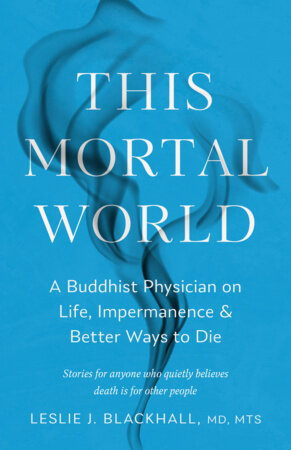
From This Mortal World © 2027 by Leslie J. Blackhall. Reprinted in arrangement with Shambhala Publications, Inc. Boulder, CO.

Thank you for subscribing to Tricycle! As a nonprofit, we depend on readers like you to keep Buddhist teachings and practices widely available.