
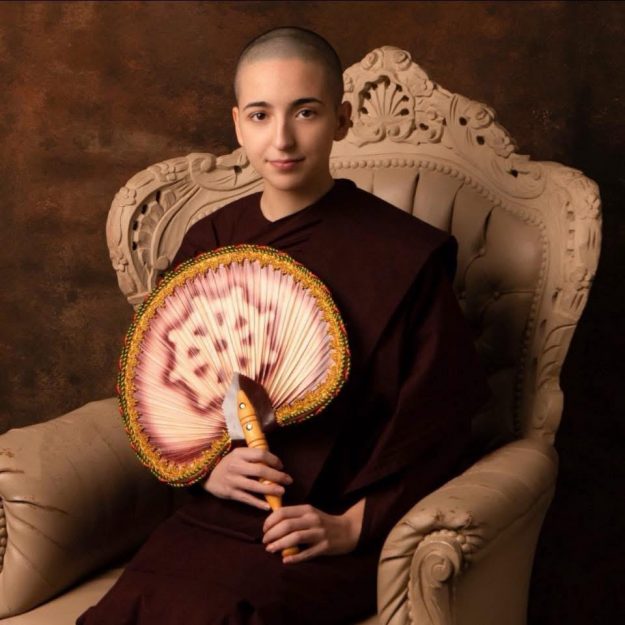
Born in 1999 and raised in southern Italy to a Catholic family, Venerable Gotami did not grow up with Buddhism as part of her cultural inheritance. Her childhood was difficult and unstable, yet from an early age she felt a strong, intuitive pull toward Asian spiritual worlds—dreaming of monks, temples, and distant places long before she even had the words for them. Ordained by Venerable Ashin Nayaka as a Theravada novice nun in 2022 at the age of 23, Gotami, formerly called Martina, now teaches in English, Italian, Sinhala, Spanish, and Mandarin Chinese. With more than 97,000 followers on Facebook, 200,000 on TikTok, and 30,000 subscribers on YouTube, she shares the dhamma widely with young people through her social media and writing. Her forthcoming spiritual autobiography, Gotami: A Life Rewritten by the Dhamma, will be available in English and Sinhala.
You grew up in Italy, without a Buddhist background. How did you first encounter the dhamma, and what struck you about it? I come from a Catholic and Christian family, and I didn’t have any direct connection with Buddhism while growing up. Still, even as a child, I felt a deep attraction to the East. I used to dream of monks, temples, and places I had never seen. Even today, when someone mentions Sri Lanka or Nepal, I feel emotionally moved in a way that’s hard to explain.
I didn’t know there was a Buddhist temple in Catania when I was young, even though there was a Sri Lankan temple very close to my home. I only discovered it later, almost by chance, when I learned that one of my high school teachers regularly went there. I couldn’t believe it—it was just minutes away. I went the same day. I was about 19 or 20.
From the very first visit, it felt like coming home. Not only Buddhism as a teaching but the Buddhist community itself felt immediately familiar. I began going every weekend, listening to the monks, attending dhamma school, and learning about meditation, forgiveness, metta, compassion, and how the mind works. What had once felt abstract suddenly became real.
What was happening in your life at that time, and how did practice affect you personally? At that point in my life, I was really struggling. I had grown up in a very difficult family situation. My mother suffered from mental illness, my father wasn’t present, and I had to work from a very young age. I was full of anger and resentment, extremely negative, insecure, and lost. I failed school several times and truly wasn’t the person I am now.
When I started going to the temple, the monks gave me tools I had never had before. They taught me about awareness, meditation, forgiveness, and especially how to replace hatred with compassion. They explained how the mind works—how thoughts arise and pass away. That understanding changed everything.
I honestly don’t know where I would be if I hadn’t encountered Buddhism. It didn’t just help me a little—it rewrote my life. For me, Buddhism isn’t only a religion; it’s the community, the sangha, the sense of belonging. It saved me.
I honestly don’t know where I would be if I hadn’t encountered Buddhism. It didn’t just help me a little—it rewrote my life.
When did the idea of ordination first arise for you, and how did you relate to that aspiration? Seeing what the monks did for the community inspired me deeply. I saw how they helped people who were suffering—mentally, emotionally, psychologically—and I felt a strong wish to give something back. I wanted to help others in the same way they had helped me.
For me, ordination never felt like renunciation. Renunciation implies giving something up with a sense of loss. I didn’t experience it that way at all. I never felt a strong pull toward marriage or family life. Becoming a nun felt more like returning to my natural state.
I sometimes thought I might ordain later—after studying or living what people call a “normal” life. But the aspiration was always present, every single day. At a certain point I asked myself: If my mind already felt ready for monastic life, why postpone it?
Your ordination journey involved travel to Myanmar and the United States. Can you speak about that period? In 2022, I went to Myanmar in order to undertake a temporary ordination, which is common there. It was a risky decision because it was during the civil war, and I didn’t even tell my mother—she thought I was still in Italy. Looking back, it was an intense and challenging period.
Later, while in the United States, I met the teacher who is now my master, Venerable Ashin Nayaka. We met almost by chance but immediately recognized a deep alignment. I told him very clearly that I wanted to ordain and dedicate my life to this path. Under his guidance, I took the ordination in 2022 and began teaching and working closely with young people.
How did your mother react when you told her about your decision to ordain? Eventually, I had to tell my mother. At first, it was extremely painful for her. She cried, she was afraid, and she felt a great sense of loss. We had already been through many difficult things together, so the idea of my choosing monastic life was a shock.
Over time, though, she began to understand. She met my teacher, and today they have a beautiful relationship. In many ways, this path didn’t only transform me, it transformed her as well. She often tells me that it forced her to confront impermanence and uncertainty in a very direct way, and that this, too, has been a form of spiritual growth for her.
You’ve become widely known for sharing the dhamma with young people, especially through social media. Why does that feel important to you? I started sharing the dhamma online even before ordination. I used to offer weekly live talks, discussing suttas in English, and over time, people—especially from Sri Lanka and Myanmar—began listening.
I think young people are more open to listening to someone close to their own age. If I were much older, my story might not resonate in the same way. Being young myself, I can show that transformation is possible now, not only later in life.
This also connects to your decision to write your autobiography, Gotami: A Life Rewritten by the Dhamma. What is at the heart of that book? I wrote the book because I felt that my story might help someone—especially young people who feel broken or lost. I speak very openly about my childhood, my anger, my failures, and how Buddhism transformed my life.
One of the most important things I learned is that thoughts do not define who we are. They are phenomena that arise and pass away. I had been labeled as a lost cause, and I believed it myself. Learning how to work with the mind changed everything, and I wanted to share that possibility with others.
Your monastic name refers to Mahaprajapati Gotami, the first Buddhist nun. What does she represent for you? For me, Mahaprajapati Gotami represents courage. She walked hundreds of kilometers barefoot with 500 women to ask for ordination from the Buddha. That was an extraordinary act of leadership—one that still feels radical today.
In many ways, it was the first march for women’s rights. After 2,500 years, her story continues to teach women to stand up, to walk forward together, and to claim their place in the dhamma.
How do you see the role of women in Buddhism today? There are still forms of discrimination against women monastics, but it is possible to move beyond them and create something different. We need to reclaim our own power. What I have learned is that silence is not always a virtue, and not every community is meant for you. Women do not need to be only sweet, quiet, and obedient in order to be spiritual. Femininity can also include strength.
Many young people reach out to you with questions about ordination and spiritual life. What do you usually tell them? If someone is trying to run away from pain, I tell them not to ordain. You only bring your unresolved issues with you. Ordination needs to arise from clarity and joy, not from fear or escape.
Most people are meant to live as lay practitioners, and that is completely fine. Monastic life isn’t better—it’s simply different. What matters is honesty toward oneself.
If you had to offer a core message to young people today, what would it be? Live truthfully. Follow your own path rather than your parents’ fears or society’s expectations. A wholesome life grounded in ethics, courage, and openness is possible.
And especially for young women: You don’t have to choose between softness and strength. You can be both. That balance, for me, is at the heart of the path.

Thank you for subscribing to Tricycle! As a nonprofit, we depend on readers like you to keep Buddhist teachings and practices widely available.