On “The Zen Rancher” (Spring 2025):
I found parts of Bill Milton and Jack Pearson’s discussion difficult to accept:
“‘It comes back to appropriate response,’ [Bill] says. This is a habitat that evolved with grazing animals, where grass is eaten and fertilized. In the absence of livestock, it deteriorates. ‘It includes killing, but so does almost everything we do.’”
The original grazers were bison. They did not need human management to be stewards of the land. We (white people) killed them off. Yes, everything we do involves killing, but as Buddhists, shouldn’t we try to avoid it and not make a profit from it?
One of the reasons I became a Buddhist was because its circle of compassion included animals. It seems true that Bill is a better steward of the land than most ranchers (I come from a farming/ranching state), but the slaughter of cattle is full of pain and fear. I have not yet heard of “humane” stockyards, transportation, slaughtering methods, despite the efforts of Temple Grandin and other animal rights spokespeople. I know a lot of Buddhists eat meat. I don’t understand that either. But perhaps I am in the minority. I guess we all draw the line in different places and do the best we can. But it hurts me to think of the animals in our slaughterhouses. And all his bowing doesn’t remove their pain and suffering.
–Paulette Callen
I appreciate Bill Milton’s dedication to land preservation, donating his father’s ranch to Montana Fish, Wildlife, and Parks instead of selling it to developers, and I can appreciate many of his viewpoints regarding Zen practice. However, I have trouble understanding how raising sentient beings expressly for slaughter honors the first precept and the environmental crisis in which we find ourselves in this present moment.
In part, Thich Nhat Hanh’s translation of the first precept is “. . . aware of the suffering caused by destruction of life, I am committed to cultivating compassion and learning ways to protect the lives of . . . animals.” Beyond questioning the wisdom of the first precept, “. . . our taste for animal flesh has exhausted the Earth. Worldwide, 80 billion animals are slaughtered every year for meat [including Bill Milton’s cattle]. Raising all those animals has claimed most of the world’s farmland. It has led to zoonotic diseases and vast deforestation. It has polluted air and water and spewed planet-warming gasses into the atmosphere.” I’m quoting the New York Times, but this is something we all know. I do understand that the Miltons are ranching in a “responsible manner,” but they, too, play a part in our environmental crisis, which is largely driven by unlimited craving for meat and the money that can be made catering to this desire.
I’ve often thought that the definition of our human species could be our endless capacity for self-justification. Perhaps this is not the case for Bill Milton and Jack Pearson, his zealous interviewer, but it’s difficult for me to see that this is not at work here.
–Diana Huntington
Yes, indeed, life eats life and we derive our sustenance from other living things. However, I view the ethics (as Buddhists) of what we eat to be one of “harm minimization.”
I am extremely fortunate that I can choose to source my protein needs from pulses, nuts, and other plant-based sources. I have been vegetarian for forty years. If there weren’t a market for something that involves so much suffering, i.e., meat products, that market would not exist. I have chosen not to be a part of the demand for the body parts of these animals.
I choose not to demand that animals suffer and die for the sake of my dietary choices.
After practicing the metta bhavana for thirty years, it took only one year of sincere practice for me to see the glaring contradiction between the suffering of animals and my sincere wish for “all beings to be happy.”
Isn’t there enough suffering in the world without my choices adding to that suffering?
–Thomas McCrossan
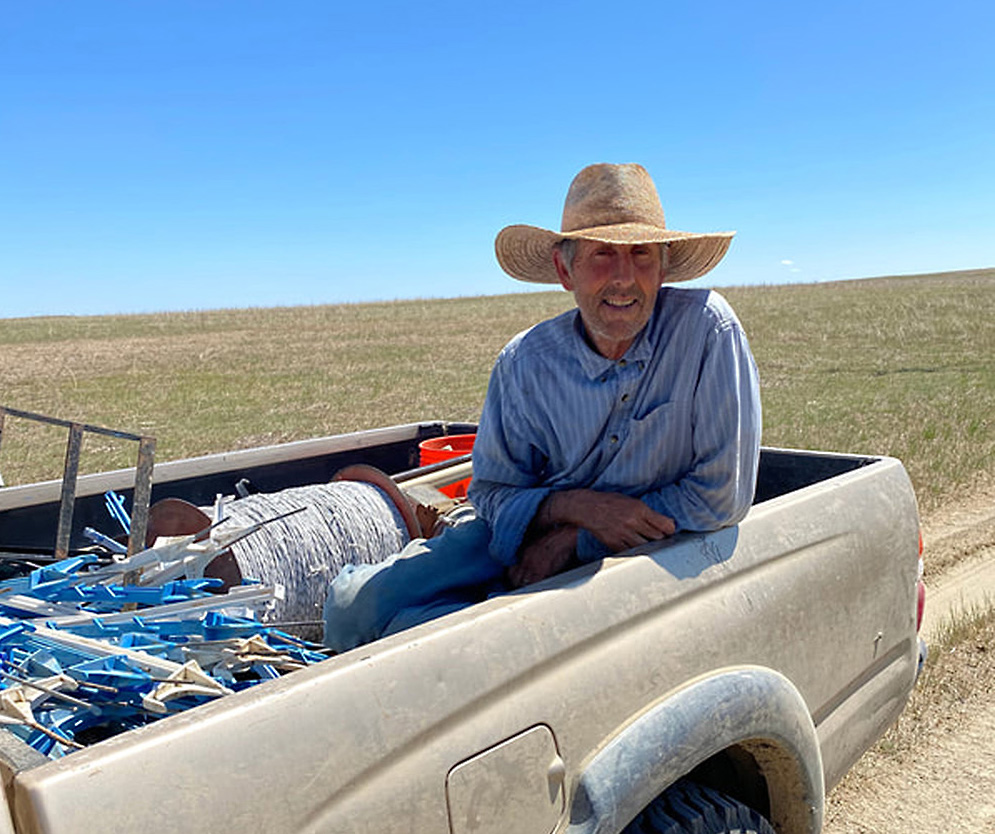
Bill Milton’s response:
It is not surprising that readers might question my ethics and intention, having avowed to practice the ten Zen prohibitory precepts and the three pure precepts. These include not killing, avoiding all evil, and living for the benefit of all beings.
There are many things I could say to this. I could note that our enterprise supports most species of wildlife and plants present when Lewis and Clark passed through Montana in the early 1800s. I could argue that vast herds of native ungulates—and the landscapes upon which they depended—were harvested and managed by First Nations people to a much greater degree than was originally understood. I could highlight our regenerative approach to grass and crop management, which limits or avoids the use of pesticides and herbicides, thus increasing microbial rich soils, enhancing water storage and quality, improving mineral cycling, and contributing to diverse, resilient plant communities. To address the concern of how animals are killed, I could point out that our Country Natural Beef coop was the first meat company certified by Temple Grandin for compassionate practices. I could mention the need to support local food systems and the local farmers who participate in them—who need some profit at the end of the day.
I could even argue that many of the products we all rely upon, like food, shelter, transportation, electricity, computers, clothes, etc., can and do often result in significant harm to our planet’s habitat, and thus suggest we all share a responsibility for collective harm.
However, all of these are a way to sound “less guilty.” None of these arguments are sufficient to resolve or massage the reality that I, my family members, and my coworkers are directly involved in both supporting life and taking life. The last of the five remembrances chanted daily reflects that my actions are my true belonging, I cannot escape the consequences of my actions; my actions are the ground upon which I stand. My bodhisattva vow to save and awaken with all beings requires intentional daily action. In this relative world, not knowing, all I can do is continue to bear witness to my own actions and the actions of others, appreciate our inseparability, and practice avoiding discrimination and judgment. All I can offer—certainly imperfectly, and moment by moment—is an appropriate response to care for all beings.
–Rev. Bill Milton

I enjoyed “Embracing Fluidity” (Spring 2025) by Kurt Spellmeyer. There are many illusions that were somehow written as bibles, fables, myths, and lore onto stone and page—preserved by males as the most valid above all others. The Vimalakirti Sutra seems to be a means to prove Buddha Gautama and Buddhism as a whole somehow view the female as equal. I think we should just accept these ancient scriptures as food for thought from males and that females must enact their own freedom from these limited views. This is not to say female views are not limited as well. But to insist that females are included legitimately within these male-written doctrines is absurd.
Rather, we must sort out the dharma from this beautifully relevant dogma and formulate a new understanding of reality unfolding. This is difficult, and I’ve been my own worst enemy. With the incredible amount of bullshit I’ve had to sift through, as well as the ignorance embedded within this community, it can seem impossible.
We are truly lost without equanimity within sangha and the means to express myriad forms of dharma.
–Jill Davidson
It is impossible to know what happens when I die, and what it will look like. All I can do is imagine it based on what I do know (I know just about nothing), what I imagine, what I hope—what feels possible and right. Given these necessary limitations, “Pig at the Crossing” (Tricycle Film Club Selection, Summer 2025) has succeeded in giving me more to think about and encourages me to try harder to live as best I can, assuming there is even some choice in the matter. I’m grateful to have watched this film. Thank you for making it possible to view it via Tricycle, or I wouldn’t have known about it at all. And thank you to all those who made the film. Peace to all.
–Peter Van Der Ven
To be considered for the next issue’s Letters to the Editor, send comments to editorial@tricycle.org, post a comment on tricycle.org, or visit us on social media. Letters are edited for clarity and length.

Thank you for subscribing to Tricycle! As a nonprofit, we depend on readers like you to keep Buddhist teachings and practices widely available.