Playing 1 of 1
Vow: Meaning, Purpose, and Impact
Download Transcript It has been edited for clarity. Subscribe or Log in to Download Transcript
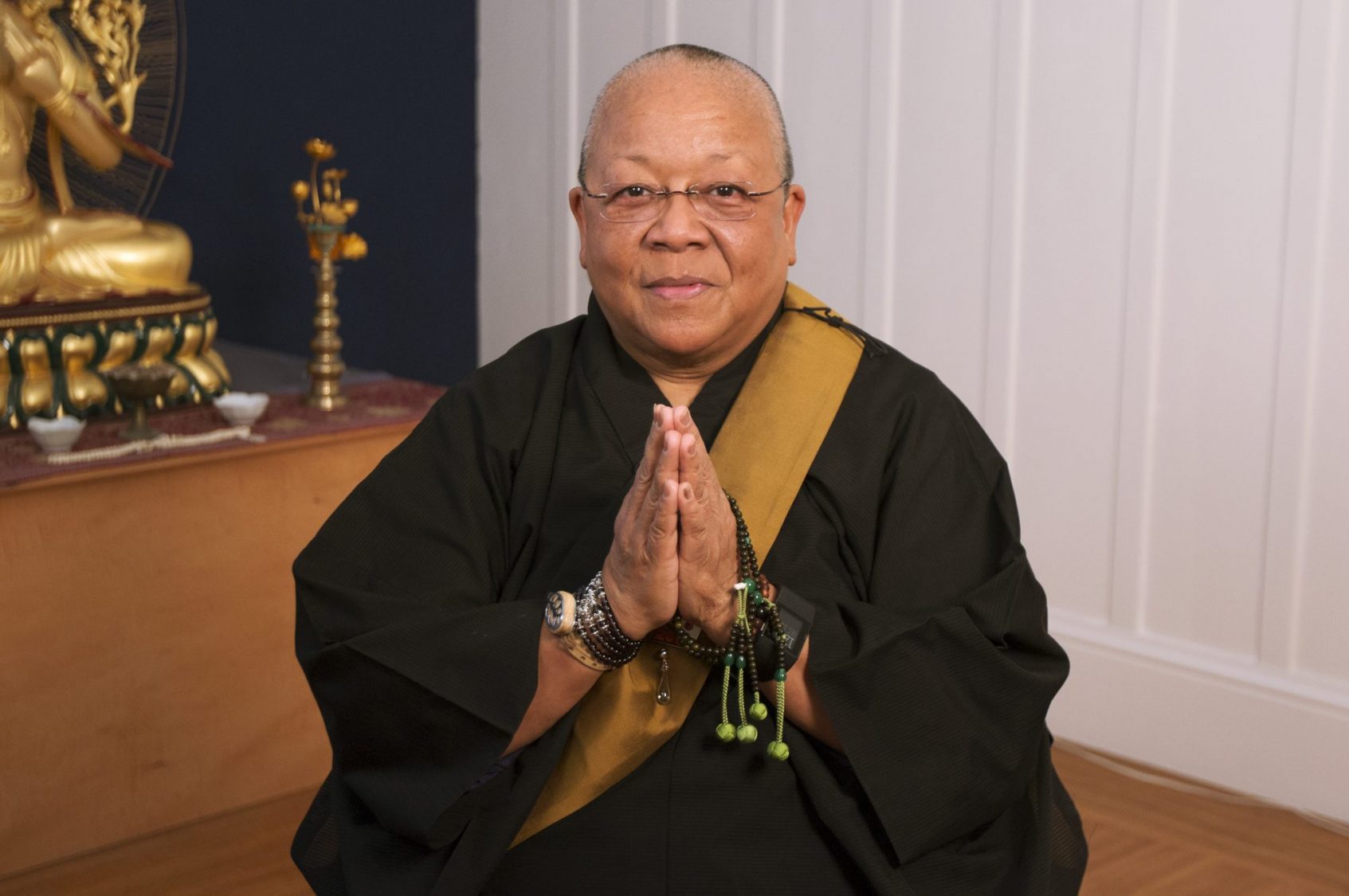
What happens when we make a vow? Does it make an impact? Although there are no real requirements in the taking of a vow, Myokei Caine-Barrett, Shonin, believes that vows lead to the development of virtues and a strengthening of character in accord with the vow’s intention.
Myokei Caine-Barrett, Shonin is the first African-Japanese woman and the first American to hold the position of bishop in the Nichiren Order of North America. She is the resident priest of the Myoken-ji Temple in Houston, Texas.
Transcript
It has been edited for clarity.
READ MORE
Hello. Welcome. Thank you for joining me today.
I want to talk about something that’s at the very heart of our practice: something we recite, something we declare, and yet something we rarely stop to examine. That is vow.
Not vow as a duty, not as a promise we make to please a teacher or earn spiritual points,
but a vow as the living engine of the bodhisattva path. This is based on my experience and study of the Lotus Sutra and the writings of nature and Nichiren Shonin (1222–1282).
The Meaning of VowWhat is a vow really? What does it do and what happens when we make one, especially when we make one without ceremony, without witnesses, or without even fully understanding what we are doing?
Ordinarily, one would consider the vow to be a solemn promise, a solemn commitment.
We vow at weddings, at inaugurations, in courtrooms… and these vows tend to bind us, creating obligations. They have witnesses.
In the Lotus Sutra, however, a vow is something more. In chapter 16 of the Lotus Sutra, the Buddha says, I am always thinking, how can I cause all living beings to enter the way and quickly become Buddhas? One thing we can notice here is that it’s not a contract.
It’s not a list of rules or promises made to someone else. It is a question—a question that lives inside him at all times. How can I help?
And that’s the meaning of vow in our tradition. It’s not primarily a promise you keep. It is a question that we become.
When Nichiren Shonin declared, “I will be the pillar of Japan, I will be the eyes of Japan. I will be the great ship of Japan. This is my vow, and I will never forsake it,” he wasn’t reciting a formula. He was telling us that he had become the vow. The vow and the person became the same thing. So the meaning of vow is this: It is a shape one’s life takes when one stops asking, “What do I want?” and starts asking, “What does the world need?”
The Purpose of Vow
So if that’s the meaning of vow, then what is its purpose? It’s not to earn rewards or to gain protection or to secure a good rebirth. Those things may come, but they are side effects and not purpose. The purpose of a vow is to transform the one who makes it.
In the opening of the eyes, Nichiren Shonin makes clear that the person who makes a great vow will inevitably face three obstacles and four devils: illness, opposition, discouragement, and slander. These aren’t punishments. They are the touchstone, the testing ground, where the vow proves whether it is real. So why would anyone make a vow that guarantees obstacles? Because the obstacles are the transformation.
If we think of it this way, a sword is not made by being praised. A sword is made by being hammered, heated, and plunged into cold water and hammered again. The purpose of the hammering is not to destroy the metal. It is to make the metal into a sword. The purpose of a vow is to make us into a bodhisattva, and the bodhisattva is not one who has escaped suffering but someone who has learned to use suffering as nature. As Nichiren Shonin wrote from his exile, “The icy prison became a crane’s nest.” The purpose of the vow is to give one the alchemy that turns poison into medicine.
So when we think of bodhisattvas and the ground of the vow, it’s something that’s fairly precise in the Lotus Sutra. The place where the Buddha’s non-discriminating compassion is found is in chapter five, where the Buddha says, “I do not see this one or that one. All are the same to me.”
What this does is establish the equality of one’s worth, the equality of one’s access to the dharma, and the equality of one’s buddha-nature.
But also notice, rain needs ground, and rain comes from the rain of the dharma falling on different herbs, trees, and plants. But it needs the ground, and without Earth or the ground, rain has nowhere to fall, seeds have nowhere to root, and growth cannot happen.
So chapter five gives us the rain, and in chapter 15, the bodhisattvas did not appear from heaven or pure lands or other worlds. They emerge from the earth of the Saha world itself. The Saha world is the world of suffering. That matters because the Saha world is the world of endurance, conflict, injustice, impermanence, and mixed karma. So the ground actually means the actual conditions of lived life.
The vow does not float above history. It arises within it. And bodhisattvas of the earth do not volunteer. They don’t compete. They don’t claim superiority. They appear because they have lived a long time under the Saha world, practicing quietly and enduring invisibility.
The vow is not a heroic decision; it is fidelity to the life we have already lived.
The ground of vow is formed by experience.
The Impact of Vow
So what is the impact of a vow?
It changes our relationship to suffering, because when we can understand that our suffering, or the obstacles we face, are the transformation, and suffering is the fuel for our growth and the energy that allows us to keep walking the path, it does not mean that suffering stops hurting.
It does hurt. It can kick you in the tail and knock you off your feet. But the meaning of that hurt changes because it becomes the ground of one’s mission.
We quit asking, why is this happening to me? We begin asking, how do I use this to fulfill my vow? To be able to say, what is the good that exists for me in this situation?
The vow also creates unshakable resilience.
So even when you’re not experiencing support, backup, friends, power in your life, the internal resilience that has developed as a result of the vow. The fact that one’s vow becomes one’s identity. It’s not arrogance.
When we identify ourselves with the vow, we stop asking, should I continue? We simply do so. And the energy to continue arises from the vow itself, not from favorable conditions.
This is the impact. You become essentially invincible, not because you cannot be hurt, but because nothing can stop you from being who you have vowed to be.
The vow also transforms your environment. Because of the concept or principle of the 3,000 realms in a single moment, the individual and the environment are not separate. So when we transform ourselves through a vow, we are also at the same time transforming the world around us. Nichiren’s vow to be the pillar of Japan was not a metaphor. He understood that one person upholding the wonderful dharma could purify an entire nation, not through magic, but through the mutual possession of self and environment.
When we make a vow, we are not just changing ourselves. We are changing the air that everyone breathes.
There’s an expression in Nichiren Buddhism, or Lotus Sutra Buddhism, that when one chants, we polish the mirror of our lives. This leads to the development of virtues and strengthening of the character in accordance with the vow’s intentions. So even though we may not fully grasp the meaning of a vow—we have no witnesses, no ceremonies, it’s just something we have decided to do—it’s an act of the heart.
Virtues are not abstract qualities. Courage doesn’t exist in a vacuum, and compassion doesn’t float in the air. Virtues are responsive to specific situations, and, I think for all of us, when we encounter a circumstance a person that hits us right where we live, we have to ask ourselves, is this in accord with who I am becoming, or who I now think I am? If we’re not, we have to examine where we are.
We have to try to apply our practice. Or, as Yoda would say, “There is no try. There is only do.” We must apply our practice. We must study ourselves, develop our wisdom and insight into the beings that we are. When we do this, our lives open up even more, and we’re more easily able to influence the environment, more easily able to influence those around us, and embrace them freely with great compassion and loving-kindness.
These, then, become our gifts, not only for ourselves, but for the entire environment around us. We can become a light in darkness and a safe place to land for those who need it. We can lead the way to the dharma to save all beings. And we will always encounter beings—things that are difficult to save. That’s where we learn patience and perseverance.
So when we vow to be the pillar of our communities, we will inevitably face situations where we must stand alone. That is where our courage is born: not in the absence, but in the presence of fear. And the vow becomes our spine. The vow strengthens our character, not because it’s a self-improvement program, but because it throws us into the fire, and in the fire, only what is real can survive.
So let me leave you with this: The vow is not a burden. It is not a duty. It is not a test that we pass or fail. The vow is the decision to stop living for ourselves alone.
That decision, once made, even quietly, even imperfectly, can change everything. It changes our relationship to suffering. It provides resilience that conditions cannot touch. It radiates outward into the world, and it grows virtues in you, like a garden growing in soil we did not even know we had.
You don’t need permission to take a vow. We don’t need ceremony. We don’t need to get the words right. We only need to mean it, and if we mean it even a little for a moment, then the vow is alive in you. And a living vow, tended day by day, will carry us further than we could possibly imagine. That is what happens when we make a vow.
May your vow be alive in you today. May it grow and may you become, as Nichiren became, a pillar for those who need you, eyes for those who cannot see, and a great shift for all who are still crossing the sea of suffering.
Thank you for listening and thank you for your vow, whether you have spoken it aloud or only in the silence of your heart. Nam-myoho-renge-khe.