
For Hoa Nguyen, writing is akin to a shamanic practice summoning ancestors and the dead. “I’m interested in talking with the dead in poems to connect across time and generations, across lineages of kinship,” she told fellow poet Nguyễn Phan Quế Mai. “I want writing that exposes its own troubles, that self-problematizes and risks uncertainties to sculpt language with an ear to that including how language might slide and slip as a ghost might: between sound, sense, meaning, and contexts.”
Born in the Mekong Delta to a Vietnamese mother and a white American father, Nguyen moved to the United States as a child and grew up with an acute awareness of such between-states. As her family strove to assimilate, she experienced an acute sense of loss and dislocation. “I lost a whole language and sense of place, everything I knew, even memories,” she says. “It happened and wasn’t spoken of. It was an inchoate rupture.”
As a poet, Nguyen views writing as a way of giving language to experiences of rupture and constructing new narratives and possibilities. Her latest collection, A Thousand Times You Lose Your Treasure, turns in particular to the cultural pressures leading up to and following the “Fall of Saigon,” interweaving a verse biography of Nguyen’s mother (a stunt motorcyclist in an all-women circus troupe) with unflinching accounts of the devastation wrought by the US military on the Vietnamese people and landscape.
In complex, lyrical verse, Nguyen’s poems conjure a world inhabited by spirits, gods, and ghosts, where time becomes circular and loss is ongoing. “To write as a poet is to see that the songs of the living and the dead resonate inside of everything,” she says. “They are there already, and we can sing with them, even when we don’t know the name for the song.”
–Sarah Fleming, senior editor
Warm Rain
rain is a blessing from god she said
covered in hose water and mud
washed out washington dc stars
night sky exit window to low roof
thousand-miles-away wall scene
hand-painted on rice paper
she knew her worth
the halo born
Buddha blest she was
precipitation (n.) “act or fact of falling headlong”
Feast of the First Morning of the First Day
You want money to flow into the house like water
and leave the house like a turtle
No sweeping or cutting on Tet
Don’t sweep or cut your luck
Earth cakes are square
Eat them
The Kitchen God rides the carp
Wear your best new outfit
Invite a rich neighbor through the door
Yellow apricot flowers bloom
tied with red ribbons
Burn incense for the ancestors
Hang poems on the walls
Sacred Ficus Sonnet
Cinched belt tugged tight around the heart
5 or 6 aerial roots dangling A strangler fig
Do homeless ancestors live inside the tree?
Child of noise Hold the loosened ends You
may miss the moon or fall in love with it Embrace
ashes I too am far removed A thirst that wanders
thirsting And I could never ask the name of the boy
who died A baby boy who died but what could you do
and maybe words hang in sinew and care Writer
of dead words or living words and life’s hammer
Encase the host tree and erase it I don’t know
the folk songs on farms far from here The dead buried
and gone To dig the grave Who dug the graves
Darling the sea widens for you tonight and deepens
Sings the Wishing Well (The Ghost Well Cared-For)
in the story the men get to live
the wife faithful dies
her death
is pious strangled stars bangle
gather floating flowers
underworld yourself
a beautiful dreamer
in the mosquito myth
with visions of owning a grand house
she grows ill in the fields dies
is arrayed in a field of flowers
saved by blood magic she later betrays
doomed to live as nuisance
begging begging
don’t go
again I call
newly flooded
fields of rice farm girl sits
on the flood wall
sings the wishing well
we sing her story beyond time
wield feathers and clouds of her
a melted floating love gem
our tears mix with tears
I have no sacred rites for you
saving the sacred
grove you grew
♦
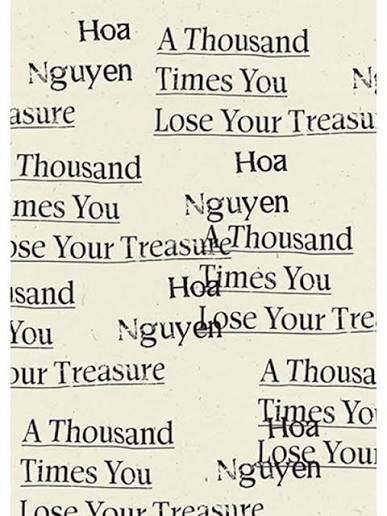
“Warm Rain,” “Feast of the First Morning of the First Day,” “Sacred Ficus Sonnett,” and “Sings the Wishing Well (The Ghost Well Cared For)” from A Thousand Times You Lose Your Treasure, copyright 2021 by Hoa Nguyen. Reprinted with permission of the author and Wave Books.

Thank you for subscribing to Tricycle! As a nonprofit, we depend on readers like you to keep Buddhist teachings and practices widely available.