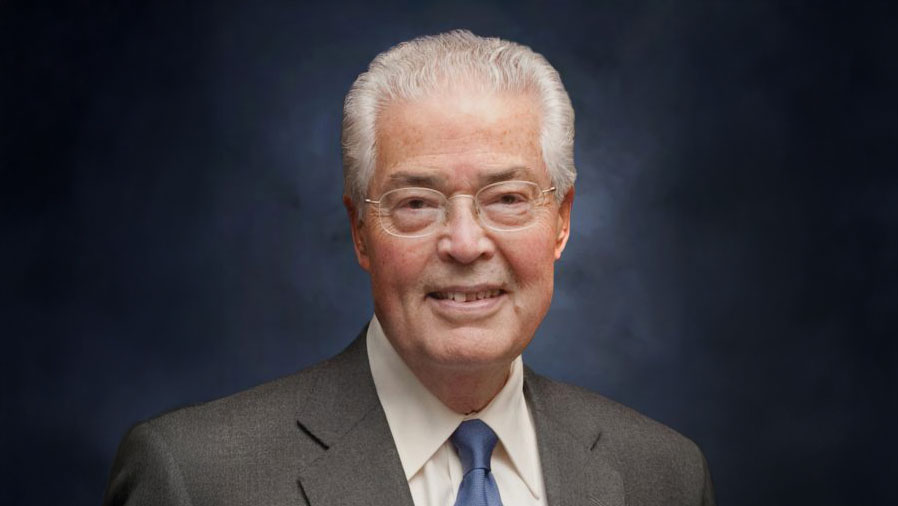
Robert Hung Ngai Ho, C.M., O.B.C., philanthropist, newspaper journalist and editor, and a global patron of contemporary Buddhism and Chinese culture, passed away peacefully in Vancouver on November 30, 2025. He was 93.
Across several decades, Mr. Ho helped reshape the global landscape of Buddhist scholarship, cultural preservation, and public engagement with the dharma. Through his careful philanthropy, he strengthened Buddhist studies as an academic field, supporting generations of scholars and socially engaged practitioners. His efforts helped ensure that Buddhism’s intellectual, artistic, and ethical resources would remain accessible and relevant in the modern world. Nonsectarian in spirit, his vision was grounded in the conviction that Buddhist wisdom—supported by strong institutions and animated by the energy and creativity of emerging scholars—could speak meaningfully to the moral and existential challenges of contemporary life.
That conviction found its most enduring institutional expression in the Robert H. N. Ho Family Foundation, which he established in 2005. Based in Hong Kong and working internationally, the foundation has played a formative role in advancing Buddhist studies and Chinese cultural education across Asia, North America, and Europe. Through endowed chairs, research programs, fellowships, exhibitions, and publications, it has nurtured a generation of great minds. Universities, including the University of British Columbia, the University of Hong Kong, the University of Toronto, Stanford University, Harvard Divinity School, and Thailand’s International Buddhist College, have all benefited from this sustained commitment. Taken together, these initiatives have built durable bridges between East and West, and between traditional, modern, and postmodern engagements with the dharma.
Yet Mr. Ho’s commitment to accessibility went beyond universities and museums. A decade earlier, in 1995—at a moment when the internet was still in its infancy—he had already acted on the related insight that Buddhism’s future would depend not only on strong institutions but also on open doors. That year, he founded what would become Buddhistdoor Global, envisioning a digital platform through which Buddhist teachings, traditions, and conversations could circulate freely across cultures and generations. At a time of slow dial-up connections and limited public access to the Web, the idea was strikingly prescient. A physical temple could serve a community. A digital doorway, he sensed, could serve the world.
Buddhistdoor’s evolution—from an English-language site with animated temple gates welcoming early visitors to a multilingual, multimedia network spanning journalism, features, scholarship, and opinion—mirrored Mr. Ho’s own development. His life was rooted in family and religious traditions, giving Ho the foundation needed to engage thoughtfully with innovation. For him, technology was never an end in itself. It was a form of hospitality and connection, a way to ensure that curiosity could be met with clarity and that the dharma could be encountered without intimidation or gatekeeping.
Born in Hong Kong in 1932, Robert Hung Ngai Ho inherited not only a distinguished family name but also an expectation that privilege carries obligations. He was the grandson of Sir Robert Ho Tung, long known as “the grand old man of Hong Kong,” and he grew up in a household shaped by civic duty and philanthropy. The family’s historical connection with Buddhism ran deep as well, particularly through his grandmother Lady Clara Cheung, a devout practitioner and notable patron of the Buddhist community. In later years, Mr. Ho would speak of inheriting her wish to promote Buddhism as an expression of care for society.
His early life was marked by displacement and return. During World War II, he moved to southwestern China before returning to Hong Kong to complete his secondary education. That was the start of a pattern of crossing borders that would echo throughout his life. Mr. Ho’s role as a “bridge-builder” took concrete form in the institutions he supported, the archives he helped preserve, and the cultural and educational ecosystems he strengthened over time.
Mr. Ho’s role as a “bridge-builder” took concrete form in the institutions he supported, the archives he helped preserve, and the cultural and educational ecosystems he strengthened over time.
He studied in the United States, earning a Bachelor of Arts degree from Colgate University and a Master of Science in journalism from Columbia University. Journalism became a vocation that shaped how he understood public life. He worked for the Pittsburgh Press and National Geographic, learning the disciplines of reporting and editing, the patient craft of clarifying what matters, and the ethical responsibility of representing others without distortion.
After returning to Hong Kong, he joined and led the Kung Sheung Daily News and Evening News, publications owned by his grandfather. He later chaired the Newspaper Society of Hong Kong, advocating for global exchange and social responsibility in journalism. He also served as chairman of the Hong Kong Community Chest and Tung Lin Kok Yuen—the Buddhist nunnery and educational institution in Hong Kong—and as a trustee of Lingnan College (now Lingnan University). Across these roles, Mr. Ho demonstrated his understanding that healthy societies require institutions of care—press, education, and cultural memory—and that such institutions depend on steady, informed stewardship.
In the 1990s and early 2000s, that understanding matured into philanthropy aimed beyond isolated projects and toward sustaining entire fields. In 1994, he established the Tung Lin Kok Yuen Canada Society in Vancouver, extending a longstanding Hong Kong Buddhist presence into Canada. In 2005, he founded the Tung Lin Kok Yuen Canada Foundation to endow chairs and research programs in Buddhist studies. That same year, he launched the Robert H. N. Ho Family Foundation—an act of philanthropic architecture whose influence continues to unfold.
The Robert H. N. Ho Family Foundation’s breadth may seem striking—spanning health care, mental health, Buddhist studies, and Chinese cultural heritage. And yet this reflects Mr. Ho’s broad vision of human flourishing. Its support for the arts has included major exhibitions and lasting institutional contributions, among them the United Kingdom’s first permanent gallery of Buddhist sculpture at the Victoria and Albert Museum. The foundation also helped bring the Qin Terracotta Army to Canada for the first time and supported landmark exhibitions across North America and Europe, introducing broad audiences to Chinese history and Buddhist art. In Hong Kong, it developed art education programs for young people, expressing Mr. Ho’s belief that culture is best preserved when practiced.
In 2009, he established the Robert H. N. Ho Research Centre at Vancouver General Hospital, supporting research in prostate cancer, ovarian cancer, and hip health and mobility. In North Vancouver, he and his wife, Greta, helped establish the Greta and Robert H. N. Ho Centre for Psychiatry and Education, advancing mental health and addiction services while expanding medical education. He also created funds dedicated to enhancing patient care through investment in professional development for nurses and allied health professionals.
For these and other contributions, Mr. Ho received numerous honors, including appointment as a Justice of the Peace by the Hong Kong Government in 1982, the Order of British Columbia in 2013, and the Order of Canada in 2018. He also received honorary degrees from institutions across Hong Kong, Canada, and the United States. Yet those who knew him often observed that he did not treat recognition as a destination. At most, it was an acknowledgment that the work had substance.
In a 2014 interview, Mr. Ho spoke candidly about his Buddhist path. He credited his teacher, Master Wu Yi, with instilling in him the belief that Buddhism must be communicated with simplicity and ease—particularly in colonial Hong Kong, where Buddhism was often caricatured as outdated superstition. He recalled old smears about monks and misfortune, and described a lifelong effort to heal rifts between generations, lived experiences, and practical orientations. While rooted in a Pure Land family lineage, he emphasized respect for all traditions. “Every school should have a chance to express themselves,” he said.
Mr. Ho added that Master Wu told him “that there are many ways to be a good Buddhist” and that he should endeavor “to be comfortable with [his] own path.” Like many truly profound Buddhist teachings, these words might be grasped by an 8-year-old and yet deeply challenging for a person of 80 years. How often do we create barriers by clinging to rigid ideals of what makes a “good Buddhist”? And how often are we truly comfortable in our own path?
In Buddhist terms, a death is never only an ending. It is also a moment when causes and conditions become newly visible. The teachers and family who shaped a person’s mind, the institutions that made their work possible, and the long chain of generosity linking heritage, culture, and history. Robert Hung Ngai Ho’s life renders such a chain unusually clear. He received much—and gave much back. The full measure of his service will be found wherever scholarship deepens, where patients receive better care, where young people encounter culture as a living practice, and where a reader—somewhere in the world—finds the dharma because a digital doorway still opens.
Mr. Ho is survived by his wife, Greta; his sons, Robert and Kevin; and five grandchildren.

Thank you for subscribing to Tricycle! As a nonprofit, we depend on readers like you to keep Buddhist teachings and practices widely available.