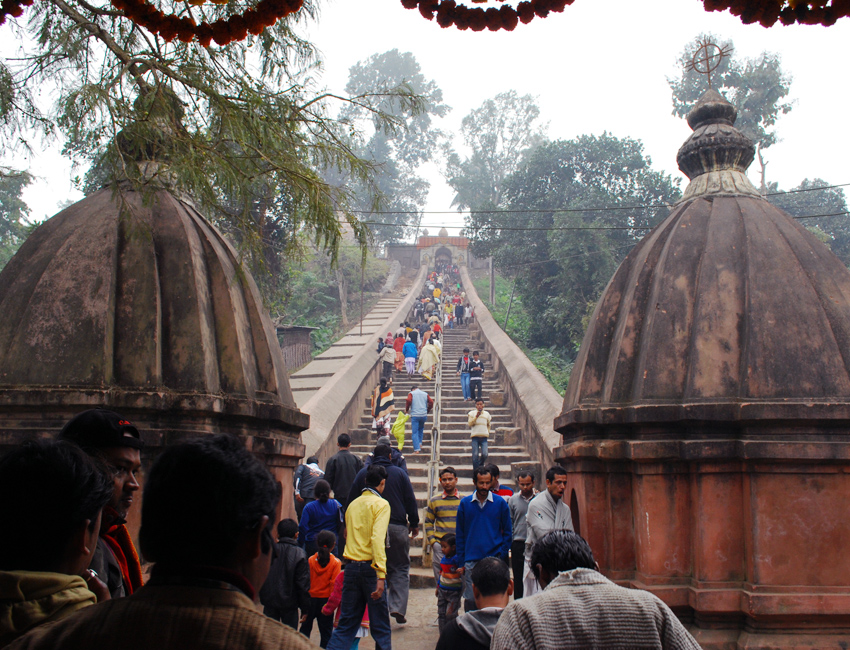
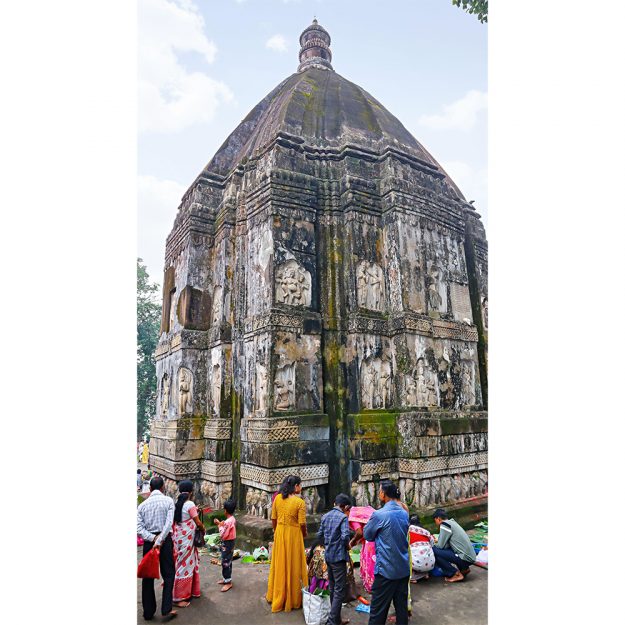
When 78-year-old Sonam Drukpa returned to the hilltop temple complex in Hajo in the winter of 2024, he was retracing a journey few Bhutanese of his generation still make. At 13, he had set out from Trashigang in eastern Bhutan with his mother—walking, riding ponies, and catching whatever transport they could find. They carried yak butter, cloth, and handmade goods to sell at winter markets along the way. Their destination was the Hayagriva Madhab temple on Manikuta Hill—a site they revered as Kushinagara, the Buddha’s final resting place, and as a shrine of Hayagriva, or Tamdrin, the wrathful horse-headed emanation of the bodhisattva Avalokiteshvara. The stone temple enshrines an image of Hayagriva, now kept from public view, that Assamese Hindu devotees regard as an avatar of Vishnu, giving the site a layered, multifaith significance.
Situated in India’s far northeast, Hajo rises along the northern bank of the Brahmaputra River in Assam. To the north lies Bhutan, and beyond that, the highlands climb toward Tibet, now under Chinese administration. In the early 1960s, these borders were far more permeable: Traders, pilgrims, and families moved seasonally across valleys and foothills, linking eastern Bhutan, Assam, and the Himalayan rim of West Bengal in a shared cultural and religious landscape. Villages, markets, and monasteries formed a living web where commerce, devotion, and kinship intertwined. At the heart of this trans-Himalayan world lay Hajo, which many Bhutanese and Tibetan pilgrims understood as a relocated Kushinagara—an accessible sacred terrain created through centuries of Tibetan Buddhist place-making.

Hajo’s sacred geography extends beyond the Hayagriva Madhab temple. Its ridge holds shrines whose histories have long overlapped: the Kedaresvara temple to Shiva, smaller Ganesha shrines, and the 17th-century Sufi shrine and mosque of Powa Mecca, revered by Assamese Muslims. Just as Tibetan pilgrims mapped the Buddha’s life onto Hajo, Assamese Muslims imagined these hills as “a quarter of Mecca,” bringing Islam’s holiest site into local terrain. The result is a devotional palimpsest in which multiple traditions coexist, layering sacred meanings across the same slopes.
A few months ago, I met Drukpa at his home in Samdrup Jongkhar, a Bhutanese town along the old Tibet—eastern Bhutan—Assam trade and pilgrimage route, seventy-eight kilometers (forty-eight miles) from Hajo. Recalling that first journey with his mother, he said: “Most of our journey was on foot. We sold yak butter and cloth at haats [markets] along the way and worked whenever we could. We went to pray to Tamdrin and to visit the Buddha’s final resting place before my mother dropped me off at Kalimpong.”
Drukpa and his mother’s pilgrimage exemplified a phenomenon anthropologist Toni Huber explored in his 2008 book The Holy Land Reborn: the substitution of Buddhist sacred sites in the Indo-Himalayan borderlands. Beginning in the 17th century, Tibetan and Bhutanese pilgrims mapped key sites from the Buddha’s life—Bodhgaya, Vulture Peak, Kushinagara—onto accessible Himalayan locations. Hajo thus became the Tibetan and Bhutanese Kushinagara. As Huber notes, this was not a geographical error but a deliberate act of sacred place-making: a devotional and practical reimagining of Magadha, the Buddha’s homeland, within reach of Himalayan pilgrims.
This was not a geographical error but a deliberate act of sacred place-making: a devotional and practical reimagining of Magadha, the Buddha’s homeland, within reach of Himalayan pilgrims.
Primary Tibetan sources vividly describe this process. The Nyingma lama Pagsam Yeshe (1598–1667) traveled to Hajo in 1633–34 and recorded the Hayagriva Madhab temple along with nearby shrines and natural features reinterpreted as condensed versions of Magadha. A pool became the Buddha’s bathing place; a black stone basin, the Buddha’s spittle; the surrounding hills, Vulture Peak. These identifications were devotional acts that anchored the Buddha’s life story within the terrain of Hajo, shaping a sacred geography that pilgrims could experience. Later, the lama Yeshe Ngodrup (1641–1727) expanded this pilgrimage geography to include caves, boulders, and river features associated with the Buddha’s austerities and daily life, further deepening this imagined Magadha.
Even earlier Tibetan sources recount visits by siddhas such as Nagabodhi and Mitrayogin, who were believed to dwell around Singri and other sites near modern-day Tezpur in Assam. These hagiographies circulated across Tibet and Bhutan, encouraging seekers to travel to Assam’s foothills for tantric blessings and reinforcing the sense of a spiritually resonant Buddhist terrain embedded in this borderland world.
Through such narratives, Tibetan pilgrims created what Huber calls a compact “replica holy land” at Hajo—mapping an entire sacred landscape onto a local geography. This reinscription emerged from devotion but also from the practical rhythms of trade, travel, and survival that shaped life in the region. Pilgrims like Drukpa and his mother traveled not only to pray but also to sustain themselves—trading goods, seeking temporary work, and moving seasonally between valleys. The kurma system—a long-standing, kin-like guest-host relationship between Bhutanese highlanders and Assamese foothill farmers—formed the social foundation that made such journeys possible. A Bhutanese family might return each winter to the same household in Assam, sharing work, food, and small rites that blurred the line between neighbor and kin. These ties created an informal infrastructure of care, giving travelers both shelter and a sense of belonging. Markets prospered on the winter influx of pilgrims and mule caravans, turning Hajo and its surrounding settlements into nodes in a network that was simultaneously religious, cultural, and economic.
This world began to unravel in the mid-20th century. Borders hardened after Tibet’s annexation by China in 1959, and again during the insurgencies that shook Assam in the 1990s and early 2000s. Trade routes collapsed. The kurma networks faded. Yet traces of the old sacred geography persist, especially among eastern Bhutanese elders who still speak of Hajo as a powerful Buddhist site and recall the journeys as part of a shared Himalayan world that has nearly vanished.
Jigme Ura, a Bhutanese pilgrim now in his late 60s, remembers making multiple journeys to Hajo in the 1980s. “We grew up hearing that Hajo was where the Buddha passed away,” he tells me. “We came for blessings from Tamdrin. The deity is very important to us.” He recalls courtyards filled with Bhutanese pilgrims—mostly older, many from eastern districts—circumambulating the sanctum and chanting to Tamdrin, scenes once common in the winter months.
Today, fewer Bhutanese make this journey, yet the thread has not fully snapped. Nripendra Bhagawati, a 70-year-old Assamese writer and temple committee member, tells me: “Before the insurgency years of the late 1990s and 2000s, many Bhutanese came. Now fewer visit. But the ones who still come believe deeply in the place.” He remembers Bhutanese and Khampa pilgrims as a familiar winter presence in his youth, arriving with bundles of goods, exchanging stories, sharing rituals—a rhythm now remembered more than lived.
Among younger Bhutanese, however, Hajo is scarcely known. The decline stems less from religious belief than from changing infrastructures and social worlds. When Pema Choden, a young travel blogger, visited Hajo in 2022, she was astonished to learn that the temple had once drawn steady streams of Bhutanese pilgrims. “I had never heard this at home,” she says. “And then I saw a well built by the Bhutanese authorities decades ago. No one in my generation knows this.” The well, remembered in oral histories as a gift to weary travelers, now sits unmarked behind the temple.
Choden’s surprise reflects a generational shift. Younger Bhutanese Buddhists are increasingly connected to mainland India through education, employment, and social media, making today’s pilgrimage circuits easy to navigate. Their elders relied on mule trails, kin networks, and kurma relationships. As these older systems fade, so, too, does the memory of places like Hajo. “It’s not that young people don’t care,” Choden said. “It’s that the networks through which this knowledge was passed down are breaking.”
For Upen Rabha Hakacham, a folklorist and professor at Gauhati University in Assam, this shift is unsurprising. “Archaeology placed the historical Kushinagara in Uttar Pradesh long ago,” he tells me. “But sacred geography doesn’t follow archaeology. Older Bhutanese still come because Hajo is a Tamdrin site—and because this was their Kushinagara.”
His insight echoed Drukpa’s reflection. “I have also been to the real Kushinagara,” Drukpa says. “But Hajo is still important. Not everyone can go so far. And Hajo has its own power because of Tamdrin.” For him, the site’s power lies not only in the deity but also in the memory of a shared world—one where Bhutanese highlanders, Khampa traders, and Tibetan monks walked the same roads, shared food, and sought blessings from Tamdrin and the Buddha.
“That world connected us,” he says. “When I went there last year, I remembered my mother. I remembered the old journeys.”
What remains of Huber’s “Tibetanized Hajo” today is subtle but perceptible: a few Bhutanese elders performing quiet prostrations, a Monpa pilgrim from Arunachal Pradesh spinning a mala behind Assamese Hindu devotees, a stupa-like structure in the temple courtyard, a half-forgotten Bhutanese well. Sacred landscapes shift. Routes fade. Pilgrimage withstands some changes and not others.
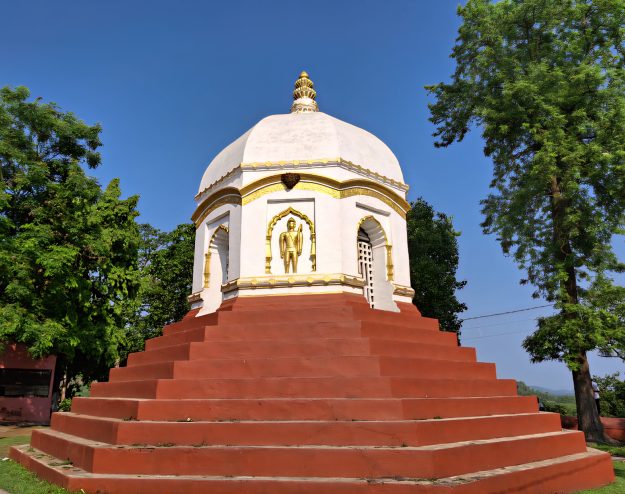
Once a hub of Himalayan devotion and commerce, Hajo now endures largely as a site of remembrance—an echo of the networks of belief, trade, and movement that once bound Assam, Bhutan, and Tibet. The hilltop remains holy, but the trans-Himalayan Buddhist pilgrimage is no longer the lifeline it once was. Its significance persists through memory and lineage, carried by elders like Drukpa and Ura, whose journeys keep alive a sacred Buddhist geography that is gradually fading, though not yet lost.

Thank you for subscribing to Tricycle! As a nonprofit, we depend on readers like you to keep Buddhist teachings and practices widely available.