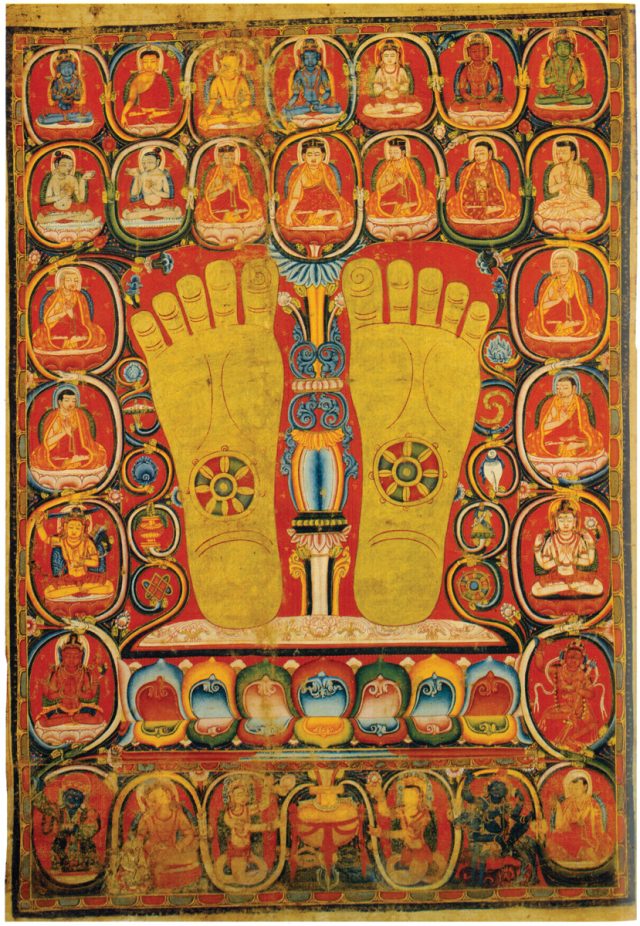
The Buddhist monastery of Nalanda was founded in northeast India in the early 5th century. Over time it became the premier institution of higher learning in Asia and, much like leading universities today, had a world-renowned faculty working on the cutting edge of the theoretical sciences and a student body drawn from across the Buddhist world. This prestige also brought with it ample gifts from the rich and powerful. At its height Nalanda had an extensive faculty teaching a diverse student body of about 3,000 on a beautiful campus composed of numerous cloisters with lofty spires that “resembled the snowy peaks of Mount Sumeru.” Then, suddenly, the serenity of this Buddhist institution was shattered. In the fall of 1202, Muslim soldiers on horses rode in and hacked down teachers and students where they stood. The once majestic buildings were left in ruins: the savagery was so great it signaled the end of Buddhism in India.
This powerful story has been told countless times. Today it is ubiquitous, appearing in everything from scholarly mono- graphs to travel brochures. Indeed, by its sheer pervasiveness, this one episode has in many ways come to encapsulate and symbolize the entire 1,300-year history of Buddhist-Muslim interaction. As a result, anytime the topic of Buddhism and Islam is mentioned it almost invariably revolves around the Muslim destruction of the dharma.
This is problematic for many reasons, not the least being that the story of Nalanda is not true. For example, not only did local Buddhist rulers make deals with the new Muslim overlords and thus stay in power, but Nalanda itself carried on as a functioning institution of Buddhist education for another century. We also know that Chinese monks continued to travel to India and obtain Buddhist texts in the late 14th century. In fact, contrary to the standard idea promoted by the story that Nalanda’s destruction signaled the death of Buddhism, the historical evidence makes clear that the dharma survived in India until at least the 17th century. In other words, Buddhists and Muslims lived together on the Asian subcontinent for almost a thousand years.
Why are these facts not better known? There are numerous possible explanations, ranging from Buddhist prophecies of the decline of the dharma to the problems of contemporary scholarship. However, I find it most fruitful to begin with the power of story. As noted above, the destruction of Nalanda offers us a clear-cut narrative, with good guys and bad. It avoids entirely the complex shades of gray that most often color the messy fabric of history. And this is certainly what the Buddhist historians who cobbled together this story wanted to do as they tried to make sense of the dharma’s demise in India. Rather than explore the complex economic, environmental, political, and religious history of India, or even Buddhism’s institutional problems, it was clearly much easier to simply blame the Muslims.
In this regard the Buddhists established a precedent that was subsequently to drive South Asian history. The British, for example, used the same claims established by Buddhists concerning Muslim barbarity and misrule to justify the introduction of their supposedly more humane and rational form of colonial rule. Indeed, the story of Nalanda was a powerful component of imperial propaganda. In turn, even as Indian nationalists questioned the moral righteousness and glory of the British Raj, they nevertheless maintained the historical model of blaming the Muslims. The humiliating imposition of colonial rule was thus not the result of Indian weakness per se, but rather the fault of the morally inferior, effeminate, and voluptuous Mughals. It is a view that is readily perpetuated in the rhetoric of today’s Hindu nationalists who want to recreate some imagined Hindu utopia by eradicating all traces of Islam in India, by violence if necessary.
This pervasive anti-Muslim view is, of course, not unique to medieval Buddhist and contemporary Hindu historiography. It has also been a part of the Jewish and Christian traditions ever since Muhammad received what Muslims regard as God’s final revelation through the angel Gabriel in the early 7th century. Many scholars have argued in addition that the modern Western construction of itself as the paragon of righteousness was often done at the expense of Islam. Yet even though such “orientalism” has been roundly critiqued by decades of scholarship, these earlier views persist. In fact, the attempts by contemporary scholars and museum curators to overturn such stereotypes by means of books and lavish museum exhibits highlighting Muslim tolerance and periods of Islamic exchange with Christian Europe have been unable to diminish the West’s orientalist fear. Today’s highly charged environment has further obstructed such a reevaluation, no matter how necessary it may be. If we take into consideration all these disparate strands, it is perhaps not at all surprising that the story of Nalanda and the attendant narrative of Islam destroying Buddhism are so readily accepted by Buddhists in much of Asia and the West. To many they just make sense. Moreover, they fit popular preconceptions about two religious traditions: whereas Buddhism is a good, rational philosophy with post-Enlightenment values, Islam is an inherently violent and irrational religion.
Far from being diametrically opposite, Buddhism and Islam have much in common, and Buddhist and Muslim thinkers alike have long tried to solve the tensions that arose between their communities.
In the popular imagination, there are probably no two traditions more different than Buddhism and Islam. One is synonymous with peace, tranquility, and introspection; the other, with violence, chaos, and blind faith. One conjures up images of Himalayan hermitages and Japanese rock gardens; the other, primitive and dirty villages with men brandishing AK 47s as casually as briefcases. While Buddhism is seen as compatible with a modern mind-set, its teachings even in tune with the most pioneering science, Islam is largely looked upon as backward, its teachings and punishments redolent of the Middle Ages. And yet, just like the whole enterprise of orientalism and the construction of Islam as innately evil, this image of Buddhism as the perfect spirituality for the modern age is equally a Western fantasy, a construction of the 19th century. In fact, it was during those heady days of empire and modernity that Buddhism came to be conceived as a philosophy that could solve all the world’s problems.
Modern Buddhism had many authors, from British colonial officers to Asian nationalists and from German philosophers to Russian Theosophists. All, however, agreed that this tradition shorn of rituals, doctrines, and communal structures was clearly the spiritual philosophy for the age of secular humanism. Such a philosophy was not what Buddhists in Asia actually practiced, of course, but to the modernizers Buddhism’s traditions had lost touch with the true teachings of the Buddha and had instead descended into a morass of ritualism and superstition. It was hardly coincidental that their view dovetailed neatly with Protestant apologetics—namely, that the teachings of Jesus had been deformed by paganism and papism and then redeemed by Martin Luther—as well as with 19th-century debates about Aryans and Semites. It provided a powerful narrative arc and presented Buddhism, seen as the meditative path for individual liberation, as the very antithesis of Islam.
Given the influence of these background elements, it makes sense that so few question the story of Nalanda’s destruction. It is a perfect story, with the requisite and familiar actors playing their appropriate roles. Moreover, in recent years this story has emerged as not simply some event long lost in the fog of history, or an abstract frame with which to map and order the chaotic progression of history, but rather as a concrete reality. In March 2001, it played out on television screens around the world when the Taliban used tanks and antiaircraft weapons to demolish the colossal Buddha statues of Bamiyan.
This wanton act of destruction not only reenacted the story of Nalanda but also reaffirmed Western, and often Buddhist, stereotypes. What better image could one have to represent Buddhist-Muslim history than that group of fanatical Muslim militants senselessly mauling the peaceful and passive representations of the Buddha in the name of Islam? That is invariably how it was presented in the international media. Little thought, however, was given to the possible historical contingencies shaping the event. Perhaps most important, there was little recognition that the statues had until then somehow survived 1,300 years of Muslim rule—another of those inconvenient facts that somehow muddied the story. It was perhaps better not to think about it, since if one did, it opened the door for the whole messy reality of history to come rushing in, which in turn could very well challenge, possibly even shatter, the conventional narrative that has been told over the past millennium.
Over the years, shining a light on the history of Buddhist-Muslim interaction has been a scholarly focus of mine. I have been especially interested in how this history played out along what is often called the Silk Road, or more precisely Inner Asia, the wide swath of territory stretching from Afghanistan to Mongolia.
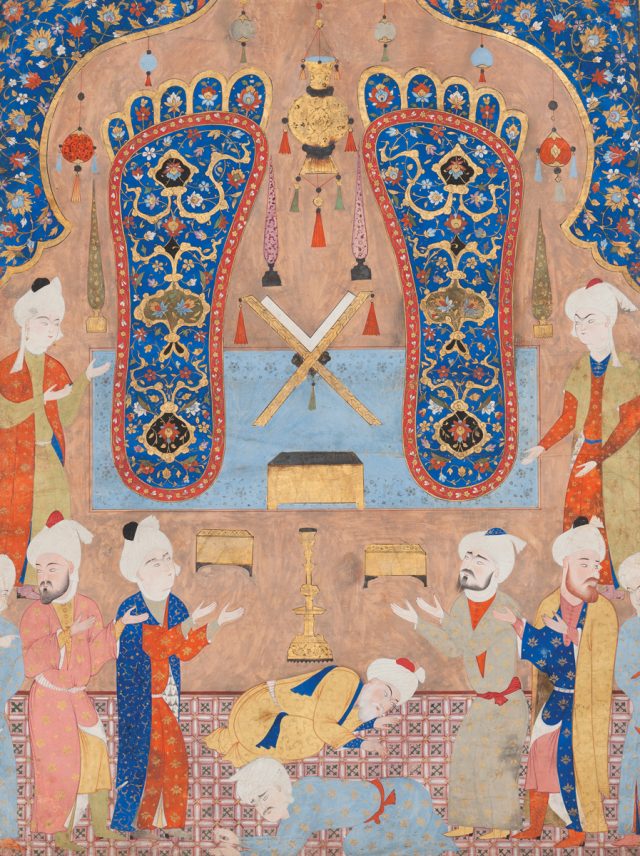
In the course of studying this often overlooked chapter of human history, I have been intrigued by how both Buddhism and Islam were reshaped by their encounter. A most telling example of this can be found in some of the developments in Mongol Iran, when Muslims started to represent Muhammad in imitation of Buddhist visual culture, and Muslim clerics and Buddhist monks engaged each other in theological discussion that brought to both religious communities new ways of thinking, such as the adoption by Sufis of the Buddhist idea of rebirth. Indeed, it is precisely by exploring the meeting of the two traditions in unconventional spaces—such as Mongol Iran—that many assumptions are challenged. Furthermore, in this way some of the conventional divisions that shape our understanding of the world—such as notions about East and West and the Middle East and East Asia—are revealed as conceptualizations that have often distorted historical realities and our sense of the world, especially our limited views about actual possibilities of cross-cultural understanding.
Far from being diametrically opposite, Buddhism and Islam have much in common, and Buddhist and Muslim thinkers alike have long tried to solve the tensions that arose between their communities. Yet it is clear that the problems of prejudice and suspicion and intolerance still often characterize relations between Islam and Buddhism. Recent theoretical frameworks—such as ecumenicalism, multiculturalism, pluralism, and cosmopolitanism—offer hope, but the fundamental issue of how one should deal with “the other” remains as pressing as ever. How such difference is to be articulated and dealt with is not only an ongoing process but also a fundamental aspect of the human experience. By understanding and challenging the common narrative, which pits the peaceful Buddhists against the militant Muslims—precisely the view used today in Myanmar to justify the genocide by Buddhists of the Rohingya—we can see our way clear to leaving them behind.
In the encounter of Buddhism and Islam there has been and continues to be conflict. But there has also been much else. An appreciation of not only the history of conflict but also that of cross-cultural exchange and understanding overturns the common narrative. And this tells us something about history itself, about its power to reveal truths that have been covered over by prejudice and forgotten because of suspicion of difference.
♦
Adapted from Buddhism and Islam on the Silk Road, with permission of the University of Pennsylvania Press.

Thank you for subscribing to Tricycle! As a nonprofit, we depend on readers like you to keep Buddhist teachings and practices widely available.