
Tricycle is pleased to offer the Tricycle Talks podcast for free. If you would like to support this offering, please consider donating. Thank you!
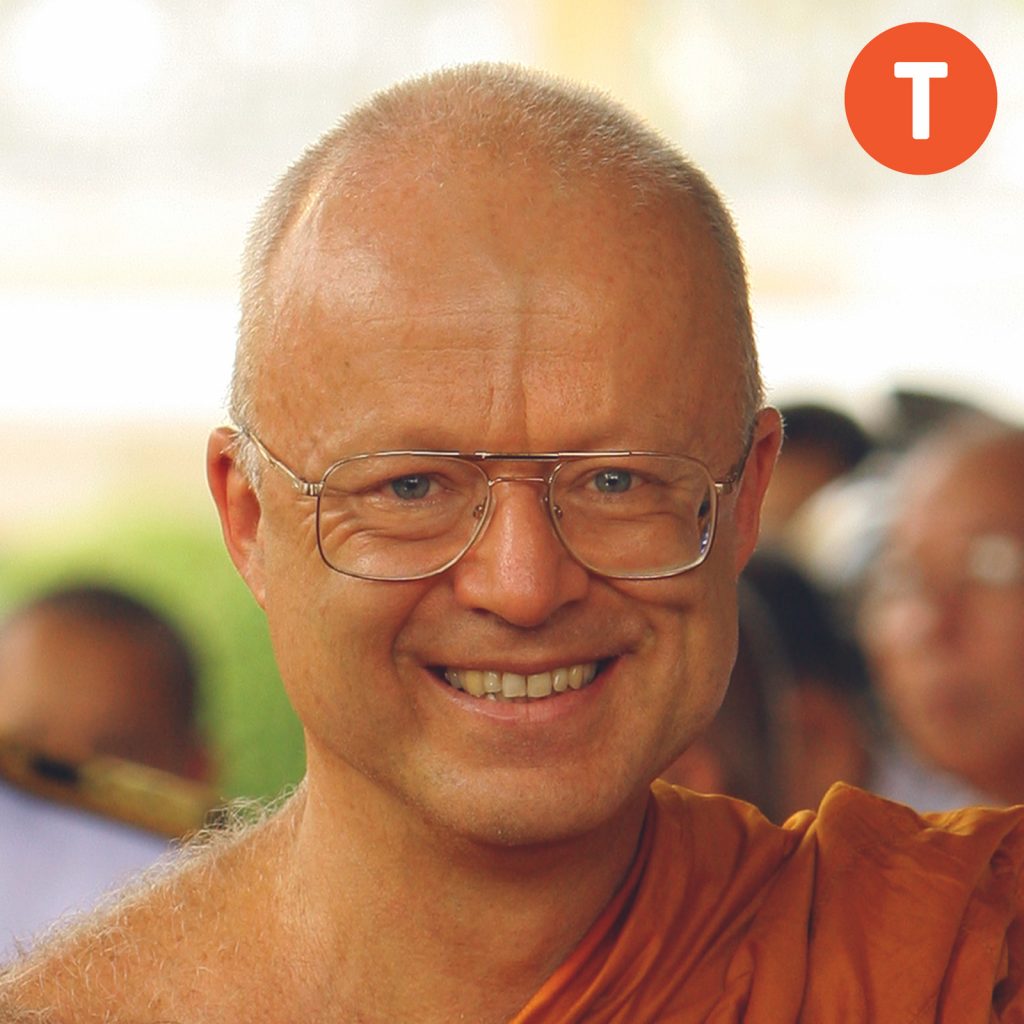
Thanissaro Bhikkhu is an American Theravada Buddhist monk trained in the Thai forest tradition. He currently serves as abbot of the Metta Forest Monastery in San Diego County and is a frequent contributor to Tricycle. Over the years, he has written extensively on the Buddhist concept of not-self, including the many misperceptions that have arisen about this teaching over the centuries.
In this episode of Tricycle Talks, Tricycle’s editor-in-chief, James Shaheen, sits down with Thanissaro Bhikkhu to discuss why the Buddha refused to answer when he was asked whether there was a self, what it means to consider not-self as a strategy rather than an ontological truth, why perceptions of self and not-self are types of karma or activity, and why all views and perceptions are eventually discarded on the path to awakening.
Tricycle Talks is a podcast series featuring leading voices in the contemporary Buddhist world. You can listen to more Tricycle Talks on Spotify, Apple Podcasts, and iHeartRadio.
♦
We’d love to hear your thoughts about our podcast. Write us at feedback@tricycle.org.
Thanissaro Bhikkhu: There’s a passage in the canon where the king comes to see the Buddha, and the Buddha asks him, “What have you been doing in the middle of the day here?” And the king is remarkably frank. And he says, “Oh, the typical things of someone who’s obsessed with power, gaining power, and maintaining it.” And the Buddha says, “Suppose someone trustworthy were to come from the east and say there’s this huge mountain moving in from the east, crushing all living beings in its path. Another trustworthy person comes from the south, another from the west, another from the north. It turns out there are four mountains moving in from the four directions crushing all living beings.” He says, “Given this horrible destruction of life, all this horrible chaos, what would you do?” The king says, “What else could I do but practice then dharma?” And then the Buddha says, “Well, I tell you, aging, illness, and death are moving in, crushing all beings in their path. What are you going to do?” And the king has to admit, “What else shall I be doing but practicing the dharma?” So this is a teaching I give again and again. It doesn’t matter which political figure is riding which mountain, but the mountain’s moving in, and the whole purpose of the dharma practice is to give you something that will not be crushed by those mountains. James Shaheen: Hello, and welcome to Tricycle Talks. I’m James Shaheen, and you just heard Thanissaro Bhikkhu, whose friends and students call him Than Geoff. Than Geoff is an American Theravada Buddhist monk trained in the Thai forest tradition. He currently serves as abbot of the Metta Forest Monastery in San Diego County and is a frequent contributor to Tricycle. Over the years, he has written extensively on the Buddhist concept of not-self, including the many misperceptions that have arisen about this teaching over the centuries. In my conversation with Than Geoff, we talk about why the Buddha refused to answer when he was asked whether there was a self, what it means to consider not-self as a strategy rather than an ontological truth, why perceptions of self and not-self are types of karma or activity, and why all views and perceptions are eventually discarded on the path to awakening. So here’s my conversation with Thanissaro Bhikkhu. James Shaheen: So I’m here with Thanissaro Bhikkhu. Hi Than Geoff, it’s great to be with you. Thanissaro Bhikkhu: Hi, it’s good to see you, James. James Shaheen: Well, first of all, I should point out that you’ve invited me to push back against some points, and so in case anyone thinks I’m being disrespectful, you asked for this. Thanissaro Bhikkhu: Right, Fine. Makes it more interesting. James Shaheen: I should also mention that you think I should push back more often against our guests, but I’ll think about that. So we’re here today to talk about the Buddha’s teachings on not-self, which you’ve written a lot about over the years. So to start off, can you tell us what the Buddha meant by not-self? Thanissaro Bhikkhu: Okay, for that you have to ask what he means by self and why self is an issue for him. Here we get back into the major context for the teachings, which is that it’s all about suffering and the end of suffering, and he defines suffering as clinging to the five aggregates: form, feeling, perceptions, fabrications, consciousness. One of the main ways in which we cling to those things is to our sense of self. We perceive self in any of these things, either that we are the aggregates or we own the aggregates, or we are in the aggregates or the aggregates are in us. And so he says that’s the way that we create suffering, but that is suffering for him. We think that by claiming these things as self, we’re going to find happiness. So he had to change our views on this, and he means just about any way you would identify with them. In other words, you thinking you have a permanent self or an impermanent self, connected, separate, whatever, however you perceive self, you’re going to cling. So his teaching on not-self is to eradicate any notion of why you would see it in your interest to cling to these things. In other words, he wants to change your sense of your value judgments around this. You value these things as a positive thing you’re doing. He wants you to see that as a way of actually getting in the way of finding the true happiness you really want. James Shaheen: Okay, so there have been a lot of debates over whether the Buddha believed that there is a self or not, and so one strategy to resolve the debate is to view these teachings as operating on different levels of truth. Yet even this yields no resolution. Why is that? Thanissaro Bhikkhu: Well, it’s because, again, however you define self or not-self, you have a view that you’re going to cling to. One of the reasons they invented the teaching on two truths was that there are passages when the Buddha talks about self in a positive way, that you need to take your self as your own mainstay. You have to take your self as your governing principle, he calls it, which means basically your reason for practicing. Then there are other passages where he talks about not-self, and so the question is if by not-self he means no-self, then you’ve got a contradiction. So to get past that contradiction, they came up with the theory of two truths, which doesn’t really adequately resolve things because if something is ultimately true and something is conventionally true, then the conventional truth is not really true. It’s a falsehood. But you can see that the Buddha didn’t take a position on whether there is or is not a self. The times when he was asked about that, he refused to answer. And as you said, the questions of “What am I? Do I exist? Do I not exist?”—these are all questions to be put aside as a form of inappropriate attention. Then you realize that that resolves the problem. James Shaheen: Well, tell us about when he was asked point-blank about whether the self exists and he remained silent and refused to answer. So first, can you tell us this story or about this story? Why did the Buddha refuse to answer, and what does this teach us about the debate whether there is a self or not? Thanissaro Bhikkhu: Well, there was a wonder named Vacchagotta, who appears several times in the canon and keeps asking the Buddha questions around this topic. One day he comes and ask him point-blank, “Is there a self?” The Buddha is silent. “Is there no self?” The Buddha is silent. Vacchagotta gets up and leaves. Ananda is sitting by and asks the Buddha, “Why didn’t you answer him one way or the other?” And the Buddha explains that if you say that there is a self, you’re siding with the eternalists. In other words, there’s something in there that you should try to cling to as you or yours. If you say there’s no self, then you’re siding with the annihilationists, who basically said there is no good or evil because you’re going to be annihilated after death anyhow, so you might as well just do what you want. Then he goes on to say, “If I told Vacchagotta that there is self, wouldn’t that get in the way of the teaching that all dhammas are not self?” which is one of the realizations that you use to pry away your attachments to things. “And if I said that there was no self,” he said, “Vacchagotta would be confused. He’s already confused as it is, and he would be even more confused.” James Shaheen: So that would tip us into a kind of nihilism. That would be the danger. Thanissaro Bhikkhu: Right, right. James Shaheen: Okay. So you suggest that both sides of the debate are not partially right, but totally wrong. Thanissaro Bhikkhu: Totally wrong, yes. James Shaheen: That’s very you, your not-self or whatever. But that they’re totally wrong because they assume that the Buddha’s teachings begin with the metaphysical status of the self. So why is this incorrect? Thanissaro Bhikkhu: Well, because as he said, what he taught was suffering and the end of suffering, and his interest in the way things are outside was totally determined by whether they’d be relevant to answering the question of how to understand suffering or how to put an end to it. And by claiming there to be a self or staking a position on this issue, he said it turns into a wilderness of views. There was another time when he was talking to a group of monks and he said, “The questions, ‘Do I exist? Do I not exist? Who am I? What am I?’ These lead to a wilderness of views, one of which is ‘I have a self’ and another is ‘I have no self.’” And it’s a wilderness of views because it gets you entangled in your own thoughts and also entangled in a lot of discussions with other people. He was more interested in seeing, how do you put an end to the clinging that is suffering, and the teaching of not-self is designed to do that. It’s there to change your value judgment. As I was saying earlier, we have a value judgment that we cling to these things because we see that it’s in our interest for the sake of happiness, that we see ourselves, one, as the producer, someone who’s capable of doing what will lead to happiness, and then two, as the consumer, someone who will enjoy the results, and then three, as the commentator who watches over your actions and decides what you shouldn’t be doing, what you did right, what you did wrong. And all of these are useful functions in looking for happiness, and we say that they’re worthwhile. In fact, the Buddha actually has you use them on the path quite a long way until you’ve completed the path. Then it’s time to let go of all assumptions like that. James Shaheen: Okay, so you take an interesting approach where you suggest that the Buddha’s teachings on self and not-self are strategies to help students attain the goal of the teaching, and they no longer apply once the goal is attained. So what do you mean when you talk about not-self as a strategy, and how does that strategy work? Thanissaro Bhikkhu: The strategy works in two phases. For most of the path you identify as self the things you need to do. You are the one who’s doing the path. You are the one who benefits from the path. And even when you think about developing the thought on not-self, the Buddha says, “Let go of what is not yours. It will be for your long-term welfare and happiness.” So it’s assuming there’s a you in there for the purpose of this motivation. And anything that would pull you off the path, then, you would identify as not-self—your desires to break the precepts, your desires to go off with the distractions when you’re practicing concentration, that kind of thing. James Shaheen: So, you know, you sent me a teaching or a paper by Bhikkhu Bodhi, who agrees with you on much of this, but there’s an area where he disagrees with you, and it’s easy for me to take up that same position because it seems to make sense. Bhikkhu Bodhi argues for the ontological underpinning of not-self and the liberative insight that can follow from that. So the contemplation of impermanence is something that, say, is continued among arhats, say. Why isn’t it, in a sense, a commentary on the nature of being, the nature of things? For instance, if things can be described as not-self, and if we can be described in the same way, why is that not an assessment of things as they are, as Bhikkhu Bodhi would say? Thanissaro Bhikkhu: Well, you have to remember the Buddha never called what we call the three characteristics, anicca, stress, and not-self, he never called them characteristics; he called them perceptions. These are perceptions you apply to things. And then the question is, as perceptions they’re actions, and why are you doing these actions and what are the consequences of doing the actions and how far do you have to keep on doing them? Because if you say that this is the way things are in and of themselves, that gives you something more to cling to, whereas he’s very conscious of the fact that this is a perception. On the one hand, as I said, it is an action. And then the Buddha also said that perceptions never give a full view of things. It’s not the case that everything is totally inconstant, everything is totally stressful, everything’s totally out of your control. They have their other side. As you said, if things were not pleasant, if the aggregates are not pleasant, we wouldn’t latch onto them. We wouldn’t cling to them. So it makes you more self-aware that when you’re applying this perception, you are doing it with a purpose, which is to change your value judgments about the aggregates. And then when it has done its purpose, then you let it go. James Shaheen: So in other words, even, say, anicca, or impermanence, is a perception, and to be applied as a strategy and not an ontological statement about the nature of things. Thanissaro Bhikkhu: The Buddha seemed to be interested in the nature of things only insofar as it helped understand suffering and how to put an end to suffering. Beyond that, he said, “I’m not going there.” And it is true that these things have their side which is inconstant, stressful, not-self. But the question then is is it always beneficial to focus on that? James Shaheen: I see what you’re saying, but if I were to ask you, Than Geoff, whether things are impermanent, would you say yes? Thanissaro Bhikkhu: I would say yes. But then I’d say this truth is something that may not always be beneficial. We talked about how things can be true and beneficial and things can be true and not beneficial, and you have to know the right time and place to use them. There was a case one time when a young monk was being asked about what is the result of action, and he said, “The result of action is stress and pain.” And the sectarian who asked him the question said, “I’ve never heard that from any other monks. You better go check that with the Buddha.” So he does, and the Buddha basically calls him a fool. He says, “When you’re talking about karma, you don’t talk about all feelings as being stressful.” Another monk butts in and says, “Well, maybe he’s thinking about that teaching that all feelings are stressful,” and the Buddha says, again, another fool. He says, “When you’re talking about kamma, you’re talking about the three kinds of feelings—that there are feelings that are pleasant, those that are painful, and those that are neutral—so that those who have the question about what kind of actions should they do will have motivation for doing the skillful actions.” James Shaheen: Okay, I’m going to try to paraphrase Bhikkhu Bodhi, and I don’t know if I’ll do it correctly, so this, just consider it my paraphrase. He seems to conclude that anatta, or not-self, derives its liberating power from its correspondence to reality’s actual nature, not merely from its therapeutic utility. So the teaching succeeds because it reveals truth about existence, not just because it’s psychologically helpful. Where he agrees with you is the strategy; where he disagrees with you that it has, again, ontological underpinnings. So it seems reasonable to me. Why do you differ from him there? I mean, you said a little bit, but it just seems so powerful an argument. Is it, again, just because perception is not to be relied upon? Thanissaro Bhikkhu: One, perception is not to be relied upon. Two, if you’re going to gain awakening, you have to let go of all views. There’s one passage where the Buddha talks about how on the verge of awakening, you see that as things arise and pass away in the senses, that the concept of existence doesn’t apply to them, the concept of nonexistence doesn’t apply to them. These concepts just don’t occur to you. At that point, when you’ve reached a state of mind where concepts of existence and nonexistence become meaningless, you’re not going to go back and hold to a metaphysical view that the self doesn’t exist, because the concepts have lost their meaning at that point. James Shaheen: Yeah. But one without views, then, entirely without views, would that mean then one has crossed over? That one has reached nirvana? Thanissaro Bhikkhu: Yeah, that’s one of the ways you get there is by letting go of views. And seeing not-self as a strategy is one way of holding to a view as long as it’s useful and then realizing that you turn it on yourself and realize that this, too, is something I have to let go of. James Shaheen: Well, one other thing that occurs to me as you’re talking, you know, the two truths doctrine you felt was created to address a particular problem or resolve it. When we talk about nirvana, is that at all similar to two truths, when we’ve got our samsaric existence that I live in anyway, and then there’s this state that we can’t really talk about called nibbana, where it’s not a state, even. It’s the unconditioned, say. Isn’t that pointing in a certain way to two truths, or is it two modes of what? Thanissaro Bhikkhu: Well, in samsara you’re basically engaging in actions. When you get to nibbana, there are no more actions, which means that at that point, even the path gets abandoned, and all the right views that you had that would get you there, those get abandoned as well. Think of the image of the raft. You’ve got this river flowing, and on this side of the river, it’s dangerous, and the other side is safe, and there’s no nibbana yacht that’s gonna come over and pick you up. So you have to build a raft. And so what do you build the raft out of? You build the raft out of the aggregates, out of the twigs and branches on this side of the river, which the Buddha equates with the aggregates. And then you use those aggregates and you hold onto them in the form of virtue, concentration and discernment as you swim across the river. But then to get on the bank, you have to let go of the raft. James Shaheen: Okay, so I hate to disappoint you, but I’m not going to be pushing back for a while. Maybe something will come up and I’ll take the opportunity, but for now, we’re just going to proceed. You suggest that perceptions of self and not-self are types of karma or activity, or kamma in Pali, and therefore they should be evaluated in terms of whether they contribute to suffering or lead to its end, as you said a few moments ago. So how are the actions of self and not-self evaluated in this way? Because we don’t often hear of self and not-self as actions, or at least the perception of those things as actions. Thanissaro Bhikkhu: It’s important to see that they are actions. They’re something you do, and again, as I said, there’s a reason that this is really useful. The Buddha one time said that the dharma is nourished by commitment and reflection. You do something and then you look at the results of what you’ve done. And so in the cases where your sense of self is skillful, you look at it and say, “Okay, this has actually helped me along, so I’ll hold onto it as long as it’s helpful,” and then that self will be useful for cutting away your attachments to whatever is unskillful. And these are things we actually do all the time. They are perceptions. Suppose your little sister’s being beaten up by some kids down the street. You know, she’s your little sister and you’re going to go down and protect her. And then you bring her home and she starts playing with your toy trucks, and she won’t give them back to you. And all of a sudden, she’s not your sister anymore, she’s the other. So we tend to shift these boundaries between where we see our self and not-self all the time. The Buddha is simply asking us to be more systematic about that and be more reflective for the purpose of getting on the path and to end suffering. James Shaheen: You know, we often hear about a belief or view of self as a fetter, but the Buddha posits that the view “I have no self” can be as much of a fetter. So how is this the case, and how do both views take the attention from more important matters? Thanissaro Bhikkhu: Okay. When you start staking out the view that “I have a self” or the view, “I have no self,” in what context are you doing that? You’re going to be arguing with people who hold the other side. Whereas if you say, “I’m just going to apply the perception of not-self to things that are making me suffer, and I’ll apply the perception of self to activities that are going to be helpful on the path,” that’s your own private business. It’s your own internal discussion. If you’re going to take a position, “I have a self,” “I have no self,” you have to get involved in all of the metaphysical issues of, “Well, if there is no self, then . . .” which we hear again and again. James Shaheen: Are you suggesting we resign from the debating society? Thanissaro Bhikkhu: Yes. Well, the Buddha himself told the monks, “Don’t get involved in debates.” He himself was in charge of the debate whenever there was a debate in his presence. But in India in those days, that’s one thing that kings would do is when they started their reign, they would set up a question, “This is a question I want to have answered by the contemplators in my realm, and anybody who answers the question to my satisfaction will get my support.” Now, you can’t tell a king that that was a stupid question to begin with, whereas the Buddha was in a position where he would actually put questions aside. He had this framework for treating questions. One was questions that deserve a categorical answer, yes or no across the board; two, those that required an analytical answer where you would go back and redefine the terms of the question; three, those that required cross-questioning where you have to ask questions of the person who asked the question to make sure they’re going to understand the answer when you give it; then four, questions that you put aside because they’re not useful on the path. He was very strict with himself in sticking to these categories, and the few times when the issues of existence or nonexistence of the self come up, they all fall into that fourth category. He just puts the question aside because it’s not useful. James Shaheen: You know, you talk about certain types of matters that were seen as a form of slander regarding the Buddha’s teachings, those that were fully drawn out and those that were not. Can you tell us a little bit about that distinction and how misunderstanding either is slander? Thanissaro Bhikkhu: Okay. There are issues where the Buddha would have you take something and think about it and sort of figure out for yourself what the implications were. There are other statements he made that he would just sort of leave as they were. He said, “Use this statement as it is and then start reflecting on that.” For example, there’s the teaching, “All dharmas are not self.” Now, some people from that could draw the conclusion or the implication that this means that there is no self. In fact, there was a monk who did that one time in the Buddha’s presence. He was thinking the thought after he listened to the Buddha, and the Buddha called him a fool, which indicates that that particular teaching is not one that you would draw implications from. And what happens when you look at the teaching, “All dharmas are not self,” in other words, it’s saying these are all things that should be let go of. And the question is, what is a dharma? And dharma can mean phenomenon. It can actually mean action, and it can also mean teaching. You start reflecting on that, and you realize once you’ve used this teaching to cut away your attachments to other things, you can turn it on itself, and so this too should be let go. This too is not self. Which makes it part of that path, which the Buddha said the noble eightfold path is a path of karma leading to the end of karma. So this is a use of a particular form of right view, which is part of the path, to lead to the end of attachment to any views including itself. So these teachings that you wanted to have performed in this way, I think those belong to the category of things where you don’t draw out the implications in other terms. James Shaheen: Yeah, I was just thinking, going back to debate for a moment, because this made me think of it. Are there debates that are useful or helpful in hammering out those teachings that are drawn out, that are hammered out in a way that is elucidating or helps people understand the teachings better? Thanissaro Bhikkhu: There are, and it depends on the intentions of the people involved. If both sides are looking for the truth, then it’s a useful debate, but if someone is saying, “I’m just going to stake my claim and not change,” that’s not really useful. James Shaheen: What about the debate about whether not-self has ontological underpinnings? Thanissaro Bhikkhu: I think that’s useful. James Shaheen: Oh, good. So holding to the view that there’s no self is even seen as a form of passion or desire. I mean, that’s sort of a strong statement, and it might be surprising to some, but how is holding onto the view that there’s no self a form of passion or desire? Thanissaro Bhikkhu: Okay. There are a lot of people who really hate themselves, or they don’t like the idea of being responsible and they actually like the idea that there’s no self that lifts any responsibility off their shoulders and also gets rid of the self that they don’t like, so they can be quite passionate about it. There are also cases where people claim that they’ve had an experience in meditation where they saw that there was no self, which is usually an indication of either the first stage of awakening or a step there. And so then there becomes a strong sense of “I” around the fact that I realize this. There you have to ask the question of what kind of experience meditation would prove that. Usually it’s the sense that whatever you identified as your self suddenly stops and you see it stop, and for the time being, you don’t see anything taking its place. So you assume that there’s no self, but that’s not really a valid conclusion to draw from that kind of experience. James Shaheen: What conclusion would you draw from that experience though? Thanissaro Bhikkhu: I’d say, well, let’s see what happens next. James Shaheen: Okay. So a lot of people, as you say, use not-self in a very self-serving way, and they can take it to mean there’s no self, so there’s no karma and no accountability. So how does the Buddha counter this misconception? Because it’s an easy one to arrive at, just like it’s easy to think, “I don’t want to be this person anymore, there’s no self anyway, so I’ll be something else.” Thanissaro Bhikkhu: Well, there was that one case where the monk drew those conclusions in the Buddha’s presence. He just thought them, of course. And instead of arguing with the monk, he just called him a fool and then turned to the monks and said, “Let’s look at the five aggregates and go down the five aggregates and see if they’re inconstant, stressful, not-self. And if they’re inconstant, stressful, are they worth calling your self?” So he actually showed the monks that this is how you use the teaching to peel away your attachments. James Shaheen: Right, you say that the Buddha demonstrates how not-self can be a strategy for abandoning clinging, not an excuse to abdicate responsibility. Thanissaro Bhikkhu: Right. James Shaheen: That was very nicely put. I felt called out. So you say that avoiding this question of the existence of the self allowed the Buddha to focus directly on I-making or my-making, in other words, I, me, mine, as activities and to examine when they are skillful. So we’re considering these once again as perceptions and activities. So the skillfulness of not-self is more obvious, but when are perceptions of self skillful? Thanissaro Bhikkhu: When you take on the perception that you are capable of doing the path. There’s a passage where Ananda is talking to a nun, and he says that we practice for the sake of putting an end to conceit, which may mean the sense of “I am,” but you have to use conceit skillfully on the path to get there. And the conceit that he recommends is, “Other people who have gained awakening, they’re human beings. I’m a human being. Why can’t I?” So you have that sense that you are capable of doing this. Secondly, thinking of the self as the consumer that will enjoy the results of the path. If you reflect on the fact that you’ve gone on the path because you wanted to put an end to suffering, and now you’re getting tempted to fall off the path, do you not want to put an end to suffering? Do you not love yourself? And that’s another skillful use of self that keeps you on the path. And finally, when you’re practicing concentration, you have to have a sense that you are doing this because you have to do the concentration and then reflect on the results and take responsibility for what you’re doing. So those are skillful uses of self. James Shaheen: I think you put it more plainly when you say whatever gets you there. Thanissaro Bhikkhu: Right. James Shaheen: So can you say something about the progressive nature of our practice? You know, you talk about, as you just did, a healthy self-concept, the perception of not-self that seems perhaps to follow if this is a correct progression, and then realizing the goal of practice is freedom from all clinging, including clinging to views. How do you see this progression? Do you see it as sort of a linear progression? Thanissaro Bhikkhu: There are a lot of feedback loops in which you work on your virtue, work on your concentration, as you develop your concentration, develop some discernment, then you use your discernment to further perfect your virtue and concentration. Your concentration also helps you see more clearly what your intentions are, which makes your virtue better as well. So the three trainings help one another along. It’s not that you just do A and then you do B and then you do C. You have to do them all together to strengthen one another. James Shaheen: Okay. There are lots of strategies that you teach. In fact, I mean, we just got through discussing how self and not self are strategies, not ontological truths, although there’s some debate around that that you’ve engaged in that you even find useful. But these strategies eventually are abandoned once the goal is attained, which is not my problem right now, and you point out that the awakened person cannot be described and has no way of describing their self. Could you say more about this? Thanissaro Bhikkhu: Well, there’s the passage where the Buddha says that we define ourselves as beings based on our passions, passion for form, feeling, perceptions, thought constructs, consciousness, and then you get a person who goes beyond all those kind of passions, goes beyond those forms of passion, and there’s no way you can define them. When you can’t define somebody, then you can’t describe them. James Shaheen: Is this kind of like an attempt to describe or explain nirvana? Is it more or less like the way that Kant’s numinal world resists any approach or description? Is that something similar in Western thought? Thanissaro Bhikkhu: It’s similar, but the Buddha actually does talk about nirvana as existing, and secondly, he gives lots of metaphors. He says don’t confuse the word for the goal, but these metaphors give you an indication of the direction you’re going. James Shaheen: Is it sort of like from the Zen tradition the finger pointing at the moon? Thanissaro Bhikkhu: In some ways, yes. James Shaheen: How is it not? Thanissaro Bhikkhu: Sometimes you have to look exactly at the finger. Is the finger pointing the right way? James Shaheen: I don’t want to get you in trouble, Than Geoff. So back to views. After awakening, views are no longer needed and are just regarded as events or phenomena, and the categorization of true or false also no longer applies Thanissaro Bhikkhu: For the sake of the arhat’s own mind. The mind is beyond those categories of true and false. But when you’re teaching somebody else, you have to have a clear sense of what’s right and what’s wrong, and you follow that. It’s right and wrong based on whether this particular view gets in the way of the practice or progress in the practice or whether it actually helps. James Shaheen: Right, so we don’t just descend into sort of a rank relativism. You know, that tends to end up in a very self-serving, methodical course of action, I would say. So why are views such a trap? I mean, this comes up again and again, right view and then abandonment of views, not too soon, but for the arhat. First of all, is it possible to live without views? And secondly, why are views potentially such big traps? I mean, right view is a view and a skillful means, I bet you would say, but why otherwise are views so treacherous? Thanissaro Bhikkhu: Well, so many times we identify ourselves around the views that we have—we have the right view, somebody else has the wrong view, and we get into fights around that. It is possible to hold the right view for the sake of your own practice and get benefits from it. But if you’re using it to argue a lot with other people andbang them over the head, then there comes a point where it’s counterproductive. James Shaheen: Well, I guess we see that all around us right now, right? Thanissaro Bhikkhu: Oh yeah. People are killing one another for their views. James Shaheen: I think I gave you a subscription to the Nation or something like that. Has it expired again? I can’t keep up. That’s it’s full of views, and you do engage, you do know what’s going on around you in your life. How do you avoid falling into rancorous debate? What is your relationship to this kind of topsy-turvy world? Thanissaro Bhikkhu: Well, my relationship is I have some views, but the question is when do I use those views and when do I put them aside. Who do I talk to them about? Who do I not talk to them about? James Shaheen: Do your views ever drive you nuts? Thanissaro Bhikkhu: That’s when I put them aside. James Shaheen: Okay. Let’s say, I’m going to go back to Dogen just to prod you a little bit, and I think maybe you’ll like this one a little better. We talk about getting beyond views that are no longer needed, and they’re just regarded, as I said before, as phenomena, and the categorization of true or false no longer applies. So theoretically someone gets beyond views. Is this at all similar or can we compare this to Dogen’s beyond thinking? I know you’ve read Dogen. Thanissaro Bhikkhu: Well, I think Dogen was more interested in not so much in beyond thinking but de-thinking. If you actually read some of his analysis of what’s going on when you’re just sitting, it’s not just sitting there, not thinking, so you ask questions about is my mind in my body? Is my body in my mind? Who’s doing the breathing? What’s doing the breathing? So you actually are trying to take apart your preconceived notions about things, but eventually you do get to a point where there’s a state in the mind that has nothing to do with thoughts, nothing to do with views or actions at all. And that if there’s any school of Buddhism that gets you there, then they’re all getting you to the same place. James Shaheen: So this ties to the broader question of the limits of language, and you point out that one of the common questions posed in the canon is, “To what extent is this so?” So could you talk about this question and how it can help practitioners see both the limits of language or description and what lies beyond them? Thanissaro Bhikkhu: Well, language is all perceptions and thought constructs. In other words, it’s all aggregates. And so we’re here to let go of our clinging to aggregates, but we have to use aggregates in order to get there. And the extent to which we can use them, that’s when they’re true or false, right or wrong. You also have to realize that because, as the Buddha said, perceptions have their limitations, thought constructs have their limitations. The question of “How far is this true?” gives you a sense of humility about your views, realizing no matter how right they may be, there may be areas in which they are not right, because there are only two teachings that the Buddha said are true across the board categorically. One is the principle that skillful action should be developed and unskillful action should be abandoned, and then the other is the four noble truths. Everything else has its limitations. James Shaheen: I think the challenge is developing the discernment to know what is skillful and unskillful. Thanissaro Bhikkhu: Right, it takes a lot of discernment. That’s one of the reasons why you also need a teacher, because things that seem perfectly skillful to you may not be so. I had a lot of experience with Ajahn Fuang in this, and I thought my views were perfectly right and he pointed out, no, they were pretty stupid. James Shaheen: You know, as long as your teacher has discernment, I guess. We’ve had, we’ve had a lot of mishaps. Thanissaro Bhikkhu: Right, discernment and genuine compassion. Yeah. James Shaheen: Yeah. So in other words, as you say, the Buddha’s teachings are primarily performative rather than just descriptive. So we get back to this idea of a strategy rather than a metaphysic or an ontology. Is that right? Thanissaro Bhikkhu: Right. Because you think about when he says, “I teach only suffering and the end of suffering.” And by the way, he didn’t say, “I teach only one thing.” James Shaheen: Right, Bhikkhu Bodhi apparently cleared that up in an essay, Thanissaro Bhikkhu: But he taught suffering and the end of suffering. Well, what are those? Those are things that you do. You are the one who creates suffering, and you are the one who can act in certain ways that will lead to the end of suffering. And so his teachings are always focusing on those actions. And of course, his teachings themselves are actions to induce people to not only know what they should do but also to get them to want to do the right thing. This is where they have to be performative. He’s not just saying, “Oh, this is the way the world is.” He’s trying to get us to see, “OK, given that there are these features to the way your mind works, you really have to change the way you work your mind.” James Shaheen: Now, I don’t know if this is just a product of my own clinging, but I’m going to go back to metaphysics and ontology for a second. It seems to me that right view would imply, to some extent anyway, metaphysics and ontology in the sense that, as Bhikkhu Bodhi says, we see things as they are, and for him that is to see them as conditioned. It’s pretty hard to live, I mean, ontology and metaphysics, they seem to come naturally to people. I mean, building a framework within which one understands the world. Is it something that we do because we must, but as long as we understand that these are constructed, it’s okay, or is there this sort of pernicious quality to them that creeps into our consciousness and gets us to mistake things for something they’re not? Thanissaro Bhikkhu: I think that both issues are involved. One is your motivation in doing it and your self-consciousness or self-awareness about how these things are constructed. As long as you realize that you’re doing this with a certain purpose, then you have to ask yourself, well, what’s my purpose in seeing things in this way? You think about science, where you get a geologist to describe a certain rock, and you get a subatomic physicist to describe a certain rock, and they’re both right given their frameworks. But then the question is which framework is most useful for you right now? James Shaheen: Right. But that there is a framework would suggest, too, because it exists everywhere that we must have a framework. Is the point to see that it’s a framework? Thanissaro Bhikkhu: See that it’s a framework, and you know, the Buddha didn’t avoid metaphysical issues entirely. There’s one big metaphysical issue that he tackled, which is karma, and that’s the central point. And then I’d say that the teaching that provides the framework for him would be dependent arising. There’s a question of does dependent arising happen in the world, or does it happen just inside your mind? And the answer is both. In fact, your sense of your world and your sense of your mind are products of dependent arising. Dependent arising is very elaborate working out of the principle of karma. James Shaheen: I wonder, you know, a lot of us are doing what had been considered monastic practices, and yet we’re laypeople. You, however, are a monk, and you’re a monastic and you live a monastic life and you are very meticulous about abiding by the vinaya. How do you see laypeople doing these monastic practices? I mean, because a lot of contradictions or tensions arise from that. Do you come across this with your students? Thanissaro Bhikkhu: Yeah. I mean, a lot of people feel that they can’t fully devote themselves to the path because they do have other responsibilities. My feeling, though, whatever extent you can do the path is all to the good. My teacher taught laypeople primarily more than he taught monks. He devoted a lot of time to that. He split his time between our temple out in the hills of Rayong, and then in Bangkok, and he saw that it was worthwhile and a lot of people benefited from that. They would come and they would meditate with him. So I think it was a good thing. James Shaheen: You know, you do something that I don’t hear about that often, because people who come to Buddhism associate it with renunciation and this sort of approach to practice. And one thing that you’ve said that’s always interested me is try to find a place in the breath that is enjoyable, because otherwise you’re not going to keep doing it. Can you say something about that? Because here we have laypeople who have mixed feelings about their own enjoyment of things. And then here you are saying, enjoy your breath. Try to enjoy it. If you don’t, you’re not going to do it. Thanissaro Bhikkhu: Right. Well, it’s a basic principle that if you’re just forcing yourself out of a sense of duty, it’s not going to last very long. You have to have some rewards along the way. And the Buddha himself says that if you’re trying to say, go on your defilements, if you don’t have the pleasure that comes from concentration, then no matter how much you know the drawbacks of your defilements, you’re gonna go back to them, because the mind needs something to feed on. So what we’re doing is giving the mind something better to feed on. James Shaheen: So when you teach retreats around the world, what are some of the questions and misconceptions that students tend to have about not-self? What is it that you’re hearing from lay students like me? Thanissaro Bhikkhu: If there is no self, then dot, dot, dot. That’s a big one. James Shaheen: Well, that’s not a bad one. It’s a good one. Thanissaro Bhikkhu: Yeah, and I always have to say, wait a minute, the Buddha never said there was no self, he didn’t take a position on that topic. And then if you see that he’s teaching not-self as a strategy for letting go of the clinging that’s causing you to suffer, that makes it a lot more relatable. James Shaheen: Well, you like to flip that question. You know, rather than beginning with not self, you begin with karma, I think, because the question is related to karma is if there is no self, who is reborn? Well, this has been asked forever, right? So how do you flip that to make it intelligible to someone who has that question? And I think we all have it. Thanissaro Bhikkhu: Let’s say flip the context. You’re trying to take questions on kamma and put it in the context of the teaching on not-self, which you have turned into a teaching on no-self. And it’s better to flip the context, starting with the Buddha’s teaching that all he teaches is suffering and the end of suffering. And as I said, those are actions. And then the question of how you put an end to suffering, what kind of action is the perception of not-self? What kind of action is the perception of self? When are they skillful, when are they not? James Shaheen: You know, you said if there is no self dot, dot, do, that’s the big one, really, because what is reborn? That often happens. But then what is continuing through time from lifetime to lifetime, since you’re a traditional monk and this is the framework that, until you reach nibbana, it’s one that you’re going to work within. How do we understand that then? Thanissaro Bhikkhu: Well, the Buddha never answered the question of what it is that gets reborn. He only answers the question of how it happens. You’re not responsible for what, but you are responsible for how. And so you focus your attention there. So again, you’re looking at actions and the results and seeing, “If I do this, what are the results going to be? If I do that, what are the results going to be?” So I focus people’s attention on this is the how, and this is something you can actually do something about. This is something that you can actually train yourself as you’re meditating. James Shaheen: So this is eminently practical stuff, is that right? Thanissaro Bhikkhu: Right, yeah. I mean, teaching you how to die properly is one of the most practical issues that needs to be taught. James Shaheen: You mean I’m going to die someday? Thanissaro Bhikkhu: I think so. James Shaheen: I probably will, although in Silicon Valley they’re working on immortality, but we’ll see how that works out for them. So what other questions do people have? The dot dot dot one was pretty good, and that was pretty central, and that’s something that we hear again and again. Are there others that stump you? Thanissaro Bhikkhu: I wouldn’t say stump me, but there’s the question of what’s wrong with passion. James Shaheen: So what’s wrong with passion? Thanissaro Bhikkhu: Okay. It depends on what you have passion for. Again, the Buddha didn’t say all craving or all desires were bad. There are skillful cravings, there are skillful desires, and if you don’t have skillful desires, you’re not going to be able to practice the path. James Shaheen: What would be an example of a skillful desire? Thanissaro Bhikkhu: Realizing that you’ve been unskillful, that you’ve got some bad habits, and saying, “I’d like to get rid of these bad habits.” James Shaheen: Is it a skillful desire to want nirvana? Thanissaro Bhikkhu: Sure. I mean, that’s going to be your guiding determination. There’s a passage where the Buddha talks about four determinations that are central to the path: the determination or renunciation, the determination on truth, the determination on discernment, I forget what the fourth one is right now. But anyway, determination is when you set up one particular desire and say, “I want all my other desires to serve this.” And so let’s say you’re determined on truth, you’re determined on renunciation, you’re determined on generosity, you’re going to be giving up your defilements. He talks about nibbana as being the ultimate truth, the ultimate generosity, the ultimate discernment. James Shaheen: Well, how would everyday lust serve this greater desire? Thanissaro Bhikkhu: Everyday lust doesn’t deserve this desire. James Shaheen: It pulls you away, right? Thanissaro Bhikkhu: It pulls you away. This is why the Buddha would have you develop a sense of pleasure in your concentration, to help get past that thirst for, “I want some pleasure right now.” The Buddha says, “Okay, here’s the pleasure of concentration.” Not only are you encouraged to develop it, you’re encouraged to let it spread throughout the whole body, so your whole body is saturated with a sense of pleasure, a sense of fullness and refreshment. That’s not bad. James Shaheen: Yeah. I mean, to put it very crudely, if there were no daily payoff to the meditation practice, you wouldn’t do it. So you have to play with desire in that way to serve, in other words, this greater goal. Thanissaro Bhikkhu: Of course. Because as I said, the Buddha is tasked with not only to get you to know what the path to awakening was but also to get you to want to follow it. And he says there’s six things you can delight in on the path. One is just the fact of the dharma itself. Another is learning how to abandon unskillful qualities and develop skillful ones. That’s something you should delight in. Delight in the fact that you can find some seclusion not only from other people but also from your own defilements, and that the goal you’re aiming at is one in which there’s going to be no affliction and no conflict. And given this world in which we live with, there’s a lot of affliction and a lot of conflict. The thought that you’re on the right path away from those things is really, really refreshing. James Shaheen: You know, you mentioned the world, and we talked about that a few minutes ago, and it seems particularly chaotic. So do students ever ask you, “How do I live in this world?” Thanissaro Bhikkhu: All the time. James Shaheen: And what do you say? Thanissaro Bhikkhu: There’s a passage in the canon where the king comes to see the Buddha, and the Buddha asks him, “What have you been doing in the middle of the day here?” And the king is remarkably frank. And he says, “Oh, the typical things of someone who’s obsessed with power, gaining power, and maintaining it.” And the Buddha says, “Suppose someone trustworthy were to come from the east and say there’s this huge mountain moving in from the east, crushing all living beings in its path. Another trustworthy person comes from the south, another from the west, another from the north. It turns out there are four mountains moving in from the four directions crushing all living beings.” He says, “Given this horrible destruction of life, all this horrible chaos, what would you do?” The king says, “What else could I do but practice then dharma?” And then the Buddha says, “Well, I tell you, aging, illness, and death are moving in, crushing all beings in their path. What are you going to do?” And the king has to admit, “What else shall I be doing but practicing the dharma?” So this is a teaching I give again and again. It doesn’t matter which political figure is riding which mountain, but the mountain’s moving in, and the whole purpose of the dharma practice is to give you something that will not be crushed by those mountains. James Shaheen: You know, a lot of people may imagine you in Metta Forest Monastery kind of sealed off from the world, but I experience you as somebody who is pretty well-informed. Sometimes I’ll tell you something that you haven’t yet heard because you’re not as plugged in as I am on a daily basis looking at the computer all day. But how do you maintain that balance? On the one hand, I imagine you want to know what’s going on in the world because people come to you and ask you, “Well, this is happening,” and it would be helpful if you understood what was happening. How do you maintain a balance, like with your news intake, say? Thanissaro Bhikkhu: One, I limit the amount of time that I read things like this, and secondly, my attitude is I have to know these things when people come and ask questions to know why they’re distraught by a particular cycle in the news cycle. But my attitude is, hey, this is samsara. What do we expect? James Shaheen: Yeah, sometimes you’re unaware of the fact that you’re trying to make things perfect or work without glitches. But it’s samsara. Thanissaro Bhikkhu: It’s samsara. Someone called it the bumbling on. James Shaheen: That’s a good description. On the other hand, we don’t want to just say it’s samsara and ignore it because we can’t. Thanissaro Bhikkhu: No, I feel one of my purposes is to get people a good grounding so that their minds are not crushed by the mountains as they move in and also to inspire people saying, look, the Buddha’s teachings on generosity is you’ll give where you feel inspired. That’s not necessarily that you just give material things, but if you see there’s a political cause or ecological cause that is inspiring to you, go ahead and give. James Shaheen: I’ll ask one last question. Last weekend I went to the No Kings March. I don’t know if it made any difference. I mean, like everybody else, I’m wondering, does this make a difference? But I did it anyway. You’re a monk. You don’t do that. I mean, you can’t do that. What do you advise to students? To engage, since we’re laypeople? Because engaging means entering into political debate and means working in affairs of state or culture or society, this sort of thing. Thanissaro Bhikkhu: To see that as a form of generosity. As I said earlier, you give where you feel inspired and you feel that it would be helpful. And so wherever you feel that you have the talents, wherever you feel that you have the ability to make a difference, go ahead. James Shaheen: I guess you must get students who come to the monastery, laypeople who are completely burnt out. Thanissaro Bhikkhu: Yeah. That’s when I say, okay, put a pause button on. You’ve got to look after yourself. Because it all comes down to this. Ajaan Suwat, the founder of the monastery, once said that we’re not here to get anybody else. We’re here to get ourselves, because each of us has only one person, i.e., our self, that we’re responsible for. You have to be responsible for your own well-being, and if you’re going to be doing good in the world, you have to maintain your own inner strength. So that’s something you’ve got to nourish all the time. James Shaheen: Okay, so we’re running short on time at this point. We do have a few minutes. Is there anything else before we close that you’d like to say? Thanissaro Bhikkhu: I think I’ve said pretty much everything I planned to. James Shaheen: We didn’t even get into a real fight. I was a little afraid, but I really did come away with something to think about when you sent me Bhikkhu Bodhi’s writing and your own, and I’m glad to hear that that’s a sort of healthy reflection. It helps to clarify teachings, and I can’t say I land on either side so much as I kind of don’t know. And I wonder to some extent, is that, again, my attachment to a particular framework or desire to know how things are? But anyway, there’s a lot to think about there. What do you think, before we close? Thanissaro Bhikkhu: Well, as the Buddha said, the effort to point out what is not dharma and what is dharma, even though it has very clearly a very strong sense of right and wrong, is very useful. You need to be clear thinking. You look at the way the Buddha taught and the strategies that he used, the strategies are very clever and they’re very circumspect. He says you use right view, but then you also look at the act of holding to right view and what does that do to you? So you’re not just one-eyed, you see things with two eyes. He was very sensitive and very circumspect, and I think we underestimate those two qualities in him, and it’s good if we try to develop those qualities within ourselves. James Shaheen: OK, Than Geoff, I know you feel sometimes I make your job difficult and that you need to clear matters up. Thanissaro Bhikkhu: Yeah, and sometimes I want to make your job difficult too. James Shaheen: Yeah, exactly. Sometimes you make my job difficult, but I just want to tell you how much over the years I’ve appreciated your contributions. Your teachings have been very clarifying, and I’m deeply grateful for them. Thanissaro Bhikkhu, it’s been a great pleasure. Thanks so much for joining. Thanissaro Bhikkhu: It’s been my pleasure too. Take care. James Shaheen: You’ve been listening to Tricycle Talks with Thanissaro Bhikkhu. To read some of Thanissaro Bhikkhu’s writings on not-self, visit tricycle.org or dhammatalks.org. Tricycle is a nonprofit educational organization dedicated to making Buddhist teachings and practices broadly available. We are pleased to offer our podcasts freely. If you would like to support the podcast, please consider subscribing to Tricycle or making a donation at tricycle.org/donate. We’d love to hear your thoughts about the podcast, so write us at feedback@tricycle.org to let us know what you think. If you enjoyed this episode, please consider leaving a review on Apple Podcasts. To keep up with the show, you can follow Tricycle Talks wherever you listen to podcasts. Tricycle Talks is produced by Sarah Fleming and the Podglomerate. I’m James Shaheen, editor-in-chief of Tricycle: The Buddhist Review. Thanks for listening!

Thank you for subscribing to Tricycle! As a nonprofit, we depend on readers like you to keep Buddhist teachings and practices widely available.