
In the year of John Coltrane’s centennial, numerous initiatives have set out to honor the life and work of the legendary jazz artist. With his new album, Ananta: Spirit of Coltrane, Los Angeles–based arranger and composer—and practicing Nichiren Buddhist—Miguel Atwood-Ferguson explores both the musical and spiritual legacy of his idol and reinterprets some of Coltrane’s classic works alongside a diverse array of outstanding contemporary musicians, including Brandee Younger, Shabaka Hutchings, Jeff Parker, Joel Ross, and Immanuel Wilkins.
“John Coltrane is the most influential modern artist on my life,” Atwood-Ferguson tells Tricycle. “There are many, many aspects of his life and artistry that inspire me. It’s perhaps fair to say that the main influences on me have been [Coltrane’s role] as a composer, elite performer, bandleader, philosopher, graceful and kind communicator, family person, [and as] someone who was able to transcend his personal struggles with deep sincerity and a sense of service.”

“He’s also someone who was able to fuse together his passion with his influences, goals, and inspirations in a way that was extremely personal and led to continual growth and evolvement,” Atwood-Ferguson continues. “Fueling oneself from within via a sense of mission and service, gratitude, wonder, joy, hope, determination, and curiosity. That all has . . . influenced me to unearth and take responsibility for my own gratitude, service, love, and perception of truth. [Coltrane] has continually inspired me to dig deeper into my own spiritual practice and journey of joy expansion in a way that inspires me to want to grow forever, be happy, and be of service.”
Released on the Impulse! label, often called “the house that Trane built,” Ananta: Spirit of Coltrane contains eight new recordings arranged by Atwood-Ferguson; seven of them are Coltrane compositions, including some of his biggest hits, such as “Naima,” “Giant Steps,” and “My Favorite Things,” all three originally released in 1959 and 1960. This period was significant for Coltrane; it marked a time when he had already left Miles Davis’s famous band—even though he did play on 1959’s Kind of Blue, arguably the most successful jazz record of all time—and had begun the process of forming his own quartet. Soon after being fired by Miles in 1957 as a result of his growing heroin and alcohol addiction, Coltrane managed to overcome it completely, quitting cold turkey. Coltrane, who had also begun meditating and exploring Eastern spirituality around the same period, later described this process in the liner notes to A Love Supreme as his “spiritual awakening, which was to lead me to a richer, fuller, more productive life. At that time, in gratitude, I humbly asked to be given the means and privilege to make others happy through music.”
During that era in the late ’50s and early ’60s, many artists and writers in the West were encountering Indian and Chinese philosophy for the first time, as well as Buddhism. The Beats had listened to jazz music, particularly bebop, and read Zen books by authors like the Japanese scholar D. T. Suzuki. Jazz musicians then, in turn, started reading the Beats and looking toward their inspirations, which they found in classic spiritual books. Coltrane was one of these curious seekers—his library contained copies of The Gospel of Sri Ramakrishna, Paramahansa Yogananda’s Autobiography of a Yogi, and Mabel Collins’s Light on the Path, a favorite of the Theosophical literature–inclined written in 1885.
At the heart of Coltrane’s spirituality lay a certain universalist idea, similar to one Aldous Huxley set forth in The Perennial Philosophy (1945)—a comparative study of mystical traditions in which he cited teachers and texts from various religious schools including Catholicism, Buddhism, Daoism, Sufism, Hinduism, and Vedanta. While Coltrane was brought up a Baptist Christian, at this point in his development he allowed himself to seek truth and wisdom in other spiritual traditions and practices—aside from the Bible, he studied the Quran, the Bhagavad Gita, and the Daodejing, and occupied himself with Zen Buddhism, kabbalah, and astrology. “I believe in all religions,” Coltrane once said. “The truth itself doesn’t have any name on it to me, and each man has to find it for himself.” In one of his last interviews—conducted by jazz critic and historian Nat Hentoff and printed in the liner notes for Coltrane’s 1966 avant-garde album, Meditations—he looked back at his own artistic evolution and referenced the Platform Sutra, a key text of Chan/Zen Buddhism: “There is never any end. There are always new sounds to imagine: new feelings to get at. And always, there is a need to keep purifying these feelings and sounds so that we can really see what we’ve discovered in its pure state. So that we can see more clearly what we are. In that way, we can give to those who listen, the essence—the best of what we are. But to do that at each stage, we have to keep on cleaning the mirror.”
Ananta: Spirit of Coltrane also contains three songs from a later stage in Coltrane’s musical evolution—1964’s melancholic jazz standard “Central Park West,” the second movement of “A Love Supreme” (1965), and, most notably, “Compassion,” a tune from Meditations. In the liner notes for that album, Coltrane reflected on his own path to spiritual freedom and how it impacted his playing: “Once you become aware of this force for unity in life, you can’t forget it. It becomes part of everything you do. . . . My goal in meditating on this through music, however, remains . . . to uplift people as much as I can. To inspire them to realize more and more their capacities for living meaningful lives.”
Post–spiritual awakening, Coltrane had taken up a daily meditation practice that he kept until his death. It is said that even the structure for his masterpiece A Love Supreme came to him during the sitting hours before dawn; at least that’s what he once told his wife, Alice. Eventually he’d come to see improvisation in music as another form of meditation: To improvise effectively, the musician needs to remain in the moment, without being distracted by thought. Zen Buddhism teaches that complete immersion in physical activity—cleaning, crafting, playing music—can, in fact, lead to meditative states, even to a form of samadhi. The ego does not have a place here; losing all preconceived ideas of identity while being in the moment, and nowhere else, is exactly what leads to great musical improvisation, such as some of Coltrane’s best recordings. Zen teacher Sean Murphy writes that “the truest and deepest improvisation is an act of faith, because the player never knows what is going to happen. This is something Coltrane knew, especially in the later years of his work, and expressed consciously through both words and music.”
To improvise effectively, the musician needs to remain in the moment, without being distracted by thought.
Ananta: Spirit of Coltrane includes some of today’s most stellar players such as harpist Brandee Younger, guitarist Jeff Parker, alto saxophonist Immanuel Wilkins, tenor saxophonist Azar Lawrence, flautist Shabaka Hutchings, and vibraphonist Joel Ross. “With any project, I try to get to the most sincere place emotionally and spiritually that I can get to related to it,” Miguel Atwood-Ferguson explains of his approach in assembling the personnel and selecting the tunes of the collection. “My goal is to be an enabler for the most soulful expression of the work itself. Then, out of that vibration and intentionality, I try to find the sweetest spot that sets everything ablaze in the most positive way.”
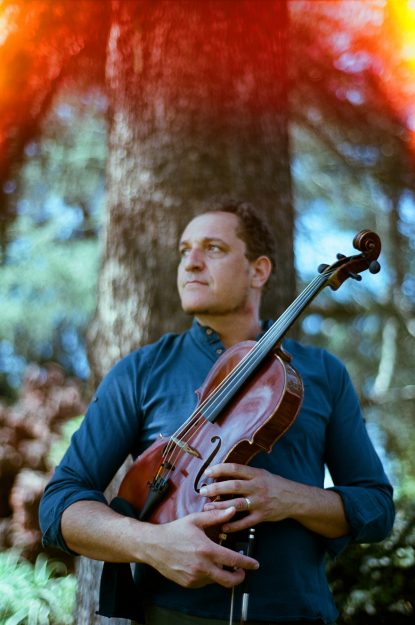
For the Ananta project, Atwood-Ferguson began by choosing fourteen songs to explore and reimagine and making lists of musicians to reach out to. The first recordings involved two sessions of five different players, after which he surmised where he wanted to overdub color percussion and his harp and string arrangements, as well as additional soloists. “Overall, all of these choices existed to serve an overall balance and energy to the album,” he says. “It was very important to me to have a variety of colors and emotions to show as many sides of John Coltrane as I could.”
In the past two decades, a new generation has started engaging deeply with John’s (and Alice’s) music, and there has, of course, also been a revival of the wider “spiritual jazz” tradition—admittedly, a rather vague, imprecise term that is often employed to describe a “vibe” rather than an actual spiritual element to the music itself. This is clearly not the case for Atwood-Ferguson and his comrades, even though you can practically smell the sandalwood incense sticks that were burning in the studio. The selection of the tunes feels totally intentional, the recordings expansive. What I find particularly successful is the inclusion of an original composition featuring spoken words by the Brooklyn-raised poet aja monet. Overall, the album reinterprets some of Coltrane’s classics and captures a vision of cosmic music that feels rooted in tradition, while transcending the “spiritual jazz” tag at the same time.
“It was very important to me to have a variety of colors and emotions to show as many sides of John Coltrane as I could.”
I can’t imagine that John Coltrane would be turning in his grave over this kind of tribute, himself being someone who kept pushing forward relentlessly until his untimely death. Even at the height of his success with the legendary Quartet, when he was already seen as one of the greatest players in jazz history, he kept collaborating with young musicians from New York’s free jazz underground. Toward the end of his life, he unsettled longtime fans with some of his most wild, expressive recordings. Asked what made him stand out from so many other legendary jazz musicians, Atwood-Ferguson says: “His ability to continually evolve deeply as a human and artist. The voracity at which he evolved is incredibly rare and I think led to his having numerous transcendent qualities in his emotional, spiritual, and artistic being.”
♦

Preorder Ananta: Spirit of Coltrane on Verve.

Thank you for subscribing to Tricycle! As a nonprofit, we depend on readers like you to keep Buddhist teachings and practices widely available.