Life Metal, a lauded 2019 record from experimental metal duo Sunn O))), opens with the sting of a goad, the wild-eyed whinnying of a horse, and the gathering thunder of hoofbeats. Though the sounds are muffled, as if heard from a distance through kicked-up dust, they call forth an uneasy apprehension. At first vague, the sense that something terrible might happen comes lurching into focus—and at just that moment, it does. At the volume this record is meant to be played, “chord” doesn’t precisely describe what I suddenly feel quaking the roots of my teeth. It’s a force, exposing a vulnerability in my flesh. The distortion sustains, flaring at the edges of control, before unfurling into a dirge-like riff, soon traced by a sepulchral incantation: Not forever on earth, only a little while here / Be it jade it shatters / Be it gold it breaks . . . Like a painting, we will be erased . . . We will come to an end.
Samvega is a Pali and Sanskrit word for the “quaking” of shock we feel when confronted with the frailty of our bodies and the grim certainty of impermanence. As Thānissaro Bhikkhu has described it, samvega encompasses not only such alarm but a chastening recognition of one’s own complacency and an urgent drive to make good use of this present life. Dharma teachers have long valued this feeling as the stinging goad that turns us urgently toward the Buddha’s wisdom and channeled it in their own pedagogies. As the first chord of Life Metal descends with its megalithic weight—and especially as its poem emerges from the fray—I feel a shuddering in my flesh that I’ve grown to recognize and savor as samvega. This is no coincidence. Sunn O))) is one of many metal bands in recent years who’ve worked Buddhist themes and references into the sonic extremes that define their genre, testing out metal’s potential to carry the dharma. Their record Kannon (2015), YOB’s Our Raw Heart (2018), and Dhyana’s Amituofo (2024) make clear how the confrontational aesthetics of metal might serve as an unlikely but potent vehicle for samvega, and thus for Buddhist wisdom. But what strikes me most is what they suggest about the value of this particular kind of feeling—shock and dread, perhaps lined with pleasure—in Buddhist life.
Depending on your orientation to Buddhism, the creative marshaling of such feelings to teach the dharma might seem counterintuitive. At least in North America, Buddhist teachings have often been marketed in soothing colorways and a neutral—somewhat flattened—emotional palette, aligned with a commodified wellness. In meditation retreats or mindfulness seminars, we’re often taught to distance ourselves from the hijinks of the passions. Shock, revulsion, and angst have rarely featured in this transmission—except perhaps as things to be avoided or cleansed with “mental hygiene.” But something is lost in that flattening. If the dharma has always known that discomfort can be a threshold rather than an obstacle, then the question becomes where, in contemporary life, we might find the goad that moves us.
The dharma has historically invoked distress precisely as an invitation—or challenge—to practice more robustly. These roots run deep. In canonical biographies such as the Lalitavistara or the Buddhacarita, it’s Siddhartha Gautama’s experience of samvega—shaking distress at the four sights of old age, sickness, death, and renunciation—that goads the sheltered young prince to leave behind the comforts of his upbringing in search of a penetrating perspective on suffering. In the Buddhacarita, the poet Ashvaghosha compares the prince’s agitation to the trembling reflection of the moon in troubled water, the shock of a bull who has heard crashing thunder nearby, or the anguish of a lion whose heart has been pierced with a poison arrow—metaphors for an intense embodied sensation, encompassing even pain, which literally moves Siddhartha to take up his quest. What a mentor of mine once called the prince’s “oh shit” experience turns out to be the very genesis of awakening.
If the Buddha is the model we’re to emulate, it’s good to experience samvega. In the Siha Sutta, the Buddha compares his teaching to the roar of a lion, shaking all the creatures of the forest into awareness of their mortality and a fearful urgency to do something. But while the dharma by its very nature should instill such feelings, the Buddha acknowledges elsewhere that some of us may need more intense stimuli than others to experience samvega for ourselves. It’s one thing to acknowledge in theory the truth of impermanence, quite another to register its quaking in our flesh.

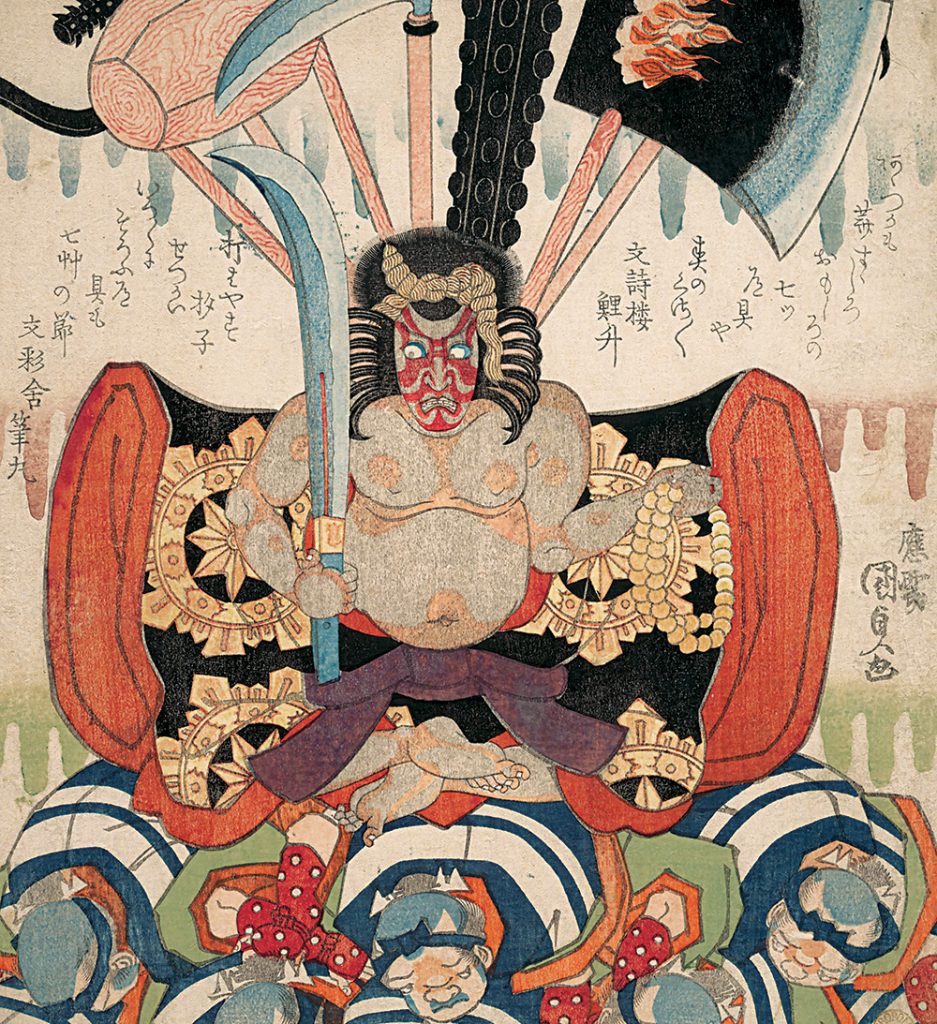
In the Patoda Sutta, the Buddha draws a sinister analogy between the pain required to spur a horse into motion and the proximity to sickness and death required to spur us toward insight. Some horses, he explains, need only to see the shadow of the goad to become agitated and spring into motion. Others need to feel it sting their coats before moving, while still others need to feel it prick their hides. A final class of horses needs to be whipped to their very bones before stirring themselves. Just so, some people need only to hear of a sickness or death in the next village to be “stirred and agitated.” Others need to see the infirm or the dead to be so moved, while others need the afflicted to be a member of their own families to experience samvega. In the final category are those who need to feel the encroachment of illness in their own bodies to be shaken toward the dharma.
The Buddha offers his own summary of what samvega, properly received, sets in motion: Stirred, he becomes appropriately resolute. Resolute, he both realizes with his body the highest truth and, having penetrated it with discernment, sees.
What does this sliding scale of susceptibility mean for dharma teachers? The Patoda Sutta extends the principle that teachers should adjust their method to the capacities of their students, here in the specific terms of samvega. Depending on the student’s sensitivity to evidence of their own impermanence, the astute teacher (or artist) will calibrate the degree of shock and dread accordingly: in some cases, confronting us with mere glimpses of old age, sickness, and death; in others, clothing reflections on impermanence in a wistful aesthetic; in still others, marshaling grievous or horrific imagery to put the twang of samvega into our bones.
These approaches surface across Buddhist traditions in art, performance, and embodied practice. The melodic lines of Cambodian dharma song bring lyrical confrontations with impermanence into sharp focus. We might detect the shudder of samvega in Japanese courtly poetry and Noh theater, with their evocations of the transience of things. Temple-run amusement parks in Thailand and China, meanwhile, bring accounts of the torments of hell realms into riotous three-dimensional display, awash in blood and guts.
Each of these examples carries a different intensity of affective charge, yet all of them work to render the abstract truth of impermanence into a felt, embodied conviction—in other words, to be transformative. This is the continuum of dharma teaching in which recent experiments in Buddhist metal take their place. The aesthetic continuity between a Khmer dharma song narrating the baleful decay of the listener’s corpse and Sunn O)))’s invocation of bodily impermanence on “Between Sleipnir’s Breaths” is striking—the chief distinction being the latter’s accompaniment by the tectonic force of a wall of amplifiers. Coincidence though it may be, the sounds of whinnying and hoofbeats that embellish that recording even imply the sting of the Patoda Sutta’s goad.
Life Metal’s opening track is one vivid example of the shuddering resonance between Buddhist shock tactics and contemporary metal. There’s also Gorguts, whose 2013 record Colored Sands is shot through with allusions to Tibetan wrathful deities; the Taiwanese outfit Dharma, who chant sutras and mantras over turbocharged riffing; and Agriculture, who deliver koan-like riddling amid blistering noise on the 2025 song “Bodhidharma”—among many other examples.
The term samvega remains relatively unknown in Western Buddhist circles outside some Theravada-inspired communities—it’s rarely a stated aim of teachers, translators, and artists, and I doubt it’s an explicit target of any of these bands. Yet it would be difficult to spend time with the dharma and not occasionally sense the Buddhist penchant for shock and dread. For an artist already working with such tonalities, those traces of samvega are bound to stand out.
Three recent metal records strike my ear for the depth and ambition of their engagement with the heavy side of the dharma. On Our Raw Heart, Portland doom metal band YOB foregrounds personal experiences of impermanence in a song cycle of uncommon emotional force. Sunn O)))’s Kannon takes a more ceremonial—but no less excoriating—approach in its invocation of suffering and compassion. And on Amituofo, Louisiana-based solo project Dhyana transforms extremes of volume, saturation, and duration into an absorbing meditation on sense and space.

Since the late 1990s, YOB’s discography has been threaded with nods to the dharma. Catharsis (2003) features a Buddha image on its cover. The Great Cessation (2009) lays the groundwork for its onslaught of exhilarating psychedelia with a field recording of Tibetan Buddhist chanting. And Clearing the Path to Ascend (2014) introduces its tumult with a recording of Alan Watts coolly telling us “It’s time to wake up.” There’s a skyward tilt and expansiveness to all this music that points toward a spiritual motivation—perhaps grounded in frontman Mike Scheidt’s long-standing exploration of meditation practices, Buddhist and otherwise. This is most evident on 2018’s Our Raw Heart, which was informed by the frontman’s navigation of painful personal experiences.
In early 2017, Scheidt was diagnosed with a gastric illness that developed into severe diverticulitis. Numerous surgeries brought crippling pain, hallucinations, and the threat that—if not his life—the frontman might lose his voice. Scheidt had engaged in meditative practices for years but suggested in a Bandcamp article that they met their fullest purpose amid this ordeal: “I’d anchor myself in a mindfulness practice, or practice a mantra, and things would either lighten up or dissipate altogether.” When he had recovered some strength, songwriting with bassist Aaron Rieseberg and drummer Travis Foster became another way to refocus.
The result is Our Raw Heart. Each of its seven lengthy tracks marshals the punishing churn of doom metal toward something more emotionally complex—and it’s this range of feeling that sets it apart. Its first track, “Ablaze,” opens on a searching note: As we muse in the fray / The source ever remains / Shining / As it all falls away. Angular chordal explorations shift into the stuttering, martial lurch of death metal, intricate grooving, and then an echoic, meditative reflection—setting the stage for the record’s centerpiece, “Beauty in Falling Leaves.”
The song turns explicitly to impermanence in a sixteen-and-a-half-minute meditation that’s wistful and colossal in equal measure. Delicate arpeggios and Scheidt’s wail give tenderness to even its most ribcage-rattling passages: Endless worlds in endless mind / Caught in dreams of our own design . . . All around you the infinite / Seeing / Beauty in falling leaves. This is metal at an unusually emotive register, offering insight won from pain, at once brutal and therapeutic, unsettling and affirmative. Our Raw Heart gathers its force from a transparent embrace of the Buddha’s four sights and belongs, I think, in any canon of samvega.
It’s one thing to acknowledge in theory the truth of impermanence, quite another to register its quaking in our flesh.
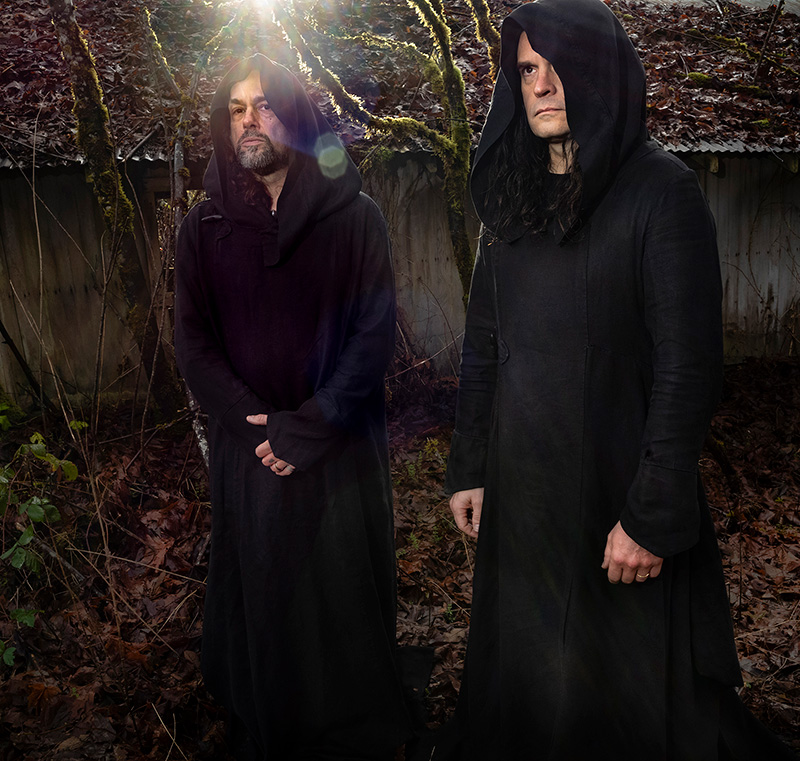
Where YOB takes a first-person, experiential approach, Sunn O)))’s 2015 record Kannon explores dharma more formally, as an invocation. The band is no stranger to ritual or Buddhist teachings: They’re known for choreographed live “actions” in hooded black robes amid heavy fog, unleashing solemn progressions with movements suggestive of supplication, and their core lineup of Stephen O’Malley and Greg Anderson often perform as “Shoshin Duo,” referencing the Japanese expression for “beginner’s mind.” A 2021 live recording is titled Metta, Benevolence, and a track on their most recent, self-titled LP is named after the Tibetan monastery Mindrolling. On Kannon, they go deeper into these tendencies, with three hymnlike tracks dedicated to the bodhisattva of compassion.
Here, named in Japanese and appearing in her female manifestation, Avalokiteshvara is called forth over the record’s three tracks in lyrics that depict her as fierce as she is merciful, Vowing to never rest / Despite strenuous effort. The compositions approach the meticulous grace of sacred music: more concise and melodically driven than much of Sunn O)))’s repertoire, channeling their superdense bottom end, metallic sheets of guitar noise, and synthesized sonorities into awesome interplay with vocals by metal legend Attila Csihar. Opening with a trancelike processional, Kannon gathers intensity as Csihar’s vocalizations develop from corpse-like groans to intoned plainchant to the searing shriek of “Kannon 3.” The record closes on an incandescent major chord whose force—sustained over half a minute—seems to cause its own substance to tremble. It’s as though we’ve witnessed the incantatory summons of an uncomfortably powerful being.
Kannon relates itself to traditional Buddhist narratives and teachings and even approximates the summoning, offering, and releasing template of esoteric Buddhist ritual. But its most compelling dimension is the exploration of Avalokiteshvara as a being who embraces, bears, and transforms suffering. In her liner notes to Kannon, conceptual artist Aliza Shvarts asks, “What’s metal about mercy?”—a question tacitly answered in Csihar’s characterization of Avalokiteshvara as The tiger who feasted [on death]. Elsewhere, the bodhisattva appears as a musician with the power to [destroy] mortality and [turn] hell into paradise. Just as Avalokiteshvara—the one who contemplates the sounds of the world—is merciful to the degree she can absorb terror, pain, and even mortality itself, Sunn O))) confronts us with sounds that register in the body as discomfort and dread yet transforms them into passages of grace and refinement. The challenge the record poses is to find, in our uncomfortable experience of the “sounds of the world,” the moment where we can realize beauty from—or perhaps with—them.
Where YOB works from personal experience and Sunn O))) from ritual invocation, the more recent and enigmatic Dhyana brings metal to bear—as its name suggests—on meditation. Since their 2021 debut record Bodhisattva, the Louisiana-based solo project has released at least one full-length offering per year on Bandcamp, with titles such as Dzogchen and Shikantaza, drawing what they call “meditative sludge/dharma doom” into direct dialogue with Buddhist contemplative traditions.
Dhyana works in metal subgenres already recognizable as “meditative.” Their patient manipulation of vast, fuzzed-out slabs of guitar distortion nods to drone metal pioneers Earth, whose seventy-four-minute magnum opus Earth 2 sardonically quotes listeners transformed by sustained tone: “When I got up, I could swear I was a few inches off the ground!” Their groovy yet brutal rhythm section, meanwhile, recalls the stoner rock and doom metal of OM, well-known for invoking Buddhist and other contemplative practices in tracks such as “State of Non-Return.”
Within Dhyana’s discography, Amituofo realizes an exceptional degree of concentration. Named for the Buddha Amitabha, this single fifty-nine-minute track is spacious and difficult to describe—especially at full volume, where its almost imperceptibly slow development resists easy overview. What happens in the music emerges unhurriedly from a thick mass of guitar sound that grounds the entire hour in a constant yet shifting presence. Progressions ripple out from the drone: simple riffs forming out of sonic matter, here and there ornamented with airborne guitar solos like smoke on a breeze, ultimately fading back into Amituofo’s atmospheric rumble.
This vision of Buddhist metal is less evocative of samvega than of certain meditative insights. To my ear, it’s about holding patient focus on the constancy of change, which—paradoxically—becomes a source of stillness. This is all the more impressive since there’s nothing gentle about this music. It’s relentlessly loud and heavy, and includes moments of wickedly enjoyable rock ’n’ roll.
Whatever dose of samvega these records deliver, there’s often—in the same gesture—an element of pleasure coursing through them. This doesn’t square easily with the Buddha’s teachings: The point of the Patoda Sutta isn’t to delight in the sting of the goad but to let recoil transform into insight and urgent action. Yet even the most traditional meditations on samvega also carry their own aesthetic charge. No matter how bitter the truths expressed in Ashvaghosha’s evocation of the four sights, the sinuous lilt of a Khmer dharma song, or the rolling thunder of a YOB track, there’s an undeniable gorgeousness to all of these—a complex beauty that can be savored at the same time as it strikes instructive dread into us.
How might this vibration between angst and delight—which metal’s sonic excesses seem so well-suited to deliver—be spiritually valuable? The risks of too much pleasure should be familiar to any student of Buddhism, and neither the dharma nor metal achieves its galvanizing effects without substantial discomfort. But too much pain risks turning us against the world, nourishing a cold asceticism that refuses to engage with life in all its brutality and beauty. Finding a measure of enjoyment in even the most existentially difficult experiences—in the “sounds of the world,” replete with suffering—keeps us in a living, transformative relationship to being.
The dharma and metal find each other in a place where heaviness becomes affirmative—locating us in our mortal, quaking flesh precisely to make us more alive. Like the dharma at its heaviest, metal at its best confronts us with darkness not to double down on the unbearable but to make us better at bearing it—more joyously, perhaps. The title Life Metal, it turns out, describes the dharma as aptly as it describes the genre.

Thank you for subscribing to Tricycle! As a nonprofit, we depend on readers like you to keep Buddhist teachings and practices widely available.