
An endless road appears and disappears in front of me as the sun rises, illuminating a distant village with an amber glow. I am walking the Camino de Santiago, an ancient pilgrimage route beginning in the foothills of the Pyrenees in the quaint picturesque village of Saint- Jean-Pied-de-Port, France. About 500 miles west, in Santiago de Compostela, Spain, lie the relics of Saint James, or Santiago, in Spanish. The Camino gained popularity during the Medieval Ages when more than a quarter million Christian pilgrims would walk it annually to admonish their sins. The funny thing is . . . I’m Buddhist.
One may think that a Catholic pilgrimage to the remains of a saint is a strange place for a Buddhist to end up. I might have agreed with you, especially on the first day, when I was trailing a priest for about five kilometers. Upon passing him, he stopped to pray for me, Bible in hand. I figured an extra prayer or two couldn’t hurt, but it did get me thinking, wait . . . why am I walking the Camino? Shouldn’t I be in Bodhgaya or maybe circumambulating a Buddhist stupa somewhere?
An hour after my interaction with the priest, I found myself alone on the seemingly endless road to Santiago. I had considered walking the Camino de Santiago only after first learning about it from my neighbor a year earlier, and because I was living in Spain as an English teacher, I had the summer off to explore. I asked myself again, “I could be on a beach somewhere instead. Why am I walking?” halfway hoping the Camino would respond.
The next morning, I noticed a boulder on the hillside painted with the question, “Why are you walking?” A great question for any person to ask, I decided, and with a shrug, I did what any pilgrim would do and kept walking.
Discovering Pilgrimage
Going on a pilgrimage invites us to look deeper, as we leave behind the daily routine of our lives and connect with our inner and outer journey, often following in the footsteps of countless seekers before us. While the term “pilgrimage” is most commonly described as a journey to a sacred place, I began to question the true meaning of pilgrimage. What if pilgrimage was actually every step of the way? How does it differ from simply going on a long walk?
I remember an interview that Oprah Winfrey did with Thich Nhat Hanh. She asked the Vietnamese Zen master, “Do you meditate every single day?” He smiled and said, “We try to meditate not only every day but every moment.”
At this point in my life, I was fairly new to meditation. It was 2016, and I was at the tender age of 23. I was living in Ibiza, Spain, teaching English and understanding what it meant to be on my own for the first time. I knew I wanted to learn about meditation, so when I found a flyer that said, “Thank Buddha it’s Tuesday – Weekly Meditation Group,” I was intrigued. I made the weekly pilgrimage to the other side of the island on my Vespa to practice meditation in community. A small group of us would gather in a circle, letting go of our to-do lists and busy minds, noticing the movement of breath in the body. Again and again, I’d come back to my breath, allowing myself to drop into present-moment awareness. With each passing week, my intrigue transitioned into trust and gratitude. But the concept of meditation in every moment was a lofty aspiration. Sitting for a fifteen-minute practice still felt like an eternity.
If there’s ever a time and place to practice this mindfulness stuff, it’s while I’m walking across an entire country on an ancient pilgrimage, I thought. A week into the pilgrimage, I was serendipitously given a book from a fellow pilgrim on the trail, Silence: The Power of Quiet in a World Full of Noise by Thich Nhat Hanh. Inspiration soared. Thay’s words landed with such precision:
“Breathing mindfully and becoming aware of your responses to people and events around you is a deep practice. Instead of reacting, instead of even thinking, you allow yourself just to be. You practice mindfulness to be with your breath, your steps, the trees, the flowers, the blue sky, and the sunshine.”
I took it as a sign to go into silence as I walked.
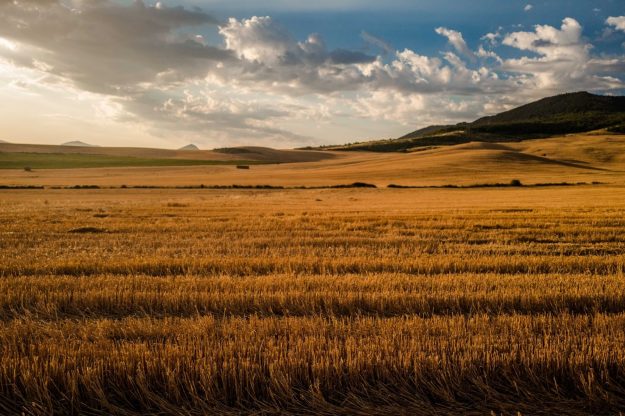
I began to notice things as if I were experiencing them for the first time, my mind settled by the steady crunch of earth beneath my feet. The dirt road ahead glowed a dusty red-orange under the afternoon sun. On either side, endless rows of grapevines hung heavy with purple grapes, ready for harvest. In the distance, an old man moved slowly across a field on his tractor. Sweat rolled down my cheek, and the air smelled faintly of earth and grapes. Memories flickered in and out between the vineyards, a meditative rhythm that comes after hours alone on the Camino. With each breath, life felt simpler. For the first time, I felt deeply at peace in the present moment.
The Camino Provides
Traditionally, albergues, or pilgrim’s hostels, were run by monasteries, churches, or local communities as a way of supporting pilgrims on their journey. Many albergues offer a communal atmosphere and foster a sense of sangha, often with a shared dining area and dorm room setting that can range anywhere from four to one hundred beds per room. Because, do you really know someone if you haven’t heard them snoring?
One afternoon, I arrived at the albergue where I would stay that night. There, I met a group of Italians who were wildly expressive with their hands and faces. A chuckle escaped me as I listened to their stories, feeling as if my whole being was lighter, unrestricted by the usual distractions of daily life.
The Italians decided that they’d make dinner for everyone, because, well, they’re Italian and that’s what Italians do. I was grateful and walked with them to the singular market in this tiny village. When my new friends couldn’t find what they were looking for, the old woman working at the store tried to help them. Two babies, probably her grandchildren, crawled around by our feet. Because of the language barrier, they couldn’t understand what the other was saying. The Italians began to speak louder, their hand gestures more wild. Confusion had reached an all-time high when the woman began to laugh uncontrollably at the situation. The Italians froze, first looking at one another and then back at the woman who was laughing so hard that tears were streaming down her face. Then, we all began to laugh. The whole store burst into laughter just at the sound of our own laughter. The wave of gladness was impossible to ignore. After some time, we found what we were looking for and returned to the albergue.
“The Camino provides,” a pilgrim once told me. “It’s this weird thing that starts to happen . . . you’re walking along in need of some help, like a knee brace, or whatever, and bam! Just like that, the right person comes along and, without being prompted, says, ‘Hey, I have this extra knee brace if you want it.’ Or you’ll be wrapped up in some deep processing when you see some graffiti that says exactly what you needed to hear.” I laughed because that’s what happened to me, and the more time I spent walking this pilgrimage, the more I began to embrace the truth of this statement. Some call it “Camino magic.” It’s almost like, as spiritual seekers, we are protected by an outside force.
Later that evening, the Italians cooked us a beautiful dinner, filling the air with the smell of garlic and fresh tomatoes. We gathered around a long table, savoring the pasta and Spanish red wine, our muscles sore from walking and our faces sore from smiling. It was then that I realized how incredibly healing it can be to be fully available to the aliveness of right now. Our minds can spin out thinking about what we have and don’t have, insecurities and defenses, but instead we are choosing to see how interconnected we really are. The simple fact is that we all want to be happy, safe, and at ease. What a relief to know that we’re all in it together.
Like rivers converging into the ocean, nearing the end point of the pilgrimage, I merged into groups of eager pilgrims, all of whom walked varying distances to arrive at this very place.
Letting Go
Much like attending a meditation retreat, pilgrimage is a time to let go of the constant demands and overstimulation of our daily lives. When on a pilgrimage, one carries only the necessities, packed in a backpack.
At the onset of my journey, the weight of my backpack was a huge burden. Half the time, I felt like I was nearly falling over because of the weight of it. Gradually, I realized how little I actually needed. In life, we accumulate excess much in the same way—half-read books on overflowing shelves, cluttered junk drawers, overstuffed closets packed with clothes. This pattern also extends to the mental and emotional aspects of our lives where unnecessary worries, elaborate plans, and enticing fantasies take up space in our minds.
By the end of my pilgrimage, my backpack felt surprisingly lighter. Not only did I let go of the things I didn’t actually need but I also shed the mental weight of constantly clinging to the past or worrying about the future. I was practically skipping to Santiago on the last day of the pilgrimage.
The Path Is the Goal
The much-anticipated moment was just within reach. Like rivers converging into the ocean, nearing the end point of the pilgrimage, I merged into groups of eager pilgrims, all of whom walked varying distances to arrive at this very place. We passed through a tunnel just before the famous Plaza del Obradoiro as Galician bagpipes played in the distance.
The nerves kicked in, and my stomach fluttered with excitement. I looked down at the familiar sight of the movement of my shoes until I reached the far side of the plaza to get a full view of the Cathedral of Santiago de Compostela. I closed my eyes, took a deep breath in, lifted my head, and opened my eyes as I exhaled.
The cathedral filled my field of vision, with scaffolding covering half of the structure and ominous rain clouds as its backdrop. I stopped and fully took in the last moments of my monthlong pilgrimage, all of the emotions swirling around in my chest: delight, exhaustion, relief. I began to cry, unsure what this moment meant. Then I shrugged off my backpack until it hit the ground with a satisfying thud. I couldn’t help but shake the subtle ache of disappointment that the final moments of my pilgrimage didn’t quite encapsulate the fullness of the entire journey. Dukkha, I laughed as I cried, wiping away my tears with my shirtsleeve. I finally understood the phrase “the path is the goal.”

Thank you for subscribing to Tricycle! As a nonprofit, we depend on readers like you to keep Buddhist teachings and practices widely available.