A few years ago a friend of mine taught me the expression “moving up in the world.” Probably many of us have experienced the thought that we were moving up in the world, perhaps because we bought a new vacuum cleaner or a new toothbrush. When that happens, we can be almost ecstatic for a few minutes or, if we are really lucky, maybe for half an hour. We may also be doing spiritual practices such as meditation, yoga, or even Buddhist-oriented meditations to quiet our mind and help us feel joy and wellness. This is very good, something that we should welcome, but those practices may not make us happy in the ultimate sense. In my tradition, the Tibetan tradition, they say that the only way you can be happy in the true sense is to experience this thing called equal taste. How does that sound? It might not sound interesting if you are going to a restaurant. We don’t want to experience equal taste at a restaurant.
This phrase “equal taste” is an analogy of course, an analogy used to describe a profound, extraordinary experience that we can all have access to. It is an experience of some kind of equanimity in which we are no longer lost in our hopes, fears, anger, or anxiety. We are no longer reacting to life’s situations. We are simply embracing whatever is unfolding in front of us. We are experiencing something like all situations as having the same flavors, the same taste. It’s almost like we are experiencing that the taste of death is the same as the taste of birth. It’s almost like the taste of losing our possessions is the same as the taste of gaining this and that. When we experience this, it means that we are no longer lost in our preferences, no longer lost in this trap of fear and expectations.
In my tradition, they say that this equal taste is pretty much the only secret to absolute, unconditional happiness. Until we experience that, we will not know what unconditional happiness is. All of our happiness and joy is transient, changeable, and reversible until we know how to access this state of our own consciousness. Sometimes we might think, “Oh, it would be really nice to know this thing called equal taste.” Then we try to practice meditation and all kinds of techniques, hoping that someday we can understand the equal taste that Tibetan teachers talk about.
Personally, as many of you know, I have been walking the spiritual path for many, many decades. I have learned from personal experience that you cannot force yourself to be liberated. It is not an easy endeavor. I feel I am a new student rather than a master in this field. It is a lifelong journey that humbles me again and again. What you need is some kind of surrender, humility, and devotion. You have to have an open heart, a heart open to something greater than your own ego, your own personality.
The idea of opening the heart beyond your own self reminds me of a rather ordinary event that happened not so long ago. I was flying to a meditation retreat I was leading, and I happened to open the shade on the airplane window to an amazing sight. The plane was flying above a thick layer of white clouds, and the sun was reflecting off those beautiful clouds. It was glorious, and I was very moved. I felt an amazing, heart-opening devotion to the beauty of the world and the beauty of existence. I also felt a powerful feeling of devotion to Tara, a female buddha. In the Mahayana tradition Tara symbolizes universal compassion. Tara is not outside; she is within each of us. She is a symbol of the universal compassion that lies at the core of our being. I felt such incredible inspiration and devotion that I wrote a poem or hymn in Tibetan to Tara, the embodiment of the divine. When I went back and read the poem that I had composed, I recognized that this was the true voice of my own heart. There is a lot of surrender in the poems that I write! Basically, in these hymns I recognized that sometimes I can’t liberate myself; I can’t enlighten myself. I can’t force myself to experience this thing called equal flavor, equal taste that is the secret of unconditional happiness. So I was praying to Tara to please help me overcome all of my inner resistance and help me experience this awakened mind that realizes the same flavor or equal taste.
Perhaps many of you use prayer in your life. You don’t have to be religious to pray. Prayer is an act of surrendering and trusting something much bigger than your own ego, bigger than your own personal will. When you read Tibetan spiritual liturgies, you find that they are filled with aspirations and prayers. “May I experience this equal flavor.” We may need to use inquiry to find out what our resistance to experiencing this equal flavor, this equal taste is.
There are many extraordinary mystics, mahasiddhas such as the Tibetan yogi Milarepa, who live in this spirit of equal flavor. There is a story about a Zen master who was meditating near a village. In this village, a young woman had an affair with a young man and she got pregnant and gave birth to a child. But having a child out of wedlock was shameful in her culture, and she couldn’t really tell anyone who the father of the child was. Finally, she said that the monk was the father of her child. He was an easy target; perhaps she felt safe with him. Her family and all of the people of the village approached the monk and said, “Oh, we thought that you were a noble being, but you are not. This is your child.” The monk didn’t try to argue or clarify. He said, “Is that so?” He took the child and became an amazing, kind, and responsible father, dedicating all of his time and effort to taking care of the child. Some years passed, and the woman finally had the courage to tell the truth. She told everybody that the father of the child was somebody else. Her family and all of the villagers became very excited. They went to the monk and said, “We are so sorry. We made a mistake. Now we are going to take the child away from you.” This would be very painful for someone who has been taking care of a child and developed a close affinity with them. The monk didn’t resist. He said, “Is that so?” This famous anecdote points out the extraordinary inner freedom of a freed consciousness in which all conditions, all circumstances are the same. We no longer have preferences. We no longer have fear and expectations.
What is the resistance to having such inner freedom? When we look inside, we often find a deep-seated desire to have complete control over our life. This ingrained impulse governs our everyday life and our relationship with the world. The truth is that we do have limited control over our life. For example, tonight you can cook anything you want for dinner, and when you go to the store, you have choices, you can buy this or that. It may seem that we have a lot of control over our life. We have a choice about who we are going to be with, who we are not going to be with. We can decide what we are going to wear. We can choose to continue sitting, or we can get up and dance ecstatically. Ultimately, however, we don’t have control of our life. For instance, we have no control over our death. Someday we are all going to die. We don’t know when we are going to die, but we all know intellectually that we are going to die. Not one human being in all of our history has been able to escape death. Everyone dies eventually. If we live a long life, then we are going to age. We have no control over our aging. We have no control over our bodies. We don’t know when we are going to get sick. We also don’t know what event we are going to confront within even the next few hours. Anything can happen in our life in the next few hours. Life is always reminding us that we don’t have absolute control over anything.
Every morning when we wake up, we may want to remind ourselves that we have no absolute control over our life and, in spite of that, welcome the day with an open heart. We may want to remind ourselves that we are going to invite the whole day with an open heart and with courage, even though we don’t know what we are going to encounter. We may encounter beautiful, pleasant surprises, or we may go through tragedy, even catastrophe. Somehow we are living under this illusion that we can control life, and whenever we feel that we are losing control over our life we feel anxiety and anger. We are challenged and shaken to our very core.
It might be wonderful if we all prayed now and then. Prayer is a very powerful method. It is a means of inner liberation. Sometimes prayer is our last resort. If we have been walking the spiritual path, trying to become awakened, there may come a point when we realize that we can’t force ourselves to experience this thing called equal flavor. Then prayer is our last resort. Prayer is an act of surrendering and opening our heart, trusting something that is much greater than our own personality, our ego.
There is a deep impulse in each of us that knows how to pray. We don’t have to recite traditional prayers. We can all compose our own prayers. Did you ever have the experience when you were in trouble or when you were confused, that you naturally started praying? Maybe you didn’t know that you were praying. Maybe you didn’t have any concept of who you were praying to. There are some traditions where you have someone divine or sacred that you pray to. There are other traditions, nontheistic traditions, where you pray but you are not praying to anybody. When we are struggling with anything in our consciousness, we can always pray, remembering that we don’t have to be religious or Buddhist to pray. We can ask the universe, “May I have the readiness to overcome my fear.” Or if we are struggling with resentment, we can pray to the universe to help us overcome that. Praying to the universe is a very safe thing to do. We can ask the universe to bestow a shower of blessings on us and help us to overcome our inner demons of resentment, fear, and anger.
In the act of prayer, you can feel yourself surrendering all your hopes and fears, and you are freed from your resistance to accepting that you have no control in life. You feel true humility, in which you’re no longer trying to be in charge, but letting life itself be in charge. Let yourself recognize that this is the highest freedom you can have. Try to live that freedom every day as much as you can. There will be moments in your life when you will feel that you don’t need that freedom, but as humans we are going through ups and downs, and in some moments freedom will be the only refuge you have. We human beings are extremely resilient and strong—we have the capacity to be openhearted and to surrender in any situation. It is our innate potential. Let’s use it.
◆
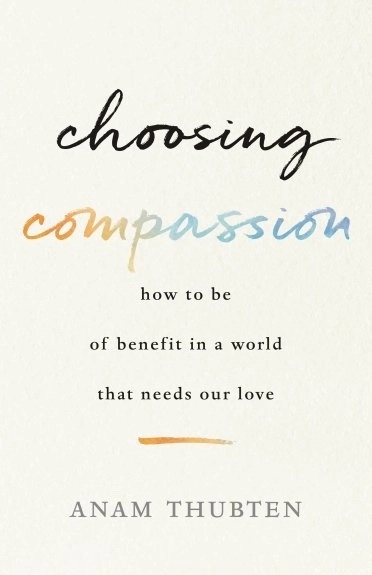
From Choosing Compassion: How to Be of Benefit in a World That Needs Our Love by Anam Thubten. © 2019 Anam Thubten. Reprinted in arrangement with Shambhala Publications, Inc. Boulder, CO

Thank you for subscribing to Tricycle! As a nonprofit, we depend on readers like you to keep Buddhist teachings and practices widely available.