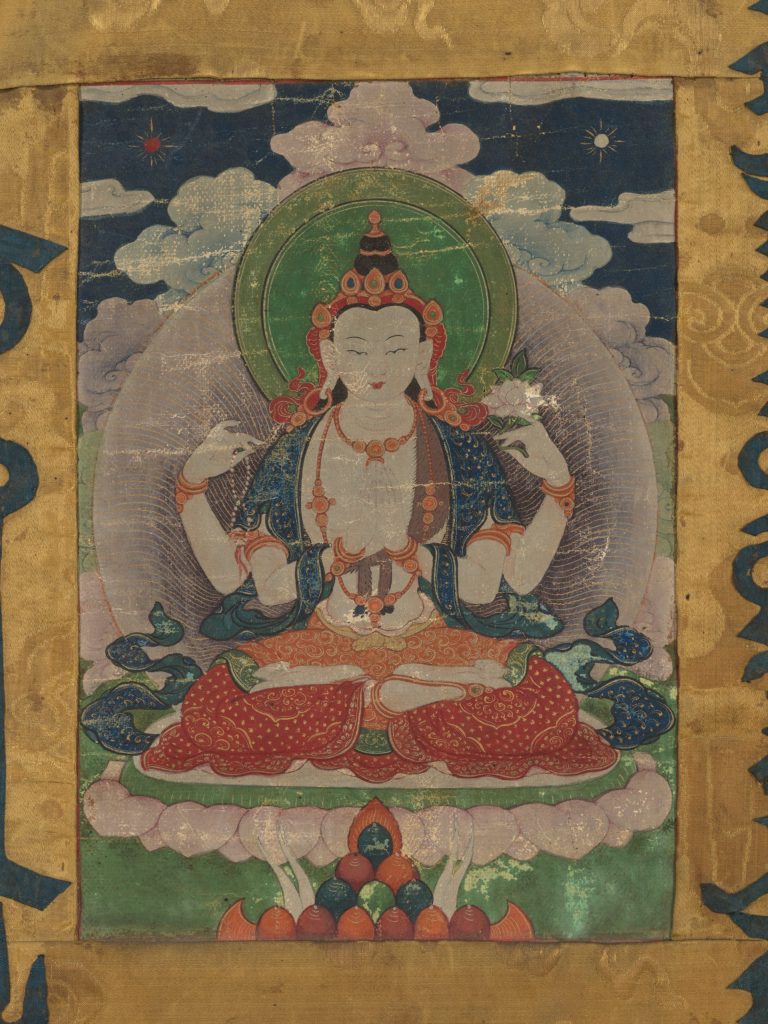
Nāmo Lokeśvaraya!
You see all phenomena as devoid of going or coming,
yet you strive single-pointedly for sentient beings’ welfare.
O supreme guru and lord, Avalokiteśvara,
I pay homage to you at all times through my three doors.
The fully enlightened buddhas, the source of all benefit and happiness,
emerge from cultivating the sublime Dharma, which, in turn,
relies on the knowledge of how to practice it.
So I explain here the practices of a bodhisattva.
1. When the great ship of human existence has been found,
it’s the practice of a bodhisattva to engage without distraction,
day and night, in study, contemplation, and meditation,
so that they may help liberate self and others from samsara’s ocean.
2. Toward our loved ones, attachments flow like streams of river;
toward our adversaries, anger blazes like a raging fire;
they trap us in delusion’s darkness, causing amnesia of moral norms.
So it’s the practice of a bodhisattva to shun our native place.
3. Having shunned unhelpful objects, the afflictions are gradually
reduced;
with no distraction, virtuous practices enhance in their own accord;
with clear and fresh mind, ascertainments of Dharma arise.
So it’s the practice of a bodhisattva to seek a place of solitude.
4. We will be separated from the loved ones of long time;
material resources gathered through much effort will be left behind;
this guesthouse body will be vacated by its guest, consciousness.
So it’s the practice of a bodhisattva to give up attachment to this life.
5. When associated with, the three poisons proliferate,
and cause the activities of study, contemplation, and meditation to
degenerate.
They make divorce us from lovingkindness and compassion.
So it’s the practice of a bodhisattva to shun negative friends.
6. When [a guru is] relied on, all faults come to an end,
and virtues increase like a waxing moon.
So it’s the practice of a bodhisattva to hold
sublime spiritual mentors dearer than one’s own life.
7. Trapped in samsara’s prison themselves,
how can the worldly gods save anyone?
So it’s the practice of a bodhisattva
to seek refuge in the Three Jewels.
8. The unbearable sufferings of the lower realms,
the Buddha said, are the fruits of negative karma.
So it’s the practice of a bodhisattva to never commit
negative acts even to save one’s own life.
9. The joys of the three worlds are like dewdrops on a blade of grass;
so fragile is their nature, lasting but a moment.
So it’s the practice of a bodhisattva to seek
the immutable state of liberation, most excellent.
10. Mother sentient beings who’ve cared for me since beginningless time,
if they are suffering, what point is my own happiness?
So it’s the practice of a bodhisattva to generate the awakening mind
for the sake of freeing limitless sentient beings.
11. All suffering comes from desiring happiness for ourselves;
fully enlightened buddhas arise from the heart that cares for others.
So it’s the practice of a bodhisattva to exchange thoroughly
one’s own happiness for the suffering of others.
12. Even if, out of greed, someone were to rob us
of our entire wealth or make others do so,
it’s the practice of a bodhisattva to dedicate to that person
one’s body, material resources, and roots of virtue.
13. If, without even the slightest justification,
someone were to chop off our head,
it’s the practice of a bodhisattva to take on oneself,
through compassion, the other’s negative karma.
14. Even if someone were to pronounce across the cosmos
all sorts of unpleasant stories about us,
it’s the practice of a bodhisattva to speak about
the virtues of such a person with a heart of lovingkindness.
15. If, amid a gathering of many people, others
dig into our flaws and utter insulting words,
it’s the practice of a bodhisattva to humbly bow to them,
with recognition of them as spiritual teachers.
16. Even if someone I have nurtured as my own son
were to view me as though I were their enemy,
it’s the practice of a bodhisattva to care especially for them,
just as a mother would for her sick child.
17. If someone who is equal or lower in status
were to try and belittle me out of conceit,
it’s the practice of a bodhisattva to honor them
with respect, 1028 just as one would with a guru.
18. Even if we become impoverished, constantly scorned by others,
assailed by grave illness and by harmful spirits,
it’s the practice of a bodhisattva to even take on
the suffering of all beings and remain undaunted.
19. Even if we come to enjoy great fame and are honored
by the crown of many and obtain wealth rivaling Vaiśravaṇa,
it’s the practice of a bodhisattva to see no meaning
in mundane excellences and remain free of hubris.
20. If we do not tame anger, the inner enemy,
outer enemies will keep growing, even as we defeat them.
So it’s the practice of a bodhisattva to tame one’s own mind
with the army of lovingkindness and compassion.
21. The objects of sensual desire are like salty seawater—
the more we consume, the more our craving increases.
So it’s the practice of a bodhisattva to instantly renounce
those objects that give rise to clinging and attachment.
22. All that we perceive is nothing but our own mind,
and mind itself is free primordially from the bounds of all
elaborations.
So it’s the practice of a bodhisattva to know suchness
and not bring to mind the signs of subject and object.
23. When met with something appealing to the mind,
though it might appear attractive like a summer rainbow,
it’s the practice of a bodhisattva to not view it as real
but to relinquish clinging and attachment toward it.
24. All the varied sufferings come from grasping as real
what is illusory, like the pain of losing a child in a dream.
So it’s the practice of a bodhisattva to view
an adverse condition as unreal when encountering it.
25. If one aspiring for enlightenment needs to give up even the body,
what need is there to speak of giving away one’s material things?
So it’s the practice of a bodhisattva to practice generosity
with no hope of reciprocity or of the reward of [karmic] fruits.
26. Without morality, if one’s own welfare cannot be achieved,
expecting to accomplish others’ welfare is laughable.
So it’s the practice of a bodhisattva to observe morality,
without no aspirations pertaining to samsaric existence.
27. For a bodhisattva who aspires to a wealth of virtue,
all perpetrators of harm are like precious treasure houses.
So it’s the practice of a bodhisattva to practice forbearance,
with no enmity whatsoever toward anyone.
28. One sees that even śrāvakas and pratyekabuddhas,
who seek their own welfare, strive as if their heads are on fire!
It’s the practice of a bodhisattva to cultivate diligence,
a source all good qualities, for the benefit of all beings.
29. Realizing that it’s insight endowed excellently
with tranquil abiding that utterly destroys the afflictions,
it’s the practice of a bodhisattva to cultivate meditative absorption,
which utterly transcends the four formless states.
30. Without wisdom, the five remaining perfections cannot
lead to attainment of full enlightenment.
So it’s the practice of a bodhisattva to cultivate wisdom
endowed with method and not conceiving in terms of the three
spheres.
31. If we do not examine our own illusions, we risk
doing non-Dharma in the guise of a Dharma practitioner.
So it’s the practice of a bodhisattva to constantly examine
one’s own illusions and then eliminate them.
32. If, out of afflictions, we speak of the faults
of other bodhisattvas, this could undermine ourself.
So it’s the practice of a bodhisattva to never to speak of
the faults of a person who has entered the Mahayana.
33. People dispute with each other over honor and resources,
which can undermine the activities of listening, reflecting, and
meditating.
So it’s the practice of a bodhisattva to relinquish attachment
to loved ones, home, and benefactors.
34. Harsh words can disturb others’ minds;
they can undermine the conduct of a bodhisattva.
So it’s the practice of a bodhisattva to relinquish
harsh words most unappealing to others’ minds.
35. Once habitual, the afflictions become hard to avert through
antidotes.
So when mindfulness and meta-awareness arise, hold firm the weapon
of the antidote.
The moment afflictions like attachment arise,
it’s the practice of a bodhisattva to level them right there and then.
36. In brief, whatever activities we might pursue in whatever place,
it’s the practice of a bodhisattva to examine
“What is the state of my mind?” and, being endowed at all times
with mindfulness and meta-awareness, work for others’ welfare.
37. All the virtue gathered through effort in these ways,
the practice of a bodhisattva is to dedicate them
for the benefit of limitless sentient beings, through
wisdom utterly pure with respect to the three spheres.
The points taught in the sutras, tantras, and the treatises
I have presented here, following the words of sublime masters,
in terms of thirty-seven practices of the bodhisattva
for the benefit of those who desire to train in the bodhisattva path.
As my intellect is weak and my expertise feeble,
this [work] may lack in prosody delighting the learned,
yet since it is grounded in the sutras and the words of sublime ones,
I feel [what I have presented] is indeed the unmistaken bodhisattva
practices.
This said, since the expansive deeds of the bodhisattva remain
beyond the comprehension of a feeble intellect like mine,
whatever faults, contradictions, and incongruity there are,
I ask forgiveness for these from the sublime ones.
Through the virtue emerging from this, may all beings,
through the supreme awakening minds, ultimate and conventional,
not abide in the extremes of either samsara or nirvana
and become equal to Lord Avalokiteśvara himself.
This was composed for my own benefit and that of others by the monk Thokmé [Sangpo (1295–1369)], a proclaimer of scripture and reason, in the cave known as Rinchen at Ngulchu.
♦

From The Bodhisattva Ideal: Selected Key Texts, translated by Thupten Jinpa and Julia Stenzel. © 2026 Institute of Tibetan Classics, reprinted with permission from Wisdom Publications, Inc.

Thank you for subscribing to Tricycle! As a nonprofit, we depend on readers like you to keep Buddhist teachings and practices widely available.