Khyentse Rinpoche woke up between four and five in the morning. He let me know he was awake by sitting up in his bed. I would then rise, roll up my sleeping bag, step out briefly to wash up and get dressed, then return to his side and turn on the light. I prostrated three times before him, then approached to receive his blessing. I removed and folded his blankets and put them away in a cupboard. I then draped Khyentse Rinpoche’s shoulders with a cape and brought him his prayer book of several hundred pages, which Rinpoche opened on a cushion placed before him. In the delicate jade cup that he used every day, I served him hot water from a thermos prepared the night before. I then opened a case containing vials filled with little pills made from medicinal plants mixed with the relics of past masters. These pills are prepared with care, placed around a mandala, and consecrated in the course of a drupchen, a ceremony that may last several days. If the ceremony is dedicated mainly to progress toward enlightenment, it will also include sections devoted to longevity and other beneficial qualities. The pills are therefore considered to be carrying the blessings generated by the ceremony. I put one of each kind into little vessels arranged on the table for Khyentse Rinpoche, and for his wife and Rabjam Rinpoche, and other lamas who happened to be present. There was one there for me, too.
Rinpoche then silently engaged in various meditative practices for the next two or three hours. I sat on the floor facing him, opened my own book, and applied myself to my daily practices and prayers, while also regularly refilling his teacup. At 7:30, he was brought a bowl of tsampa, the roasted barley flour that is a basic part of the Tibetan diet, mixed with salted butter tea. Tsewang Lhundrup then took care of Khyentse Rinpoche’s grooming, pulling his long gray hair into a little chignon. I had once tried to do this when we were at Dehradun to receive the Rinchen Terdzö teachings, but I was unable to twist the braid correctly so that the chignon would hold by itself. I was relieved of that task after a few days, the Bhutanese being far more dexterous than I am! We conscientiously preserved any long strands of hair that clung to the comb to give as relics to his followers.
Imagine that you were given a tunic worn by Socrates or a lock of Jesus Christ’s hair; these objects would certainly evoke the presence of those remarkable beings with great force. When people preserve the hair of someone beloved, this aid tangibly revives his memory. The relics of great sages of the past are not only pleasant keepsakes; they also reanimate in our mind the wisdom and infinite compassion of an enlightened being. According to the Dalai Lama, these blessings derive from an inner opening to a guru’s qualities that is generated in the presence of objects that connect us directly to him.
Toward 8:30 a.m., Khyentse Rinpoche would break his silence and go into the larger room to receive the visitors who had gathered at his door. In accordance with their requests, he would offer them spiritual instruction, practical advice, teachings, or a simple blessing. He consecrated sacred statues or paintings and met with visitors who had come from afar—pilgrims or messengers sent by other lamas—and exchanged news with them.
His grasp of the teachings and contemplative practices was such that it was impossible to imagine him being stuck for an enlightening answer to any question I might ask him.
When an important ceremony was on the schedule, Rinpoche went to the temple where the monastic community met; he stayed all day long, sitting on the main throne with his legs crossed. He remained seated during lulls in the ceremony and received visitors. When a student requested a teaching, he often asked her or him to return at lunchtime, when he ate his meal from a platter in the temple. While chatting with a visitor, he almost always shared his food, telling them to “eat, eat!” Then, opening the text containing the instructions that the student had requested, he began the teaching. His grasp of the teachings and contemplative practices was such that it was impossible to imagine him being stuck for an enlightening answer to any question I might ask him. And yet, Khyentse Rinpoche never called attention to his vast knowledge or his spiritual realization. Whenever he explained the various stages of the path and described the signs of spiritual accomplishment, he would stipulate, “I have never accomplished any realization myself, but this is how my spiritual teachers spoke of these signs.” During empowerments, he often said, “Right up to my own teacher, these teachings have been transmitted by a succession of fully accomplished masters, like the links in a gold chain.”
Khyentse Rinpoche was deeply gentle and patient, but his imposing presence inspired respect. You were loath to leave him and eager to return to him. Khenpo Pema Wangyal, a Tibetan spiritual teacher and student of Khyentse Rinpoche, observed that one is naturally attracted to someone whose heart brims with compassion, even as you are in reverential awe of the fact that he has fully realized the emptiness of phenomena. He recalled an anecdote about the great hermit Patrul Rinpoche. A student once said to him, “Some people love you, while others fear you and are barely able to say a word in your presence. Why is that?” Patrul Rinpoche paused a moment before replying: “Perhaps some people love me because I practice compassion and goodness nonstop. I scare others because I believe that the ego and phenomena are empty of inherent existence.”
In his wise benevolence, a spiritual teacher has no reason to tolerate the vagaries of students that only perpetrate their own suffering unnecessarily. I had direct experience of that. When Khyentse Rinpoche was kind enough to take me on in 1980, he treated me with uncompromising severity for some time. Nothing I did seemed to find favor with him. He scolded me if I set something down on the left, and if I set it down on the right he did likewise. It got to the point where his wife, Khandro Lhamo, finally said to him, “Why are you so strict with that boy?” Khyentse Rinpoche did not answer. Dabzang Rinpoche, a lama who knew my teacher well, told me, “Khyentse Rinpoche behaves that way with students who he believes can make progress. He never reprimands the others.” This “preferential treatment” continued for quite a while. Even if I didn’t quite grasp the whys and wherefores of his rigor, I sensed that it held a profound lesson that was beyond my everyday understanding.
When it came to the advice that every student needs to make progress, everything he proposed went straight to the heart of the matter, dispelled doubt, and opened new ways of seeing. His advice, often offered point-blank, gave us exactly what we required at that very moment, helping us avoid getting lost down blind alleys.
It might include suggestions about life choices, such as when he advised me to take monastic vows or to stay with him rather than take the first three-year retreat held in Dordogne. It was more often of a spiritual bent, directing me to undertake such or such practice at any given moment along my spiritual path. He also offered counsel about everyday affairs. For instance, I had chosen not to take antiparasitic medicine so as not to kill the solitary worm that appeared to have taken up residence in my intestines. Ani Jinpa, a Dutch nun, had gotten wind of this intrusion and reported it to Khyentse Rinpoche, of whom she was a close student. Rinpoche asked her to bring him the appropriate dose of medicine—a tall glass filled with a whitish liquid, which he placed on the table. The next day at dawn, he beckoned to me, held out the glass, and told me, “Drink!” I drank. He added, “Your human life is more precious than that of a worm.” The next day, he playfully asked me if we should call a monk to sound the conch that was usually used to summon the community to pray for a woman having trouble giving birth. It was his way of asking whether the worm in question had vacated my bodily frame.
♦
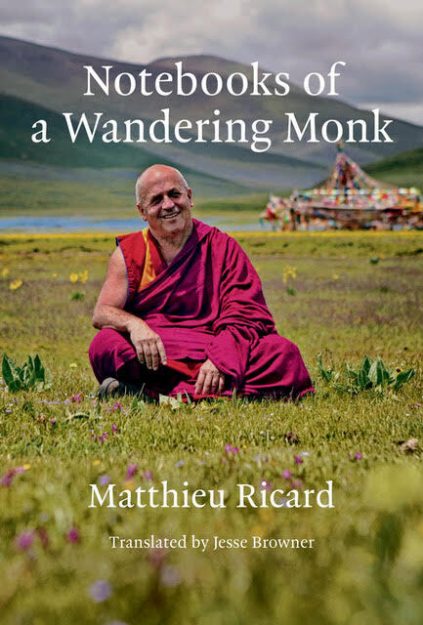
Ricard, Matthew, Jesse Browner (trans.), Notebooks of a Wandering Monk, © 2023 Massachusetts Institute of Technology, by permission of The MIT Press. Original French edition © Allary Éditions 2021.

Thank you for subscribing to Tricycle! As a nonprofit, we depend on readers like you to keep Buddhist teachings and practices widely available.