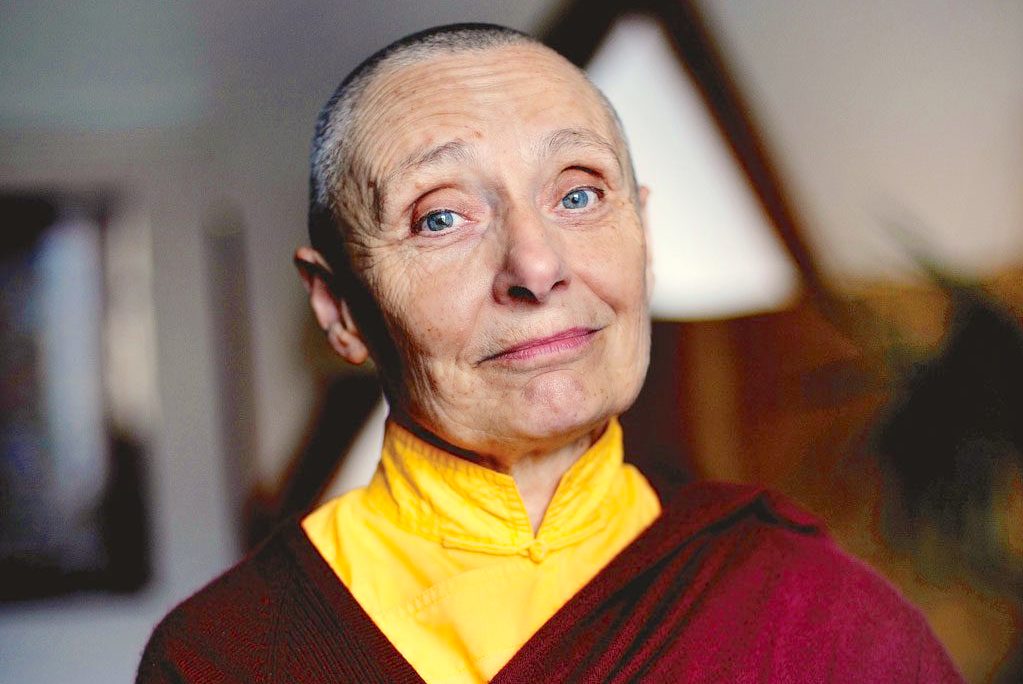
Jetsunma Tenzin Palmo, the renowned nun in the Tibetan Buddhist tradition, will lead us on a study of the Eight Worldly Concerns—which we might also call the eight anxieties or “hang-ups.” Jetsunma lists them as gain and loss, praise and blame, good reputation and bad reputation, and pleasure and pain. Overcoming our anxieties about these worldly concerns liberates tremendous amounts of energy for finding our true purpose in life, and our innate perfection.
Jetsunma Tenzin Palmo was born in London in 1943. When she was 20 years old she traveled to India, and soon after met her teacher. In 1964, she became one of the first Western women to be ordained as a Tibetan Buddhist nun. After twelve years of study and frequent retreats during the long Himalayan winters, she sought complete seclusion. She found a remote cave, where she practiced intensively for twelve years. Cave in the Snow: A Western Woman’s Quest for Enlightenment is the story of her life. Jetsunma Tenzin Palmo is a renowned champion for the rights of women to attain spiritual enlightenment. She is the founder of Dongyu Gatsal Ling, a nunnery in India. Learn more about supporting this groundbreaking nunnery here. Her newest book is Into the Heart of Life, from Snow Lion Publications. She recently visited the US to promote this book and the Endowment Fund for her nunnery.
ANNOUNCEMENT:
Hello Retreat participants,
Welcome to July’s Tricycle Retreat with Jetsunma Tenzin Palmo!
Because of Jetsunma’s demanding schedule, we ask that participants submit all questions for her each week by Wednesday at 1:00PM Eastern Time. Her responses will be posted each weekend, before the next week’s teaching begins.
Please feel free to continue to discuss the teachings throughout the entire week with one another.
best,
Monty McKeever
Tricycle
Dear Jetsunma Tenzin Palmo,
Thank you for the wonderful and inspiring talk. I always look forward to your talk and reading your books. You have been my teacher from a distance.
Regarding the talk, I have two questions:
During time of difficulties, we should take this as an opportunity to transform ourselves and build courage to face the problems. Do you have any advice how we should transform ourselves and build up courage?
If we are able to transform ourselves and build up courage, does wisdom arise (so we know how to solve the problems)?
May you live a long life and stay healthy so that you can teach us more dharma.
Best regards,
Bee Leng
A common problem that many people live with is a lack of self esteem – a low self image that says ‘others can do but not me’. We don’t believe in ourselves or in our ability to make progress and change. So we should listen to what messages we are constantly giving ourselves. Do we undermine or encourage ourselves? Actually we can do almost anything if we really believe that we can and put forth the required effort. So the crux is the conviction of possibility.
Personally I think it is important to remember that our inherent nature is filled to over brimming with wisdom, love and power. We already have all these qualities as our birthright but somehow they are locked away and we seem to have mislaid the key. We need to develop trust in our own abilities and innate understanding. Often in our hearts we know what we should do – but we lack the courage to act on this knowledge. But like anything else, this trust develops gradually with practice and slowly transforms into clear practical wisdom
Beautifully said. Thank you.
Would you please suggest practical ways to develop the trust, such as the example you give on listening to the messages we give ourselves.
With much appreciation for your generous teaching,
Susan
Perhaps we could set ourselves tasks that can actually be accomplished – like getting up half an hour earlier to meditate or keeping the Five Precepts (or as many as we can manage). Start by making the determination and then carrying it out. Nothing too ambitious. “From now on I will never harbour a single negative thought and will have only loving feelings towards all beings everywhere!” This only sets us up to fail. So look at your life and mind realistically and consider where improvement is needed. Gradually we begin to appreciate that we can progress step by step and so we gain confidence in our own potential through direct experience.
Is there a transcript available for deaf retreatants?
Hi Clanoneill,
We’re sorry to say, there are no transcripts available.
best,
Monty McKeever
Tricycle
Just because there aren’t transcripts or captioning available right now, doesn’t mean that you can’t add them. I would think that your magazine would want to make the dharma and the website available to all viewers, especially as inclusion and compassion for all people is central to Buddhism. Like the commentor above, I am disabled and it hurts to be shut out like this. Hope you will consider it.
thanks for the feedback nsgagnon. We do want everybody who is interested to be able to participate in these retreats and I think adding a transcript option would be great. I’ll see what I can do!
Thanks very much for being amenable to the feedback. I hope to see captioning on videos on here soon! _/_
I am happy to write the talk down if it helps. Pls. let me know
Thank you for this opportunity. 🙂
Hi Charuramesh, yes! What a generous offer! By all means, if you would like to transcribe the talks please feel free. The only guideline is that they cannot be published anywhere outside of this retreat. Also, I would appreciate being sent a copy (monty@tricycle.com).
This practice of participant transcription happened all throughout Thanissaro Bhikkhu’s retreat and it was great.
I would appreciate a copy as well. Thank you so very much.
Lynn
Ok, will send you the document and perhaps you can add it to the site wherever it fits best.
Sorry, it might take some time, though I will try to make is as quick as possible.
I read “Cave in the Snow” by Vicki MacKenzie in 1998 and was so amazed by Tenzin Palmo’s inner, spiritual quest. Her thirst for a path led by the Dharma. In 2002 I read “Reflections on a Mountain Lake” and absolutely loved the way Tenzin Palmo spoke about different aspects of Tibetan Buddhism. I look forward to reading “Into the Heart of Life”.
Thank you Tricyle for bringing Jetsunma Tenzin Palmo to life now (so to speak)…taking her off the bound pages and onto the screen in this “Eight Wordly Concerns” retreat.
_/_
Thank you for your supportive words. Actually the Dharma is such a precious gift that – once encountered – how can we not make it the centre of our lives?
I will continually support the Dharma AND your boundless, tireless work at the Dongyu Gatsal Ling Nunnery which I hope to someday visit. Thanks to you and HH Dala Lama, Pema Chodron, Chogyam Trungpa Rinpoche and countless others who share and support the teachings, the Dharma has become the centre of my life ! Tu-je-che _/_
I look forward to a peer woman teacher; I have had many wonderful experiences wiith male teachers, but there is something more for me w/ a contemporary, Western, woman.
Of course inherently there is no male or female, but nonetheless on a relative level the female voice has been conspicuous by its absence in the Buddhist world through the centuries. Perhaps this gradual redress of the gender balance is one of the contributions that the West is making – along with contemporary Asia – to the richness of the Dharma modern times.
Thank you for this beautiful example of right speech. Straight from the heart to the heart.
From Marjorie Major
Thank you, Tenzin Palmo, from the depth of my heart for an eye-opening, inspiring, enlightening, empowering talk. You have helped me to understand so much. I can now see petals on the muddy path ahead. Bless you.
Andrew
The Buddhadharma is a miracle of enlightened practical ways to transform our lives into something meaningful and helpful. We should all be deeply grateful.
“Our personality is the mask we present to the world depending on the role we are playing at that point”
“Life is the gymnasium of the soul”
INDEED !! 🙂
Thank you, Tenzin Palmo for a wonderful foundational instruction on the 8 worldly concerns. I thoroughly enjoyed your dialogue and it has helped me to integrate so many other reflections that I have been collecting over time in my practice.
Blessings to you for your teaching and I look forward to the next sessions.
Stephanie
As you remark, the essential point is to take the Dharma instruction and integrate this into our daily lives. Only then can it work.
Thank you Jetsunma Tenzin Palmo for the effort you have made throughout your life to save all beings from suffering. As a man whose primary teachers have been men, wise and compassionate men, I am trying to understand better what your being a woman brings to your way of teaching. I don’t think it is just the efforts you have made to improve the standing of nuns and female teachers, or to bring feminist understanding to Buddhism, or to gently criticize the chauvinist elements of Buddhism. Is it your humility? There are arrogant male teachers, but there are humble ones, also. Is it your kindness, gentleness, humor, down-to-earth wisdom? Again, I know many male teachers with these qualities. The answer, I think, may be that there is a way that your understanding that your being a woman is only a quality masking a deeper true nature is refreshingly unfamiliar. I think male teachers don’t often study deeply the essence of their maleness and how it is only a bit of persona from a Buddhist perspective. Perhaps gay teachers sometimes do because they have been compelled to by this culture. In any case, the refreshing quality of your teaching is a beautiful gift and a lesson in itself.
It is interesting that even most realized male teachers do not appreciate the gender bias that permeates the Dharma at all levels (except the ultimate). They say, ‘Buddha nature is beyond male or female – we are all equal” and yet deny women the opportunity for study and training and routinely relegate nuns to the back of the temple (or outside). If we point out this discrepancy we are told that we are lacking ‘the view’. However awareness is growing and the double standard – once seen – is slowly being redressed.
Thank you Tenzin Palmo for your retreat on the eight wordly concerns. I found it to be very helpful. Learning from the bad things in life can be a hard pill to swallow but I guess the effects can help us grow as a person.
The Four Noble Truths begin with the fact of duhkha, the general unsatisfactoriness of our ordinary mundane existence. Once we really accept in our hearts that this is the way things are – that it is alright when things go wrong – then we can inwardly relax and get on with the job of turning trash into compost.
Thank you for this teaching of characteristic clarity! My question, which is I think a common one, if we give up our hopes and fears and try to only accept what comes and deal with that in a constructive way, how can one at the same time cultivate and intelligent wish and drive to make progress, even if slow, on the spiritual path, (which could include offering service as well as mediation & “formal” practice”) – as this is normally quite demanding and requires significant resolve, which we would normally try to achieve through something like hoping, wishing, desiring to make this spiritual progress. Hope that’s reasonably clear?
Maybe i Missed your point.
Acceptance, in my opinion doesn’t mean just “taking it sitting down” so to speak, and hoping and praying that things will turn out all right, but using the so called adversity as an opportunity to grow, mentally and emotionally. Using it as a learning tool. And while it’s not easy, it gets better as we go along. Acceptance is acknowledging that “what is, is”; then taking it from there and making things work within the frame of “what is”.
Of course the desire for progress and enlightenment is valid – we need to make constant efforts in order to make progress on the path, but this should be – as far as we can manage – for the joy of present effort and not just the dream of some distant goal. As we walk the path we can sometimes look up at the far snow peaks, but it is wiser to pay attention to the road under our feet with all the flowers – and garbage – along the way.
In the Tibetan tradition at the beginning of a practice session one establishes one’s motivation – to attain enlightenment for the sake of all beings – and then one just meditates to meditate and let come what may. Meditation should not be undertaken with the hope of actually achieving anything! To bring into our mind training the concept of future success and accomplishment is just a worldly mindset and can be just another ego play.
Whatever activities we undertake should be carried out to the best of our abilities with mindfulness and dedication, which in itself is a deep practice. Then the results can take care of themselves. If we do our best in each moment then there is no hope and fear concerning results.
Thank You ….()…
Venerable Jetsunma Tenzin Palmo, thank you for giving us the blessing of your wisdom. One question I have is when we find ourselves in a long-term situation, like a chronic illness, how do we ride the waves, so to speak? When physically, you are in a position of having chronic pain, it becomes difficult to not hope for relief, to not want just a moment of absence of pain. How do we get past that desire? How do you develop equanimity in that situation? I have systemic lupus and sometimes have a lot of pain that can last for a month or more. During that time, how do I deal with the physical pain, and the mental disturbances it creates? I try to meditate during those times, but sometimes all I want is the pain to just stop. Stop for a moment so I can get ahead of it. What can I do to cultivate equanimity during those flares?
The Buddha said that there are 2 types of suffering – physical and mental. Physical suffering is unavoidable as long as we have a body of flesh. But mental suffering can be avoided if we develop the right attitude. Of course no one would choose to be in pain, especially of long duration. But when it is unavoidable then it certainly makes sense to take this unwanted experience on to the path.
We need to bring ourselves to accept whatever we encounter in our lives and recognize that things are as they are. Then we can inwardly relax and decide on the best course of action under the circumstances.
A practice which can be transformative is to use the pain itself as the object of meditation. Instead of trying to go beyond it or gain release, bring the focus of the attention on to the painful sensations and just try to relax and go into the pain. Actually pain itself can be a powerful focus of attention since it is not particularly subtle and is in fact compelling. Behind the noise is silence.
A specific meditation during chronic ill-health is the practice of tonglen or ‘ ‘sending and receiving’. Many Lamas use this technique when they are sick or dying. In the case of someone who is suffering, the basic practice is that on the in-breath you imagine receiving into yourself – in the form of black light – the sickness and pain of all beings in the world who are suffering from the same disease as yourself. Visualise that all their pain and fear, together with the causes of their disease (both immediate and karmic) are drawn into oneself rather like a vacuum cleaner. This black light then absorbs into a small black pearl of one’s self-cherishing mind at the centre of one’s chest. (This is the egoic mind that does not want to suffer and certainly does not want to take on the infinite additional suffering of others!)
Then this black pearl transforms into a brilliant diamond (this represents one’s innate buddha nature which is never polluted and always pure and brilliant). On the out-breath imagine clear bright light radiating from the diamond and going out to encompass the whole world and especially merge with those who are suffering from the same disease as oneself. Imagine that they are filled with light and experience relief, healing and peace.
This visualisation follows the natural inhalation and exhalation. It is important to gradually develop the aspiration to become the substitute for all these beings. How wonderful if I could suffer their pain and they would be relieved! However at first we can just compassionately note our natural resistance to this idea.
It is important to use our own suffering as the key to open the heart to the problems of others. Without the springs of compassion and empathy we inwardly wither like an unwatered plant. It is sometimes easy to become complacent if everything in our life is smooth and untroubled. We lack the imagination to reach out to the distress around us. But along with compassion we also need to cultivate joy and appreciation for the goodness and all that is right in ourselves and in the world.
Poetess, I understand your pain, and your difficulty accepting it. I have had disabling physical pain now for almost 9 years, every single day. It is at a high level almost every hour of every day and I therefore get too little sleep. Meditation helps me to stay sane and do better with other things that happen in my life that are unrelated to the pain. I see many wonderful things in the world and know I have the potential for happiness. But I can’t honestly say that I’m able to enjoy this life. Knowing that some people manage to be happy in the presence of pain such as this gives me hope that one day I will. Perhaps that kind of wishful thinking is all right.
Hi everybody,
I just sent the questions that have been posted so far off to Jetsunma!
best,
Monty
Clear and concise — though I’ve read and heard explanations before, you present these worldly concerns in a fresh way. Perhaps I was more receptive this time around but I heard you with Bose speakers tonight. Thank you, thank you.
Ah, sadly, I don’t have a fast enough internet connection (mobile broadband in a remote area on the Washington coast) to watch the video, which must be fairly large. Is there any way to have an audio-only option? I’m guessing not, but there must be other people like me out there, living a life that is not quite “up to speed”….audio would be a wonderful option for us.
Indeed, there is no audio-only option. Having a low bandwidth web connection low bandwidth can definitely be a challenge for video retreats, I’m sorry to say… However, depending on how much bandwidth you do have, it may help if you download and install this flash player: http://www.vimeo.com/help/flash and, if you don’t use it already use it, to download and install Mozilla Firefox as your primary internet browser (http://www.mozilla.com/en-US/firefox/personal.html ). Firefox is faster than most other browsers. The video files aren’t particularly large so these downloads may help. Also, you may be able to start the videos and immediately pause them to let them “buffer” for a while—this method has worked well for people in the past whose connections are not quite fast enough to stream in real time.
Thank you, Jetsunma Tenzin. Your teaching is so clear. Life is the sandpaper we need.
I read”Cave in the Snow” when it first came out. It greatly uplifted and challenged me. I know you would like to be there again. I, too, seem to be in a cave, taking so much time alone. Hopefully it is a healthy choice for me. Deep peace is the prize for mindfulness and quiet.
May you have more time for your cave wherever it will be.
Namaste’,
Beatrice
Wow. This simple lecture is absolutely true for me and my avoidance of this basic truth has caused me so much suffering over the past decades, and even last week. Yet now I do face adversity, see it as an opportunity for growth (I always say that there is always a positive side to any situation), but I have not yet labeled it as neither good nor bad. I can judge my maturity—or lack thereof—according to how long it takes me to accept adversity. I accept it, but it takes me a bit, so I still suffer but for much less time.
She is absolutely true about alcoholics and that something was missing. I am an alcoholic who drank for more than 3 decades, but have been sober for almost 5 yrs. I remember Rilke said: “It wasn’t in me. It went out and in. I wanted to hold it. It held with wine.” Yes, something was missing. I think this is likely true for most people too. The Dharma here helps me fill this void.
Hoping for the best, yet fearing the worst. How true, but it leaves us victim to the whims of fate. And we lose the opportunity for growth. I shall ponder this basic teaching. Again, thanks for this teaching.
May I thank all of you who have joined this online Tricycle retreat and especially those who wrote in with such appreciative comments. This enables me to practice going beyond attachment to praise and blame. Is this an invitation for criticism to even the balance?
Wouldn’t it be nice if one day we were all beyond judging the merits and faults of others….?
Developing a deep insight into dukkha has been, to say the least, quite challenging…especially when we see so much pain and suffering all throughout our lives, and around the world…
Please correct me if I am wrong but wouldn’t going beyond one’s attachment to either praise and blame, or any other of the “8 Worldy Concerns or Dharmas” simply mean we have learned to fully let go at self-grasping ? That kind of clinging only gives rise to our destructive emotions. With attachment, our view is incredibly biased…no ?
As you so beautifully stated ” the path guides us to deal with transforming the negative into the positive”. That’s the path we all wish to travel….
Yes indeed all we have to do is let go of self-grasping…. sounds simple. But as we know, simple doesn’t mean easy. There are so many levels of attachment of increasing subtlety. The conceptual mind is a grasping mind, hence the destructive emotions. The Buddhist path is concerned with seeing this situation and learning skillfully to open the tight fists of our attachment and then…..let go.
Your teachings are so clear and understandable to me. Thank you so very much for them! I suffer the most from my anticipation of loss…particularly the loss of my partner/spouse who is 14 yrs. older than I am. I know cognitively that what I am doing is causing me great suffering. I know I “ought” to let go of the anticipatory fear of losing her, but it’s the continuous turning of the wheel of suffering anyhow. Is there a secret practice in the “how to” of letting go? I guess I would like to know how you worked with attachment/aversion on your own path. Thank you Jetsunma Tenzin Palmo. Lynn
Actually I don’t think there is a ‘secret’ to letting go of our attachment, (apart from a deep realization of non-self or emptiness). The problem is we do not face and accept impermanence. We are hoping that who and what we love will always remain the same. But that is impossible. All meetings end in parting. That is just the way things are – at all times and everywhere. So in the meantime it makes sense to enjoy the present time. How sad to waste one’s life in fears for the future! Please concentrate on having a loving and happy relationship here and now and allow whatever comes to unfold in its own time. Perhaps you should cultivate mindfulness of the present moment and watch your feelings of anxiety just arise and fall without identifying with them.
Hello Jetsunma Tenzin Palmo:
Bob here. This clinging/aversion gig is tough. I lost my job of 23 years about 6 months ago. I clearly had a work persona that was shattered. I identified with the role I played – I believed that it was me. Musing on these events has been therapeutic, and an opportunity to recognize the Dharma. Like you said, “Gee didn’t Buddha say something about impermanence.” Thanks again, Bob
Sometimes it takes a hard jolt to get us back on the right track or to crack open the thick shell of our complacency. Congratulations on using your challenges as a means to wake up!
Hi everybody,
I just wanted to post a reminder that because of Jetsunma’s demanding schedule at the Dongyu Gatsal Ling nunnery, we ask that participants submit all questions for her each week by Wednesday at 1:00PM Eastern Time. Her responses will be posted over each weekend.
best,
Monty
Thank you Jetsunma Tenzin for a master class in Buddhist philosophy and thinking. It’s hard to put into words how meaningful it is but you are touching on some of the core issues on a deeper level that speaks to the soul….thank you and look forward to next week…All the Best, Eileen
Jetsunma Tenzin – in your opinion, what is it that we humans really want? And why do so many of us who take up the dharma seem to have such a hard time?
Also, big thanks to Monty for his retreat moderation.
Thanks for the kind words jshanson!
I think that what we are all really looking for is genuine happiness and a sense of wellbeing. This is the reason why many people come to the Dharma after experiencing a lot of suffering. The tragedy is that most people are searching for happiness along the very path that the Buddha pointed out leads to duhkha.
2,600 years ago the Buddha said that those seeking to practice the Dharma are like fish swimming upstream against the current – imagine what he might say nowadays! Of course it is difficult to tame and train our wild minds in the midst of a society that glorifies and encourages the three poisons. But that is all the more reason to make the effort. The world is so much in need of people with well-trained minds.
Dear Jetsunma Tenzin,
Thank you for your teachings. I have a question concerning the difference between love and clinging/grasping. I find it often difficult to separate the two. In the examples you give it all seems so clear. But in practice I sometimes worry that it is not love but apathy that has taken the place of clinging. Once clinging is gone, what becomes of caring? Is there a way to distinguish between a deadened sensitivity and the release from clinging?
With metta,
Glenn
Love is a feeling of warmth and caring in the heart that wishes the wellbeing of the other. It is the opposite of apathy. Clinging is heavy and feels weighted down, whereas loving kindness releases a positive energy whereby the heart expands and is filled with a sense of lightness and joy. Love dances.
Dear Jestunma Tenzin Palmo,
Will we experience peace if we truly let go? Or is it just a beginning to something else we need to work on, like the acceptance of all of our karma, interdependence, and so on? I have a terminatly ill 4-year old daughter and thinking of letting go of her does bring me peace at times, allowing time to care for her current needs. But thinking of letting go of attachment to her completely is very frightening to think of. Why is that so? How can we balm the hole of fear and trust that letting go is indeed the answer? Thank you for such clear teachings. Love, Katarina
One of the most challenging areas for learning love and compassion without attachment is with the loss of loved ones. But you have already said that acceptance brings the peace that allows one to be caring in the present moment. If we can genuinely accept the impermanence of those we hold most dear, then it opens up the space for loving with joy and appreciation for this time together now. Fear comes from the attachment not from love.
So give your daughter all the care she needs and when it is time for her to leave then wish her well on her future journey and pray that in her next lifetime she may meet with the Dharma and all good fortune.
Thank you! Your words strike my heart and I hear you so clearly even thou I speak very weak English as I am a native Swede. It is love that heals and fear that hurts, easy actually but sometimes we are so used to the other way. Apart from dedication and many blessings and prayers from various lamas is there any other specific prayer we can say so a person will meet the Dharma and have good fortune in their next re-birth? Thank you again for your time and wisdom shared with us. We are so blessed to hear your teachings and thank you that you are born and alive at this time of great need of this earth and people including myself. Your example of life is pure love. May you have a long life and help many many beings!
Actually since we are reborn in accordance with our karma (i.e. intentional actions) and aspirations, unless someone has made a strong connection with the Dharma in this life, it is uncertain whether or not they will meet it next time around. This is one reason why it is important to go for Refuge every day and formally perform the Refuge ceremony when the opportunity allows. It all plants seeds.
As to meeting with good fortune in future lives, again this depends on how the person has used this lifetime. However in the case of someone who has recently died, it is recommended to perform acts of charity and merit making (such as pilgrimage) on their behalf. Then dedicate this positive energy for their future well-being and that they may meet with the Dharma.
Thank you dear Jetsuma Tenzin Palmo.
We just love learning the Dharma from you.
This July retreat is truly a gift of love from you as we DO NOT HAVE TO TRAVEL to learn from you.
Looking forward to learning more with you this summer retreat month of July via Tricycle website.
Thank you! Best wishes for good health for you and all the nuns at Dongyu Gatsal Ling Nunnery.
Much gratitude for your effort and hard work in bringing back the extinct lineage of the Drukpa Kagyu yogini order.
Bravo for your work with women and equality in Buddhism. Loved your discussion with the HH Dalai Lama about this subject!
With much gratitude,
Joy from Petaluma, aka Pema Dolma.
P.S. Will stop busy Berkeley traffic or traffic anywhere with arms akimbo so you can cross safely…will “fall for you” anytime like I did at the Bohemian Redwood Grove on UCB campus (tripped, fell down, but NOT hurt!) We enjoyed the tall trees and cooling shade…looking up smiling!
We love you and wish you’d visit NORCAL again! Twas fortunate to “co-coordinate” the teaching weekend for you and participants with Larissa a few years ago at the Berkeley Shambhala Center. Come Back Please!
Posting these words again:
Thank you dear Jetsuma Tenzin Palmo.
We just love learning the Dharma from you.
This July retreat is truly a gift of love from you as we DO NOT HAVE TO TRAVEL to learn from you.
Looking forward to learning more with you this summer retreat month of July via Tricycle website.
Thank you! Best wishes for good health for you and all the nuns at Dongyu Gatsal Ling Nunnery.
Much gratitude for your effort and hard work in bringing back the extinct lineage of the Drukpa Kagyu yogini order.
Bravo for your work with women and equality in Buddhism. Loved your discussion with the HH Dalai Lama about this subject!
With much gratitude,
Joy from Petaluma, aka Pema Dolma.
P.S. Will stop busy Berkeley traffic or traffic anywhere with arms akimbo so you can cross safely…will “fall for you” anytime like I did at the Bohemian Redwood Grove on UCB campus (tripped, fell down, but NOT hurt!) We enjoyed the tall trees and cooling shade…looking up smiling!
We love you and wish you’d visit NORCAL again! Twas fortunate to “co-coordinate” the teaching weekend for you and participants with Larissa a few years ago at the Berkeley Shambhala Center. Come Back Please!
Thank you. Right now our DGL nuns are all in a 2 month retreat for the Rainy Season during which they maintain silence apart from chanting. This is a welcome break from the mainly academic program in the rest of the year.
Dear Jetsunma Tenzin Palmo
On an intellectual level I understand that grasping and clinging and trying to make things the way we want is not possible but it is incredibly difficult when someone you love is suffering and you want their suffering to end. I find that my days are good days when my son is not suffering but when he is then it feels like everything falls apart as I want to make things better for him and all my energy goes into trying to sort out his problems. On one level I know I cannot sort his life out for him but on another I cant help but try. How do I let go of this anxiety and suffering. How do I simply let go?
Thank you for your teachings.
With metta
Jo
We have to accept that however much we care for our loved ones, in the end they are the heirs of their own karma. We do what we can for them with loving kindness and compassion, but indeed wisdom says that we cannot lead another’s life for them. In this case you have to allow your son to make his own mistakes and experience his own suffering because that is his journey. You cannot always be hoping to solve all his problems – he has to be allowed to fall and then learn how to pick himself up again whether in this lifetime or later. However let him know that whatever he does you will always love him. There is nothing he could ever do that could cause you to stop loving him. He can trust that you will always be there for him.
Dear Jetsunma Tenzin.
I have seen several of these video retreats, all of them with great teachers; and I just wanted to say that you are one of the best.
I hope that you have time to read everything that I write here, but I will warn you that I do have a tendency to ramble on, so I’ll try to be as brief as possible. I was diagnosed around 27 years ago with a degenerative neuromuscular disease which affects my muscle strength and coordination. I have gone through my fair share of tough times and suicidal thoughts. Now, no longer wanting to kill myself, I am looking forward to death; who can say what it will be like, yet I am so tired of “living,” or “existing” here. The one thing that gets my goat most of all here is that I have never had a romantic relationship; and your talk the other day about clinging and love really helped me to put things into perspective. I will continue to veer off the path from time to time, but your teachings will make it easier to get back on.
Thank you once again, and take care!
Paul Woodall
Personally, in a lifetime of having observed the upswings and heartbreaks of so many people, I think that most romantic relationships are seriously overrated and usually the result of our deluded projections. This explains the prevalence of divorce once the dream of unrealistic expectations fades.
It is of course tragic to lose one’s physical mobility but you still have your mind – and that is the most important treasure! Please do spend your days in cultivating your inner world. There is nothing stopping you from observing the thoughts and emotions and recognizing pure awareness. You can also develop your heart with loving kindness and compassion – directed first towards yourself and then towards all others. And as Professor Dumbledore wisely observed, “For those with a well-organized mind, death is but the next great adventure!”
Dear Jetsunma Tenzin Palmo: Thank you very much for your Dharma Teaching. Your words are full of love, compassion and wisdom.
I love the way you talk, very clear and easy to understand.
I would like to ask you :
Which is the best way to transform our negatives emotions into Wisdom and Compassion?
I send to you all my love and gratitud.
Aida Elena
Such a short question which embodies the whole Dharma as an answer! But in brief we need to cultivate Mindfulness to arouse wisdom and meditation of the Four Immeasurables [Loving Kindness, Compassion, Empathetic Joy and Impartiality] to open our hearts. I would recommend you read Alan Wallace’s book Genuine Happiness.
Dear Jetsunma Tenzin Palmo,
Thanks once again for the enlightening talk. This is one of the topics most of us have experienced and I believe that everyone would like to find a way to end this suffering or to let go of attachment/grasping/clinging. The loss (especially with our loved ones) is extremely unbearable and painful. Through experiences, I have noticed the attachment is so strong and it is causing all the sufferings one has experienced. We usually encountered dharma (if we are fortunate enough) when we experience sufferings and we find what Buddha said is so true! This is an opportunity in disguise.
One question is how do we strike a balance between care and love without attachment? An excellent example you have quoted is your mom’s love. For some people, they would think that your mom did not care about your safety. This love without attachment seem to be cold and insensitve to them. How do we bring the right message across?
Your mom is a great woman and an excellent example of unconditioned love. Thanks for sharing the stories, I believe these have touched many people hearts.
Looking forward to hearing more dharma talks from you.
With great respect,
Bee Leng
As has been said again and again we need to distinguish between genuine love and attachment because love brings happiness and advancement on the path whereas attachment is the cause of most of our suffering. Truly loving someone we hold them gently and allow them to be who they are rather than what we would like them to be. This can be difficult. It is the balance between protecting and granting freedom.
Viscerally understanding the difference between attachment and Love is a significant lesson for me. Thank you for your guidance.
Hello Jetsunma Tenzin Palmo,
Thank you for the inspirational dharma teachings. Your perspectives and ‘down to earth’ approach to the the causes of suffering and the path to reducing suffering are refreshing, clear and very motivational.
As ‘Bob” points out, our sense of self (who we think we are) is often determined by what we cling to. In Bob’s case it was his job. Others cling to family, spouse, toys, etc., but everyone has a tendency to cling to something, it is just a matter of degree. This seems to be why releasing attachment to the concept of ‘self’ is the ultimate remedy to suffering. And when we release all sense of self, we discover ‘who’ we really are… that which is connected to all beings but connected to no thing, situation, person, relationship or concept.
Question: If ‘who’ we are is not really who we think we are and all are connected as one, then where does individuality come from? How is “me” any different than “you”. Where does personality fit in? If all inner essence is the same where is the fun in being different and unique?
-Namaste
Normally we identify with our race, gender, profession, personality, memories and personal history etc. to give us a sense of individuality and uniqueness: the sense of ‘I’ in contradistinction to ‘others’. The Buddha himself observed that although he still made use of conceptual language he was no longer fooled by it.
Pure awareness is a state of clarity that lies ‘behind’ the stream of conceptual dualistic thinking. But that state of awareness is like waking from a dream. Everything becomes more vivid and distinct. Things do not merge into a cosmic soup.
When one meets with truly realized people they seem more alive and unique than the average person. It is not that we become an amorphous blob but that we are able to express our true being – wisdom and compassion included – instead of merely playing a scripted part. Try it and find out for yourself!
How does this relate to social activism? Understanding impermanence, “just allowing,” letting go of grasping, “going with the flow” seem, at first, opposed to the idea of working passionately to make a better world. Yet I see Buddhist teachers who are social activists – and somehow in a fresh way. As a social activist and follower of the Dharma, this really perplexes me…
Although acceptance and letting go are important qualities to be cultivated as aspects of wisdom, there is also an equal emphasis on compassion. These qualities of wisdom and compassion are likened to the two wings of a bird needed to fly to enlightenment. When our hearts are open to the needs and suffering of others then to act is the natural response. So if we can act with both mindfulness and impartial compassion, we are uniting both aspects of the path and everyone benefits.
Dear Jetsumma Tenzin:
Ditto to Jo’s email as her every word could have been written by myself. How does one let go when an adult child suffers psychologically, with constant ups and downs?
With metta,
Helen
As I replied above to Jo it is a hard lesson and there is no simple solution. Ideally we should accept the situation but so often our natural affections pull us in the opposite direction.
However in the end we have to allow our loved ones to walk their own path, even as one tries to smooth the way when possible. You could practice Tong-Len and visualize that their suffering as gradually being released. But eventually we have to accept that we are each of us responsible for our lives. Of course what help we can give we do, but in the end it is no use to destroy our own happiness if that does not bring any benefit to another.
Hi everybody,
FYI- This week’s questions were sent to Jetsunma at noon today.
best,
Monty
Dear Jetsumma Tenzin,
Thank you for your insights. Acceptance is the answer. But how does one accomplish this?
Hello everyone,
Since we all would prefer to be happy rather than miserable and we therefore expend such a lot of time, energy and money to acquire happiness, we might expect to all be blissed-out by now. However the Buddha said in the Second Noble Truth that the root cause of our suffering is our clinging grasping mind. There’s the rub! We still believe in our heart of hearts that true happiness lies in satisfying our wants and desires, – whatever they may be – and to drop all wanting sounds too bleak. We confuse the freedom of non-grasping with the aridity of penance and denial. Non-attachment sounds cold and uncaring. But genuine renunciation is simply a letting go of those old encumbrances – mostly mental and emotional – that weigh and wear us down.
Sorry for such a pedestrian question, but I order the hardcover book, and can’t discover how to download the free e-version. Would some compassionate geek instruct this pen-and-paper troglodyte?
Thanks
Heidi Wilson
Cancel my previous message — I got an email with the link to do the download of the e-book. I had been looking for it on the web page.
Heidi Wilson
Heidi, would you post here how to get it? I emailed, but have never received a reply from customer support. Thanks! Barb
Hi Barb, if you purchased the book, an email with a download like should have been sent to you. If anything went wrong, you did the right thing by emailing support and someone should be in touch soon.
best,
Monty
Thank you for this teaching. For a tiny moment, I felt the letting go within.
I am thoroughly enjoying your teachings, thanks Jetsuma Tenzin Palmo 😉
I feel that you get right to the heart of matters by providing practical real life examples and being willing to ‘expose’ your own vulnerability in the process.
Your messages resonate and give me renewed courage to continue my own journey on the path, despite having an extremely determined and extremely negative inner voice that likes to tell me what a total time waste of space I am in so many different ways. I shall continue to be equally determined and equally positive in response to it, that I can and I will.
With gratitude, Stephanie
is there a way to download/save just the audio file so that these can be listened to ‘on the go’ vs. having to be connected to the internet?
Hi Linda, there is not. One must be logged in to the site as a Sustaining or Supporting Member.
hi, I am not actually in retreat – just downloading your discussion for my wife who is following you.
It must be hard to be so restrained in your language, as I see Buddhists are – no doubt for a reason.
Not that I didn’t learn from you.
thank you
Hi everybody,
Remember, all questions for Jetsunma must be posted by Wednesday and 12PM Eastern Time.
best,
Monty
Is there way to enable fast-forward on the video? I accidentally closed the window and had to re-start from the beginning ( which was useful of course… ) however it would be convenient…
Hi genat,
These teachings are video streams, so once they are fully “buffered” one can jump around to any point. Once you begin to play the video, even if you immediately press pause, you will see the black bar next to the play button begin to turn white, once all of it is white you can then jump to any part of the talk.
Monty…..what if Jetsunma replies to you and you reply back to her after Wednesday….does the dialog between us then cease ?
Each week, as I send the current week’s questions, I have been looking for follow up questions and statements in previous weeks discussions to include as well, so as to keep the dialogue going.
Hi,
I notice that this week’s transcript is already there. So, there is not need for me to do one, I suppose?
Indeed, jan5 was kind enough to do this week’s. I’ll check with you both on Monday once the next teaching is up so as to avoid any confusion. Big thanks to you both!
Hi
Somewhere I missed out on the transcript for the second
talk…Gain and Loss…..
can it be posted again?
Also to say that having the opportunity to have this
teaching is marvellous, without having to travel anywhere
it comes straight into my everyday life.
It does give me a very powerful sense of what ‘the path’
is. Thank you
Sorry about the glitch…
I have found the transcript now. These are very useful also
and I hope to pass them on to people who have not heard
of Jetsunma..
Thank you for your teachings, Jetsuma. Your words are simple, direct and to the point, and get right to the heart of the matter. Thanks again. Maria
Thank you Jetsuma ! Karin
Jetsunma,
I am so grateful for these inspiring instructions about the path of practice. “Our weaknesses are the path”!!!
YIKES! This self-inquiry you speak of as part of the mature meditation practice- how would one truly assimilate the methods and techniques of inquiry and deconstruction of negative mind energies – anger, doubt, fear, desire? I normally get stuck in this practice after breathing into the shape and depth of the energy/feeling, noticing visceral sensations, notice thoughts, and am not certain as to the next step in this unfolding of letting go…
With deep thank you for your teaching and wisdom,
sheryl
Dear Jetsunma,
Thank you for these teachings…..I find your discussion about criticisim so touching and essential. I think people can perceive words & feelings & events very differently, and when I judge that I feel like I’ve just created a bigger more rigid wall between myself and whatever was truely there!
With deep gratitude,
Diane
Thank you Jetsunma Tenzin Palmo, as always your teachings are a true gift to all of us. As a symbol of appreciation I just donated to the DGL nunnery. In my case, I gave an amount that was stretching my budget. I’m sure I won’t miss it tomorrow.
Why don’t we all give up our Starbucks, or other small (daily?) indulgence and adopt a nun! http://tenzinpalmo.com/support/donate.htm
We can make a big difference by supporting the practice and education of these devoted women by thanking Jetsunma Tenzin Palmo for her time, energy and clear insights.
with best wishes,
fm
Thank you Jetsunma Tenzin Palmo, as always your teachings are a true gift to all of us. As a symbol of appreciation I just donated to the DGL nunnery. In my case, I gave an amount that was stretching my budget. I’m sure I won’t miss it tomorrow.
Why don’t we all give up our Starbucks, or other small (daily?) indulgence and adopt a nun! http://tenzinpalmo.com/support/donate.htm
We can make a big difference by supporting the practice and education of these devoted women by thanking Jetsunma Tenzin Palmo for her time, energy and clear insights.
with best wishes,
fm
Bless you Jetsuma Tenzin Palmo (and the Tricycle team) for giving me the opportunity to benefit from such wise advice so beautifully expressed. Your teachings have helped me to see again the wide blue sky beyond the clouds. Thank you 🙂
Jetsunma Tenzin Palmo, I have purchased Into the Heart of Life, and many of my questions have been answered as I am reading. I can hear you saying the words as I read because of this wonderful retreat and the movie about your life that I have been so blessed to see here on Tricycle’s web site. (Thank you Tricycle for this too !!!!!! It has deepened my practice so much. As a full time social worker I wouldn’t otherwise have the opportunity to learn from such a wide variety and caliber of teachers.)
I will be very diligent about staying in the moment, deepening my practice of mindfulness, and observing FEAR as the phenomenon that it is. I see fear as a sub-personality within me. I have asked it to reserve its voice for times when there is immanent danger. Have you ever considered writing an autobiography, dear teacher? I am so glad that the universe brought us together. Thank you so much from the bottom of my heart!!!!!! Lynn
Dear Jetsunma Tenzin Palmo,
Many thanks for all your guidance and encouragement thus far. In fact, we know what we actually wanted in life, genuine happiness. All we need to do is to PRACTISE – being mindful at all time, generate positive thinking, building up courage, encouraging ourselves. Indeed, we are swimming against the current, that is why we need to work harder and keep encouraging ourselves.
With great respect,
Bee Leng
You express these teachings so beautifully, thank you Jetsunma. I have a question: How can I best help a loved one who has great difficulty because she has low self esteem, is highly self critical, and extremely sensitive to perceived criticism or disrespect by others towards her? As you said, I should act in ways that help her feel better about herself and not worse and I should be careful to not use harsh speech with her. But she has many conflicts that don’t originate with me, but with bosses, coworkers, friends, and so forth. She suffers a lot, and has created problems for herself. Now I try to listen deeply when she is upset, and show her love and understanding. That helps her feel better, until the next incident. She comes to me for sympathy, not advice. But should I also try to suggest to her (when she’s not agitated) that there’s a different way to perceive and respond to such events? Should I try to pass on one or two simple ideas that I’ve gleaned from the teachings? It’s possible that she will react negatively. Thank you for the advice. A lotus for you.
I also have a loved one who suffers in the same way. Thank you Jetsunma ahead of time for any advice you can give.
People with low self-esteem and extreme sensitivity to criticism are ironically often caught up in a very egoistic state of being. Whether we react strongly to approval or disapproval it all circles around this precious ‘I’ that cannot be touched. Your friend seems to be trapped within her own self-concern and the need to protect herself.
Does she feel that she can’t function without approval so that any disagreement is seen as a rejection? So then she reacts angrily? It seems likely that such intense feelings come from some deep hurt inside – otherwise she would not need to react so extremely. This really needs to be looked at and investigated. Perhaps she should consult a sympathetic analyst.
Meanwhile of course you can suggest ways for her to deal more skilfully with her problem, but it sounds as though she might need someone whom she trusts to work with her in overcoming this psychological disability. She needs to be able to look clearly and discover where these negative habitual reactions originated. We have all learned bad emotional habits at some time in the past and now need to start reprogramming ourselves.
What you’ve hit on here, and maybe you are unaware of it, is more often than not the behavior of many western Buddhist teachers – constantly criticizing, monitoring, and trying to control their students. A power relationship that often spills into areas of their student’s lives their noses don’t belong, their ability to dump their shit on the student as Steven Allan Hassan from Freedom of Mind would say, or in the relationship of male teacher to female student sexual predation. You see crazy wisdom is big in America and I say this out of anger because I’ve lived in crazy wisdom for 8 years and I’ve had it practiced on me by people who had no right and definitely not the wisdom to do so, just the ego. So lets look at our anger but at times anger is justified if unnecessary “spiritual” teachings are being given or are based in a power relationship. Not everything is acceptable – humility does not imply humiliation. And isn’t sometimes courage standing opposed to the obedient controlled pret a porte herd mindset that all religions or sects can slip into? I’m a big believer that we know our faults and at times having them pointed out to you is fine and necessary but I really believe that .it is the inspiration of joy that “burns” or diminishes the obstacles that get in the way of kindness, wisdom, and compassion. I also believe that just practicing the dharma simply – meditate, dharma talk, communal caring of the premises, cooking, a walk, etc are just fine. If you read Pema Chodron’s first book – The Wisdom Of No Escape – which I’m rereading now the freshness, perhaps the beginner’s mind, the simplicity of it is so encouraging and inviting and I often wonder why can’t we, including me, maybe her, just keep it that simple?
Indeed the Dharma is basically so simple (not to be confused with easy) that we usually complicate things just because we cannot believe it could be so straightforward. A clear mind and a good heart. Of course then there are many methods and techniques to help us to cultivate these qualities making use of a mind that is filled with the 3 poisons….
The question of teacher abuse – physical, emotional and psychological – does not just concern western Buddhist teachers, I can assure you. However one problem is that the students are often too naïve and trusting. Of course they are encouraged to be so. HH the Dalai Lama often quotes texts that state one should ‘test’ the teacher for up to 12 years before accepting and surrendering. We need to use our discrimination and if what is asked starts to set off inner alarm bells, then we should definitely withdraw. Crazy wisdom or no crazy wisdom.
We learn from our experiences, so there is not much point in reacting with anger – just another negative reaction to match the negativity we are reacting to. Better to take stock of the situation, see where the problems lie and warn others to be more careful. There are a number of books written on this theme because it is so prevalent, but in the end we also have to take some responsibility for the situation, especially if it is one that happens to us again and again.
Thank you. The only person who has ever told me they “could walk all over my life” and have done so was a Buddhist who thought they had big awake one taste mind. I’ve asked this teacher multiple times to get out of my life but he is so arrogant he won’t and now he monitors my phone calls, contacts my employers, and even paid a woman money to tell him about our sex life. I’m not naive, I’m insulted by this BS. Thanks you for your answer and, of course, the epicenter of this elitist, abusive, and manipulative “Buddhism” is Boulder, CO regarded by many as the cult capital of America.
Crazy Wisdom is horseshit – crazy wisdom is what the Communist Chinese are practicing on Tibetans. Of course, all the elitist, materialistic, “buddhists” in America and Boulder, CO point to it as a “spiritual” teaching and the compassion the Tibetan’s are learning while being tortured, raped, and murdered and then they discuss the crucible of wisdom fire while eating sea bass with a fine chardonnay. They act like they are learning something from that human indecency and they aren’t – they are endorsing it so they can feel “compassionate.”
I will never play along because its safer that way. 🙂 You are quite a remarkable human being, I bow down.
Hi everyone, this week’s questions have been sent! best, Monty
Thank you, Jetsunma, for this talk that has come at exactly the right time. I am indeed six year old grabbing at pleasure and pushing away pain. So thanks for telling me to grow up in such a nice way!
.
Thank you for this teaching. Having just paid for an expensive furnace repair (my furnace also heats my hot water so waiting until cool weather was not an option), I’m afraid I’ll have to wait a few months to help support a nun, but I do intend to do that in gratitude for the wisdom you offer here.
All of us come to this birth with a general backlog of unresolved conflicts and of habits both good and bad. This is called samsara. One of our tasks in this lifetime is to start clearing up the muddle and getting things functioning more smoothly. So we have to see the problem clearly and then set about putting it right. As Buddhaghosa states, ‘All the world is entangled in a tangle. Who can succeed in untangling this tangle?’ Practicing the Dharma is the way to untie the knots and release us from our bondage. But this takes time – with lots of patience and perseverance.
Thank you for your teaching. It was just what I needed to bring into my heart.
Thank you again for your talks and the great effort that brought you to such wisdom.
Is it healthy to want to be move on to the next life? Because of the death of my twin sister when we were three and the death of my eight year old brother the next year, I have had this desire. I just came to the realization that the frozenness I feel in difficult situations is because I, at four, saw that brother fall into a pane of glass which cut his jugular vein. Life has felt like an endurance test. I learned to be deeply present to my grandchildren from these tragedies and the parents are annoyed that the kids love to be with me. And at the same time, I do not do well with socializing and have been dropped by a friend who said, “I was so different”. I do cling to the desire to be with my grandchildren and find it hard to want to be with adults doing frivolous activities. Since I have a husband, I do make some effort with that.
Thank you ahead of time for your input.
Namaste”
My heart really goes out to you, Beatrice. Your journey has indeed been a very challenging one. It seems apparent to me that you are clinging to your relationship with your grandchildren out of fear that you may loose them like you did your sister and brother. Fear is a huge issue for so many, as this morning’s Tricycle message mentions.
Some might say we are what we fear. What do you fear? Are you even aware of everything you are afraid of? Are you aware of why you are afraid of the things you fear? How much does fear control your life? Do you avoid making choices because you fear the outcomes? Are there some tasks that make your stomach turn just to contemplate them?
Without a doubt we are a species firmly rooted in fear. Fear can be a great survival tool of course. The ‘flight or fight’ condition erupts within us anytime our personal safety is threatened and it erupts out of fear of death. Fears like that are necessary for survival but even those kinds of fears must be confronted and controlled sometimes as those in law enforcement or the military can attest. We call it courage when someone confronts fear of personal safety and charges into the pit in spite of it. Sometimes we call such acts foolhardy though. Jumping out of a perfectly good airplane for ‘fun,’ hoping your parachute opens the way it is supposed to as you plummet towards the earth at eye-blearing speed gives a lot of people a huge ‘rush’ of adrenalin that can be very addictive. Confronting fears in this way has become routine and acceptable in modern society but there was a time taking such unnecessary risks would have been viewed as insane. Some people (like me, for instance) consider them insane today, actually.
Fear of abandonment is another fear we all deal with. Abandonment is viewed by the ego as rejection and the desire to fit in and be accepted is so overwhelming that the idea we may not be able to do this drives some to behave like social butterflies or into deep depressions. Such people tend to avoid making any statements that may put them in conflict with what they perceive to be the collective attitudes of the group they desire to be a part of. Fear micromanages their lives in suffocating ways that prevents them from being able to participate fully and joyfully in the life experience. They desire to belong, but they desire this because they lack the courage not to belong, not because they recognize the spiritual connection we all have with one another.
Fear of not being part of any group at all can be paralyzing for such people. Our society gives lip service to the importance of individuality, personal choice and personal expression, but the majority of individuals feel incapable of actually living their lives in this manner. Fear prevents them from stepping off the mainstream path but society seems to respect those who do have the courage to do this. Why? Because inwardly we are awe of those who have overcome their fears and we seek to be like them. Our fear prevents us from taking that first step though.
Fear of failure may be the most common fear humans face on a regular basis. Fear of failure can be paralyzing. Many people avoid taking on challenges at all because they fear they will fail. The fact is though; failure is an inevitable part of the life experience. Everyone fails and most fail on a pretty regular basis. Many people continue to take on challenges anyway though and those who do this most often may eventually become very successful in areas they once failed at repeatedly. The fact is, failure is natural and necessary. Failure happens to everyone and it is the path to success.
The Buddhist path to enlightenment is the path that leads away from fear and domination by the ego. It is the path of awareness and freedom that allows us to make choices we might otherwise fear to make.
Confronting our fears then, is why we are here. Confronting fear and overcoming challenge is how we grow stronger and wiser. Remember that the next time you feel the familiar darkness of fear surging up from the pit of your stomach. Remember that the next time you find yourself longing to move on to the next lifetime. Each lifetime is very unique and special because it provides us with opportunities to overcome challenges and grow in very unique ways. From great challenge comes great growth. If you can find a way to embrace your situation as a gift instead of a disaster, you will be on your way to gaining great benefit from this lifetime. That awareness will allow you to truly exist here and now in the present moment instead of being distracted by the past or the future.
Many blessings in your journey, my friend.
Namaste
Beatrice,
Wishing for the next life does not solve the problems of this life – you just take your unresolved problems with you! Consider the First Noble Truth of Duhkha: the Buddha didn’t just stop there. Life is not just an ‘endurance test’ but the means to overcome and transform our difficulties into something positive. You seem to have gotten stuck at the emotional age of four – and yet you are a grandmother!!! Those earlier traumatic events are not to blame for your suffering. It is your inability to let go of them in your mind that has created your suffering even into the present. What are you holding on for? Why have you created such a painful identity? Try to appreciate impermanence and just let go and release.
I wonder if those who inflict pain upon themselves are sometimes trying to get into the present moment, away from their other troubles, because they know of no other way? It seems that – beyond meditation – physical pain (and certain types of emotional pain) can be very powerful forces in making one focus on the present. For example, when you stub your toe, there is little else from the past or future on your mind.
People who inflict pain on themselves are often sending out a cry for help, hoping for others to hear their anguish which is often caused by self hatred and guilt over some past traumatic happening. It is doubtful if it is a way to connect with the present moment since even great pain (after the initial impact) becomes discursive reaction and bound up with feelings.
Thank you, Jetsunma Tenzin, for your teachings. I see myself in you. I am honored to have that experience. Blessings, Diane
Namaste, Jetsunma Tenzin Palmo. My question concerns the practice of compassion. Intellectually, at least, I understand using one’s own personal hardships as the path. Our problems and issues ARE our path, and if nothing bad ever happened, we wouldn’t have much to work with. My biggest difficulty arises when I try to practice being more open-hearted; for example thru tonglen practice, I often experience what I call overwhelm. There is so much suffering in the world. My own suffering is nothing in comparison to people who live in a war zone, people who are starving, people who have lost everything in a natural disaster, animals who are horribly abused. The list goes on and on. Every day you hear about some other dreadful occurrence. When I try to open my heart to this kind of suffering, I just shut down. It’s as though my mind cannot bear to contemplate that sort of suffering, so it just closes off. Or else, I am sad and depressed afterwards, feeling helpless. I don’t think this is the purpose of tonglen practice! But I keep questioning how can this help? How does my practicing meditation – or any of my Buddhist practice – really help the world? I try to be a good person, and I suppose if everyone in the world tried to do the same, there would be huge changes, and we can only work with what we’ve got … ourselves! But I would very much appreciate your advice on how to practice compassion without overwhelm.
Thank you and many blessings,
Kate
The meditation on compassion and tonglen prepares our heart/mind to open to the universality of suffering in this world. This motivates us to reach out and help in whatever way we can. The practice of tonglen is targeted at our self-cherishing mind. But we start with compassion directed towards ourselves.
Samsara by its nature is duhkha but this has always been the way. Since beginningless time there have been wars, diseases, brutality and everything nasty you can think of. Nowadays we are just more aware of all this because of the media that considers that the only news is bad news. Actually every day at every moment very good things are also happening – but these don’t get reported. The world is full of beautiful and kind hearted people. Ironically our basic goodness is often called to the fore in cases of tragedy and disaster.
Getting depressed only adds to the negative energy put out into the universe, so it is more useful to ‘think positive’. Consider His Holiness the Dalai Lama who, on the one hand, has lost everything and daily listens to tales of terrible suffering – of his own people as well as others. His Holiness weeps openly in empathy with other’s pain, but a few minutes later is roaring with laughter, often with the same people! His eyes are sparkling with kindness and good humour because he is the bodhisattva of compassion. Compassion is shown smiling.
Anyway instead of brooding, think of practical ways to help out in your community: ‘think global and act local”. There are always ways that we can help others. Even helping a few people everyday can change our attitude. Help your neighbours; work in a soup kitchen; visit the sick…whatever.
I’ll never forget what Frank Berliner, a teacher at Naropa University, once said “the Buddha didn’t call it the First God Awful Truth, he called it the First Noble Truth.” Not saying I entirely understand Frank’s meaning but there is a truth in that juxtaposition he made, maybe its just being human.
The First Truth is Noble because the Buddha didn’t stop there. The Existentialists understood something of the first truth and had glimpses of the second truth but they did not know anything about the third and fourth truths. Thus for them the first truth would indeed be “God Awful” because they could offer no solution or means of escape. It would be like diagnosing a fatal illness but with no hope of a cure or remedy.
This is an especially important teaching for me. I’ve experienced relatively severe physical pain every day for more than 8 years now (Thoracic Outlet Syndrome). Following doctor’s advice I was on strong pain medication for years but, after discovering that medication was not a good solution, I have almost eliminated that. I’ve learned to endure the pain without panic, generally. What I am trying to do now is not to succumb to sadness, fear, or anger because of the pain. I have had some modest success with this, but one of my primary problems is not being able to get sufficient sleep because of pain. I feel exhausted, and find it harder to maintain equanimity. In a short film that I saw about your life, the filmmaker pointed out that you used a meditation “bed” to sleep in that didn’t seem particularly conducive to a good night’s sleep! I wonder if you are either a great sleeper under any condition, or don’t need much sleep, or…were you able to develop an ability to endure sleep deprivation or sleep through discomfort? I wonder if you have any suggestions for me. Thank you! (BTW, your advice last week was spot on, thank you.)
Have you tried different pain medication or consulted an alternative specialist?
When I was staying in the cave I did sleep sitting in a meditation box (as thousands of practitioners in Tibet still do). This allows for only a few hours of deep sleep but since one is usually in retreat it is a skilful way to blend practice and sleep.
It is important to allow the body and mind sufficient time to rest, relax and recuperate. Therefore you should certainly consider finding a medication regime that allows you some hours of undisturbed slumber. You are only increasing your mental and physical pain by denying yourself access to methods of relief. Even high lamas agree to take pain killers along with doing their own meditation practices. You need compassion for your body too.
Dear Jetsunma Tenzin Palmo,
Thanks for such an inspiring talk! My experience with mental pain is that it comes and goes. When the pain is still manageable, I would be able to overcome it with meditation or transforming my negative thoughts to more positive ones. However, there are times, the pain is overwhelming that I am unable to use meditation (or transforming it to positive thoughts) to overcome it. So I let it be there and experiencing the pain, but at the back of my mind, I know that this is not going to be permanent, this feeling will subside soon or later so I feel more comfortable in a way. However, during the initial part I seem to be trapped with this deluded mind and I suffered. I don’t know whether I am on the right track?
Many thanks to all your teachings, they are priceless and wonderful gift.
With great respect and gratitude,
Bee Leng
Yes, during times of great mental or physical distress it is good to remember impermanence. Perhaps you could also have a backup strategy for these difficult times, something that would normally lift the heart like a walk in the park, looking at nature or the sky, doing some physical work to help get beyond the brooding mind. Feel gratitude for all the beauty and goodness in the world and within yourself.
Dear Monty,
Thanks so much for organizing this wonderful online retreat, I have benfited a lot from these teachings!
Thanks and best regards,
Bee Leng
You’re very welcome Bee Lang. It is an honor to help facilitate these teachings. Thank you for participating!
Hello everybody,
I just sent this week’s questions to Jetsunma! She informed me that she is teaching a meditation course in Dharamsala at the moment, so will not be able to respond until this weekend.
big thanks to you all for your participation and engagement,
Monty
Hi
Not sure about the timing on this one…also it is to do with
a question in ‘the book’ by Jetsunma.
She seems to think that ‘self-fulfilment is not a valid
justification for finding out who we are/can be/could be
and I find this a rather negative approach which is difficult
to reconcile with Buddhism. Doesn’t Buddhism
allow for individuality ?
Where does she place writers/artists/poets?
regards
Catherine
Hi Catherine,
I’m sorry to say, this retreat is now over and due to Jetsunma’s demanding teaching schedule she will not be able to answer any more questions.
You raise a very interesting question and I think this is something we should continue to explotre. For now, I think you may be interested in this blogpost my colleague Sam did a while back: http://www.tricycle.com/p/2303
best,
Monty
Thank you Jetsunma and Tricycle. Very inspiring talks. These online retreats are a great resource for those of us practicing alone without teachers or other forms of support. -A
Infinite thanks go out to Tricycle, Jetsunma Tenzin Palmo and all involved for organizing this wonderful online retreat, I have benfited from these teachings as well as other teachings/retreats presented !
namaste’
Judy
Thank you _/_
These last questions seem mainly concerned with duhkha. But the Buddha began his ministry with a discussion of the unsatisfactory nature of existence. Two thousand six hundred years later the problems – and the solutions – have not changed so much.
Pain – whether physical or psychological is an omnipresent reality. When the Buddha spoke of the Noble Truth of Duhkha, he was not being pessimistic but merely realistic. The sense of dis-ease underlying our lives is something that any sensitive or thoughtful person has experienced. Whether our pain seems mainly physical, mental or existential – even when it is not centre stage – it lies there like a sore tooth gnawing away at the edges of our consciousness.
Of course the good news is that the Buddha, like a skilled Physician, not only diagnosed the sickness and the cause of our sickness, but also held out hopes for a complete cure and – even more reassuringly – gave us a detailed prescription to be followed in order to regain full health!
So we learn to take our pain with us on the Path, and sometimes it becomes the path. This present lifetime is such a small part of the whole picture.
For some reason I cannot access the week four segment of the retreat with Jetsunma. I have listen to all the others and am disappointed that I am missing this one on pain and pleasure.
Hi ryogan, the week 4 talk seems to be working just like the others…
If you are still having trouble please feel free to email me at monty-at-tricycle.com
How delightful
To be able to press a button and receive pith instruction from a precious women who has long been an inspiration to me and reflect on the world wide community of those waking to the possibility of freedom. Thank you so much Tricycle. Jetsunma your simplicity blazes x
Kindest of regards
Chela
Can I still ask questions? About this Story with the self-hate and low self esteem of western People and the reaction of HH Dalai Lama. Sometimes I am wondering. Tibetan Society (in Tibet) has been patriacharlic and undemocratic. now, of cause, Tibetan Government in Exile seems to be a role model for Democracy. But, what I am aiming at: western Society has made the Transition from a pyrimidal Society structure to functionally differentiated Society structure, where People sometimes might have Trouble in finding orientation or there place in Society, leading to this type of feeleing of low self esteem. But, Society as a whole has progressed (also considering the descriptions of societies according to Spiral Dynamics). So, sometimes I get lost, sometimes I think it might be. that some of the practical advices from tibetan buddhism are based on a different society structure and cannot be applied 1:1 for People living in western societies. To me it seems, that on the Level of Society, the West is more advanced than the East, but somehow on a personal level I am not sure what is going on.