Playing 1 of 1
Ethical Diets: Veganism and Omnivorism in Early Buddhism
Download Transcript It has been edited for clarity. Subscribe or Log in to Download Transcript
Should Buddhists eat meat? What does mindful eating mean for Buddhists? What is an ethical diet? We need to eat to survive—and, more importantly, we need to eat in a way that supports our spiritual practice and helps us make progress towards awakening. Ayya Soma will speak about how we can relate to food in a way that aids the mind in letting go of defilement and attaining full enlightenment.
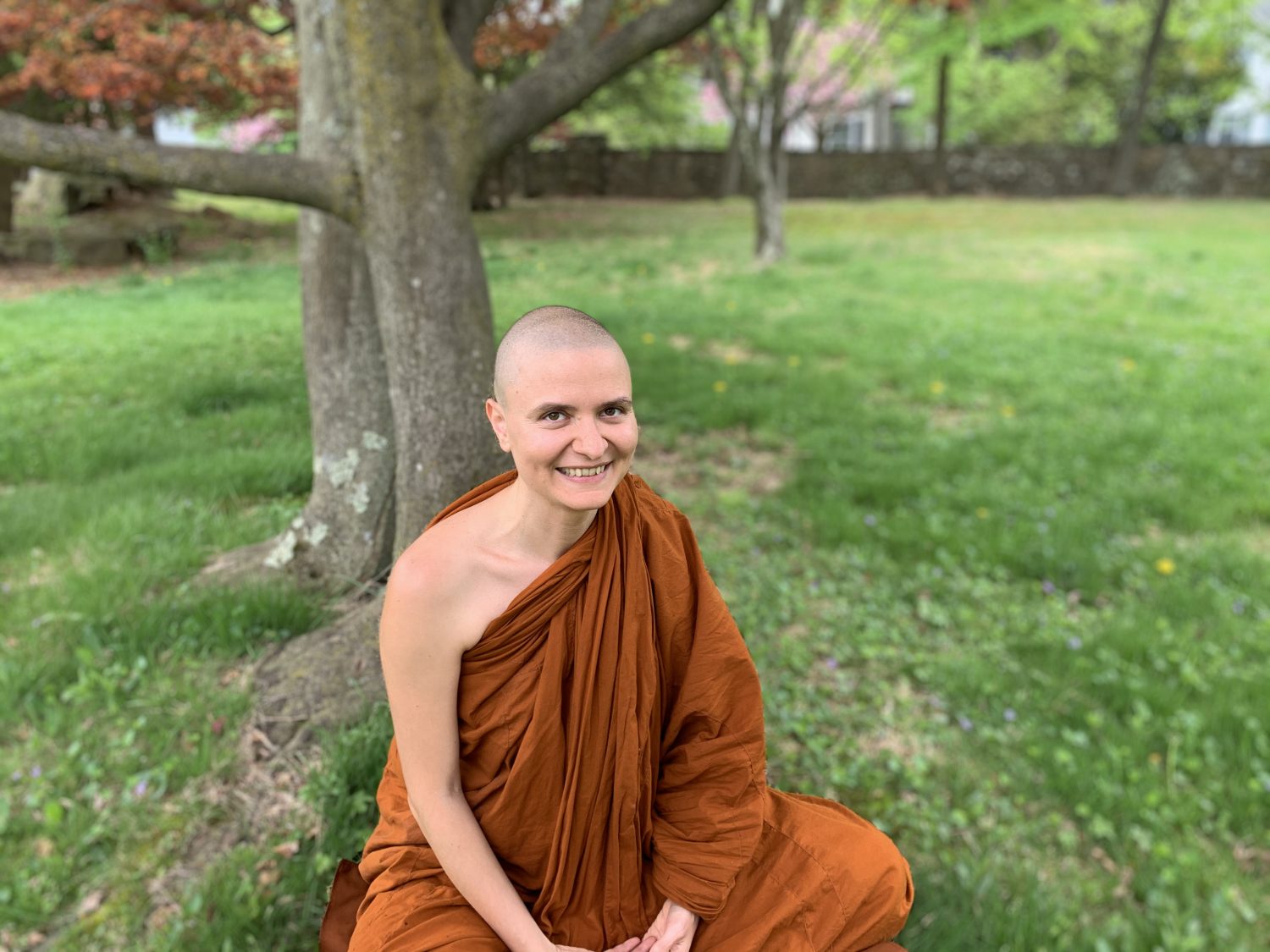
Ayyā Somā is an Italian Buddhist monk and co-founder of Empty Cloud in the USA and Italy. A former fashion and lifestyle editor, her first encounter with Buddhist monasticism was at Santacittārāma Monastery in Italy, in the tradition of Ajahn Chah. She started practicing as a renunciant in 2016, received monastic ordination in 2018, and full bhikkhunī ordination in 2020. As the co-founder of Buddhist Insights, a non-profit organization connecting people with monastics, she has learned the dharma through the perspective of monks of all different traditions like Bhante Suddhāso, Bhikkhu Bodhi, Ajahn Pasanno, Ven. Paññavati, Ven. Robina Courtin, Khenmo Drolma and Thich Phap Hai.
Transcript
It has been edited for clarity.
Hello, friends. I’m Ayya Soma, and today I’d like to explore the topics of harmlessness, ethical eating, and diet from a Buddhist perspective.
Hopefully, together we will better understand how to make wise, compassionate choices in this complicated modern world. If you’re drawn to the Buddhist teachings, chances are you likely hear deeply about ahimsa. That’s the practice of harmlessness in Buddhism, and as practitioners who deeply care, it is just normal to ask if and how our daily habits of eating potentially cause harm to ourselves and others.
READ MORE
The Buddha recommended five precepts for moral living. The very first is to abstain from healing sentient beings, and the second is to abstain from taking what has not been given. When the Buddha discusses wrong or immoral livelihoods, one that he specifically singles out is the selling of meat. So it is natural for some of us to conclude that a good Buddhist should be vegan or vegetarian, and we can recognize how the impulse behind this reasoning is noble. It’s fundamentally a genuine desire to minimize suffering and refrain from supporting harm.
Yet visit most Buddhist temples in the Theravada of Tibetan traditions, and you might be very surprised to find meat routinely offered and consumed. This is by both monastics and lay practitioners alike. This raises a difficult question: Is this behavior a corruption of the original teachings? Is there a deeper principle here that we’re missing?
What Do the Early Texts Say?
Personally, whenever I encounter something that seems slightly off, or when I don’t quite understand a practice or custom, or cultural behaviors maybe that I don’t understand, I like to take a pause and dig deep into the early discourses. I look for teachings that might explain them, examine the core principles behind them, and then critically analyze them together with my own assumptions and views. Then, I see how those timeless insights apply to our modern situation. So I invite you today to do this research together, and to go and look at some of those early discourses together. So let’s see what they have to say on the subject matter of eating meat.
The moral debate around eating meat is certainly not unique to our era. It existed in the Buddha’s time too. In the Amagandha Sutta, we find a Brahmin confronting the Buddha Kassapa, who was one of the Buddhas of the past, on precisely this subject. So the Brahmin, seeing that the Buddha Kasaba eats meat, tells the Buddha that what he is doing is impure. Eating meat pollutes the person who eats it, he says. The Buddha here explains that moral pollution does not come from the food on our plate. It comes from acting out of greed, hatred, and delusion.
In another sutta, the Jivaka Sutta, the current Buddha, Shakyamuni Buddha, is asked by his doctor about the ethics of eating meat. So here, the Buddha explains how monastics cannot accept meat if they see, hear, or even suspect that the animal was killed specifically for them. But outside of those conditions, if they receive meat with a mind cultivated in goodwill, compassion, sympathetic joy, and equanimity, if they accept it without greed, attachment, or delight in the sheer taste, then they eat blamelessly. So why is that, we may ask? Well, that’s because in Buddhism, the karmic burden lies in the intentional act of slaughtering the animal, not in accepting offered food.
In the Buddha’s teachings, there is a clear line between mere action and intentional action. Intention is what really creates karma. Intention is what really makes all the difference. Now, obviously, there is quite a distinction here between monastics and lay people. So, monastics here rely entirely on alms. We do not buy food, we do not cook food, or choose what is placed in our bowls. The Buddha is saying that a monastic receiving offered food with a mind free of greed is blameless. Throughout the suttas, in fact, the Buddha gives us monastics clear instructions on how not to eat, and so the Buddha says we should not eat for fun, for pleasure, for adornment, or for beauty, but only for the health and sustenance of this body and to support our spiritual practice.
To help us truly internalize this, the Buddha offers us a striking parable in the Puttamamansa Sutta, the discourse on the child’s flesh. He asks us to picture a family stranded while crossing a vast desert. In this parable, the Buddha paints a very very grim situation for the parents. While stranded, starving in the desert as a last resort for survival, the parents tragically have to cook and eat the flesh of their only child just to make it out alive. And so the Buddha here in this parable encourages us to reflect: in that desperate situation, the parents certainly wouldn’t be eating for entertainment or or. Would they? They definitely wouldn’t care about preference. They wouldn’t care less about how eating that food would affect their looks. They would just be in deep, deep grief, fully aware of how tragic their predicament was. How tragic it is that in order to survive, they have to eat the flesh of their only son.
This parable uses strong wording by design. So notice that the Buddha applies this heavy principle to all food. He doesn’t single out any type of food. What he’s saying is that when eating food, whether it’s lettuce or chicken, we need to understand the gravity of eating food. Sentient beings are harmed in the production and preparation of our food, no matter the ingredients. We are in a tragic predicament too, just like those parents. In fact, as human beings, simply having a physical body means our existence is bound to unintentional harm. Every time we take a walk or drive a car, we inadvertently step on or hate living beings. This is part of the first noble truth of dukkha, the noble truth of suffering. These five aggregates are truly suffering, the Buddha says. And so now the Buddha is not trying to oppress us. He’s not suggesting we fall into despair or wail on the side of the chick beyond our spoon. What he’s pointing at is that no matter what we eat, we should pay attention to how we direct our minds, how food affects our hearts.
Basically, the question is, how does this food help or hinder our progress towards awakening? And so, the Buddha wants us to see food for what it really is: fuel to cross the desert of suffering, fuel that sustains us so that we can get out of this desert and reach awakening.
Ultimately, this teaching is aimed at shifting our focus from what we eat to how we eat it, and the Buddha goes as far as saying that one who fully comprehends the nature of food can eliminate sensual desire and even attain the third level of awakening. This is really no small accomplishment. So we should really take the time to understand food deeply, look at our daily actions, and understand what causes and conditions influence them.
What Should Lay Practitioners Do?
So this brings us back to our modern dilemma, if for monastics who rely purely on alms, accepting offered food with a mind free of greed is blameless, what does this mean for lay practitioners who can actually purchase food? We can’t deny that when we buy food today, we are directly funding a global supply chain, and in this day and age, this is also connected to nutritional, ecological, and existential crises. So, given today’s conditions, wouldn’t it be more compassionate to interpret the teachings in a stricter light, perhaps, and embrace maybe a shift towards a purely plant-based diet? When it comes to eating, what is the true ethical choice as Buddhists?
Well, an answer to this question, I’m afraid, isn’t as simple as just changing our diet. If we reduce food ethics to a rigid realistic view, like vegan or omnivore, vegetarian or carnivore, we risk missing the larger picture.
The truth is, today more than ever, the specific ingredients on our plate are only one factor among many that contribute to the well-being of our bodies, of our minds, of our communities, the animals involved, and the planet at large. The sad reality is that today a person can eat a strictly plant-based vegan diet while still actively supporting industrial monocultures, and what this really means is supporting a system that brings topsoil depletion, chemical poisoning, and exploitative labor. Conversely, someone might consume animal products, but they’re derived from environmentally responsible regenerative systems, and what does this actually mean? This means systems that actually restore topsoil, foster biodiversity, and bring life back to rural communities. So, as Buddhists, our practice calls us to develop deeper wisdom, to really discern what is truly beneficial for all sentient beings, and that includes ourselves and also others.
Wise Reflection
Developing a nuanced sense of action is a key part of yoniso manasikara. This Buddhist teaching is wise reflection, deeply analyzing how certain conditions yield certain results. So, when we take a wider look at the current global food scene, we can investigate those consequences much more deeply. And what we will find is that the truth is that today our current food system is complicated by design. It is really the deliberate result of policy decisions made to consolidate power. Reduce transparency and prioritize corporate profit over human and animal welfare. From a dhamma perspective, we are living in the institutionalization of greed and illusion. It’s basically no different than a structural form of miccha-ditthi, wrong view.
Things haven’t always been this way. It’s very important to understand that this is not a usual samsaric predicament. Prior to the Second World War, most farms in America were diversified systems mixing livestock, crops, and orchards, which recycle manure back to the soil as a natural fertilizer. Today’s global market deregulation has forced farms to adopt the “get big or get out” model controlled by a handful of corporate giants in the United States. Just four conglomerates control over 85 percent of the domestic beef processing market. It’s only four agricultural giants, one of which Bayer recently acquired Monsanto, that control over 70 percent of seeds and pesticides, a mere dozen companies control 70 percent of grocery distribution. This level of corporate consolidation is deeply problematic. It distorts the entire food supply chain. For the sake of pursuing endless profit, corporations intentionally set prices well below the actual cost of production for farmers, and this puts independent farmers in a stranglehold.
This is all by design because it forces them to sell off their assets or surrender their independence to contract farming, and this is simply for them to make ends meet. So tragically, today death by suicide among farmers is now roughly 3.5 times higher than the national average. The situation is literally dramatic. Today, the number of acres of family-owned farms has dropped by around 31 percent since the 1950s as struggling owners sell their land. At the same time, financial firms and billionaires are buying up that farm land at unprecedented rates at a 60 percent surge since the year 2000. So, for example, Bill Gates is currently the largest private farmland owner in the United States, holding roughly 275,000 acres across 18 states. Land is no longer being treated as a living landscape to be carefully and responsibly maintained. It is now a financial asset to be exploited. Corporations have basically become the new colonial powers. It is capital markets that dictate what is grown, how it is harvested, and who is allowed to survive economically.
And this isn’t just a problem in the United States. It’s happening worldwide. Every morning here in Italy, I walk from a rural monastery to the nearby town for alms with my fellow monastics, and we see countless signs advertising farm land up for sale. In the past six years alone, 60,000 agricultural enterprises in Italy went out of business for the same exact reasons as in the United States, and you go to Northern Europe and you’ll find a similar situation. Twenty years ago, for example, in Ireland, Ireland had over 600 commercial vegetable growers. Today, fewer than 75 remain, and despite its fertile land, Ireland now imports over 80 percent of its food, leaving its supply chain severely vulnerable to global shocks, pandemics, wars. Sounds familiar.
This current system is designed to disrupt regional food security across the globe. Farmland is currently being absorbed by industrial conglomerates or converted into housing developments, logistics warehouses, and data centers to enrich the wealthy. Once that living land is lost, it is nearly impossible to restore it. Once again, this is by design.
When small farms vanish, we all lose. Generations of agricultural heritage, local land stewardship, and regional culture all disappear along with those farms. That is not a small thing. What disappears is what the Buddha numbers among the highest of blessings in the Mangala Sutta, bahusaccah, learning and the passing on of skills and craftsmanship, a condition that aids us in the path towards awakening.
The truth is, cheap supermarket food is a very dangerous illusion, whether it’s derived from plants or animals. So we do not pay for it at the checkout register, but we pay for this cheap food through government subsidies and through countless environmental, social, and health repercussions. Honestly, the most obvious horrible trait of this system is its perpetual cruelty towards animals. We have probably heard. About are or seen pictures of the horrible conditions of factory farming, in which animals are packed and crammed into feed lots, immersed in their own waste, routinely mutilated to prevent stress-induced aggression. Animals forced to eat food that their bodies are not built to digest, like soy, corn, and grain, which breeds systemic inflammation and disease in the animals, which is then passed on to the humans who consume them. But it’s very important that we understand that this isn’t just about animal livestock. Unfortunately, crops grown through intensive industrial agriculture, euphemistically called conventional farming, are just as destructive. Whether it’s growing soy to feed cattle or growing almonds for almond milk, conventional farming is a destructive modern invention that relies on heavy machinery, synthetic fertilizers, and toxic pesticides that strip topsoil, poison watersheds, and kill millions of field mammals, birds, reptiles, and pollinating insects every single year, but most importantly and most harmfully, I would say, it is a system that relies on human exploitation.
In my home country of Italy, the news right now is filled with heartbreaking stories of migrant workers harvesting tomatoes, zucchini, and citrus under brutal conditions. They work up to 14 hours a day in temperatures exceeding 100 degrees Fahrenheit for as little as three euros an hour. They’re living in dangerous shanty towns without clean water or basic human rights protections.
Eating Vegan Isn’t a Perfect Answer
When we look closely at all these things, switching to vegan, unfortunately, just becomes not enough. A plant-based diet that relies on the exact same exploitative industrial machine used to produce animal products is just far from harmless. We need to understand that the industrial food system intentionally capitalizes on our desire for moral purity. So take commercial almond milk for example. This is like heavily marketed as this green, ethical, animal-free alternative. Yet almond monocultures in California drain massive water reserves and require over a million honey bee hives to be trucked across the country each year, and nearly half of which collapse due to pesticide exposure. And so, in the end, what we get is a final product that is a heavily processed liquid containing very, very little real nutrition. As public awareness of these harms of factory and conventional farming grows. New corporate solutions have emerged today. Patented or artificial lab-grown and synthetic foods are being heavily promoted as high-tech, climate-friendly alternatives to traditional farming.
So whether it’s lab-grown meat, lab-grown dairy, or cell-cultivated chocolate, synthetic food is being marketed as the ultimate ethical breakthrough to our agriculture crisis, but let’s be clear: these are not real ethical alternatives to industrial agriculture. It’s as far as you can get. They are funded and patented by the very same corporate conglomerates that dominate modern mass agriculture, and that includes meat giants like Tyson Foods, Cargill, and major venture capital firms. Rather than fixing the current system, they might even make the problem worse, because unlike living cattle or heirloom seeds or traditional crops, laboratory-based food manufacturing processes can be patented. What this really means is that this transfers total control of the food supply to corporations. That means creating an outright monopoly over food products. This basically eliminates independent farmers and ranchers altogether. And to be clear, these are also very very far from ecological responses, producing lab-grown food requires energy-intensive industrial bioreactors powered by fossil fuels. That’s the very same energy powering our environmentally destructive food system today.
As our dear teacher Ayya Santacitta has reminded me multiple times, we should stop being fossil fools.
As spiritual practitioners, we must remember that one of the primary meanings of the word dhamma is, in fact, nature. So when we align our lives with nature, we are effectively aligning our lives with dhamma. When modern industrial farming or lab-grown artificial food does it really like just cuts out our connection to how nature works, and the further disconnected we are from nature, the further we are disconnected from reality, and the further we are disconnected from reality, the further we are disconnected from the dhamma, and the. Further, we are disconnected from the dhamma. The more suffering we generate for ourselves and for the entire world at large.
What Really Matters
When we endlessly debate dietary labels, we fail to ask what really matters. These are really the questions that right now we should be asking ourselves when it comes to food. So we should ask ourselves, where did this food come from? How was the soil treated? Who harvested it, and under what conditions? How does this impact myself and others? Will this food nourish my body and sustain it, or will it make me addicted to chasing a fleeting taste? Will my food choices contribute to the well-being of the farmers, the ecosystem, and society as a whole, or will they contribute to their downfall?
So this reflection takes us far beyond simple labels like meat eater or vegan. It asks us to come together and understand we are in a shared predicament. We are stuck in that desert of suffering where it’s very, very difficult to make a true ethical choice. We are in a deep crisis, and in this crisis, we must work together. We must come together in harmony, and we must together transcend it. We keep being told that these inhumane ways of farming are the consequences of the need to feed a soaring worldwide population, but once again, let’s be clear: global agriculture already generates roughly 2,800 calories per person per day. That’s basically enough to feed 10 billion people. Yet today, one in nine people still suffers from chronic hunger. The issue here is not a lack of yield; it is an issue of distribution and corporate control.
Can We Change?
Another important question to ask ourselves is: Is this mass consumption really inevitable? So historically, human societies almost never consumed meat in the astronomical quantities we see today across the world, with few, very few exceptions, animal flesh was understood to be a highly concentrated food source, consumed sparingly and occasionally. The traditional Mediterranean diet, for example, was never meat heavy. It consisted mostly of whole grains, legumes, wild grains, seasonal vegetables, and extra virgin olive oil, and that with the occasional addition of meat or fish for nutritional variety. My own personal grandparents in Italy ate animal products very, very sparingly. Yet today, the modern Italian eats meat, fish, and cheese multiple times a day. My parents’ generation cooked all their meals at home and rarely ate at restaurants. Their children today buy pre-cooked food and routinely dine out. This dramatic shift happened in just a few decades. It was not driven by biological necessity. This shift was driven purely by corporate marketing and commercial greed. It is an engineered preference pushed through the active erasure of local culture and culinary heritage for financial gain.
From a dhamma perspective, this is the engineering of tanha. This is the engineering of craving. So now the question is: How do we break free from this exploitative food system?
In navigating these complex times, we should really just follow the example of our teacher, the Buddha. The Buddha was a true realist. The Buddha always directed us to take gradual, wise steps towards a better world, rather than demanding a radical, chaotic overthrow of existing systems. While wavering in his commitment to non-killing and non-harming, the Buddha would still meet with military generals and kings without lecturing them or expecting them to be basically become enlightened overnight. He met people where they were at. So, on the spiritual path, the focus should always be on genuine harm reduction rather than demanding immediate, absolute perfection from both ourselves and others, in practical terms, fortunately, there is already a path forward. According to the UN’s Food and Agriculture Organization, nearly 40 percent of the world’s agricultural soil is already degraded due to industrial monocultures and chemical treatments. But a successfully tested viable solution to this issue has been the practice of regenerative farming. Regenerative farming reverses this destruction by integrating crops and livestock into a symbiotic relationship to restore natural biological balance. This is basically a system that prevents overgrazing, stimulates root growth, and allows pastures to sequester more carbon in the topsoil than basically the animals emit in their entire lifetimes. It matches industrial productivity while restoring the land and giving local communities direct access to their own food sources. As many of you know, monastics, while doing our wandering practice through rural Italy, we regularly have a few glimpses of farm animals moving across pastures in plant rotations. Staying together, we see firsthand how much more humane this traditional model is. It doesn’t even compare to the tragic sight and smell of factory farming that we occasionally come across during our traveling.
Meat and dairy from regenerative farms cost significantly more than conventional because obviously they account for fair human wages and humane conditions. But that should be welcomed. We should not see it as a flaw. High cost of animal products should be seen as a healthy natural restraint for society, not a problem to be solved with cheap factory farming or lab-grown substitutes. If we think about it, these economic constraints provide useful boundaries for our practice. They naturally encourage us to reduce our appetite, desire, and obsession with animal products. It basically frees up space in our hearts and minds to consider whether we really even need them to sustain our bodies. It is a healthy, natural boundary that encourages us to reduce our consumption and treat animal products with restraint and the respect that they deserve.
Not Just a Cultural Challenge, But a Spiritual One
Because ultimately, repairing our food system is not just an agricultural challenge; it is a cultural and also a spiritual one. To move toward a real solution, we must cultivate a mind bent not only on the regeneration of the planet, but also on the regeneration of our communities and also on the regeneration of ourselves. As spiritual practitioners who value compassion and renunciation over self-interest and convenience?
First and foremost, we must refuse to view ourselves merely as consumers. When I first moved to the United States in 2008, I was appalled to hear people being referred to as consumers rather than citizens. It was just not something I was used to. Back then, in my home country of Italy, we were still referred to as citizens. But now that I have returned to Italy to establish our forest monastery in southern Italy, the word citizens has magically disappeared here as well. So almost everyone right now in Italy refers themselves and others as consumers. This is crazy. This self-perception deeply affects our relationship with food. If our engagement with food is limited to selecting options on a supermarket shelf, well, you know what? We are trying to solve the crisis using the very same logic that created it. Consumer choices alone only ever create new niche markets for corporate monetization? True resilience comes from having good spiritual friends, and comes also from community interdependence. It cannot come from isolated self-sufficiency or technological substitutes. When everyone is hyper-connected digitally, but no one is actually needed locally, we lose solidarity.
We rebuild that solidarity when we care for and share with one another, and when we recognize how inextricably dependent we are upon the earth and upon fellow sentient beings. Buddhist practice is just not a solitary endeavor. It is supported by teachers. It is supported by peers. It is supported by community guidance. Our modern industrial system functions by isolating individuals, replacing neighbors with commercial services, and mutual aid with market transactions. It sells a spiritual practice as a means to become a little less stressed out about the current situation, and you know, just enough to get back to reproduction in our daily lives. So, to build true independence and choose ethical food requires a return to a culture of interdependence and care, a move away from the impersonal machinery of mass distribution. When we shift our view away from narrow self concern and connect with local farmers, something remarkable truly happens. Our world becomes much bigger when we buy directly from a local farmer. Our purchase isn’t just a transactional drop in a bucket. What it is is a direct act of support that builds relationship. It builds trust and human connection, dispelling the isolation and social anxiety that so, so deeply characterize modern life.
This is really not too complicated. Slowly but surely, we can reduce harm starting right where we are. Nothing too complicated. If we currently rely on processed food, we can begin by introducing more nutritious whole foods. Once we eat mostly whole foods, we can progressively switch to sourcing our produce from local farmers, developing personal relationships with them, and if we’re eating a lot of animal products, we can also slowly reduce our intake. Then we can ask ourselves: Do we even need such products in the first place? What can we renounce right now? So if we meet a farmer, we can join CSA Pro. We can join buying groups. We can build community. We might not solve the problems of the world, entire world overnight, but we can build a disaster-proof, pandemic-proof, resilient local system that directly supports farmers and nourishes our immediate communities and does not collapse as soon as there is an issue on the other side of the world, this is very, very, very important, and this, of course, all this means basically slowing down.
In this age of constant doom scrolling and time sucking apps, choosing to invest in real food means making a deliberate decision to make time to cook at home from scratch, for example, it means practicing mindfulness over what we prepare and sprinkling that all too forgotten ingredient metta or loving kindness into our dishes for family, friends, and strangers.
My kalyanamitta friend Bante Sudasso often says that when we say we don’t have time to do something, it’s not that we really don’t have time; it’s that we choose to do something else with that time, and this applies also to our meditation practice. Ultimately, if we’re serious about breaking free, we must become very serious about spiritual practice. We must prioritize spiritual practice. We need a purpose higher than our personal desires. Also, higher purpose even than fixing the world. We need a return to radical goodness, moral discipline, and true renunciation. We need a return to a spiritual path that brings us to true transcendence from suffering.
Religion is more than just an identity. It’s more than a set of rituals or a belief system. It is a training of the heart. It’s a path to true liberation, and true freedom is not about getting whatever we want in the most convenient way possible. It is about having the courage to simplify our lives, to renounce the unnecessary, and to make radical ethical choices instead of reverting to corporate dependency, our spiritual practice cannot just be a weekend hobby or a coping mechanism for stress. It must pervade every single aspect of our lives. We must also become agents of change. It’s important that we go to our local monasteries and dharma centers. It’s important that we become more engaged in our community, it’s important that we support it. It’s important that we support our religious communities, and if we don’t have access to a monastery or dharma center close by, we can consider opening our homes to establish the seed of a new spiritual community, of a meditation group.
We can invite people in and offer spaces for study, for quiet reflection, and genuine human connection, the Buddha taught us that all unwholesome action stems from ignorance and wrong view. The ultimate crisis we face in the world today is not just the food crisis, but a fundamental error in how we view reality. A truly Buddhist approach to food requires moving beyond dietary identity politics and taking full responsibility for our place in the web of life. This means recognizing that every single meal connects us to the health of the soil, to the dignity of the farmer laborers, the lives of the animals, and the stability of our local communities. When we correct our view, our actions will naturally follow. So thank you so much for joining me on this reflection. May all beings be free from harm, and may we all walk this path toward awakening together.
Sadhu, sadhu, sadhu.