Playing 1 of 1
Crossing the Threshold
Download Transcript It has been edited for clarity. Subscribe or Log in to Download Transcript
When we enter a new space, we cross a threshold. Every threshold is an invitation to leave what is known and step into the unknown. In Buddhist temples, the door is round and open. Sharing teachings and stories from her teacher Thich Nhat Hanh and from her recent pilgrimage to Japan for this Dharma Talk, meditation teacher Peggy Rowe Ward explores becoming more present to where we are and to what we are moving toward.
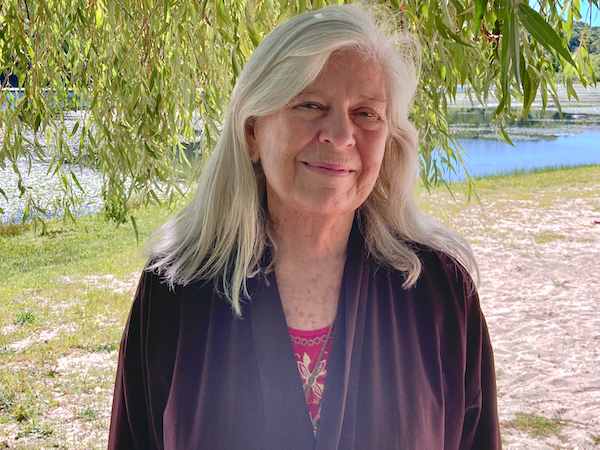
Dr. Peggy Rowe Ward has an EdD in Adult Education and her Master’s in Counseling Psychology. She is a Senior Dharma Teacher in the Thích Nhất Hạnh tradition and is a co-author of Making Friends with Time and Love’s Garden. She is also certified to teach Gentle Yoga and likes to combine art, music, movement, and yoga in her practice. Finally, she is the cofounder of the Lotus Institute.
Transcript
It has been edited for clarity.
Good day to you, dear friends. Such a joy to be with you and to be invited by Tricycle to teach. I’m so grateful, and I’m grateful this morning for being alive—I just had a birthday—and for being a student of Thich Nhat Han. So welcome. We’re going to do a short awareness at the beginning and end, and in between I’m going to talk about a metaphor and teaching from Thich Nhat Hanh, and also from my most recent pilgrimage in Japan.
READ MORE
I invite you to settle in for a second and get comfortable wherever you’re sitting, making any adjustments.
Begin with soft eyes. Become aware of where you are right now. You can move your head really slowly to orient yourself in space and time, and be aware of what’s in your field right now: the sounds, the scent, temperature, colors… I’m going to invite you into awareness right now.
Where I am is in North Carolina, on Cherokee land, and my awareness is that the magnolia blossom, the first one, is out. I can see it right directly in front of me. And the starlings are protecting their eggs. You can hear that. There are crows in the distance. It’s warm. It feels like summer and smells like summer here. Honeysuckle, magnolia. Now, what comes into your awareness as you orient yourself in space and time?
Now I invite you just to close your eyes if that’s comfortable, or just keep them defocused and tune in more with your body and your inner world. Be aware of your bum on the chair or cushion and feet on the ground, your body in space and time. Tune in to your interior world in your body. How’s your heart today? Scanning your whole body, inviting relaxation. There’s nothing you need to do, no place to go for the next few minutes. Noticing your breath, shoulders, and really getting a sense of your feet. You can wiggle them if you want to, but really grounding in on the feet and your heart. Set an intention for this very short practice. Any intention. Very good.
Then I gently invite you to open your eyes back up and stretch if you want to. I’m going to stretch. A little stretch seems to help me get even more in my body.
My intention today is to share some of my love for my practice and my teacher. Any wisdom is theirs, and any mistakes are mine. So I’ll do my best. As I said earlier, I’m just back from a Shokoku pilgrimage in Japan, where I went with 40 people from our Plum Village community: four monastics and lay people from 10 countries. This is a pilgrimage walk on an island off of Japan that is connected to Kukai in the ninth century. There are 88 temples that are around the perimeter of this island. The entire pilgrimage is all 88, and each of the temples has a number and a deity. We visited and practiced in 16 of the temples, and I was reminded so much of my teacher and an important teaching he shared over and over: It was the only time his teacher really got mad at him. I don’t think he used the word mad, but upset. I’m pretty sure he used the word upset.
He was 16 years old, and he was a novice monk, and he came running into his teacher’s room rather excitedly. As he opened the door and came into the room, the teacher stopped him and said, “Please, do this again. Be mindful of every step.” And he felt really corrected and taught in that moment. So he stepped back out, and then he made every movement conscious as he experienced his feet on the ground and where his body was in space and time. Then he really focused on his hand on the doorknob as he entered and re-entered the room.
My teacher said that’s the last time in his whole life that he ever entered a room unmindfully, and I believe him. Those of us who were with Thich That Hanh or have seen him on film can see that he moves in such a way that you can feel the presence of his whole body right there, whether he’s holding a teacup or reaching for an object.
Repeatedly he taught about how we needed to practice any time we entered or left a room, that this was a holy act. And then, as part of the pilgrimage, this is part of what they call the pilgrimage etiquette, but also practices of devotion, and as we traveled through Japan, it was part of our devotional practice at each temple to go through each steps of the ritual, to sing the Heart Sutra twice, to do prayers and light candles, all these devotional practices at each temple. But what was most important was how we entered the temple, and that’s the focus today: Entering that temple.
I invite you to join me as we enter a temple on this island. It’s called the Henro, and there’s a lot of steps. It’s often described like a big wedding cake: many steps to get up to what is an entrance. And in Japan and China and many of the temples in Korea, the temple entrance is open. There’s a gate. There isn’t any closure. There aren’t any doorknobs. There’s an open gate, and one of the sayings in the sutra is that the door is round and open. And in many Buddhist teachings, gates and doorways symbolize how we shift consciousness. That it’s mostly about our attitude, not about a place in time. We’re going somewhere different, but we’re shifting our consciousness. We’re entering into, we’re stepping into. We have the intention of moving somewhere, and mostly somewhere beautiful within our consciousness.
So as we are up to the top of the temple, you see on each side, in the right and left side, in the Shinto tradition, there are lions—kind of fierce-looking, stylized lions. And in the other traditions, there’s like these husky, muscled guys, angry-looking, wrathful-looking deities. And the deity or dog on the right side of the temple, as you’re facing it, has its mouth open, and the sound of the guardian at the gate is “Ah, ah.” At the left side, the deity, or the dog or the guardian, the mouth is closed, and the sound is “un an un.” And the right side represents birth, beginnings, new beginnings, and the left side represents completion or death or endings. These are the guardians of our threshold. In Joseph Campbell’s work, this was also called the hero’s journey: entering and crossing the threshold.
So as we come to a threshold in life, any threshold—where it’s “where are you right now? Where are you on your threshold of becoming?” It seems like lately there’s been many graduations and births and funerals and deaths and new babies and new jobs and retirements and different ways of ending and beginning. “Where are you right now?” In the Carolinas, we have an expression that’s “What’s learning you? What’s learning you? Which threshold is it? Is it new beginnings? Is it refinement? I seem to have several going on at once. So as we come to leaving or entering—we bow. We make a soft bow. We recognize that there are always guardians at every passageway of our life. We don’t often know them, but they’re there.
This morning, I got a note from my friend Mayumi from Japan, and I had written her a note of thanks for all she’d done to have a memorial for Larry at in Kyoto, and I said the word thanks in the U.S. language is too small. “Thanks” does not cover what I’d like to say to you. And she wrote back, and I’ve got it written down. She said, “Well, we have a word in Japanese that we really love that captures this. It’s okagesamade. Okagesamade. Okagesamade. The rough translation of that is because of your benevolent shadow and protection. Because of your benevolent shadow and protection. I really love that. To me, that is what the temple guardians are there for: to remind us of the benevolent shadow. That’s something that’s not really seen, but is there, and we know it’s there. And the protection that is there in the invisible world, in the natural world, with our ancestors, with the trees around us, with the magnolia blooming, we have this benevolent protection. Yeah, so we bow to offer our respect and to let our body and mind know as the head tips forward, it’s the posture of humility, of being open, of being a student.
So before we cross this threshold, we have a sense of our intention. We walk to the opening that is round and open, and we bow. We cross the threshold. In many of the temples in China and Japan and Korea, there’s a board in the opening. It’s probably about this big that you have to step over, and this is once more there so that we can be very conscious of each step as we cross a threshold. This invites us to really be aware of our feet, where we are in space and time, as we cross over to that other place. So we step over that piece of wood, and then we’re in the temple.
But for today, I really wanted to focus on that movement of entering the temple, entering the temple of life, and Thay spent much time on this: on our feet, on our movement, in really being conscious, in particular, in openings and gateways and doorways, that we really take the time to be—where am I in this moment in time?—checking in with ourselves. There’s no real boundary, but it’s what’s going on inside of us in this moment. And is there something we want to shift? We’re moving from something known to something unknown, and sometimes we’re moving from something comfortable into something less comfortable. And I heard a quote from Trevor Noah this week that comfort provides a floor, but it also provides a ceiling. So that’s kind of the challenge with comfort: we need both, and we cross over.
So I wanted to share Larry’s poem that has been my practice poem this last couple of months, and this is from his book Morning Night, by Larry Ward. It’s called “Enter Your Life.”
Enter your life like an epic poem.
Ride the colors of change with the wind unattached.
In light of the coming and going of all things, savor the stars in the dark blue sky.
Trust the sun in your heart to guide you home.
Here, between earth and sky, listen.
Hear your footsteps in the leaves of time.
Fix your gaze on the horizon of not yet, but stay in this moment and ask, in this great symphony, what is my instrument? What is my music? What is my song?Surrender to this crucible’s alchemy as it creates the mandala of your holy life.
Cross the lake of life’s mystery, as a fearless swan, embodying grace, peace, and compassion, as you head towards the distant shore.
Again, this is called “Enter Your Life,” and just in this moment, pause and imagine your feet on the ground. Very aware of both feet. Aware of the guardians on either side of birth and death. The benevolent shadow and protection that surrounds you, and imagine that foot stepping forward, aware of the full motion of your body as you step forward, entering into your life, into the great mystery and symphony of your life, and inviting yourself to look at this: what is my instrument? What is my music? What is my song?
In stepping into this new moment, in just a shift of perspective. A reminder that we’re always protected and supported and loved. We’re reminded that our ancestors cheer us on as we take steps in the direction of what is true and good and beautiful for our lineage. So I want to say thank you to Tricycle once again, and my teacher Thich Nhat Hanh, and Larry Ward, and all my friends in Japan, Mayumi, who brought that phrase to me this morning, and may your practice be beautiful. Thank you. Have a beautiful day.