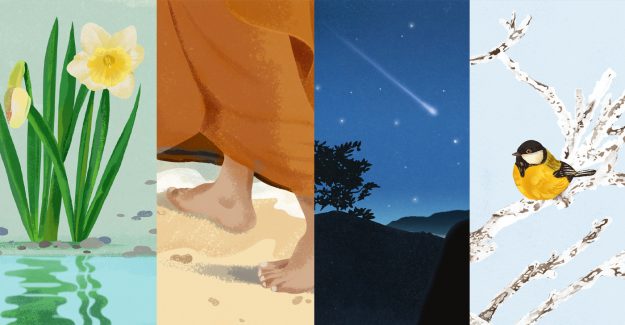
At seventeen syllables, haiku is the shortest poem in world literature. It is now also the most popular form of poetry in the world, written in nearly every language. And yet, as haiku has spread internationally, one of the most important aspects of the tradition has largely been lost—the community of poets.
In Europe and the United States, haiku is often regarded as the domain of literary elites, but this is not the case in Japan, where haiku is deeply rooted in communal activity. Millions of amateur Japanese poets belong to haiku groups (clubs, really), which are sponsored by different “schools” of haiku, each with its own magazine. Most daily and weekly newspapers carry a haiku column featuring poems submitted by their subscribers, sometimes on the front page.
To help bring back this social dimension, we are inviting our readers to participate in the monthly Tricycle Haiku Challenge. Each month, moderator Clark Strand will select three poems to be published online, one of which will appear with a brief commentary. Each quarter, one of these poems also will appear in the print magazine alongside an extended commentary. In this way, we can begin to follow the seasons together—spring, summer, fall, and winter—and share the joy of haiku together as a community.
Requirements:
Anyone can submit haiku to the monthly challenge using the form below. To be considered for publication, your haiku must:
- Be written in three lines of 5, 7, and 5 syllables:
Getting the syllables of a haiku to sit naturally inside of its seventeen-syllable form is the primary challenge. Each haiku is a word problem in search of a satisfying seventeen-syllable solution. - Contain the “season word” assigned for that month:
A haiku isn’t only a word problem. To the seventeen syllables the poet must add a turn of thought that results in more than seventeen syllables of meaning—along with a word that refers to one of the four seasons. How the poet uses “season words” like autumn sun or dew will typically determine the effectiveness of the poem.
Part of the reason haiku appeals to so many people is that its rules are simple and easy to follow, yet it can take a lifetime to master them. Ten million people currently write haiku in Japanese. There is no reason why millions can’t write haiku in English, too, provided they agree on the basics. The turn of thought you add to that simple formula of 5-7-5 syllables with a season word is entirely up to you.
Submissions close on the last day of the month at 11:59 pm ET, and the results will be posted the week after. Monthly submissions are anonymized and the winning poems are selected in a blind process.
To learn more about the history and principles of haiku, check out Clark Strand’s online course with Tricycle, “Learn to Write Haiku: Mastering the Ancient Art of Serious Play.”
This Month’s Season Word:
Submit as many haiku as you please using the submission form below. Just be sure to include this month’s season word.
Summer season word: “Snail”
watch—you’ll see moonbeams
spiral for the fun of it
on the wet snail’s shell
— Caroline LeBlanc
Grammatical imperatives like “Look!” or “Watch!” rarely appear in haiku. Haiku are already biased toward direct, close observation, and so such words are thought to be redundant. But there are exceptions. Here the poet is directing our attention toward something the eye might miss if not for the imagination. It is one thing to see the moonlight reflecting off a snail’s shell and quite another to watch it “spiral for the fun of it.” Only then do we experience the moonlight as alive. — Clark Strand
Submit as many haiku as you please on the season word “snail” Your poems must be written in three lines of 5, 7, and 5 syllables, respectively, and should focus on a single moment of time happening now.
Be straightforward in your description and try to limit your subject matter. Haiku are nearly always better when they don’t have too many ideas or images. So make your focus the season word* and try to stay close to that.
*REMEMBER: To qualify for the challenge, your haiku must be written in 5-7-5 syllables and include the words “snail.”
Haiku Tip: Keep It Light!
Lightness is a virtue in haiku. It has to be. If we try to say something too serious in so short a poem, it will come out sounding ponderous, pretentious, or forced. And yet, paradoxically, saying something serious is often easy, provided we don’t try too hard.
In haiku we learn to say difficult things simply, using seventeen syllables and a season word. If a thing is true, it can be stated in a haiku. For haiku poets, that is our primary article of faith. It’s what gives us the confidence to tackle virtually any subject—the knowledge that, in observing the 17-syllable limit, we will be able to winnow out what is distracting or evasive and get to the pith of what we have to say.
In haiku, lightness and humor are closely connected. Most haiku humor is lighthearted. That is why the Japanese characters for haiku (俳句) are sometimes translated as “humorous verse” and sometimes as “light verse.” In haiku, lightness and humor are often the same.
But a word about not trying too hard. It doesn’t mean we don’t struggle to get at the truth we want to convey. It means that we handle that truth lightly . . . simply . . . even easily. At a certain point in our quest to get the right poem, we will find ourselves relaxing and breathing a little more evenly. Whatever strain we felt before will dissipate and the syllables will just slip right out.
Learning to stick with a theme until this has happened in the greater part of mastering the art of haiku. That is why we write each month on a single seasonal theme. This kind of training will stand us in good stead for the rest of our poetic lives. So keep at it! Month after month. Season after season. Year after year.
A word about snails: A snail is a gastropod with a coiled shell that is large enough for the animal to completely retract its body. Snails can be found in an extremely broad range of environments, including ditches, deserts, freshwater streams, and deep sea trenches, although in haiku the season word does not refer to sea snails.
Snails hatch as “tiny adults” and grow their shells over the course of their lives by consuming calcium. They may be male, female, hermaphroditic, or parthenogenetic (i.e., capable of reproducing on their own). Most land snails are herbivores and are more active at night or during damp weather, since mucus is essential to their locomotion.
Snails are an important food source for humans in many cultures and have been used from ancient times to make expensive blue or purple dyes. In folklore, they symbolize slowness. But in some cultures, they are associated with sexual desire.
you need an hour
because it happens slowly
garden snails in love
June’s Winning Poem:
Spring season word: “Strawberry”
seemingly aware
of day’s end, wild strawberries
flirt with the last light
— Stevie Rosenfeld

You can find the honorable mentions, additional commentary, and June’s haiku tips here.
Previous Winners
|
2021 |
2022 |
2023 |
|
2024 |
2025 |
2026 |
|
July | ||
|
August | ||
|
September | ||
|
October | ||
|
November | ||
|
December |
♦