
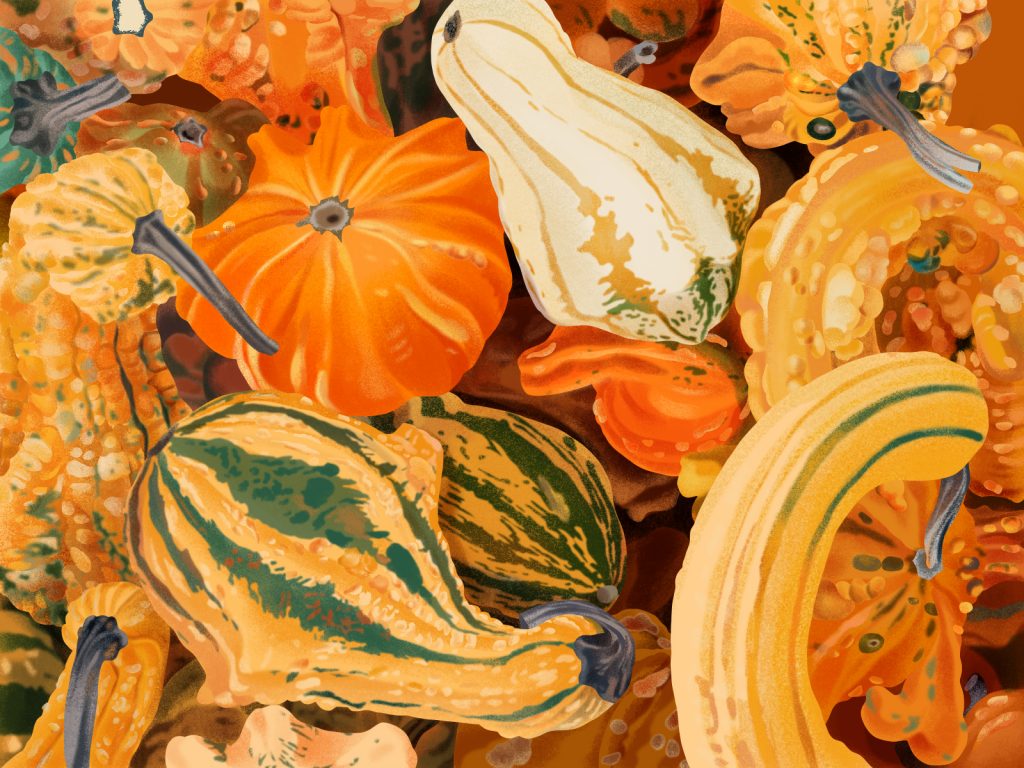
Gourds are typically harvested in autumn, which accounts for their association with that season. Some are eaten. Others are dried for use as holiday decorations, or to create containers or musical instruments. This accounts for the varied use of gourds as symbols in haiku poetry. Each of the winning and honorable mention poems for last month’s challenge took a different approach to that symbol.
- Dana Clark-Millar uses a gourd rattle to protest a world where even the truth feels like “just more noise.”
- Stephen Billias gives an ecological twist to the law of impermanence with a gourd that rots completely, like it was “never there.”
- Becka Chester finds something comical in the “law of gravity” that affects both her body and the shape of a gourd.
Congratulations to all! To read additional poems of merit from recent months, visit our Tricycle Haiku Challenge group on Facebook.
You can submit a haiku for the current challenge here.
Fall Season Word: Gourd
WINNER:
living in a world
where the truth is just more noise
I rattle a gourd
—Dana Clark-Millar
We have come a long way from the days when haiku were believed to be terse, image-only “nature poems” that were heavy on nouns and light on subjective content. Haiku were never meant to be purely objective—a concept that did not even exist in Japanese literature before the twentieth century. Even so, until the last few decades, haiku that privileged self-expression over sketching a scene from nature were relatively rare.
In last month’s winning haiku, the poet has approached the seasonal theme with an emotional honesty that is both stark and uncompromising. The lighter, more comical associations with gourds are absent: their festive, decorative quality, their odd shapes and bright colors. These have been traded for their use as ceremonial rattles—to call spirits, perform healings, or purify a person, place, or thing. And yet, even here the image is ambiguous. It isn’t clear which spirits the poet might be appealing to, what healing is even possible, or how something as large as “a world” might be purified.
The poem offers a critique of our present culture, with its contentious politics, incendiary rhetoric, and 24-hour cycle of media mayhem that presently passes for “news.” It is a world in which the voice of truth is indistinguishable from the uninterrupted, collective rant of a people who have lost their minds.
The rattle of seeds inside a gourd can’t possibly compete with that much noise. But that doesn’t seem to be the point. For all its decibels, the poem is a pantomime. We can’t hear the dry seeds rattling inside the gourd, we can only see the poet shaking it. That shaking is the point. The gourd is essentially a fist.
This haiku belongs to a growing body of work in both English and Japanese that we might call “Poems of Protest and Ecological Conscience.” There are already more than enough haiku of this quality to justify an anthology on those themes.
HONORABLE MENTIONS:
gourd rots into earth
quietly and completely
as if never there
—Stephen Billias
law of gravity
everything has descended
my body — a gourd
—Becka Chester
◆
You can find more on October’s season word, as well as relevant haiku tips, in last month’s challenge below:
Fall season word: “Gourd”
sorrow is always
wide at the bottom, a gourd
that remains upright
Submit as many haiku as you please on the fall season word “gourd.” Your poems must be written in three lines of 5, 7, and 5 syllables, respectively, and should focus on a single moment of time happening now.
Be straightforward in your description and try to limit your subject matter. Haiku are nearly always better when they don’t have too many ideas or images. So make your focus the season word* and try to stay close to that.
*REMEMBER: To qualify for the challenge, your haiku must be written in 5-7-5 syllables and include the word “gourd.”
Haiku Tip: Practice Haiku as a Group Art!
When haiku arrived in the west in the 20th century, its philosophy and principal literary technique (the juxtaposition of images) took center stage. The culture of haiku was more difficult for western poets to understand. For a century, they obsessed over what a haiku was or how it should be rendered in English. Little thought was given to how haiku happened in the first place—even though there was no mystery to it. Haiku happen in a group.
When Kenkichi Yamamoto (1907-1988) addressed the Haiku Society of America for its annual meeting in 1978, he understood that the Japanese and the American understanding of haiku were worlds apart. Yamamoto was the most influential haiku critic and commentator of modern times, so the people who attended his talk expected him to discuss the finer points of poetry. But he kept his approach as simple as possible.
He wrote two Japanese words on a blackboard—haiku and haikai—and explained them at some length. His listeners knew the first word already (or at least they thought they did). The second—the older term for haiku—was less familiar. Taken together, the two words expressed the essence of the art, Yamamoto claimed. This was (1) its “comical” sense of what life was really about, and (2) the writing of haiku within a community of poets to cultivate and express that shared sensibility.
Yamamoto did his best to bridge the divide between Japanese and English language haiku, but the distance was too great. Few poets understood haiku humor as he described it: a shared understanding that “the loneliness of this life we are living and the comical elements of life are two sides of the same coin.” Nor could they grasp the idea that it was only through community that one could nurture such a profoundly nuanced approach to life.
At one point he wondered aloud whether the Japanese understanding of haiku and the American understanding “might be slightly different”—which was a polite, very Japanese way of saying he didn’t believe they had understood at all.
The Tricycle Monthly Haiku Challenge strives to recreate the experience of community that gave rise to haiku in the first place—an experience which remains the bedrock of the art as it is practiced in Japan today.
Millions of poets come together monthly in Japan for the purpose of writing and sharing haiku—often on the same preselected seasonal theme. There are many other haiku activities as well, from classes and lectures to seasonal outings to scenic locations for the purpose of composing haiku on the spot. But all of these activities are communal in nature. The archetype of the “solitary, brooding poet” has no place in Japanese haiku for the simple reason that such a figure is anathema to the art. Haiku are the result of poets talking with one another about their shared experience of life—seventeen syllables at a time.
To that end, I sponsor a weekly version of the Tricycle Haiku Challenge in a private Facebook group, and teach an annual course on Zoom beginning each January called “A Year of Haiku” that covers everything from Bashō to the present day. But others are beginning to understand haiku as a “group art,” as opposed to the “solo sport” approach favored by most writers of western-style poetry. And so, there are many ways to learn in community.
It has been said that haiku in English is on a 50-year lag with haiku in Japan. Which would mean that we are right on schedule with getting the point that Yamamoto was trying to make in 1978.
A note on gourds: A gourd is the hard-shelled, seed-filled fruit of a vine of the cucurbitaceae family that includes squash, pumpkins, cucumbers, and melons. As used in English, however, the generic word gourd usually refers to some variety of “bottle gourd” that has been dried for use as a container or musical instrument—or for seasonal decorative displays. The latter accounts for their strong association with autumn festivals. Such gourds are harvested after the vine has died and the seeds can be heard rattling inside of them when shaken.

Thank you for subscribing to Tricycle! As a nonprofit, we depend on readers like you to keep Buddhist teachings and practices widely available.