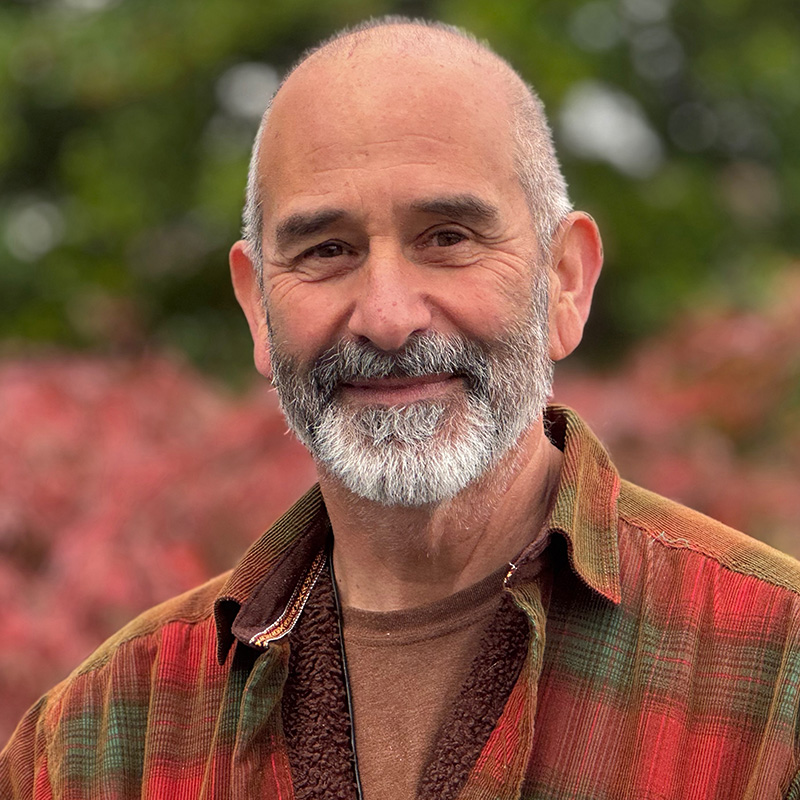
“I put a lot of stock in the telling of the Buddha’s awakening, in which he states that I and all beings awaken together, simultaneously.” Togetherness, and the support it provides, has always meant a lot to Joshin Byrnes, the guiding teacher of Bread Loaf Mountain Zen Community in Middlebury, Vermont. “I was born and raised in a tight-knit, working-class ethnic community in Brooklyn, New York. I had a million grandmothers. Even though there were really hard times, something held my family through thick and thin.” However, when they moved to the suburbs, “all of that was lost. Our problems—my father’s alcoholism in particular—destroyed my family under those conditions.” Joshin learned firsthand how easy it is for people to slip through the cracks, and that realization continues to fuel his efforts as a Zen leader.
Joshin led many lives before coming to Zen. As a young man, he practiced for two years in a Benedictine monastery, later becoming a Dominican monk for four years. “I was introduced to a socially engaged form of Catholicism, so I did a lot of work in jails and with homeless people,” he recalls. Byrnes also pursued graduate studies in medieval European musicology. Ultimately, he left the Church due to theological differences, its unwelcoming stance on being gay, and its gendered hierarchy. “I became an activist—and an angry atheist—working in the AIDS epidemic for fifteen years.” Afterward, he spent thirteen years leading a foundation that matches nonprofits and donors who are interested in building strong communities. In midlife, grappling with burnout, Joshin reclaimed his spirituality when he discovered the work of the Zen Peacemakers. Roshi Bernie Glassman and Roshi Joan Halifax’s emphasis on social justice and bearing witness resonated with his background. After years of practice and study, Joshin was ordained as a Zen priest and teacher.
The Peacemakers’ immersive street retreats have been an important part of Joshin’s path. Participants in these retreats live and sleep on the streets for a week without money, deepening their sense of compassion and interconnectedness with the people they encounter. On the street “you bear witness to all life. The sidewalk is hot, the sidewalk turns cold. Some people are wildly generous. Some angrily reject you.”
Early in his training, Joshin was contacted by his father, who wanted to see him after many years of estrangement. “My initial reaction was: ‘No way. Too much water under that bridge.’ And there I was, a Zen Peacemaker, going on street retreats and meeting everyone with an open heart. Then, when my homeless father calls me, I’m like, no way. That was my koan—it shifted me. I went to see my father and had a very powerful experience. I brought my practice and listened to him tell stories. I bore witness to his life.” To date, Joshin has completed roughly thirty-five street retreats around the country.
Togetherness has always meant a lot to Joshin Byrnes.
Bread Loaf Mountain Zen Community (BLMZC) formed as a way of responding to the growing alienation Joshin sensed in the people he encountered in the streets. “I was on a solo retreat in Rutland, Vermont—it was at the height of the opioid crisis—and everywhere I went, people were expressing a sense of anger and abandonment.” Joshin and some friends began holding pop-up events to bring people together, share food, and talk. Eventually, these efforts led to fundraising, the purchase of a food truck, and a communal house for dedicated Zen practice. Joshin estimates that there have been thirty different residents at BLMZC—some have stayed for a few months, and others for years—all at various stages of life. The community’s growth has come through shared decision-making and discussions about what steps feel right. Indeed, “One step, one breath” is the ethos that has led BLMZC to its current location in Middlebury.
Bread Loaf Mountain Zen Community’s latest home includes a meditation hall for daily sitting practice—the No Barriers Temple—residential rooms, a library, and a living room space called Gather. During the week, the building is available for anyone who needs a place to rest, a cup of hot coffee, or a bite to eat. Visitors are welcomed as they are—no questions asked—and can relax in the company of others, use the kitchen, bathroom, and shower, do laundry, and enjoy an adjacent room for crafting projects. Throughout the year, BLMZC also hosts special events, including Thanksgiving feasts, live jam sessions, meditation retreats, and Buddhist ceremonies. “We want to create an integrated Zen community right where we live—one with many dimensions: meditation, study, and direct service.” Skillfully guided by Joshin, whose name means “pure heart,” the group continues to bring this vision to life.
♦
A Short Community Zen Meditation
Take a moment.
Let your body settle. Soften your brow. Let your face relax. Allow the feeling of a slight, almost imperceptible smile to appear.
Let your breath settle.
Feel the ground beneath you, supporting your body. You’re not separate from it—and you’re not separate from the people around you, either.
Let yourself relax and widen.
Set aside the small story for now—the one where you have to manage everything, or figure it all out, or go it alone.
There’s a larger self—one that includes your family, your neighbors, your community . . . and even people you’ll never meet, in places you’ll never go. Right now, lives are unfolding everywhere.
Just imagine those connections—not by forcing anything or trying to fix them, not by thinking about all the problems they face, but by resting in what’s true: this vast, intimate web of life. It can’t be named or analyzed or reduced to a headline. But its unknowableness can be known.
It is known through the air we breathe, the food we share, the climate we live in, the economics we move through, the stories we carry. Through all of this ordinariness, we are living one life, together, like one body. Some parts of the body functionally well, others struggling and sick, some parts being born and coming to life, others fading away.
So as you breathe, remember:
What you do here—in the ordinary rhythms of your life—ripples out into the world, into the one body. And what happens in the world ripples back in and shapes who you are.
We don’t practice to take refuge away from the world. We practice to take refuge with the world, and for the world.
–Joshin Byrnes

Thank you for subscribing to Tricycle! As a nonprofit, we depend on readers like you to keep Buddhist teachings and practices widely available.