In his first sermon, the Setting in Motion the Wheel of the Dharma, the Buddha pointed out that we suffer because we identify with what he called the five “clinging-aggregates”—five piles, heaps, or clusters (skandhas) that in our ignorance we take to be the self. It’s when we “take possession” of the five skandhas—form (rupa), feeling (vedana), perception (samjna), mental formations (samskara), and consciousness (vijnana)—that we give rise to our sense of me and mine, creating the illusion of a self and the suffering that results from it.
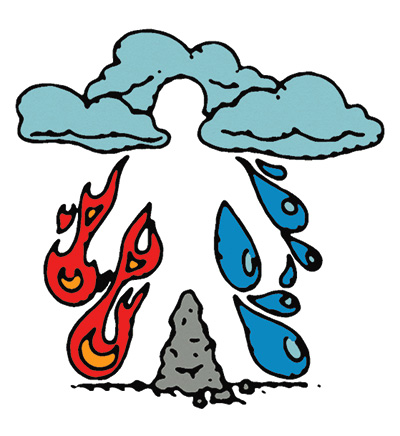
Rupa, the first of the skandhas, refers to both mental and physical objects and the four elements of fire, water, earth, and air that constitute them. Generally, we relate to forms in terms of how they can serve us: We chase after what we like, and we do our best to keep it. Yet the form we most strongly attach to is our body, assuming, as the Buddha said, “form to be the self, or the self as possessing form.” To work with our clinging, we must therefore question that possessiveness. As Bhikkhu Nanananda said, “To take the elements to be the self is misappropriation of public property.” Fire isn’t me, isn’t mine. Neither is water, earth, or air. Then why do I assume that the product of their coming together is something I can own, I can grasp? If I can’t, then what is a being? Who am I? That, noble friends, is the question, isn’t it?
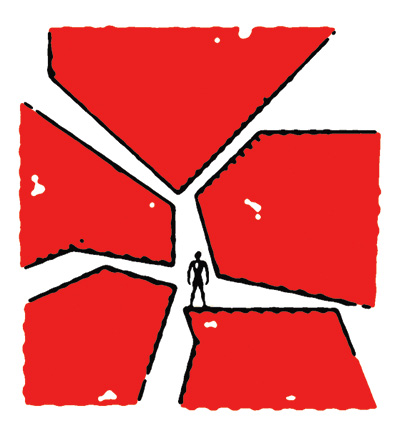
“When even this external water element [the ocean], great as it is, is seen to be impermanent, subject to destruction, disappearance, and change, what of this body, which is clung to by craving and lasts but a while? There can be no considering that as ‘I’ or ‘mine’ or ‘I am.’ ” –Shariputra
Tip: One way to work with our attachment to the body is to ask ourselves, “Do I possess my body? If I do, shouldn’t I be able to control it—stop it from getting sick, from aging, or dying? Could it be that this body isn’t mine, after all, isn’t me, isn’t myself? Could it be that I’m not a being but a process—an ever-changing, ever-evolving set of relationships?”
“Through repeated observation of these [skandhas] . . ., through practicing a different kind of knowing—with mindfulness—it’s possible for us to see that the ‘me,’ the ‘I,’ is not found within us, and through this there can be an effortless letting go.” –Anushka Fernandopulle
Tip: Contemplating the skandhas, we can see that because they are conditioned, they, too, are subject to the three marks of existence: They are impermanent, unsatisfactory, and free of self-nature. Seeing this, we can let form be form without clinging to it, or without wishing it to remain the same, which it can never do.

“We look at those five heaps in terms of, ‘Are they permanent or are they impermanent?’ And we look at them in terms of, ‘Are they self or are they not self?’ And since they’re impermanent, they cannot be self.” –Ayya Santacitta
♦
Editor’s note: This is the first installment of our series on the five skandhas: form, feeling, perception, mental formations, and consciousness.

Thank you for subscribing to Tricycle! As a nonprofit, we depend on readers like you to keep Buddhist teachings and practices widely available.