
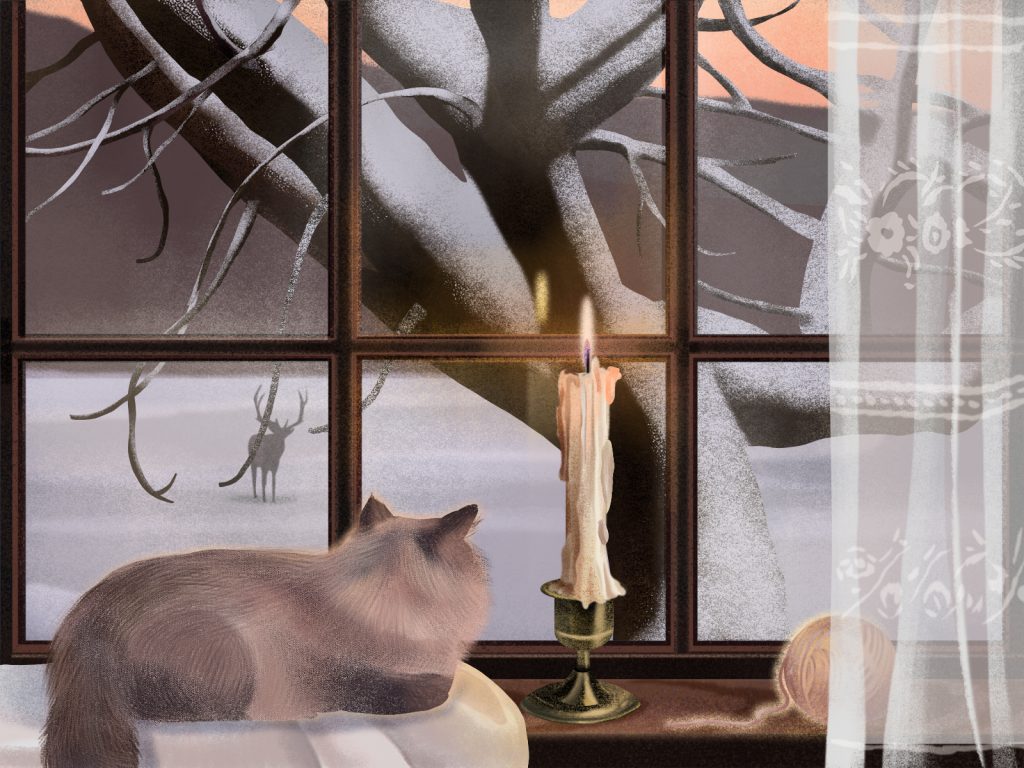
Haiku is the most popular form of poetry in the world today. It is also the form with the widest range, despite its 17-syllable limit. Poets may write on any subject, in any style, provided they bring a moment vividly to life, tying it to one of the four seasons. The winning and honorable mention poems for last month’s challenge offered cultural critiques, meteorological observations, and reflections on the mystical “body” of the world.
- Marie Derly finds herself at odds the season when her hours of work “remain the same,” even on the shortest day of the year.
- Nancy Winkler celebrates the quiet wonder of “a new minute of sunlight” on the winter solstice.
- Jesus Santos watches as the earth, “deep in asana,” opens the chakra of a winter sunrise.
Congratulations to all! To read additional poems of merit from recent months, visit our Tricycle Haiku Challenge group on Facebook.
You can submit a haiku for the current challenge here.
Winter Season Word: Winter Solstice
WINNER:
the amount of work
during the winter solstice
remaining the same
— Marie Derly
For much of its history as an emerging genre of English language poetry, haiku was hampered by mistaken beliefs about the so-called “limits” of the form—about what could or could not be said in a haiku, or whether it should address human concerns or stick to describing nature. Most of all, it was limited by the idea that haiku had a defining spirit that poets should strive for in their poetry. The truth is a lot simpler. The haiku form is an empty vessel to be filled by poets with whatever they want to say.
Adam L. Kern dispelled many misconceptions about that empty form in his 2018 anthology The Penguin Book of Haiku. Kern assembled over one thousand popular verses from the centuries leading up to 1900. It’s a mixed bag of a book that breaks down barriers of class and education. Alongside masterpieces by Bashō and Buson, we find satirical, often ribald verses by anonymous shopkeepers who entered a contest for the funniest poem, carrying home a substantial cash prize if they won.
What was Kern’s logic for mixing high-minded hokku with poems he refers to as “dirty-sexy haiku”? His point was to show that, as different as they are, the various modes of haiku written by Japanese poets exist on a continuous, culture-wide spectrum. Haiku is bigger than the style of any single poet. It always has been—right from the beginning.
Had last month’s winning haiku been selected for publication by the editor of a popular Japanese poetry column, it would sit somewhere in the middle of that spectrum. It employs a classical season word (“the winter solstice”), but its purpose is to draw a contrast between the natural world and the world of human affairs, with an emphasis on the latter. In that respect, it shares something in common with the most popular mode of poetry in present-day Japan: the sarariman (or “salaryman”) haiku.
Salaryman haiku expose the dark side of life in a modern capitalist society. In Japan their subjects are often white collar employees—“corporate drones” who work long hours, drink to excess, and often die young from stress or cancer. But the form can be used to address broader social concerns as well.
The following poem was among the winners of a 2007 salaryman contest with over 770,000 entries:
Good to be a dog:
even when trapped on a cliff,
somebody saves you.
The poem alludes to a widely-televised news story about an animal rescue, but it contains an implicit critique of Japanese society and its abandonment of humans who fall between the cracks of the country’s various social safety nets. Better to be a dog.
The critique of modern culture at the heart of our Tricycle winning haiku is muted by comparison. The winter solstice is the shortest day of the year. But this has no effect on the poet’s work schedule. Her hours remain the same.
In previous centuries, when there was no commuting and little industry, most work centered around the home. And without electric light or modern transport, its rhythms followed the seasons of the year. The longer days of summer were for tending flocks or working in the fields. There was still work to do on the shorter days of winter, but it ended for the most part when the sun went down. The land grows fallow during the winter. Human, too, once used that time for rest and reflection.
The tone of the poem is matter of fact. There is no sarcasm or even satire. Human life has fallen out of harmony with the rhythm of the seasons. Stuck at work, the poet lets the sadness of that sink in as she watches the sun fall below the horizon.
HONORABLE MENTIONS:
in only one day
a new minute of sunlight
the winter solstice
— Nancy Winkler
deep in asana
opening a new chakra
the winter solstice
— Jesus Santos
◆
You can find more on December’s season word, as well as relevant haiku tips, in last month’s challenge below:
Winter season word: “Winter Solstice”
I can’t find my head
when my shadow grows this long
the winter solstice
—Nancy Winkler
On the shortest day of the year, the sun is so low that the poet can’t find her head at the end of her long shadow. As a comical image, this is memorable. But there is also a lot going on in that phrase “can’t find my head,” just as the image of the “shadow” suggests a psychological interpretation. The result is a winter solstice poem that adds up to much more than the sum of its parts. —Clark Strand
Submit as many haiku as you please on the season word “winter solstice.” Your poems must be written in three lines of 5, 7, and 5 syllables, respectively, and should focus on a single moment of time happening now.
Be straightforward in your description and try to limit your subject matter. Haiku are nearly always better when they don’t have too many ideas or images. So make your focus the season word* and try to stay close to that.
*REMEMBER: To qualify for the challenge, your haiku must be written in 5-7-5 syllables and include the words “winter solstice.”
Haiku Tip: Practice Haiku as a Group Art!
The Tricycle Monthly Challenge strives to recreate the experience of community that gave rise to haiku in the first place. But there are other ways to write and share haiku.
For those who wish to advance at their own pace, the Tricycle course “Learn to Write Haiku: Mastering the Art of Serious Play” offers a good point of entry. For anyone wanting to immerse themselves in writing haiku regularly with others, there is “A Year of Haiku,” a comprehensive program that features weekly Zoom lessons and season word challenges, plus feedback from a team of haiku teachers who write commentaries on dozens of poems every week.
The haiku which follow on the season word “winter solstice” (along with this month’s sample poem by Nancy Winkler) were selected for commentary in 2024 by myself and guest teachers Susan Polizzotto and Mariya Gusev. Taken together, they demonstrate the creative range of a group of poets working together as they approach “critical mass” on a weekly seasonal theme.
a long dark tunnel
leading to the ancestors
the winter solstice—Jonathan Aylett
This haiku becomes even more satisfying when we realize that the poet lives in England, a country with winter solstice traditions stretching back for thousands of years. The “long dark tunnel” could be the one at Newgrange, a Neolithic structure designed to capture the first beams of the rising sun on the solstice. Or it could be figurative, referring to the longest night of the year—a time when the veil is said to be thin, making it easier to commune with the spirits of the dead. —Clark Strand
sunlight coming in
through a hole in my curtain
the winter solstice—Nelida Ramirez
Here is another take on the sun’s alignment at winter solstice—this time with an object in one’s home or close surroundings. I enjoy the contrast of the shining perfection of sunlight with the imperfection of the torn curtain. Notice how time slows as the poet focuses on a single point. Another world or universe may exist beyond the curtain, but we exist in the here and now, captivated by a fleeting image that ordinarily might pass unnoticed. —Susan Polizzotto
is it only me
or is this winter solstice
darker than the last?—Becka Chester
This verges on Popular Haiku with its political overtones and its use of breezy vernacular. The humor derives from the fact that the night of the winter solstice is always the same length and is therefore no darker from one year to the next. This intensifies the subjective nature of the poet’s experience, adding another comical layer to the poem. —Clark Strand
winter solstice comes —
the beginning and the end
meet in the darkness—Noga Shemer
The winter solstice occurred at 4:21 AM Eastern [in 2024], which means that the end of autumn and the beginning of winter really did meet in the dark. So there is the playful aspect to the observation. But we can’t get away from the dire implications of that middle line. Most people will read it as a commentary on the political and cultural times we are living in. Are we witnessing the beginning of something, the end of something—or maybe something of both? —Clark Strand
a forced paperwhite
digs deep into the darkness
on winter solstice—Nissa Valdez
There are many articles on how to “force” paperwhite narcissus. The method is simple: As they have evolved to open at the first melting of snow, you can get them to bloom indoors at any time of year by submerging their bulbs in water or moist soil. The idea of “forcing” flowers to bloom for us brings up all sorts of connotations, some of which are darker, or feminist in nature. A flower which is being forced to bloom has no choice but to dig its roots deep into the soil, in order to sustain its life. Not unlike an exhausted mother during the holiday season, who will miraculously draw strength from an unknown source, perhaps from darkness itself, in order to attend to all the things and to put on a festive face for the holiday socials. —Mariya Gusev
the winter solstice
consumes the last bit of sun
swallowing it whole—Steffie Grow
This feels mythic, like something out of an indigenous creation story. The idea of the winter solstice consuming “the last bit of the sun / swallowing it whole” suggest an animal like a raven, or perhaps a wolf. But it could also be the night itself which, having expanded as fully as possible on the night of the solstice, is like a maw opening wide. An original poem with a spooky, visceral appeal. —Clark Strand
a winter solstice
in hospice care — bit by bit
allowing the light—Lynn Morrell
Because haiku are short diary-like poems for recording personal experience, they lend themselves to chronicling illnesses, journeys, or other significant passages or life events. What I find most satisfying about the poem is its reframing of end-of-life palliative care as a spiritual process that involves “allowing” in more light. An extraordinary and deeply personal use of one of the oldest season words in haiku.
Lynn Morrel died a month after writing this haiku, leaving behind a small but extraordinary body of late-life poems. —Clark Strand
A note on winter solstice: Season word editor Becka Chester writes: “The winter solstice (falling on December 21st or 22nd) is when the Earth’s tilt takes the Northern Hemisphere the farthest from the sun and marks the first day of the year’s coldest season; it also has the shortest day and the longest night of the year. In the Southern Hemisphere, the dates are reversed. With each day following the solstice, one additional minute of sunlight is added to the day’s hours until night and day are equal in length at the equinox of spring.
The ancient monuments at Newgrange, Stonehenge, and Cahokia (where archaeologists have uncovered “Woodhenge”) were positioned to align with the sunrise or sunset of the winter solstice. Symbolic of the death and rebirth of the sun, it was a time celebrated by neolithic and paleolithic cultures around the world.
American farmer, environmental activist and poet, Wendell Berry, wrote of death and darkness as an integral part of life in his poem “To Know the Dark,” here offered in its entirety:
To go in the dark with a light is to know the light.
To know the dark, go dark. Go without sight,
and find that the dark, too, blooms and sings,
and is traveled by dark feet and dark wings.

Thank you for subscribing to Tricycle! As a nonprofit, we depend on readers like you to keep Buddhist teachings and practices widely available.