
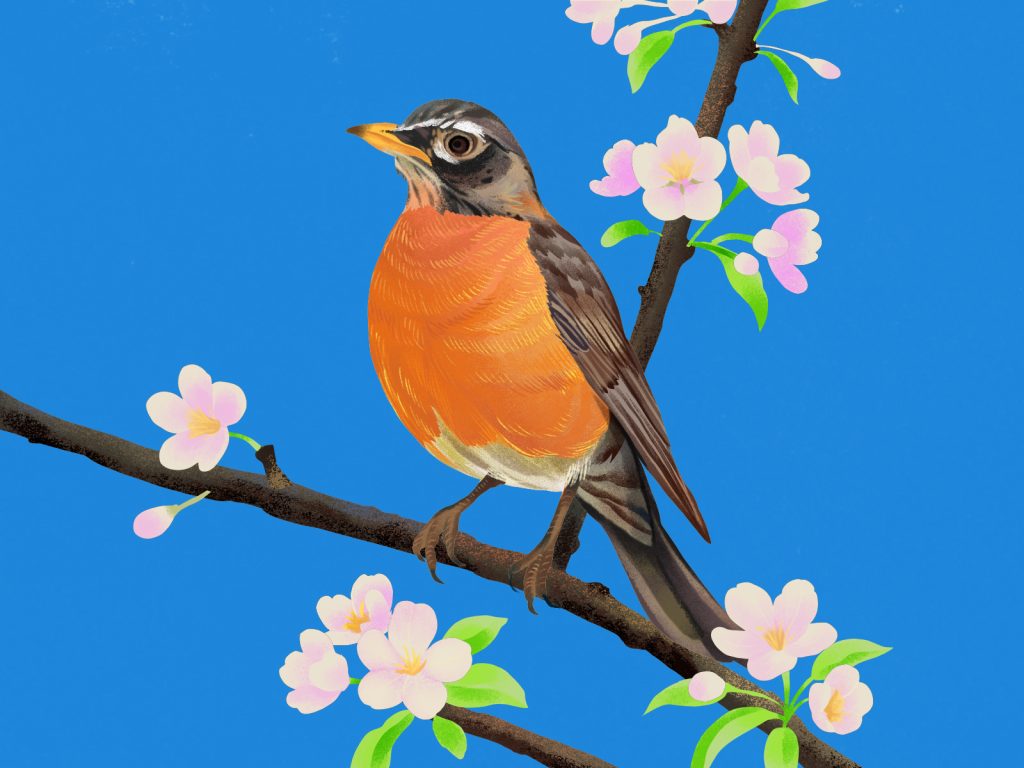
Since medieval times, in Europe and America, the robin has been one of the most celebrated signs of spring. Its red breast adds color to the world at the end of winter; its song brightens the air. In a word, the robin stands for “joy.” For that very reason, in haiku poetry it is often contrasted with darker, colder elements. Last month’s winning and honorable mention poems each found ways to balance the beauty of this favorite songbird with its opposite.
- Airi Zhang asks if anyone living will notice the “quieter mornings” that result from the death of a single robin.
- Gregory Tullock catches a glimpse of the song of a robin “on a morning so frigid” its breath hangs frozen in the air.
- Valerie Rosenfeld celebrates the serenity of a songbird that can go about its business “with no thought of war.”
Congratulations to all! To read additional poems of merit from recent months, visit our Tricycle Haiku Challenge group on Facebook.
You can submit a haiku for the current challenge here.
Plus, join Clark Strand from July 10–12, 2026 for a two-day retreat at Garrison Institute to practice using haiku to unite with the natural world. Read more details and register here.
Spring Season Word: Robin
WINNER:
when a robin dies
does anybody notice
quieter mornings
— Airi Zhang
The winning poem for the March 2026 Tricycle Haiku Challenge reads like a seventeen-syllable coda to Silent Spring. Published in 1962, Rachel Carson’s book was the first work of popular science writing to reveal that pesticide use was causing the widespread extinction of animal life. In the book’s most memorable passage, Carson writes:
Over increasingly large areas of the United States, spring now comes unheralded by the return of the birds, and the early mornings are strangely silent where once they were filled with the beauty of bird song. This sudden silencing of the song of birds, this obliteration of the color and beauty and interest they lend to our world have come about swiftly, insidiously, and unnoticed by those whose communities are as yet unaffected.
She noted, specifically, the story of the American robin, “as a tragic symbol of the fate of the birds—a fate that has already overtaken some species, and that threatens all.”
Carson was vilified by leading chemical manufacturers, including DuPont and Monsanto, but the book accomplished its aim. The Environmental Protection Agency was created in 1970, and DDT was banned two years later. Within two decades the robin population had largely rebounded. It is now one of the most common songbirds in North America.
The winning haiku recalls the title of Silent Spring, which itself was inspired by another poem. In “La Belle Dame sans Merci,” by John Keats, the narrator comes upon a knight who has fallen under a faerie enchantment. As the world around him grows dark and cold, the knight too becomes drained of color and life. The opening stanza reads:
O what can ail thee, knight-at-arms,
Alone and palely loitering?
The sedge has withered from the lake,
And no birds sing.
Carson used the last two lines as an epigraph for the book to “help explain the title.”
“When a robin dies / does anybody notice / quieter mornings?” At first glance, the question seems rhetorical. It is only on further reflection that we realize that the poem demands a response. Would we notice the absence of a single robin from the soundscape of an early spring morning? Would anyone?
I don’t believe for a moment that the poet is scolding us from a place of environmental wokeness. She seems to realize that no one living today—or at least no one with a cell phone—is fully woke to the natural world.
The question at the heart of the poem, then, is deeper than it appears. Is there any high ground left for a species in thrall to the digital age? We may feel outrage at the rollback of legislation designed to protect the world from forever chemicals, microplastics, and climate change. But our consciousness is more attuned to the ping of the news update than to the morning made “quieter” by the death of a single bird.
HONORABLE MENTIONS:
the robin singing
on a morning so frigid
i can see its song
— Gregory Tullock
the backyard robin
is going about her day
with no thought of war
— Valerie Rosenfeld
◆
You can find more on March’s season word, as well as relevant haiku tips, in last month’s challenge below:
Spring season word: “Robin”
to birth a robin
into this world means breaking
a piece of the sky
Submit as many haiku as you please on the season word “robin.” Your poems must be written in three lines of 5, 7, and 5 syllables, respectively, and should focus on a single moment of time happening now.
Be straightforward in your description and try to limit your subject matter. Haiku are nearly always better when they don’t have too many ideas or images. So make your focus the season word* and try to stay close to that.
*REMEMBER: To qualify for the challenge, your haiku must be written in 5-7-5 syllables and include the word “robin.”
Haiku Tip: Enter a Yearly Contest!
Founded by Kiyoshi and Kiyoko Tokutomi in 1975, the California-based Yuki Teikei Haiku Society takes its name from a popular approach to writing haiku in modern-day Japan. Yuki means “with season,” while teikei means “having formal pattern.” Taken together, the words describe the two most familiar elements of haiku: the 5-7-5 syllable pattern and the use of season words. Since 1978, the society has sponsored an annual contest for formal haiku in English, for which the season words are pre-assigned.
In addition to the poems that you submit for our Tricycle Challenge this month, to hone your skills, you may wish to review the season words for the 2026 Kiyoshi & Kiyoko Tokutomi Memorial Haiku Contest and write haiku on any that resonate with you. From among those poems, choose your favorites to send to the contest following the submission guidelines on the society’s website. The deadline this year is April 30, and you can submit your haiku by email.
The Yuki Teikei approach to writing haiku was pioneered by Takahama Kyoshi (1874-1959), the most influential haiku teacher of the 20th century. Kyoshi wrote haiku as an objective sketch from nature and encouraged others to do the same. His “just-the-facts” approach to poetry became part of the DNA of modern haiku, and every poet can benefit from learning to write this way. Yuki Teikei haiku teach us how to convey subtle thoughts and feelings without stating them directly, relying on the images to speak for themselves.
A note on robin: Season word editor Becka Chester writes: “There are two species of robins, both of which are a type of thrush: the American, which grows to around ten inches in length, and its counterpart, the European, a bird slightly over one half the size of the other. Both creatures are distinguished by their rust-red breasts and are famous for their lovely song—a brief melodic warble followed by several extended diminishing notes. Often, this is the first sound heard in spring’s early morning hours. While the American robin constructs a nest of twigs lined with mud, and lays eggs of a bright blue-green hue, the European makes a similar style of nest, but fills it with feathers and produces eggs of a whitish color.”
In Haiku World, William J. Higginson explains the association of both species with springtime: “The European robin redbreast has been thought of as a spring bird throughout British literature, since it comes back to the Isles in spring. The American robin, even though overwintering throughout much of coastal and southern North America, retains the reputation. It tends to spend winter in the woods, living on berries, fruits, and nuts, and comes back to farms and towns in spring to feed on grubs, worms, and insects, when its cheery song announces the beginning of the mating season that characterizes spring in so many species.”
shut up and listen
i tell myself and it works
first robin of spring

Thank you for subscribing to Tricycle! As a nonprofit, we depend on readers like you to keep Buddhist teachings and practices widely available.