When I got off the ferry in Juneau, Alaska, it was eleven o’clock at night and still light out. It was early May, and I had gone north to forge a new life, to see the wilderness, and to find a way to make a living. Soon, my home was a canvas tent on a platform that I built in the woods. I cleaned houses during the day and spent the evenings drinking with friends at the Red Dog Saloon, or down at the Dreamland: white Russians, rum and coke. Months later, in the constant dark of the Alaskan winter, I found myself in a cabin in the snow, thinking about ending my life. Something inside me said, “If you do, you will never know what might have been.” I didn’t know what was wrong, but I knew I needed to find another way to live.
This was the beginning of my path toward recovery and Zen practice, as I began to understand that brokenness, when it is faced and not turned away from, can become a source of healing and a way forward.
Coming back to San Francisco, I slowly began to recover from the chaos of alcohol abuse. Leaving drinking behind, I stepped tentatively onto the path of Buddhist practice, and there I found the rigor and vitality I was looking for: dynamic teachers, Buddha’s prescriptions for living, and the sangha—the community—that was unfolding at San Francisco Zen Center. I came to think of my time in Juneau as “the heart of darkness,” descending into the underworld and emerging into the light, bearing jewels.
Dogen Zenji, the sage of the 13th century who brought Zen from China to Japan, offers us these encouraging words: “To have faith means to believe that one is already inherently in the Way, and not lost, deluded or upside down, and no increase, and no decrease, and no mistake.” I came to understand that my life before practice wasn’t separate from practice. There was no “before and after.” All along, I had been, inherently, in the Way, even when I felt lost. All I needed was to go forward with the intention of being true to myself.
There is a famous story about the Zen tea master Sen no Rikyu. Traveling through southern Japan, he was invited to dinner by a host who wanted to impress him with an elaborate antique jar. Rikyu, though, didn’t seem to notice the jar and instead spoke poetically about a branch swaying in the breeze outside. He said his goodbyes and went on his way. Frustrated, the host held up the jar and hurled it to the floor, where it broke into many jagged shards.
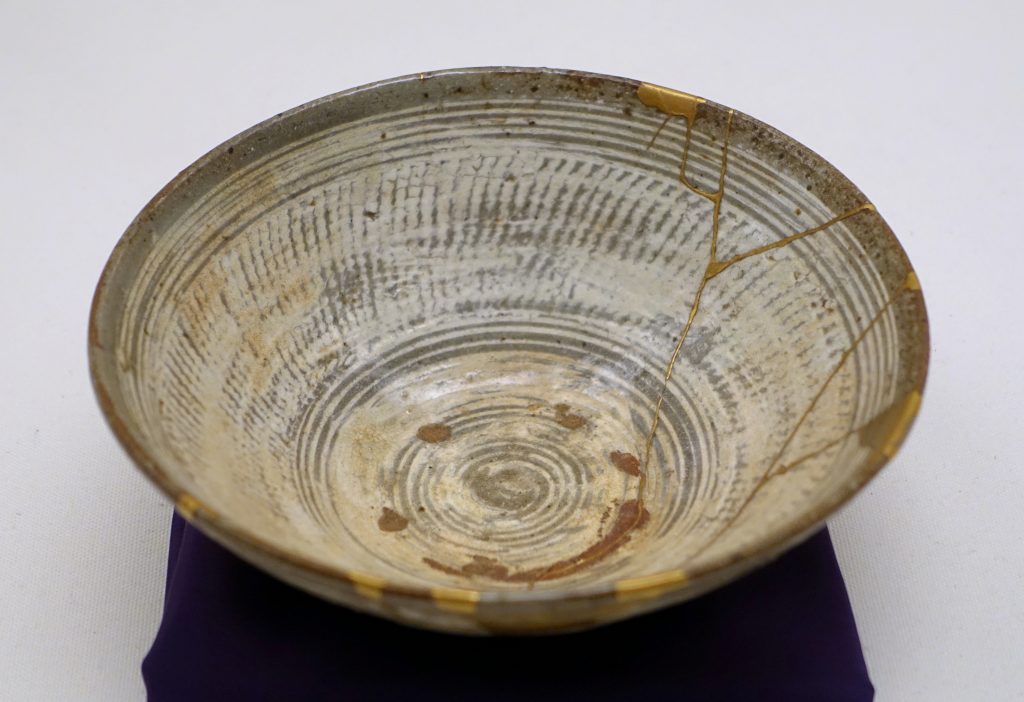
When the host turned to go to bed, his startled guests looked at one another. Gathering the fragments, they joined them using lacquer infused with gold, a technique that came to be known as kintsugi. When Rikyu returned on another visit and saw the repaired jar, with veins of gold highlighting the broken places, he exclaimed, “Now it is magnificent!”
Brokenness, when it is faced and not turned away from, can become a source of healing and a way forward.
People don’t love us for being perfect. Sometimes we forget that the places where we are broken are the places where we shine with gold, where we hold the potential to connect deeply with other beings. If we’ve suffered a terrible loss, we can connect with others who are in pain. If we’ve recovered from addiction, we can share our experience and hope with another suffering addict. In our grief, we can reach out to others who mourn. As we offer others the compassion that flows from our imperfection, even if we’ve made terrible mistakes or committed grievous harm, there is a chance for redemption, for transformation, for alchemy. When we connect deeply with others, healing occurs.
We may feel, as we review our lives, that we carry a burden we can’t put down, the burden of shame or guilt, of remorse for past errors. Perhaps we could turn and embrace the whole of ourselves, the whole of our lives, and recognize that everything that we’ve done, everyone we’ve loved, and every enterprise we’ve embarked on has led us to this moment, even the experiences that we felt at the time were abject failures.
When I first came to Zen Center, I heard that we were going to gather for Ryaku Fusatsu, the Full Moon ceremony. I imagined that we were all going to go up on the roof to admire the moon and write haiku. That night, I was surprised to find myself in the Buddha hall. Half of the residents were on one side of the room facing the residents on the other, a priest in the center, all of us doing countless full prostrations and chanting the ominous words:
All my ancient, twisted karma
from beginningless greed, hate, and delusion
Born through body, speech, and mind
I now fully avow . . .
This is the timeless ceremony of confession that Buddhist communities engage in all over the world, every full moon. I felt the heaviness of my own past; the tangled history of my family going back to the British Isles; my parents, and their parents, and their parents; and all the causes and conditions, far beyond my understanding and control, that had led me to that very moment of existence.
But the ceremony goes on. We honor the buddhas and bodhisattvas who have gone before us. We take refuge in the Buddha as the perfect teacher, dharma as the perfect teaching, and sangha as the perfect life. And we recite the precepts, a guide for living wholeheartedly, with integrity and courage, in this fleeting world.
A few years later, I was training to take on the role of kokyo, leading the chanting for the Full Moon ceremony: “Beings are numberless, I vow to save them; delusions are inexhaustible, I vow to end them; dharma gates are boundless, I vow to master them; Buddha’s way is unsurpassable, I vow to become it. . .” The priest who was helping me told me that once, when he was kokyo, he accidentally recited, “Delusions are inexhaustible, I vow to become them. . .” We had a good laugh about that. And that night, leading the chanting, I did the same thing. Maybe we were on to something. If we face our delusions honestly and befriend them, we can recognize that they are part of what makes us human.
At Zen Center, at the end of a three-month practice period, there is a formal ceremony in which the shuso, the head student, answers dharma questions posed by the participants. In closing, the shuso thanks their teachers and the other students and says, “My mistakes fill heaven and earth, leaving me no place to hide.” In this way, woven into the ceremony is the understanding that none of us does any of this perfectly—nor are we expected to. We might even forget that all these forms and rituals are made up. I understood this more fully when it was my turn, as the outgoing shuso, to say those words and to reflect on, and let go of, my own shortcomings.
There is no notion of sin in Buddhism. Instead, the Buddha taught that, out of ignorance, we sometimes think, speak, and behave in unwholesome and even destructive ways. If we truly understood the harm we cause ourselves and others, we might pause and turn in a more skillful direction. In Hebrew, the word for sin means “to miss the mark,” “to fall short of our goal.” Our missteps, if we are awake to them, can lead us forward. Poor decisions can show us what we need to do differently, and failed relationships can teach us where to go and whom we need beside us on the path. And if we carry a deep vein of resentment toward others for past hurts, shouldn’t we be willing to forgive them and accept them fully, as we wish to be forgiven and accepted?
I was relieved when I stepped onto the path of Zen and found I could put on a black robe, chant in Japanese, and drop my personal story. I thought that a life of meditation, study, and sangha would fix me. At Tassajara, we chant, “This chance seldom occurs in any lifetime,” and I was grateful for the rare opportunity to live, work, and study at the first Zen Buddhist monastery in America. I met my husband there, and we were married in the zendo.
After five years of rigorous practice, after the birth of our daughter, we returned to San Francisco. I was in an unhappy marriage that came to an end, and soon, alcohol began to creep back into my life. I still put on my black robes and went to the zendo, but I felt I was living a double life. Anyone who wakes up to the truth of their drinking knows the double life of the alcoholic.
At the end of my drinking, I said something inwardly that I had never said before: “Please, please help me.” I didn’t know whom or what I was talking to, but in recovery, I learned to listen to a loving inner witness that has always been within me, though I couldn’t always hear her. She said, “Come on, honey, let’s go get some help.” I was ready to get well.
I entered the rooms of recovery the month I went back to school to get my teaching credential. I found in those rooms a power in facing addiction that I hadn’t found before—our collective intention to stay sober and the tools we need to do that. Grounded in practice and recovery, I went on to teach hundreds of children.
In our recovery literature, we find the words, “We do not regret the past, nor wish to shut the door on it.” There was tremendous energy behind that closed door. If I didn’t want to be haunted by the past, I had to reclaim it, to take responsibility for the harm I had caused and make amends to the people I had hurt. I began cultivating a willingness to let go of self-destructive habits and self-limiting behaviors, and to open my mind to new ways of thinking. With the discipline of practice and the down-to-earth principles of recovery, I experienced a new kind of clarity, freedom, and ease. I was finally comfortable in my own skin. By saying “no” to alcohol, I could say “yes” to a whole new world of possibilities. It’s a paradox that when we finally love and accept ourselves as we are, we can also grow.
In recovery, we find that the crazy things we’ve done, the detours we have taken, and the things we were ashamed of can be helpful to others. By sharing those things out loud, the darkness dissipates, and we learn that those experiences weren’t wasted. They are the golden threads, the “kintsugi,” the broken and repaired places where we can meet others on the path toward wholeness.
Those of us in recovery say, “Keep coming back.” And practice is about coming back—coming back to ourselves, coming back to the breath, coming back to right now. We can embody this teaching when we feel we’ve behaved unskillfully, when we have “missed the mark.” We can take note and come back to our practice, to our deepest intention. If we harm someone, we can offer a heartfelt apology and transform our actions so that they align more closely with our vow to live for the benefit of all beings.
This is the path of awakening, in this broken and mended mind and body, laced with gold.

Thank you for subscribing to Tricycle! As a nonprofit, we depend on readers like you to keep Buddhist teachings and practices widely available.