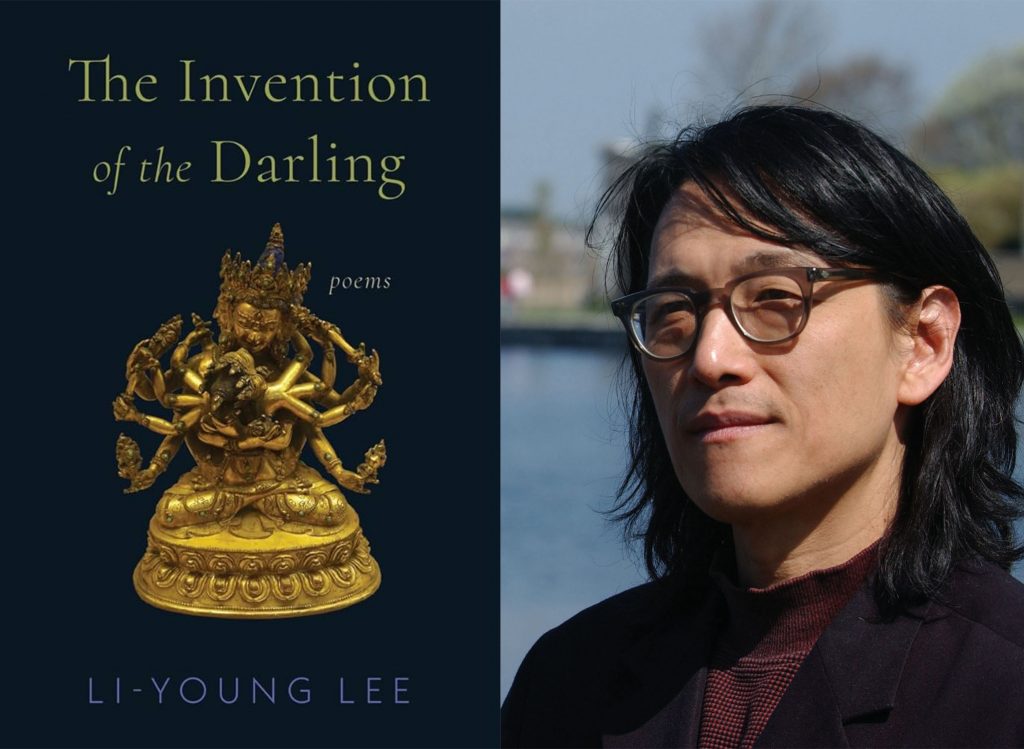
For poet Li-Young Lee, writing has always been a spiritual matter. “I go into some room in my heart or in my soul where it’s just me and God,” Lee tells Christal Ann Rice Cooper for the Asian American Times. “Poetry, contemplation, worship, prayer, all of those kinds of things are in one house but different rooms. When I write poetry, I go into that house.”
Born in Jakarta, Indonesia, to Chinese parents, both political exiles from powerful families, Lee fled the country with his family in the midst of rising anti-Chinese sentiment in the 1950s, arriving in the United States in 1964. Lee and his parents would later move from Seattle to Pennsylvania, where his father attended seminary and eventually became a Presbyterian minister in the small community of Vandergrift. Attending the University of Pittsburgh, Lee would go on to study poetry, attributing his love of language to his father reading to him and encouraging him to pursue his passions.
Lee’s poetry is influenced by the mystical, the philosophical, and the spiritual, and especially by classical Chinese poets like Li Bai and Du Fu. Sometimes called “God’s Hungry Poet,” Lee investigates themes of love, death, and family through intimate narratives, flickering memories, and phantasmic images that blur the lines between the spiritual and the universal. His 2024 collection, The Invention of the Darling, is full of poems that feel compact and yet blossom, connecting refugee stories with koan-like odes to the divine feminine and the nature of grief. Known for the use of silence, or emptiness, in his works, Lee has stated that he aims to create a sense of mystery and awe by exploring the space between words.
–Eds.
Counting the Ten Thousand Things
Start over
counting the falling petals,
I keep losing my place.
Begin again
to number these fellow passengers,
I keep losing our faces among theirs.
With every death,
I lose my story
and have to start over.
With every war,
I lose my future
and have to start over.
With every revolution,
I lose my past
and have to start over.
I lose countries, family, languages, friends,
and have to start over
with Moses and the flight out of Egypt.
Start over in secret, at night
with my mother and father and the escape to . . .
Canaan? Bethlehem? America?
Where was it we thought was safe?
Start over with the serpent cursed
in shameful banishment. With every curse,
I lose the meaning of the garden.
Start over, start over, start over!
No, no, no, she whispers,
Let the petals fall.
Stop counting.
But how will I know what counts?
I keep losing the petals at your gaze.
I keep losing your gaze at your eyes, your eyes
at your lips, your lips at your voice, your voice
at your hair, and I keep losing your hair
at the color of your hair, and the color of your hair
at the song I wrote about the changing color of your hair. Now,
what was I counting?
What was it
I thought counted?
You are one. And I am one, she says.
Together, we make two.
All of the rest are The Ten Thousand Things.
Call a Body
The one with bones
is born of the boneless.
The one with a face
is born of the faceless.
Too obvious?
The one with skin
is born of the borderless.
The one with features
is born of that without features.
Not concrete enough?
That’s the mourning dove you hear.
Any objections?
Too soon the dove?
Maybe it’s no dove calling,
but the voice of the moon
separated from its body, the pale body
missing all day, the paler voice stranded on earth.
Or maybe it’s the sound of existence reminding
you of non-existence.
Or the sound of non-existence
haunting all of existence.
Are you thinking what I’m thinking?
Too married to death.
Too untethered from earth.
Let’s wait for the body
to wash up on night’s starry shore
and its voice to fly off and join it.
You, who will never have a body
long enough to know what it was for
except the two fires—the lifelong yearning,
and then the final offering,—
as long as you go on wishing to be housed
in something other than the disintegrating
vibration you call a body,
you’ll never make any sound
but the sound of the diminishing
half-life of all things.
Can we agree?
The one with brothers and sisters
is born of the peerless.
The one with a mother and a father
is born of the motherless and the unfathered.
The one trailing dust
is born of the dustless.
The one bearing marks
is born of that
upon which no marks can be made.
Have I said anything you didn’t already know?
♦
From The Invention of the Darling: Poems by Li-Young Lee. Copyright © 2024 by Li-Young Lee. Used by permission of W. W. Norton & Company, Inc.

Thank you for subscribing to Tricycle! As a nonprofit, we depend on readers like you to keep Buddhist teachings and practices widely available.