
In the dark after evening meditation, I lose my way several times walking through the woods to my tiny cabin. They call the huts and cabins “kutis” here at the Bhavana Society Theravada Buddhist Monastery, sprawled across sixty acres in the foothills of the stony forested ridges of the Allegheny Mountains in eastern Hampshire County. My LED flashlight blinks on and off while searching for my kuti called Panna, one of the oldest of the two dozen–odd kutis that speckle Bhavana’s woodland acreage, erected since its founding in the mid-1980s in the West Virginia outback.
Panna is a word from Pali—the canonical language of Theravada Buddhism in which the Buddha’s teachings were first compiled. The word signifies wisdom and discernment, considered essential to scoping out the true nature of reality and key to attaining enlightenment. I could use some enlightening as each night I cart the body of my 36-year-old dead son into my kuti—at least, metaphorically, in my jumbled mind and fractured heart—stumbling on stones in the dark or more confident in a cone of illumination, depending on my erratic light. Yet I am deeply glad to be here a month after his shocking self-departure via suicide.
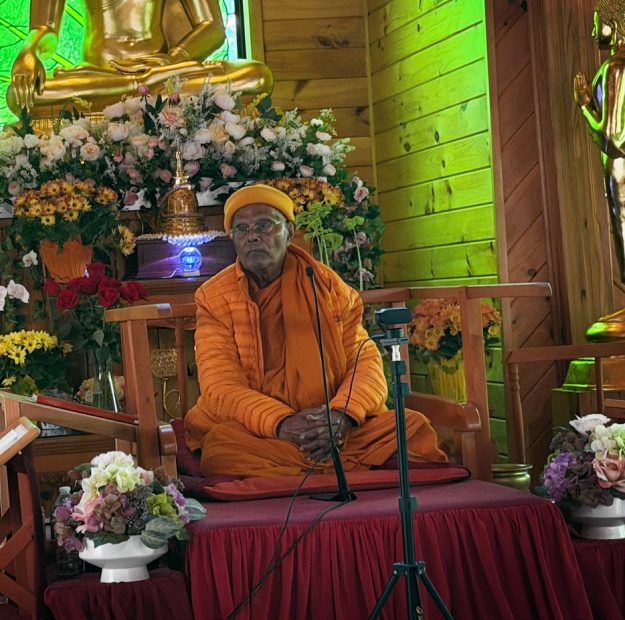
I need the calm and introspection, the instruction and authority, of a meditation retreat led by esteemed guides on the topic of the Buddha’s noble eightfold path. One instructor is my 98-year-old globally known teacher, renowned author, and polymath Bhante Henepola Gunaratana, known across the world simply as “Bhante G.” “Noble silence” is maintained during the four-day retreat, and I am glad for the chance to shut up. We retreatants speak in whispers, working communal tasks during the 8:00 a.m. work-hour or bumping shoulders in apology while undertaking walking meditation. Or we co-caffeinate before each morning’s hour-long sit, which begins at 5:30 a.m. in the meditation hall. (“There’s half-and-half in the small fridge over there,” someone utters in a low tone.)
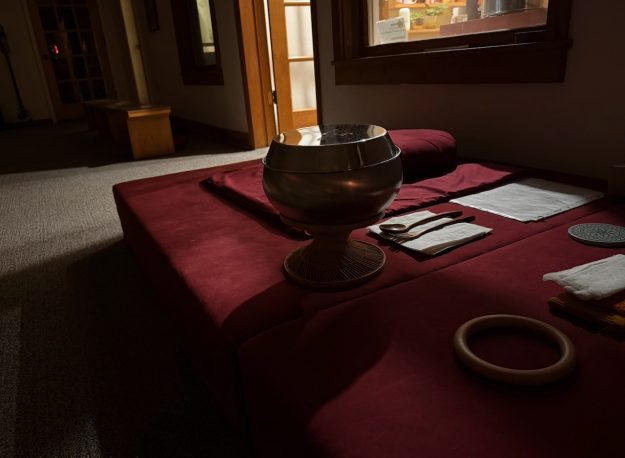
Only the teachers use their indoor voice, as moms used to say. Even questions about each day’s dhamma talks (‘“dhamma” is the Pali of the more familiar Sanskrit word “dharma”) are submitted quietly via a box in the sangha hall, where we store our cups with our names taped on them. That is where we retreatants pour out a riptide of tea and coffee, hot chocolate and oat milk, prepping for meditation or one of the retreat’s two daily meals: breakfast and lunch.
I won’t hazard to explain the Buddha’s teaching in any way that bespeaks authority. Because I don’t have that authority. Plus, far too often I have wandered off the Buddhist path into the briar patch of self-inflicted suffering, tangled up in blues so deep they’ve led to bouts of my own suicidality. So I am no Buddhist maven. Yet I am exactly the sort of wayward soul keen to grok the teachings who can benefit from a deep-dive retreat, perched on one of the Bhavana’s many ochre-red meditation cushions.
Yet I mostly wish to highlight the intriguing fact that one of the world’s leading lights of Theravada Buddhism lives in the West Virginia hills. And that he founded a thriving monastery and—may he live so long—will turn 100 years old on December 7, 2027. As of this moment, at age 98, Bhante G’s mind and guidance are as crystal pure, if a bit slower in delivery, as when I first met him in 1989. I arrived at Bhavana as a newspaper reporter a few years after its founding, intending to write about how a Buddhist forest monastery landed deep in West Virginia’s oceanic woodlands, twenty minutes from the nearest small town of Wardensville and a two-hour drive west from America’s capital city. The place so clicked with me and I with the abbot, that, at his invitation, I later served almost twenty years on Bhavana’s board, but that is a tale for another day.
Of course, I come bearing especially profound baggage to this, my first Bhavana retreat in many a year (which says something about my wayward Buddhist practice). I don’t intend to delve too deeply into a father’s angst. Yet wide awake and wrapped in a sleeping bag long after evening meditation, I pull out my journal and try to make some sense—or maybe just write some sentences—deep in the monastery night. I am thinking of writing a poetry chapbook called Letters to Luka, my pet name for my beloved boy:
……………
I write a word, then another word and then a further word. Who is this writing? The grief-stunned Dad? The wannabe-wise retreatant? The angry father of a son who too easily killed himself because America gives hardly a feck who gets a gun and how—here you go, sonny, after 10 minutes of window-shopping at Academy Sports and Outdoors, have some fun with that. Meanwhile, outside my kuti I hear the ballast of tree frogs and the whir of a million crickets. Now and then, an owl ‘hoot-HOOTS!’, which must turn the blood of shrews and mice to ice.
I am mostly calm from several days and hours of deep and then deeper meditation. All of a sudden, stark memories intrude of the Dad who found his son and I want to scream my boy’s name into the cool September evening air to call him back to my side. Yet a cry seems in-apt for the monastery night, wrapped round my tiny lodging for hundreds of yards in all directions and many miles beyond that in the four compass directions of deepest Appalachia. So, the chatty September insect and animal night-song of the ancient woods continues on, uninterrupted.
………………
There are other ways we retreatants communicate in our noble silence. On our cushions and chairs we rest chock-a-block, two feet separating us to the front, back, and on either side. Men sit on cushions to the left of the hall, women to the right. I see beside me that a fellow with a goatee brought a wooden meditation bench with rounded wooden sides. His legs fit beneath this neat seat, so he can adjust his body while sitting by rocking slightly, forward and back. After the bell rings to end one session and we bow three times to the big golden Buddha at the head of the hall, I whisper to him: “That looks neat to use. . . .” He smiles back.
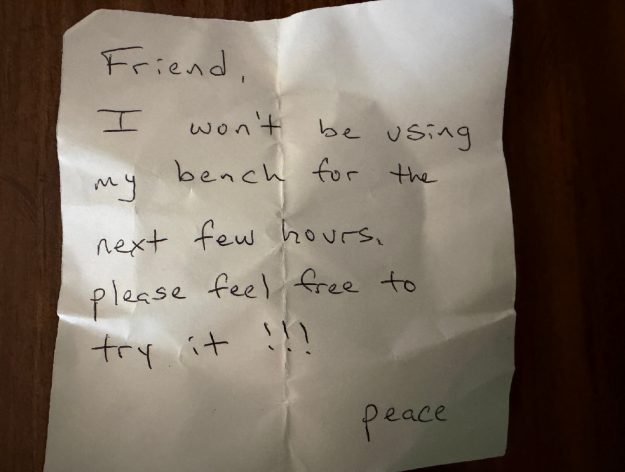
The next morning, my sitting compatriot has relocated to a chair at the side of the room. A handwritten note rests on my cushion:
“Friend, I won’t be using my bench for the next few hours. Please feel free to try it!!! Peace”
I look over at him, seated in a chair near the wall. He grins broadly at me and gives me a thumbs-up. I namaste in return. I like the rocking bench so much that following this retreat, I am thinking of adding it to the “Christmas Gifts for Dad” list my wife and dear daughter harangue me constantly to fork over. Human beings can be so lovely and so utterly cool.
I spend my work-hours in the monastery library, copyediting a new book by Bhante G. It is a magnum opus tentatively titled Seeing Things as They Are on the lifelong seriousness of purpose and sustained ethics needed to deepen a meditation practice on the path toward enlightenment. He and I worked on a prior book (with help from Patrick Hamilton and Judy Larson) titled What Why How: Answers to Your Questions About Buddhism, Meditation, and Living Mindfully (Wisdom Publications, 2020), which has since been translated into Italian, French, German, and Vietnamese. While that may sound impressive, Bhante G’s Mindfulness in Plain English, hailed by lay meditation maestro Jon Kabat-Zinn as “a masterpiece,” has been translated into nearly thirty languages.
While working my way through the first seventy-five pages of what will likely be Bhante G’s final book, I come upon words on grief that speak to my family’s devastating loss. The words resonate with me so much so that I forward them to my wife and daughter and ask Bhante G if I might quote them at my son’s memorial gathering next month:
Sorrow ordinarily arises because we cling to a person, an object, a position, an experience, or an idea of ourselves. When what we love changes, separates from us, or disappears, grief arises. Lamentation is the outward expression that may follow this sorrow. . . . Mindfulness does not ask us to deny grief or pretend that loss is pleasant. It helps us know sorrow as sorrow. Clear comprehension then investigates the attachment, expectation, and perception that sustain it. We begin to understand that everything conditioned is subject to change and that clinging to what must change brings suffering.
As this understanding deepens, sorrow is no longer fed blindly. Compassion can remain, love can remain, and responsibility can remain, but grasping gradually weakens. This is how the practice leads toward the surmounting of sorrow and lamentation.
I am assigned one physical task during the retreat: to brush leaves and twigs off the approach paths and porches to the men’s kutis. I find a small broom that looks like it might be from the house that Dorothy Gale lived in out in the Kansas cornfields, before she got swept away to Oz. I grab the miniature broom and get to work. I weave my way across hillside paths that crisscross this way and that to kutis with names like Rahula, Kalingaram, Lakhanna, Piti, and Sivali, among others. By the time I am done, I am breathing heavily. Yet, as I look back and survey my hour’s efforts, I feel as though it may be the most satisfying work I have done, in its small leafy way, in all of 2026, thus far.

I retire the broom to the doorway of my kuti. Evening sitting time approaches, and my meditation cushion calls.
◆
This piece was adapted from an article originally published on the West Virginia Ville Substack and was republished with permission.

Thank you for subscribing to Tricycle! As a nonprofit, we depend on readers like you to keep Buddhist teachings and practices widely available.