
“A felt sense of wonder, thankfulness, and appreciation for life” is how the renowned psychologist Robert Emmons defines gratitude. If you’re feeling low, it might seem a stretch to focus on something so positive. Yet recognizing the gifts in your life is profoundly steadying, increasing your psychological buoyancy, which helps you maintain your balance and poise when entering rough waters. Put simply, our gladness to be here, when the continuation of life itself is in doubt, kindles our resilience. Our essential wonder at the root of life empowers us to face the unprecedented perils of our time.
Gratitude Promotes a Sense of Well-Being
Recent research has shown that people experiencing high levels of gratitude tend to be happier and more satisfied with their lives. Are they grateful because they’re happy, or does gratitude make people happier? To find out, volunteers were asked to keep gratitude journals in which, at regular intervals, they recorded events they felt thankful for. Controlled trials have shown this simple intervention to have a profound and reliable impact on mood.
Our gladness to be here, when the continuation of life itself is in doubt, kindles our resilience.
The process of keeping a gratitude journal focuses your attention on ways you’re appreciating and being resourced by what’s around you and within you. If each evening, before you go to bed, you ask yourself, “What happened today that I’m glad about?,” you will start searching for recent memories that bring a glow of contentment. They might be of small things, such as a conversation with a friend, a minute of watching a bird in flight, or the satisfaction of completing a task. When we’re busy, moments like these can too easily pass us by, but a gratitude diary builds them into a pool of memories we can be nourished by. Such a simple step trains our minds in a basic capacity for awe and reverence, this countering the undermining impact of panic or paralysis. Experiencing gratitude is a learnable skill that improves with practice. It isn’t dependent on things going well or on receiving favors from others. It’s about getting better at spotting what’s already there.
Gratitude has three elements. The first is appreciation, the valuing of what has happened. The second is attribution, where another’s role is recognized. The third is giving thanks, where rather than just experiencing gratitude, you give it legs by acting on it.
Gratitude Builds Trust and Generosity
Gratitude nourishes trust, helping us acknowledge the times we’ve been able to count on one another. By making us more likely to return favors and help others, it also encourages us to act in ways that strengthen the networks of support around us. As psychologists Emily Polak and Michael McCullough point out, “Gratitude alerts us that there are people out there with our well-being in mind, and it motivates us to deepen our own reservoirs of social capital through reciprocation.” In such ways it plays a key role in the evolution of cooperative behavior and societies.
Gratitude as an Antidote to Consumerism
While gratitude leads to increased happiness and life satisfaction, materialism—placing a higher value on material possessions than on meaningful relationships—has the opposite effect. In reviewing the research, Polak and McCullough conclude: “The pursuit of wealth and possessions as an end unto itself is associated with lower levels of well-being, lower life satisfaction and happiness, more symptoms of depression and anxiety, more physical problems such as headaches, and a variety of mental disorders.”
Affluenza is a term used to describe the emotional distress that arises from a preoccupation with possessions and appearance. Psychologist Oliver James views it as a form of psychological virus that infects our thinking and is transmitted by television, glossy magazines, and advertisements. The toxic belief at the core of this condition is that happiness is based on how we look and what we have.
When women were asked to rate their self-esteem and satisfaction with their appearance, measures for both fell after the women looked at photos of models in women’s magazines. How we feel depends so much on what we compare ourselves to, and an increase in eating disorders is one of the consequences of having thin models as a reference group. In 1995, the year television was introduced to Fiji, there were no recorded cases of bulimia on the island. Yet within three years, 11 percent of young Fijian women were found to be suffering from this eating disorder.
Gratitude is about acknowledging the gifts in what you’re already experiencing. The advertising industry undermines this by convincing you that you’re missing something. On a website for marketing professionals, the advertiser’s Law of Dissatisfaction is described like this:
The job of advertisers is to create dissatisfaction in its audience. If people are happy with how they look, they are not going to buy cosmetics or diet books. … If people are happy with who they are, where they are in life, and what they got, they just aren’t customer potential—that is, unless you make them unhappy. …
The audience, after seeing what they could look like, is no longer happy with what they do look like, and they are now motivated to buy into the promise of change.
Research shows that people living in countries that spend more on advertising tend to be less satisfied with their lives. Depression has reached epidemic proportions, with one in two people in the Western world likely to suffer a significant episode at some point in their lives. The consumer lifestyle isn’t just wrecking our world; it is also making us miserable. Can gratitude play a role in our rehabilitation?
In looking at what drives materialism, psychology professor and researcher Tim Kasser identifies two main factors: feelings of insecurity and exposure to social models expressing materialistic values. Gratitude, by promoting feelings of satisfaction with what you have, counters feelings of insecurity and pulls us out of the rat race. It shifts our focus from what’s missing to what’s there. If we were to design a cultural therapy that protected us from depression and, at the same time, helped reduce consumerism, it would surely include cultivating our ability to experience gratitude.
Blocks to Gratitude
At times gratitude comes easily. If you’re falling in love, having a run of good luck, or just generally delighted with how things are going, appreciation and thankfulness might feel natural. But what if there isn’t so much to feel happy about? What about the times when relationships go sour, you experience injury or violation, or the landscape of your life looks bleak?
If you’re facing a tragedy in your life or in the world, searching for reasons to be grateful might initially feel uncomfortably close to denial. But you don’t have to feel thankful for everything that’s happened. It is more a case of recognizing there’s always a larger picture, a bigger view, and that it contains both positive and negative aspects. To find our power to see the hard parts clearly and respond constructively, we need to draw on resources that bring out the best in us. Gratitude does this. It’s a resource we can learn to tap into at any moment.
To find our power to see the hard parts clearly and respond constructively, we need to draw on resources that bring out the best in us.
Here’s an example. Julia had just seen the news. She felt outraged. A school in a refugee camp had been bombed, children were killed, and she was so full of fury she could hardly speak about anything else. Then, for a moment, she thought of the reporters who had covered this story. They had risked their lives so that she could be kept informed. The news editors may also have stuck their necks out, choosing to include this item in their program rather than the latest celebrity gossip. As she thought about the steps they had taken, she felt grateful. Her gratitude reminded her she wasn’t alone in caring about what happened.
When violations and injustices occur, trust is often a casualty. Loss of trust makes it harder to experience gratitude; even when help is given, the distrustful part of us may wonder what agendas are hidden behind the support. When trust is broken or undermined, is it possible to rebuild it? Trust and gratitude feed each other: to deepen our capacity for thankfulness in difficult times, we need to learn from those who have mastered this quality.
Learning from the Haudenosaunee
In autumn 1977, delegates from the Haudenosaunee, Native Americans also known as the Iroquois Confederacy, traveled to a UNComing from Gratitude 49 conference in Geneva, Switzerland. They had a warning and a prophecy to share, presenting it alongside a description of their core values and view of the world. Their “Basic Call to Consciousness,” as it is known, contained the following paragraph:
The original instructions direct that we who walk about on the Earth are to express a great respect, an affection, and a gratitude toward all the spirits which create and support Life. We give a greeting and thanksgiving to the many supporters of our own lives — the corn, beans, squash, the winds, the sun. When people cease to respect and express gratitude for these many things, then all life will be destroyed, and human life on this planet will come to an end.
The Haudenosaunee regard gratitude as essential in a world they understand as sustained by the interdependence of all things. From the perspective of Western individualism, that view might seem hard to grasp.
A timber executive once remarked that when he looked at a tree, all he saw was a pile of money on a stump. Compare this with the view held by the Haudenosaunee, who thought that trees should be treated with gratitude and respect. If we understand how essential trees are to our very breathing, we want to support them. Such a dynamic pulls us into a cycle of regeneration, in which we take what we need to live and also give back.
Receiving from the past, we can give to the future.
Much of the oxygen we breathe comes from plants that died long ago. We can give thanks to these ancestors of our present-day foliage, but we can’t give back to them. When we are unable to return a favor, however, we can pay it forward to someone or something else. Using this approach, we can see ourselves as part of a larger flow of giving and receiving through time. Receiving from the past, we can give to the future. When we are tackling issues such as climate change, guilt and fear need not be our only motivation. Gratitude can be equally powerful and fundamental to the self-organizing intelligence that supports life.
♦
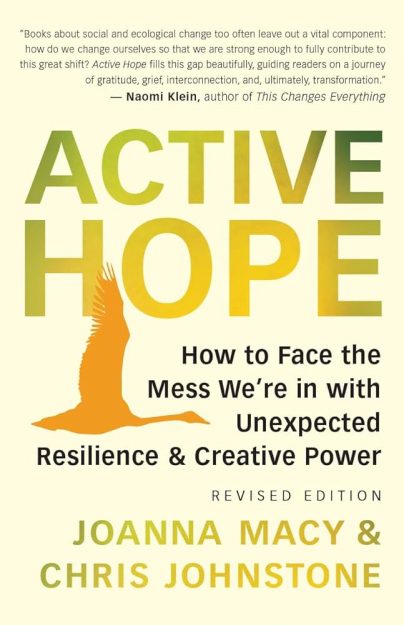
Excerpted from Active Hope: How to Face the Mess We’re in with Unexpected Resilience & Creative Power. Copyright © 2022 by Joanna Macy & Chris Johnstone. Reprinted with permission from New World Library.

Thank you for subscribing to Tricycle! As a nonprofit, we depend on readers like you to keep Buddhist teachings and practices widely available.