
The very first time Thay (the name by which Thich Nhat Hanh was known to me and many others) spoke to me, it was to ask me to bring the buddhadharma—the teachings of the Buddha—back to India. I did not know then how deeply those words would imprint themselves on my mind and give shape and meaning to my life. It was the summer of 1987. I was in Ojai, California, a burned-out activist and seeker who had never even heard of Thich Nhat Hanh. We were a bunch of us organizing an artists’ retreat where Thay was to be the guiding teacher, but none of us could pronounce his name, so we called it the “Kick the Can” retreat.
Of course, once he arrived, his presence was unforgettable. I stayed in the background, not once speaking to him in the six days he was there, just doing a recording of his talks on a cassette player. But as he was leaving, just as he was about to get into the car, seeing me among the volunteers that had come to say goodbye, our eyes met, and he said, “Bring the good buddhadharma back to India.”
Six months later, when I returned to India, I found myself increasingly interested in Buddhism, gravitating to whichever Buddhist teachers I could find at home. I went on a five-day retreat with the Dalai Lama in Sarnath, and another ten-day retreat led by the Vipassana teacher S. N. Goenka in Igatpuri.
This new curiosity about Buddhism led me back to the man with whom I had barely exchanged a word. Three months after I arrived home, I wrote to Thay, offering to host him in India, should he ever want to visit. I did not even dare to expect a reply. But, about a fortnight later, there was a call. It was Sister Chan Khong, who would later become the first person to be ordained as a monastic by Thay in our lineage, now known as the Plum Village tradition. Thay wished to come to India to visit the Buddhist sites, she said, and would I be able to help? Overjoyed, I accepted the offer instantly. Without knowing him well, I felt in my bones that he could be the teacher I had been looking for all my life. And this was my chance of a lifetime to be with him.
The only problem was that I was clueless about how to organize the trip; I knew almost nothing of the Buddhist pilgrimage routes. I had been to some of these sites as a child. But organizing for Thay was another matter.
Nevertheless, I set to work. I went on a reconnaissance trip with a friend to all the Buddhist sites, some of which I had never visited before, trying to locate accommodations and confirm logistics.
How different it was when Thay arrived! He came with an entourage of thirty people from different countries, from Argentina to Australia and France to the US. They spent the first three days in Delhi. In my innocence—and to keep costs down—I had arranged for their accommodation in the YMCA youth hostel frequented by backpacking tourists from abroad. But Thay and his group were unperturbed, making themselves serenely at home among the backpackers. They even infused the youth hostel with an energy of mindfulness it had never experienced before or since.

The evening after the group landed, I invited Thay to our home. Our home then was a magisterial bungalow, Rajaji Marg, in the center of New Delhi, allotted to my mother, who was then a senior judge at the Delhi High Court. Besides my parents, brother, and sister, I had invited some twenty of my local friends to meet Thay. It was supposed to be one of those tea parties that my mother often hosted, but somehow Thay’s presence transformed the occasion for everyone there.
As we were having tea in the drawing room overlooking a large garden, the telephone rang. My mother instantly got up to attend to the call. Thay did not even seem to notice, but when she returned from her call, Thay began sharing with us his practice of telephone meditation—the art of stopping and coming back into the present moment each time one hears the sound of the telephone. He turned even the sound of the telephone into a meditation bell.
That tea party was so memorable for the way Thay used every moment as a deep teaching, without appearing to teach at all. On the surface, he was just being social, talking to everyone, but there was not a moment when he ceased teaching.
After tea, we went to sit in the garden. It had a pond with purple waterlilies. I had laid out some cotton carpets, thinking that after our tea, we would sit in the garden to hear Thay teach. But Thay was teaching long before we went into the garden, and we didn’t even think of it as a teaching. Whether it was inside or outside, Thay sat equally still, and his calm communicated itself to us, whether we realized it or not. In the garden, Thay began to share very gently and informally what he had been doing all through the tea party—the art of mindfulness in every moment of our daily lives.
He stood up, and all of us got up too. Walking a few gentle steps, he spoke about how to stay mindful of our steps and breath at the same time. Suddenly, I was seeing our garden as if for the first time.
With Thay leading us, I could look more deeply into the beautiful Sita Ashok tree in the garden, the trunk, the shapes of the leaves, the colors, and the first glimmerings of the realization that even though we could not see the beautiful sunset-colored flowers of the tree, they would manifest themselves in the right season. And it was not just me. Each of the thirty or more of us in the garden was touched deeply by Thay’s simple teaching and walking. Several, including my brother, decided to join for part or the whole of the pilgrimage. My sister had already offered to come anyway just to support me.
I was aware, of course, that Buddhism had pretty much disappeared from India, the land of its birth, but it was during this first pilgrimage with Thay that I discovered how much of the old animosity against Buddhism still persisted.
Thay wanted to start the pilgrimage in Sarnath, as that is where the Buddha had offered his first teachings. By the time we reached the government guesthouse in Sarnath, our group was tired and in need of a good sleep. But just outside the guesthouse, a tent had been pitched and loud Hindu bhajan were blaring out of it till late at night from discordant speakers. The noise was unbearable. I went across to the tent to try and get them to either switch off the microphones till the morning or at least to reduce the volume. I found just two people in the tent, half asleep, by a cassette recorder and amplifier. I explained to them that there was a community of Buddhist pilgrims across from them who needed their sleep. But my plea to them had an opposite effect. Instead of reducing the volume, they increased it, saying that Hinduism was the religion of this land and not Buddhism.
But Thay was teaching us in his gentle, unassuming way how Hinduism and buddhadharma are inseparable. When we were in Varanasi, the daily Hindu rituals by the river Ganga were very much part of our pilgrimage. Thay made us understand that the Ganga was not sacred just for Hindus; its sacredness belonged to all spiritual traditions.
When we walked into the Deer Park in Sarnath, Thay paused near the entrance to the park and had us gather around. He shared how each step we were making was literally in the footsteps of the Buddha. If we were mindful, we could walk with the awareness of the Buddha and transform our feet into Buddha feet. As we walked, in a single line, following Thay, it felt like we were walking with the Buddha. Occasionally, he would gently ring a small bowl-shaped meditation bell, and all of us would stop. We would touch the present moment in a deep way, aware of our breath, the positions of our body, the temperature, the light breeze, the sounds, the colors. All that was within and around us in those moments.
Each day was magical on the pilgrimage. Each day was a profound teaching.
In Bodh Gaya, Thay offered to the bodhi tree growing there on the site of the tree where the Buddha had awakened a copy of his biography of the Buddha, Old Path White Clouds, that he had just completed. We spent a week there, staying at the Vietnamese temple that had just opened. Most days, we visited the Mahabodhi temple. We sat under the bodhi tree, meditated, and Thay would teach. Thay had a way of bringing the Buddha alive for us. When he talked of the Buddha, it was as if we were under the same tree that the Buddha had sat under 2,600 years ago. He brought alive the Buddha’s physical and psychological struggle, the children who became his companions, and the natural vegetation, the tree under which he sat, and the Niranjana River flowing close by. The Buddha’s presence shone through Thay, sitting there so calmly, smiling and being totally present. When he looked up at the bodhi leaves, we saw the Buddha through Thay’s eyes and understood how the Buddha had possibly gleaned his deep teachings of interbeing by penetrating the reality of the leaf—the sunshine, the clouds, the earth, the air, and space that had enabled it to manifest.
Each day, we walked meditatively around the temple, attentive to each step, as the Buddha had been. On one side of the temple, there were stones laid down on the path as reminders of each mindful step the Buddha took. But with Thay there, we hardly needed a reminder. Each mindful step we took, he told us, helped others to do the same. With Thay there as our teacher, we were also learning to be co-teachers.
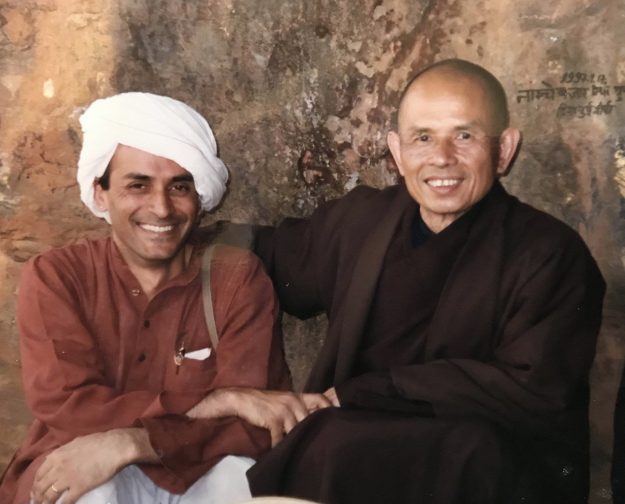
Each moment was something to be cherished, fully alive and present to whoever and whatever we encountered. As we passed farmers and pastoralists, we stopped and spoke to them about their lives and interests, the rearing of animals, and the seasons. We joined some of them in threshing. Children from the villages gathered around us, and we occasionally stopped and sat in the shade of a bamboo thicket or large banyan tree, shared tea, and sang songs. Thay picked up a bamboo leaf and showed the children how to split and roll it so that when they blew through it, it made a sound like a flute.
By the time we got to Rajgir, I could see how deeply Thay knew the Buddha and the places associated with his life. Vulture Peak was especially dear to him. When I was making the schedule, he had suggested we spend five days there. I wondered why—as a child, I had visited the hot springs in Rajgir with my father, but never Vulture Peak, as it was just a hill with nothing there of special interest. But those five days spent at Vulture Peak were truly special when experienced with Thay. Each morning, we would climb the hill, often before sunrise, and come down after sunset. Walking behind him, as he placed his feet on the same path the Buddha had walked 2,600 years ago, and stopping from time to time to look over the hills and forested landscape unchanged since the Buddha’s time, it felt like we were walking with the Buddha, seeing with his eyes. With Thay leading us, it was easy to feel a deep sense of non-separation with everything within and around us. Watching the sunset each evening as the Buddha had, in silence, gave us a sense of great joy.
An especially memorable day was on November 10, 1988, when Thay ordained the first three monastics in our order. We climbed up to Vulture Peak and all thirty-five of us seated ourselves in a formal arrangement on the flat platform at the top of the peak. Thay was in his formal sanghati monastic robe. There was only one other monk from Vietnam, Dr. Lam (in whose guest house we had stayed in Bodh Gaya), and one nun, but it felt as if there were a huge gathering of monastics and lay people, including the Buddha, to witness this historic ceremony.
In his gentle yet solemn way, Thay conducted the ordination ceremony. We were all so moved, and there were tears of joy as Sister Chan Khong, Sister Annabel, and Sister Thanh Minh’s heads were shaved. Later, Thay ordained five members into the Order of Interbeing and five others, including me, were offered the three refuges of the Buddha, dharma, and sangha, and the five precepts, as they were called at that time (later they would be known as the five mindfulness trainings). I was given a dharma name in Sanskrit by Thay that day, Chitta Bhadra, which Thay translated as “Kindness of the Heart.”
Our pilgrimage journey had been tough, and some of the living conditions were very basic—there were rats running across our bedrooms in Rajgir. So, when we arrived in Patna, we were all overjoyed to find running hot water, air conditioning, and an excellent restaurant in our hotel. At least the next three days and nights that we had scheduled in Patna could be spent in comfort. But the next morning after breakfast, Thay called me aside to say that he had decided we would go on to Vaishali. I was dismayed as it would be impossible to find decent accommodation in Vaishali, but Thay was adamant that instead of staying two more nights in Patna, he wanted to move to Vaishali.
Thay was not at all concerned with creature comforts or accommodation; so, we left it to the group to choose for themselves whether they wanted to stay back in Patna or risk the limited and basic accommodation available in Vaishali. Finally, only eight of us left for Vaishali. We found only three rooms available in a government guest house there and had to stay three or four to a room.
We were welcomed in a most beautiful and touching way. The families were poor and laid out some cloth for us to sit on the earth in front of their homes. They chanted the three refuges and the five precepts in Pali, as the Sri Lankans do (and may have taught them). After that, our group offered some chants and made some offerings at their small shrine. Thay loved being there, and the locals were so happy with our visit that they suggested we start a center near them. They said they would help in any way, and Thay later mentioned to me that we could start a Plum Village mindfulness practice center in Vaishali.
At Lumbini, we visited the Ashokan Pillar with the inscription in the Brahmi script of the third century BCE, mentioning that the Buddha had been born here. Each evening, we would sit to share in dharma discussions, while we stayed at the garden guesthouse. Thay emphasized how each birth was miraculous and if there were the right causes and conditions, as had been at the time of the Buddha, any child had the potential to awaken to be a Buddha.
The pilgrimage was nearly over, but not Thay’s teaching. We crossed back over the Indo-Nepal border at Bhairava/ Sanauli. There was a long row of trucks waiting to get a permit to get across the border; this created a massive traffic jam. Fortunately, as we were a passenger bus, we were able to edge our way past the trucks and, with a few smiles and a lot of patience, got our passports stamped. Throughout all this, Thay remained completely calm, accepting, and absorbing things as they were and responding appropriately with just the right amount of energy needed.
As we closed our pilgrimage circle, which we had named “In the Footsteps of the Buddha,” Thay suggested each one of us write an insight poem; one that was inspired by our journey together. It was a lovely way to hear each person’s voice and insight.
The pilgrimage was ending, but our lives would never quite be the same again. For me, it felt as if this was the beginning of a spiritual journey that I am still on. Thay encouraged me to go on the same pilgrimage each year as a practice and invite others to join me so that they too could meet the Buddha. Since then, I have been on this pilgrimage—In the Footsteps of the Buddha and Thay—more than a hundred times. I feel blessed to have had this practice suggested to me by Thay, my teacher. Each time I go, I feel closer to the Buddha, my spiritual guides, my land ancestors, and the living dharma.
Thay had shown us the path of awakening as a human being, of being the white cloud in the blue sky. He always had confidence that we, his students, had that potential too.
On the night of November 11, 2014, I was in Kushinagar, where the Buddha had passed away. It was there that I heard that Thay himself might be dying. He had suffered a massive stroke. Over the next days and weeks, it was uncertain that he would survive. I went to visit him in the hospital in France over Christmas, and though extremely weak, he held my hand and smiled. Miraculously, Thay had been revived, and with excellent medical support and deeply compassionate care, he lived on, though he could not speak again and was confined to a wheelchair.
However, his presence was very strong. When Gitu and I visited him in Thailand, he looked deeply into her eyes and then my eyes for a long period, transmitting his feelings without words, deep into our being.
Thay was determined to return to Vietnam and live the last phase of his life there at the Tu Hieu monastery in Hue, where he had been ordained and was the de facto abbot. When I awoke on January 22, 2022, I saw a message from the abbot of Plum Village’s Upper Hamlet: “Our teacher is now free as a cloud.”
Thay had passed away peacefully at midnight at our root temple in Hue. I felt that Thay was free as the Buddha was, many centuries ago. There are not many who are able to transcend the constraints and concepts of birth and death. Thay had shown us the path of awakening as a human being, of being the white cloud in the blue sky. He always had confidence that we, his students, had that potential too.
His presence and teaching touched the lives of countless people, and his presence remains in all of us who were fortunate to have known, heard, and read him. His lineage continues in many schools, in many hearts, and in the many sanghas in the Plum Village tradition. He helped cultivate and renew the branch of Engaged Buddhism in the land of its birth in a way that is accessible and appropriate to our times.
♦

Adapted from Touching Peace: Practicing the Art of Mindful Living by Thich Nhat Hanh. © 1992, 2009, 2025 by Plum Village Community of Engaged Buddhism, Inc. Reprinted with permission from Parallax Press.

Thank you for subscribing to Tricycle! As a nonprofit, we depend on readers like you to keep Buddhist teachings and practices widely available.