“When I was a boy in Uganda,” Bhante Buddharakkhita told us early in our Walking with the Buddha pilgrimage in March 2026, “I was so frustrated when I just could not get a delicious-looking mango to fall from the tree, no matter how many ways I hit it with a stick.”
“My brother always seemed to succeed,” he added with his characteristic laugh, “but me? Never!”
Then his brother told him the problem: He wasn’t aiming high enough. He had to hit the branch above the fruit. Bhante learned and reaped the fruits of his labor—literally and metaphorically. He started reaching higher, a lesson he carries even today in his life and teaching.
During our time together, Bhante Buddharakkhita often talked about the Buddhist monastery he founded in Uganda, a center that today not only trains monks but also educates children through high school as well as aiding the local community through providing medical resources, access to clean water, and expertise on how to build more boreholes, or wells, all while teaching meditation. Pragmatism goes hand in hand with a strong Buddhist faith as the foundation of the Ugandan Buddhist Centre (UBC). In a country where proselytizing is the rule, Bhante doesn’t seek out followers. He simply offers the teachings of the Buddha even as he welcomes and honors local traditions. (The Buddhism he teaches in Uganda, he says, always has “an African flavor.” What flavor is that? he was asked. He answered, “Chocolate.”) And the number of people who come to the Buddhist center continues to grow.
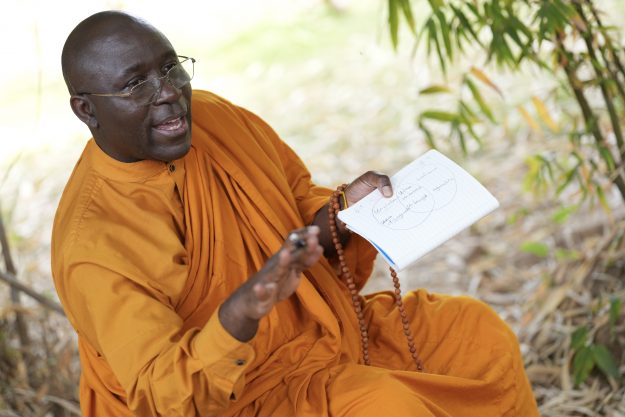
“When I started the monastery,” Bhante recounts, “it was a monastery in a tent. And I was the only member.” Bhante laughs at the memory. He never doubted his purpose and never entertained the idea that he would not succeed. He continues, “Then a second member joined: my mother!” Bhante’s mother, who has since become a Buddhist nun and still lives at UBC, had, in fact, launched him on his journey to meditating and to being a monk. From the time he was young, she would say, “If you have nothing to say, keep quiet.” And so he did.
I saw the announcement for the Walking in the Steps of the Buddha pilgrimage on Tricycle.org almost a year ago. Of course, the opportunity to travel with like-minded pilgrims, who turned out to be remarkably generous practitioners, beckoned. But it was Bhante’s smiling face, looking at me from the screen, that sealed the deal.
Still, I did not know what to expect. I had never spent much time with a monk, and during our travels together, I learned the rhythm of a monastic’s life at the same time that I learned from his dharma talks. Our pilgrimage days started very early since Bhante did not eat after noon. Though I had spent time in Thailand watching ordinary people on the street and in temples offer monks food, I had not translated that to how a monk like Bhante might practice in a pilgrimage setting.
The first time I was the one to be able to offer Bhante food was a thrilling honor. Even though I was just serving him regular breakfast food—porridge and yogurt and bread and fruit—I felt that I had become part of a millennia-long tradition.
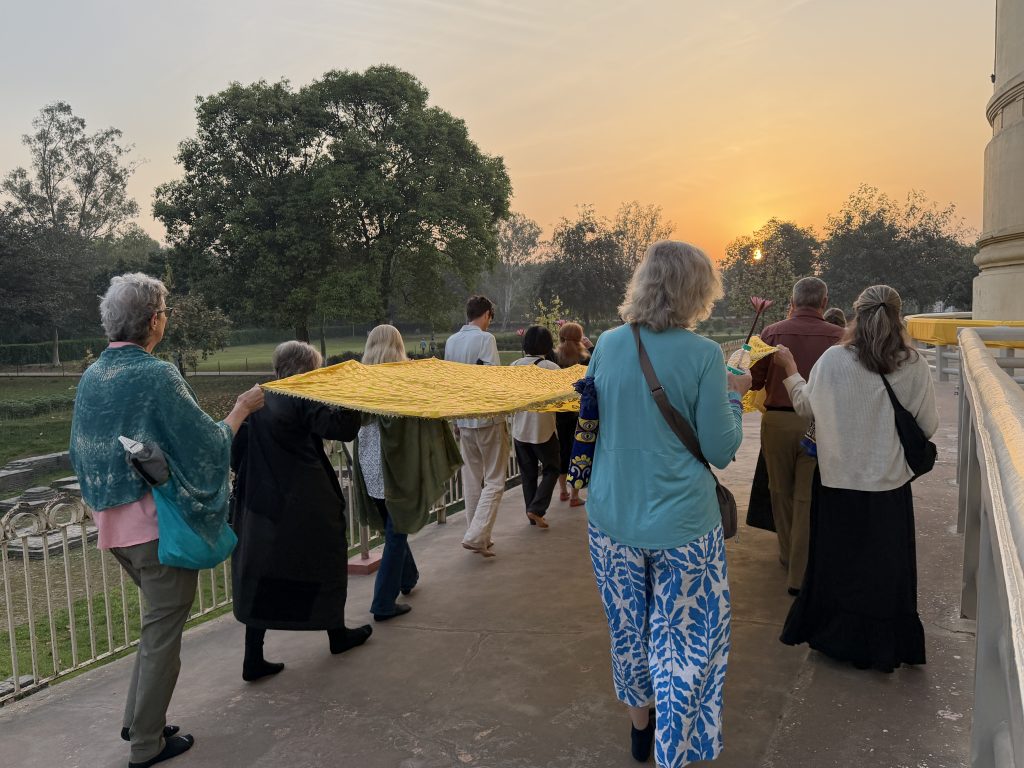
Our first formal stop, at Sarnath, the Deer Park where the Buddha gave his first sermon to just five of his followers, was a revelation for me. Of course I had heard the teaching of the four noble truths and the eightfold path and of impermanence and interconnectedness, but here, walking clockwise around the Sarnath stupa with Bhante, that learning took on a resonance I had not previously experienced. I began to understand what it meant to be part of this tradition of pilgrims and followers and learners. I was carried along, not only by Bhante’s words and the developing closeness of what we came to call our Sudden Sangha but also by the chanting processions of pilgrims, wearing robes that identified that they were from Vietnam, Thailand, Sri Lanka, and elsewhere.
In Uganda, Bhante reflected in one of his talks, a proverb observes: “If you eat a maggot in a mushroom, the maggot will eventually eat you.” But Buddhism goes beyond that determinism, that inevitability, and, as Bhante reminded us, the Buddha offered another view: You can always start again. You can acknowledge again and again and again that you have been unskillful, because you will be unskillful, again and again and again.
The impact of that teaching, which, of course I had heard before, was magnified by hearing Bhante’s words just after seeing the statue of the skeletal, near-death Buddha in the Mahakala Cave near Bodhgaya. That statue shouted an unavoidable message: The Buddha’s turning so dramatically and diametrically from his past of privilege had almost killed him. Only when he accepted the milk rice from Sujata, only when he embarked on the Middle Way after six years of austerities, could he start again.
“I am a monk who does not close a retreat,” said Bhante Buddharakkita on one of our last full days together, “so this is the beginning of the pilgrimage: a lifelong pilgrimage of states of mind.”
Speaking without notes, as he had for our many days together, he began with the first lines of the Dhammapada: “Mind precedes all mental states. Mind is their chief; they are all mind-wrought. If with an impure mind a person speaks or acts, suffering follows him like the wheel that follows the foot of the ox.”
But he didn’t stop with just quoting the lines—he looked at each of us and asked, “Do the wheels of the cart ever catch up to the ox?” Of course not, and he added, “When the ox pulls the cart, it’s suffering; and so we suffer when we pull the heaviness of our minds.”
When I returned home, I looked up the Dhammapada and discovered that the second line reads: “Mind precedes all mental states. Mind is their chief; they are all mind-wrought. If with a pure mind a person speaks or acts, happiness follows him like his never-departing shadow.” The teachings Bhante had stressed throughout our weeks together, including notions of kusala and akusala, wholesomeness and unwholesomeness, resonated yet again.
Our pilgrimage was not like the silent retreats I have attended in the past. We meditated together every morning and more briefly at other times of the day, but our days were busy and filled with noise and distraction. Yet each step we took as we walked in the steps of the Buddha offered an opportunity for the values of the Buddha to infuse our lives.
Looking out the window from my privileged perch in an air-conditioned bus, I watched people working hard and living their lives, as they bought and sold fruit and vegetables, walked to school and work, or tilled their land. Seeing the dignity of their efforts made me more fully aware of my own kinship with all humanity; watching for miles and miles became a kind of meditation for me.
All the while, I kept thinking, “May all beings be happy, may all beings be peaceful, may all beings be free.”
I am grateful to have begun this pilgrimage with Bhante.
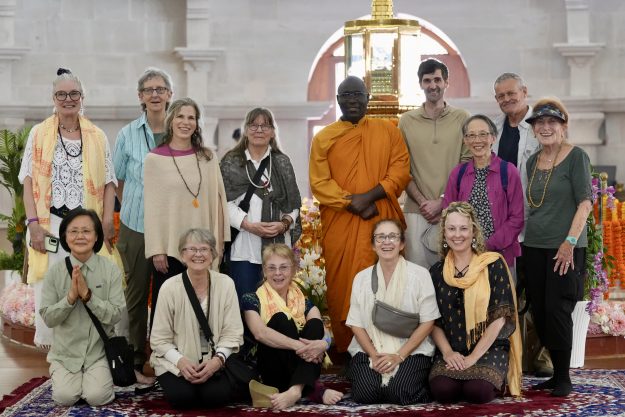
Videos of Bhante Buddharakkhita’s teaching on the 2026 Walking in the Steps of the Buddha pilgrimage can be viewed here.
A Brief Teaching from Bhante Buddharakkhita: The Most Dangerous Weapon
“I remember when I was a student in India, I had a friend of mine who said that there are three things you can never change. And he started to say, one is a speeding arrow. Once the arrow is released, you cannot catch it. Another one is a missed opportunity. Once there’s an opportunity and you miss it, you neglect it, you’ll never get it back. Another one is a spoken word.
Once you have said it, you can just say, “Okay, sorry, sorry!” But you have said it, you cannot un-say it. It’s the same with email, you know. In the beginning of email, I think AOL [used to] give you time [to] decide whether [or not] you wanted to send it. But once you click “Send,” it’s done. You can maybe write, “I sent it by mistake,” but too bad, it’s gone. You cannot delete sent mail. So it’s the same thing with speaking, you cannot delete the words you have said.
You know the most dangerous weapon? It’s the softest one, but it’s the most dangerous.
Do you know it? You’re going to say, bombs. What’s the most dangerous weapon? It is so soft, it doesn’t even have a bone. [From the audience: “Speaking!”] Yes, that one. It’s the most dangerous one, because once you say something harshly, the person you spoke to will never forget [it]. You can ruin your relationship.
I’m telling you, [all you need to] say [is] one thing, even if you’ve been doing so many, many good things, just [saying] one word [can cause the] whole thing [to] fall apart. There is a saying, “You will never regret keeping silent.”
Of course the Buddha never approved of people being dumb, not talking at all. He said that when you meet, talk about dharma, or observe noble silence. In this case, he’s not talking about total silence. Noble silence is when you practice meditation and you go into the second jhana, then you have noble silence. Before that, inner chatter is always going on, even when you’re quiet, kind of like background applications on the phone.”
Adapted from a talk given by Bhante Buddharakkhita in the bamboo grove at Rajgir in March, 2026. Learn more about Tricycle’s upcoming retreats at the official RetreaTours website.

Thank you for subscribing to Tricycle! As a nonprofit, we depend on readers like you to keep Buddhist teachings and practices widely available.