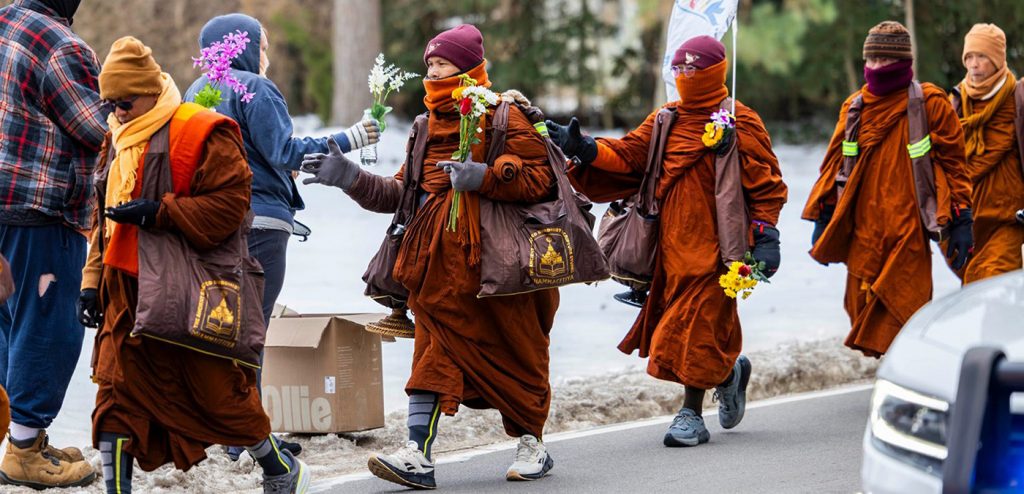
On October 26, 2025, a group of nineteen monks from the Vietnamese Theravada Buddhist tradition, affiliated with the Huong Dao Vipassana Bhavana Center, began a historic pilgrimage from the temple’s center in Fort Worth, Texas, to Washington, D.C., in an effort to promote peace, compassion, and nonviolence. To put these noble monks and their historic journey into context, Tricycle asked a selection of Buddhist teachers and authors: What is it about Fort Worth’s “Walk for Peace” monks that so captures the public’s imagination?
When it feels like everything’s sliding into authoritarianism and nothing we do makes the slightest difference, the worst part isn’t fear—it’s the feeling of being totally powerless. That’s where nonviolent action, protest, marches, and showing up in public changes everything for us. It turns doomscrolling and spiraling into actually doing something real; it provides a sense that we can push back. Instead of obsessing over these massive forces we can’t touch, we’re focused on connecting. We’re giving a voice to the sentiment “not on my watch!” Seeing that example, others, who are paying less attention to the world gone mad, realize something’s going on that demands attention and involvement. So any form of demonstration is not a pie-in-the-sky idea.
So I support the group of Buddhist monks walking 2,300 miles to Washington, D.C., on a “Walk for Peace.” It’s not some naive feel-good thing or empty symbolism. Nor is it only compassion. It’s saying “no” with legs—even when stuff goes sideways, like an accident that injured some of the monks along the way. The whole point is taking all that vulnerability and fear and grief about the state of the world and turning it into one foot in front of the other, together, just keeping going.
–JOSH KORDA, Buddhist teacher and counselor, Dharma Punx NYC
With each step, abiding fully in this present moment, the pure path of awakening unfolds beneath my feet.
With each step, serenity and calm blossom in my body and mind, my heart opens like a flower to the morning sun.
With each step, I become one with the Buddha, one with the sangha, one with the dharma, and find refuge in this warm embrace.
With each step, I vow to nourish a heart overflowing with love, tranquility, and compassionate action in service of all beings.
As a dharma teacher in the Plum Village community of socially engaged Buddhism founded by Venerable Thich Nhat Hanh, I am reminded of the practice and power of walking as an act of individual and collective healing, walking as social witness, a statement of peace and solidarity with the human and more than human world. Thay taught the practice of walking meditation as a spiritual discipline, a practice of healing and transformation. To walk in a relaxed way, calming and releasing tension in the body, generating a mindset of happiness and gratitude in this moment, is akin to prayer. Every path, whether city streets or forested trails, is the path of awakening.
Thay and Rev. Dr. Martin Luther King, Jr., shared a special friendship that Thay recalled in a poignant moment. “Martin, you know something? In Vietnam, they call you a bodhisattva, an enlightened being trying to awaken other living beings and help them go in the direction of compassion and understanding.” Thay spoke these words to King at one of their last meetings. A few years earlier, in a letter nominating Thay for the Nobel Peace Prize, King said, “I know Thich Nhat Hanh, and am privileged to call him my friend.”
Both King and Thay engaged in walking as a form of nonviolent social witness and the visible practice of peacemaking. They shared a vision of peace, compassion, and love galvanized by nonviolent social engagement that included walking meditation as a form of social action. This was particularly important during the historic Birmingham Campaign of 1963, which was a pivotal event in the struggle for racial and social justice in the United States. Organized by the Southern Christian Leadership Conference and others, this action led to the passage of the Civil Rights Act of 1964 and the Voting Rights Act of 1965. The Birmingham Campaign was fueled by the resolve and commitment of volunteers, ordinary people committed to nonviolent resistance. Each volunteer was required to sign a pledge, a written affirmation to non-violence that included a vow to meditate daily, to walk and talk in the manner of “God is love,” to pray daily, and to perform acts of service for others. This historic campaign underscores the importance of spiritual determination and principled, nonviolent action in promoting social justice through peaceful practice.
Today, as our society faces the firestorm of racial and social injustice, systemic and structural oppression and discrimination, the dismantling of the civil rights enforcement mechanisms of the federal government, threats to the rule of law, and ongoing violence, this pilgrimage for peace and compassion brings into our awareness the intersection of social justice and spiritual engagement. This walking pilgrimage of peace by these monks from Vietnamese Theravada Buddhism points us to a new order of justice grounded in compassionate action, peace, and love that challenges us to transform suffering into compassion, understanding, and love.
This peace pilgrimage is an act of love and liberation that reminds us, as it did in 1964, to rediscover what we love, what matters, and to offer this love for the good of the world.
–VALERIE BROWN, dharma teacher, Plum Village
They are walking for all of us.
–JACK KORNFIELD, American Vipassana teacher, psychologist, and author
What the world needs now is an influx of peace to impede the three poisons that MLK once named as militarism, poverty, and racism. These monks, by their mere presence, answer the bodhisattva’s call to liberate all beings from suffering.
–VIMALASARA, author and senior teacher in the Triratna Buddhist Community
This article originally appeared with more responses on tricycle.org.

Thank you for subscribing to Tricycle! As a nonprofit, we depend on readers like you to keep Buddhist teachings and practices widely available.