Playing 1 of 1
Understanding How to Care, Caring to Understand
Download Transcript It has been edited for clarity. Subscribe or Log in to Download Transcript
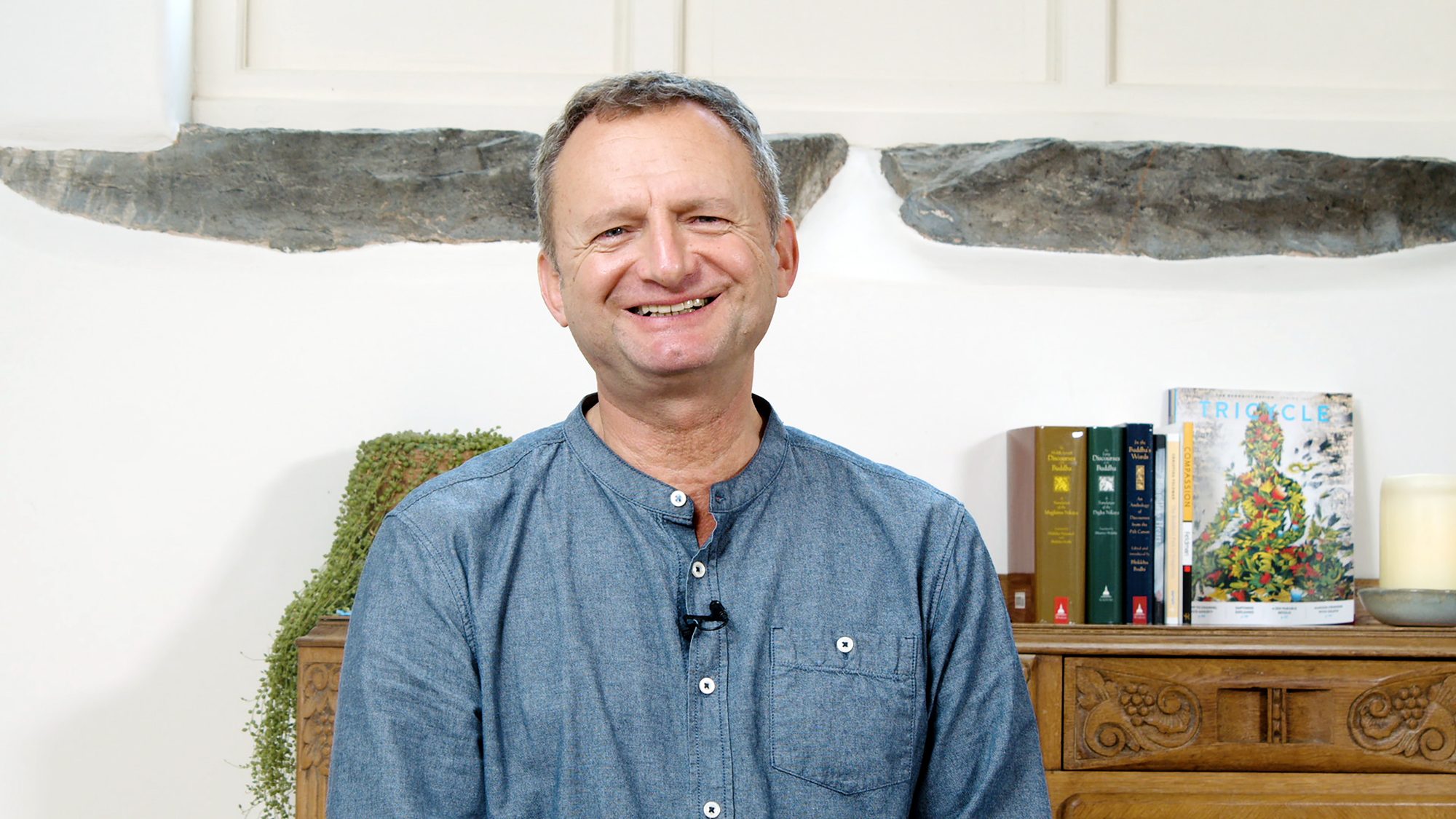
How do we meet a life we never asked for, one marked by impermanence, fragility, and uncertainty? In this talk, former Theravada monk Christoph Köck invites us to reflect deeply on our existential situation and on the Buddhist path as a way to respond with care and clarity. Drawing on the teachings of right view and right intention, this talk explores how our understanding and our actions shape the lives we lead and the world we inhabit.
Christoph Köck was born in Vienna, Austria, and spent seventeen17 years of his life as a Buddhist monk in the Theravadin tradition. He lived mainly in monasteries connected with Ajahn Chah in Thailand and the West. Currently, he lives in Vienna, working as a psychotherapist in private practice. He teaches Buddhism and meditation internationally, and is trained to teach MBSR and MBCT.
For more from Chrisoph Köck, see the Tricycle Online Course Meeting the Five Hindrances.
This Strange Human Life So life is strange in a way that we haven’t wanted to be in this world. In addition here we find ourselves embodied in a certain form that we haven’t chosen: being a man, being a woman, or whatever other possibilities there are. Being born in a Western country, in an eastern country, in Asia, in Africa, or wherever, with blue eyes or green eyes or brown eyes, curly hair or straight hair. We haven’t chosen this, and we know within this human form, life is fragile and life is impermanent. Sooner or later, life ends. And along this journey from birth to death, we are vulnerable. We are vulnerable on the level of our bodies. We feel pleasure. We feel pain. These bodies need to be fed. They need to be warm. They need to breathe. They need to be cared for in various ways. And of course, they’re prone to sickness. They’re prone to pain. Such is human life. And on the level of our hearts and minds too, we are vulnerable. We are vulnerable to being rejected. We are vulnerable to sometimes having to part from the things we love. We are subject to sometimes having to be with the things we don’t love. We often don´t get what we want. And we know in the end we have to leave everything behind. As we go along through this journey of life, we come across all kinds of experiences that we haven’t particularly asked for, that we haven’t wanted. We live in a world that we haven’t chosen. We live with people that we haven’t chosen. So life is strange in a way. And yet, as human beings, we have the potential to answer. We have the potential to respond to this situation. Human experience is, in a way, an interplay between what is given from the outside, and how we respond to it, which in turn shapes what is given. That is both in terms of our sensory input, moment by moment or on a more broader scale, how we live, in what kind of situations we live in, what circumstances we live in, how the weather is, how the climate is, how the world is. So there is always a given in our experience. But there is also a capacity that human consciousness allows, that we respond to that. And once we start to use our capacity to reflect on our actual experience, how it unfolds, moment by moment, we might notice that a lot of this responding or answering is actually habitual. It’s actually quite automatic. We have an amazing capacity to function automatically, to function according to habit, according to our conditioning that we have through our genes, through our parents, through our culture, through our experiences that we accumulated in life. And yet we have this amazing capacity to be aware. And that’s the very basis of the Buddhist teaching: that we have the capacity to consciously respond to our experience. We have a choice. I like to say: we can make a difference. We can make a difference in how we respond. We can make a difference in how we relate. This is, in my view, one of the essential messages of the Buddhist teachings. We can make a difference. And in classical terms, this is what is called right view, or an aspect of right view. The Various Aspects of Right View Right view or right understanding is, on the one hand, a reflection on what I said in the beginning of this talk to reflect on our existential situation, e.g. life is impermanent, we inevitably have to be united with what we don’t like. Sometimes we have to be separate from what we like. These are the basic facts of life. The other aspect of right view is to reflect on and to acknowledge (and use) our capacity to respond, to answer to life in a way where we can create circumstances, create experiences that are in line with our innate wish to be happy, to be safe, to be fulfilled, to be at peace, or however we define what’s important, what is valuable in our lives. This is another aspect of how Buddhist teaching and Buddhist practice only makes sense if we take seriously our existential situation, because our existential situation is not just the givens of life. It’s also the reflection of, given the givens, how do we respond? What is important? What is skillful? It doesn’t help to take on some teachings or belief systems, well, the Buddha says it’s important to attain nibbana, or it’s important to develop that which is wholesome and abandon that which is unwholesome. This wouldn’t really help unless we bring it into an organismic, felt experience. That it is felt, that we let ourselves be touched by the fact that life is strange, that we live in a world and even in a body that we haven’t chosen and our life is finite. And yet we are asked by life, by having this ability to respond with awareness, how do we respond? How do we answer this question that life asks us? What is important and how do we live that? What I want to point out is that in the traditional teaching we have the first two factors of the so-called eightfold path, the basis of the path and its factors: right understanding or right view and right intention or right aspiration. And as often with such teachings you can read over them and say, yeah, yeah. I understand, I get it. But right understanding can be really seen as taking to heart the fact of our existential situation. Both living in a world that is finite, that we haven’t chosen, and yet our capacity to make a difference, to respond to life consciously. We can do that. In classical terms, this would be called kamma. Action. What we do makes a difference. That’s part of right view. We can choose to act in a certain way. The second aspect of the basis of the eightfold path, right intention, is generally defined as the intention for renunciation, the intention for non-aversion, and the intention for non-harming. The Various Aspects of Right Intention What does that actually mean? The intention for renunciation is, in simple terms, the basic understanding and the basic realization that stuff does not make us happy. More pleasant experiences, more money, more whatever is not really what happiness is about. So really understanding and remembering that is how we get our priorities right. Stuff and money is often useful and helpful, and there’s nothing to say about pleasant experiences, but what is in the center of our aspirations? The Buddha encourages us through saying the quality of our hearts and minds is really where it’s at. Non-harming and non-aversion is the basic attitude of saying yes to this experience. Aversion is often a way of not really opening up to this existential situation. We are averse, but we don’t reflect on our aversion and distract ourselves with all kinds of things. And non-harming would translate into an attitude of caring. I decide to live my life caringly and being careful because I know if I don’t, I will be vulnerable to a lot of stress and pain. The Interplay of Right Understanding: Wisdom and Caring So to close this consideration, the basis of the path is understanding and caring. Understanding our situation as human beings, but also understanding our potential to answer to it. And caring in a sense that we are very clear that, if we don’t take this to heart, if we do not care, then our pursuit of more stuff, more things, more experiences is driven by a not really reflected fear and confusion, and will pull us away from a wise caring. Here we have the interplay of right view and right aspiration: one being an aspect of wisdom and the other an expression of compassion. Wisdom and compassion: Understanding how to care and caring to understand. Thank you.