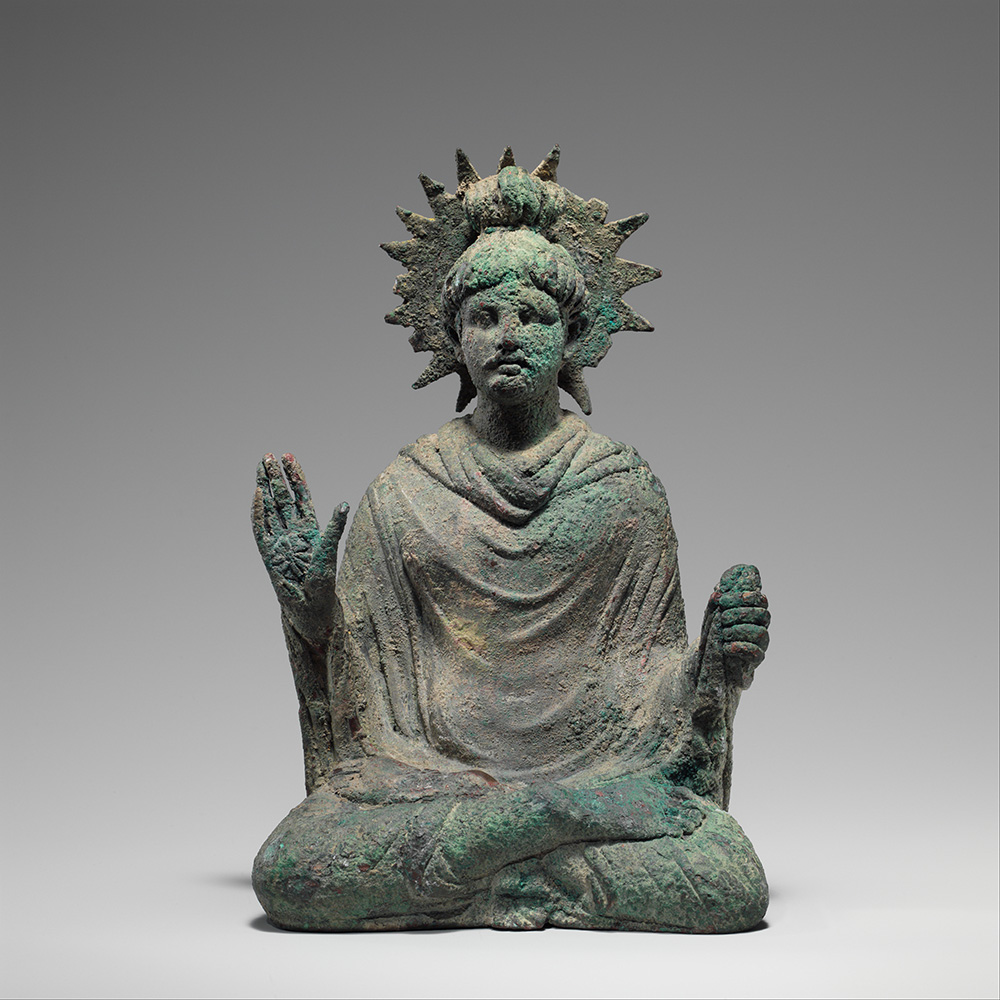
Gotama [the Buddha] and Socrates lived during turbulent, violent, and deeply uncertain times. In China, India, Palestine, and Greece alike, philosophers and religious teachers emerged during this period to explore viable ways of responding to the novel situations in which people found themselves. The philosopher Karl Jaspers coined the term “axial age” to describe this fervent and creative moment in human history. Just as Gotama imagined the rebuilding of an ancient city governed by the principles of the dharma, so Plato’s Socrates dreamed of a republic ruled by an enlightened elite who, in many ways, resembled an order of Buddhist monastics.
Whether or not Socrates had disciples whom he encouraged to carry on his work after his death depends on which sources you read. While Plato’s account of his defense speech presents Socrates as having nothing to teach and no students, Xenophon paints a picture of a more conventional teacher with followers, many of whom (like Plato) were devoted to him and at least one of whom (Xenophon himself) may have been deliberately recruited. Socrates, like Gotama, was a magnetic personality who attracted around him a diverse circle of people with widely contrasting backgrounds, motives, and views. Among his followers, we find the worldly Aristippus, who regarded pleasure as the highest good, as well as the unworldly Antisthenes, who declared, “I would rather go mad than feel pleasure.” Yet both men were drawn to Socrates. And in spite of their differences, they both loathed Plato.
Such diversity among his followers suggests that Socrates had no interest in preaching a doctrine that all his followers would be expected to study, adopt, and then disseminate. Instead, he tested and questioned them in such a way as to get them to start thinking for themselves. He wanted each of them to become independent of him or any other authority figure. Thus Plato developed his theory of Ideas, imagined an ideal state, and founded the Academy; Aristippus charged money for his teachings, enjoyed luxuries and love affairs, and trained his daughter Arete to succeed him as the head of the now forgotten Cyrenaic school; and Antisthenes sought to emulate Socrates’s radical commitment to simplicity and virtue, which eventually gave birth to the schools of Cynicism and Stoicism.
Gotama, too, attracted a wide range of followers from all levels of society, yet Buddhist tradition presents him as a teacher with a consistent set of doctrines and precepts that he delivered to all his students, largely irrespective of their individual differences and needs. If we imagine Gotama engaging with his students in a more fluid and impromptu fashion like Socrates, not only would this accord with his description of himself as an “open-handed teacher” who does not think in terms of being in charge of his community, it would also accord with his encouragement for his followers to become independent of others and for no two of them to “follow the same path.” Yet instead of allowing for a broad range of different approaches to the dharma to emerge from Gotama’s example and teachings, the council of elders convened by Kassapa shortly after his death sought to impose an orthodoxy to which everyone was expected to conform.
The dour Antisthenes appears, along with Socrates, as one of the speakers in Xenophon’s Drinking Party (Symposium), where, as in Plato’s eponymous dialogue, the theme is love (eros). When Socrates teases Antisthenes that he seems to be the only person in the room who is not in love, Antisthenes objects that he has “a violent love” for Socrates. What Antisthenes loves about Socrates is his unique character, his extraordinary capacity for being in the world but not of the world. Like Socrates, he disdains material goods. Living in poverty with few possessions, he recognizes that he still has enough to eat and drink and a cloak to keep him warm. Liberated from the ongoing struggle to acquire unnecessary things, he understands that the practice of virtue alone is all one requires to achieve dignity, self-sufficiency, and happiness. When asked what advantages philosophy brought, he replied, “To be able to live in company with oneself.”
Antisthenes was impressed by Socrates’s exemplary way of life. This he sought to emulate through his own austere behavior and instructed his followers to do the same. Like an order of wandering mendicants, they wore the same simple cloak, carried a knapsack with their scant possessions, and walked with a staff. Antisthenes heralded a movement in Greek philosophy toward greater self-scrutiny, dispassion, and disdain for the vanity of the world.
The most celebrated follower of Antisthenes was Diogenes of Sinope, who took his teacher’s asceticism to even greater lengths. Exiled from his homeland after a financial scandal, Diogenes came to Athens in search of a teacher who embodied and lived what he taught. Rather than attend lectures at Plato’s newly founded Academy, he sought out the elderly Antisthenes, who initially refused to have anything to do with him. After repeated entreaties, Antisthenes—like a Zen master—threatened to hit him with his staff, but instead of withdrawing, Diogenes—like a good Zen student—stepped forward and proffered his head. From then on, it appears, he was accepted as a disciple.
Diogenes adopted a life of uncompromising renunciation, choosing to live on the street in a large earthenware pot used for making wine; eating and drinking whatever he could beg; urinating, defecating, and masturbating in public; and heaping scorn on others. He dismissed the doctrines of Plato as “a waste of time” and the theatrical performances at the Dionysian festivals as “a spectacle for morons.” Scorning pride in one’s nationality or regional identity, he declared himself “a citizen of the world” (cosmopolites). People compared him to a dog (kynikos), transcribed in English as “Cynic.”
In both Greece and India, you could find men like Diogenes who had opted out of conventional society, dressed in rags or sackcloth, went barefoot, gathered to study and debate around teachers, preached to anyone who would listen, and berated those they regarded as fools. Sunakkhatta, Gotama’s former attendant who denounced his elderly teacher to the Vesali assembly as a barren intellectual, is said to have been awed by the saintliness of Korakkhattiya, an ascetic known as the “Dog Man,” who went around “on all fours, sprawling on the ground, and chewing and eating his food with his mouth alone.” Likewise, on seeing children drinking water from their cupped hands, Diogenes threw away his bowl as yet another unnecessary encumbrance. Gotama scorned this kind of extreme behavior as ascetic showmanship, predicting that it would only lead the Dog Man to fatal indigestion followed by rebirth as a low-ranking titan.
While on a sea journey, Diogenes was captured by pirates and sold into slavery. He was bought by a wealthy Corinthian called Xeniades, who put him in charge of educating his children, whom he trained to behave like Buddhist monks, instructing them to “crop their hair close and to wear it unadorned, and to go lightly clad, barefoot, silent, and not looking about them in the streets.” The grateful Xeniades remarked that “a kindly deity” had entered his household. Diogenes rejected his friends’ offer to purchase his freedom from slavery as imbeciles, saying that lions are not the slaves of those who feed them. He died in Corinth at an old age and was buried near the city gate beneath a column on which was placed a dog carved in marble.
The link between the Cynics and Stoics can be traced to a student of Diogenes called Crates of Thebes. When Zeno of Citium, the founder of Stoicism, arrived in Athens around 300 BCE—a century after Socrates’s death—he found himself sitting in a bookshop listening to its owner read Xenophon’s Conversations of Socrates. On asking whether such a man could be found in Athens today, the bookseller pointed to Crates, who happened to be walking past, and said, “Follow him.” Zeno studied Cynic philosophy with Crates but was reluctant to adopt the doglike behavior of Diogenes and others. He set himself up as a more conventional teacher in the Painted Stoa on the north side of the Athenian agora, which gave the school its name “Stoicism.”
The Stoics recognized that nearly everything that occurs to people in the course of their lives is out of their control. Whether one likes it or not, things just happen: from the firing of neurons in one’s brain and the digestion of food in one’s stomach to an earthquake that levels a city and the asteroid that wiped out the dinosaurs. The Stoics understood these things as the irrepressible unfolding of the natural world. They described this as the Logos (the “logic” of reality), which they equated with the divine activity of Zeus. Since one can do nothing about this primal outpouring of life, the wise person accepts things as they are and, if they are painful or troubling, patiently endures them. For the Stoics, what happens to us is neither good nor evil. It is simply the way life pours forth. The terms “good” and “evil” apply only to how we react or respond to what’s happening. Thus it is here, in the solitude of one’s own mind, that one can attain sufficient dispassion (apatheia) to make wise rather than unwise judgments. For the Stoics, this is the only place where you are free to exercise control over what is happening to you. You may be powerless over external conditions, but you do have the power to control how you respond to those conditions.
This is not quite as straightforward as it might seem. For external things like earthquakes are not the only things that “just happen” to me. The dread and terror I experience on seeing the walls of my house shake like jelly also “just happen” to me. Stoic practice, therefore, requires focusing and stabilizing one’s attention to maintain the inner stillness and dispassion that are constantly threatened by the impact of the world upon one’s senses, on one hand, and the emotional turbulence of one’s soul, on the other.
The Buddhist-like echoes in these passages are unmistakable. Yet, as far as we know, the Stoics had no contact with Buddhist thought. Particularly striking are the parallels with what tradition regards as Gotama’s second discourse: On Not-Self. In his first discourse, Turning the Wheel of Dharma, Gotama had defined awakening as the recognition, performance, and mastery of four tasks: embracing suffering, letting reactivity be, seeing its cessation, and cultivating a path. Now, he analyzes what it means to be the person or self who practices these tasks:
“The body,” Gotama declares, “is not self. If it were, it would not get sick. You could tell your body: ‘be like this,’ or ‘don’t be like that.’ But because the body is not self, it does get sick. You cannot tell it: ‘be like this,’ or ‘don’t be like that.’ ”
Or as the Stoics would say: Your body is not under your control. Sickness is something that just happens to it. No matter what measures you take to stay healthy, cancers, strokes, and viruses will get you nonetheless. And no matter how long you manage to prolong your bodily existence, in the end, it will fail you at death.
Ironically, a Stoic reading of On Not-Self reveals Gotama’s understanding of what it means to be a self. The key characteristic of a self is the ability to issue silent commands to oneself: “Be like this!” “Don’t be like that!” So if the body really were you, then you (the self) should be able to tell it what to do, just as you are able to tell yourself what to do when faced with a choice. But you cannot command your body not to fall sick on feeling the first symptoms of flu, whereas you can command yourself to respond to the flu with acceptance, understanding, and care. The self is essentially dialogical. It gives commands as though to someone else, to “another” self with whom you cohabit, who either obeys or fails to obey those commands. As we go through each day, we constantly speak to ourselves, argue with ourselves, congratulate ourselves. We are thus “two-in-one,” as the political theorist Hannah Arendt names this paradoxical feature of the human condition.
The self is the one who wills. In issuing commands to yourself, you seek to initiate an action that will have consequences both for yourself and for others in the future. In pondering over whether or how to intervene in the world, this dialogical self discloses itself as essentially ethical. Much of our internal dialogue takes the form of a debate with ourselves about what we should think or say or do in response to a particular situation in our shared world. Thus, despite being a single being, we can speak of being “torn apart” as well as “living in company with oneself” (Antisthenes) through the practice of philosophy.
For the Stoics, what happens to us is neither good nor evil. It is simply the way life pours forth.
In On Not-Self, Gotama observes that just as you do not choose your physical sensations, you do not choose how you feel about them, how they appear to you, or how you find yourself inclined to respond to them. Even these most intimate and subjective experiences happen to you. Hence, Gotama encourages his students to always bear in mind, “This is not mine. I am not this. This is not myself.” By training yourself not to identify with either the physical or mental elements of your experience, you gradually “disengage” from them until you achieve “dispassion” (viraga). And through such dispassion, you then gain freedom (vimutti) from the habits, conditioning, and constraints that hold you back from becoming an autonomous ethical agent.
Whether Stoic apatheia or Buddhist viraga, dispassion is the indispensable condition for establishing and sustaining a space of nonreactive awareness. In contrast to the pathological state of disassociation, which is a withdrawal from the world into alienated isolation, such dispassion becomes the ground for a new way of understanding and engaging with the world. This space allows the freedom for the emergence of an imaginative and creative self, no longer hamstrung by convention and received opinion. Such a self is neither an eternal soul nor a mere illusion.
Each person is a contingent, ever-changing, fluid, and sentient being, formed by a biological and historical past that predates their birth, committed to becoming the kind of person they aspire to be, and dedicated to forming the kind of world they hope will flourish during their lifetime and after their death. Gotama compared the self to a field to be irrigated by a farmer, an arrow to be assembled by a fletcher, and a block of wood to be fashioned by a carpenter. He understood the self as contingent and transient, an ongoing project, a work in progress, which chooses to detach itself from the world to find the clarity, compassion, and courage needed to fully engage with the world.
On learning that Hellenistic philosophers aspired to a nirvana-like state of nonreactivity, Buddhists may wonder what sort of contemplative practices were used to achieve it. For Pyrrho to instruct his followers to be “without judgment, without preference, and unwavering” is all very well, but anyone who has ever tried to meditate knows how difficult it is to bring the restless mind to such a balanced, collected, and tranquil state. You can’t just command yourself to be unwavering. In most cases, to attain this degree of inner calm and clarity requires a sustained contemplative practice over time. Thus, Buddhist texts not only emphasize the importance of mindfulness, focus, equanimity, and stillness but they also provide psychological tools and meditative techniques for cultivating them. Yet nowhere in the surviving writings of the Hellenistic philosophers do we find anything comparable. How, then, did Stoics, Skeptics, and Epicureans actually achieve their stated objectives of apatheia and ataraxia (tranquility)?
The French scholar Pierre Hadot, a key figure in the recent revival of interest in Hellenistic philosophy as a way of life, maintains that these philosophers practiced formal “spiritual exercises” as a means to realize a serene, non-reactive awareness. Yet Hadot is unable to provide any convincing examples of such exercises, let alone point to texts that Buddhists would recognize as meditation manuals. The Chief Maxims of Epicurus and the Enchiridion, or Handbook of Epictetus, for instance, do provide instructions for practice, yet these mainly consist of philosophical and moral precepts to follow in regulating one’s attitudes and behavior rather than exercises in how to tame the “mad elephant” of the mind.
Nonetheless, Plato records how Socrates would enter prolonged states of contemplative absorption, and Diogenes Laërtius describes how Democritus “tested perceptions” in the solitude of his garden hut, both of which are suggestive of the kinds of meditative practice found in Buddhism. One cannot rule out that Stoic, Skeptic, and Epicurean teachers gave instruction in spiritual exercises only orally and privately to their students, which is also common in Buddhist and other contemplative traditions. What has been lost in the Hellenistic philosophies, which, unlike Buddhism, died out as living schools of thought, is the continuity of generations of practitioners who convey through their personal example and oral instructions the spiritual heartbeat of their tradition.
To think of practice (bhavana) as the cultivation of a way of life rather than becoming proficient in a spiritual exercise allows us to address this question in another way. For moral precepts and meditation instructions alike consist of commands: “Do this.” “Don’t do that.” That is what unites them as practices. Initially, such commands are either read from a text or spoken by a teacher. Over time, though, they become internalized and automatic. One finds oneself giving instructions to oneself in one’s own words according to the needs of the situation. In this way, practice has more to do with becoming skilled at internalizing, issuing, and heeding commands—whether of a moral, philosophical, or contemplative nature—than with mastering a particular meditative technique.
To practice either Buddhist or Hellenistic philosophy becomes a full-time exercise in remaining sufficiently detached, mindful, and vigilant to respond appropriately to whatever life throws at you. Whether or not you call it “meditation,” sustaining such mindful attention is what shapes and transforms one’s character, bringing it into closer alignment with the goal of remaining, for example, “without judgment, without preference, and unwavering.” Epicurus may not have sat cross-legged in formal meditation like a Buddhist monk, but his ability on the final day of his life to experience joy while afflicted with “the worst possible sufferings” implies that he had achieved a similar kind of detached, nonreactive awareness.
♦
Excerpted from Buddha, Socrates, and Us: Ethical Living in Uncertain Times by Stephen Batchelor © 2025 Stephen Batchelor. Reprinted with permission from Yale University Press. All rights reserved.

Thank you for subscribing to Tricycle! As a nonprofit, we depend on readers like you to keep Buddhist teachings and practices widely available.