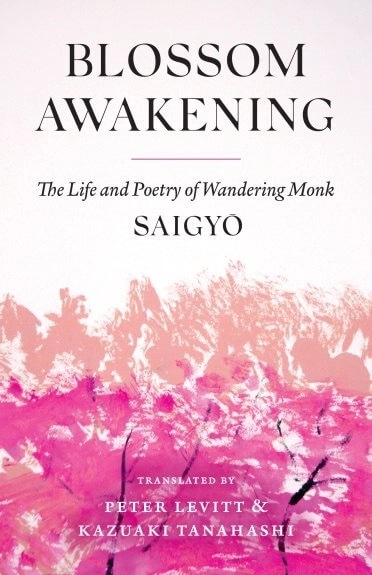
Blossom Awakening: The Life and Poetry of Wandering Monk Saigyo
by Saigyo, translated by Peter Levitt and Kazuaki Tanahashi
Shambhala Publications, 2025, 312 pp., $21.95, paper
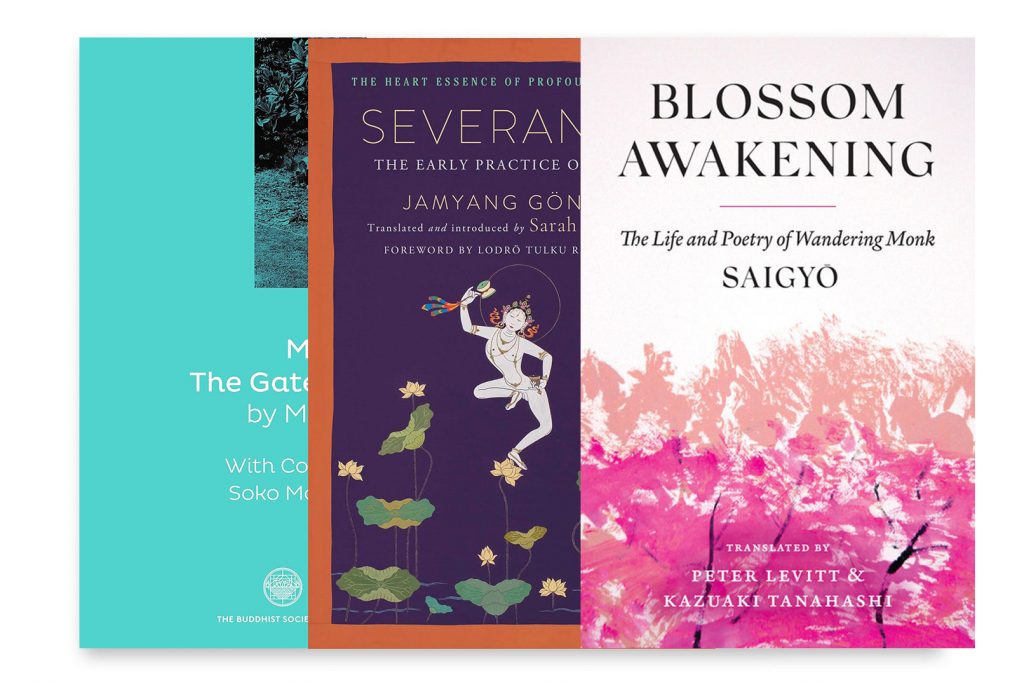
Saigyo (1118–1190) was one of Japan’s most celebrated poets, and throughout his life, he composed more than 2,000 waka, or poems. Blossom Awakening presents 193 waka organized into eleven themes, including renunciation, love, loneliness, the moon, and the dreamlike world. For Saigyo, waka were the “true form of the Tathagata (Buddha),” and reading poetry was akin to chanting esoteric mantras. Saigyo’s poetry offers an opportunity to meditate on life’s ephemeral nature and on the awakening that can come from embracing impermanence.

Severance: The Early Practice of Chö
by Jamyang Gönpo, translated by Sarah Harding
Wisdom Publications, 2025, 272 pp., $26.95, hardcover
Severance: The Early Practice of Chö presents works by Jamyang Gönpo (b. 1208–?), a master of Tibetan Buddhist chö, or the severing of ego-clinging. Translated by Sarah Harding, the verses, commentary, and instructions are among the earliest in this lineage. Gönpo’s teachings emphasize transforming reactive emotions and meeting obstacles as part of the path: “Liberate fear in its own ground by inspecting the fearful one. Obstacles will arise as glory by tossing away fixation on the body as self.”

Mumonkan: The Gateless Gate
by Mumon Ekai, with commentary by Soko Morinaga Roshi
The Buddhist Society Trust, 2023, 430 pp., $18.95, paper
First compiled in 1228 by the Chinese Chan master Wumen Huikai (Jp.: Mumon Ekai), the Gateless Gate remains one of Zen’s key koan collections. This edition includes commentary by Soko Morinaga (1925–1995), a Rinzai roshi and former abbot, who guides readers into the enigmatic world of the forty-eight cases. The secret lies in daily life: “The ordinary life you have come to accept is really something superbly splendid.” Morinaga underscores that koan practice requires direct engagement with the everyday.

SCHOLAR’S CORNER

Religions of Early India: A Cultural History
by Richard H. Davis
Princeton University Press, 2024, 616 pp., $39.95, hardcover
In Religions of Early India, historian and professor emeritus at Bard College Richard H. Davis traces two millennia of the subcontinent’s religious cultures, from the Rig Veda to the emergence of temple Hinduism. Drawing on literary, archaeological, and artistic sources, Davis reveals Buddhism, Jainism, and Hinduism as interdependent communities shaped by dialogue, competition, and shared concerns. For readers of Buddhist history, this book provides a broader understanding of the religious landscape that informed Buddhist thought and practice. Davis frames this project with an insistence on hearing primary voices, including material remains, so that we can “listen to the stories these physical objects wish to tell.”
WHAT WE’RE REREADING

Aśvaghosha’s Discourse on the Awakening of Faith in the Mahāyāna
by D. T. Suzuki
Published in 1900, D. T. Suzuki’s Aśvaghosha’s Discourse on the Awakening of Faith in the Mahayana was the first English translation of this foundational—if likely apocryphal—Mahayana treatise. Attributed to the 2nd-century poet-monk Aśvaghosha but probably composed in China, the text presents a far-reaching vision of buddha-nature, mind, and awakening. Suzuki’s pioneering effort introduced core Mahayana ideas to English readers. Later translations by Timothy Richard (1907), Yoshito Hakeda (1967), and, most recently, John Jorgensen, et al. (2019) offer contrasting readings, but Suzuki’s version remains a landmark in the global transmission of Buddhist thought. Free versions of Suzuki’s and Hakeda’s translations are available online.

Thank you for subscribing to Tricycle! As a nonprofit, we depend on readers like you to keep Buddhist teachings and practices widely available.