Long ago, in the early 1990s, when I was a new parent looking to send my son off to school for the first time, I asked some older friends where we might find “the Buddhist school.” As an active practitioner living in San Francisco, a city awash in Buddhists and progressive schools, I had just assumed, wrongly, that such a thing existed. How could it not? The Buddhists I knew were smart, worldly people who easily grasped the essential role education has in shaping the world, so why wouldn’t there be schools?
In America today, there are (according to the National Center for Education Statistics) roughly 10,000 Protestant Christian schools, 6,000 Catholic schools, 1,000 Jewish day schools, 300 Islamic schools, and 80 Quaker schools. But apart from a handful of preschools and part-time study programs attached to Buddhist temples, the Middle Way School in Saugerties, New York, is the only Buddhist grade school in America. It is a startling statistic. What is going on? Where are all the Buddhist schools?
There are 4 million to 5 million Buddhists in America, many of whom have the resources to consider private school. It would seem that such parents might want Buddhism to be part of their children’s education. And yet after three (or more) generations, a Buddhist school movement may just be getting started. What are the difficulties at work here? Is there something inherent in Buddhism that makes creating schools harder, something particular to education in America, or both?
The fact that many American Buddhists come to the practice as adult converts, without reference to an inherited culture, is certainly one force at work. Some might assume that since Buddhist education has traditionally been monastic, it needs always to be, or that Buddhist wisdom is bestowed uniquely through established lineages. Widely divergent traditions of practice within Buddhism and the current use of religion as a political tool in America all add to the difficulties.
And yet lessons that the dharma can offer to children have never been more needed than they are today. Anyone who has spent time in a classroom in the last decade has watched a growing number of mental health issues spread through the lives of children and teens. This is not just statistics but a social reality. The increasing prevalence of social media and screen culture encourages intense self-focus, competition, and the pursuit of worth as measured by likes and followers. Buddhist ethics provides essential antidotes to this mindset, challenging ideas of us and them, for and against. The dharma provides a path to shift focus from the isolation of selfie culture to considerations of our inherent interconnectedness. The hunger many young people feel for such a connection is evident in the historic increase (up 30 percent to 70 percent) in the number of new converts to Catholicism and Orthodox Christianity. Young people want what wisdom traditions have to offer.
The Middle Way School was founded in 2018 by a group of educators inspired by the vision of Dzongsar Jamyang Khyentse Rinpoche and the Khyentse Foundation. When Tricycle first reported on the school that year, Buddhist ethics were central to its mission. The school’s core belief is “the view of emptiness and the practice of bodhicitta,” the wish to awaken for the sake of all beings. That resolve has held. It is a testament to the determination and skill of the educators that the school is both thriving and growing, with a middle school program set to open in the fall of 2026.
Founders were also intent on building “a model for Buddhist education that can be replicated around the world.” In the eight years since its founding, Middle Way has become a sort of de facto lab school, revealing the opportunities and obstacles in creating and sustaining Buddhist primary education in America. What is working there, and what tensions remain, might point to a path forward.
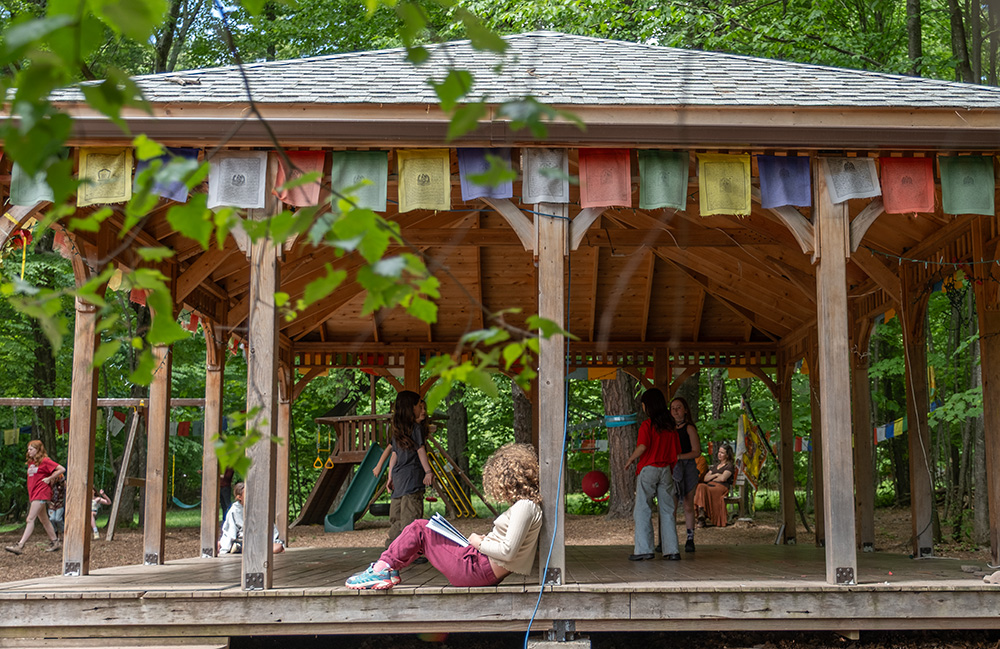
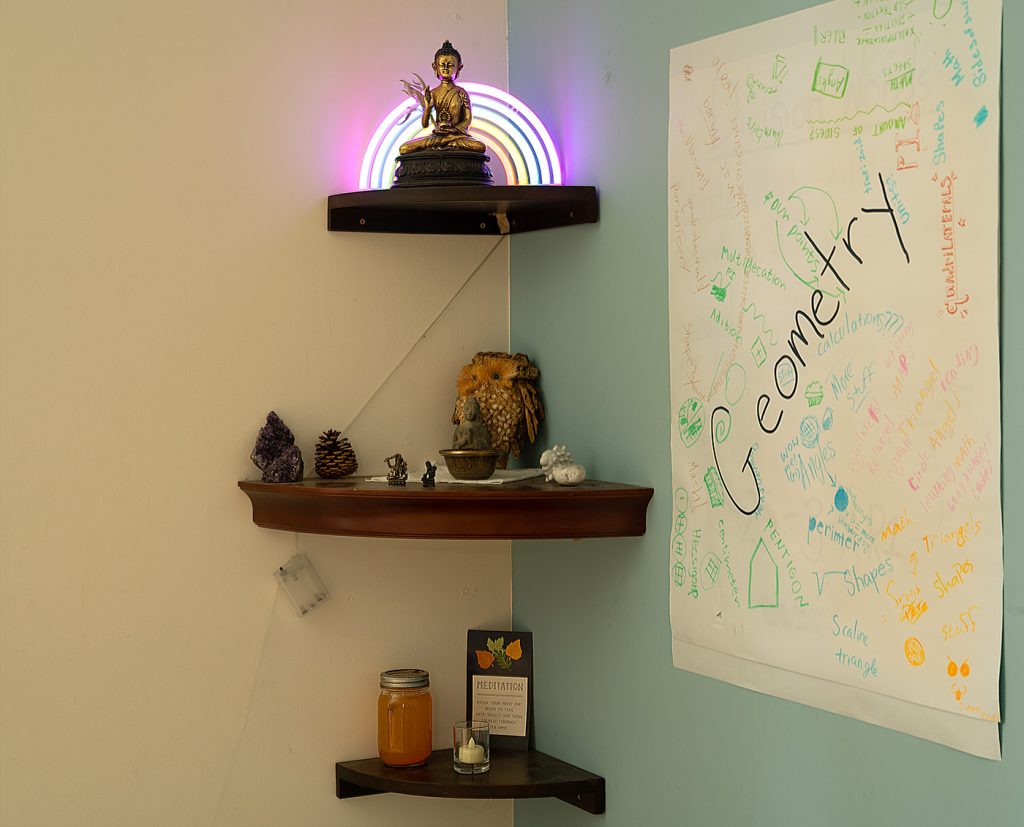
I recently visited the Middle Way School on an autumn morning bright with that particular Hudson Valley light. At first glance, Middle Way resembles other small private schools I’ve come to know from several decades of teaching. The campus, with small buildings nestled in woods and fields, is spacious and new. Prayer flags strung between the trees flutter in the breeze. The children walking through the woods are silent but for the sound of their footsteps in the fallen leaves, moving toward one of the shrines scattered in the woods for its weekly care and cleaning. Small hands brush away pine needles and leaves from the wooden platform holding a statue of Chenrezig, or Avalokiteshvara, the bodhisattva of compassion, enclosed in glass. One boy has a bottle of cleaner; others have cloths. Without talking, the children spray and clean. As they work, their faces are reflected in the glass alongside the image of Chenrezig: children and Buddha shining out into the reflected world. The scene feels timeless: children outside, quiet, absorbed in a reverent task—there is nothing exotic about it, but it is not common either.
Returning from the woods, we stop in at the library, where books are sorted by Buddhist themes: Lineage, Harmony, Bodhicitta. Among the titles in the Bodhicitta section is a book on José Andrés and the World Central Kitchen; books in the Lineage section explore grandparents and immigration. Creative ways to bring dharma ideas into children’s lives are everywhere.
More than concrete barriers, habits of thinking about Buddhist education may be standing in the way.
Back in the classroom, there is a weekly dharma lesson led by Gillian Eames, a student of Mingyur Rinpoche. The class of fifth and sixth graders sits in a seminar circle. Eames writes the word dukkha on the board and asks students to share their own experiences of change and suffering. Some hang back at first—no one is compelled to participate, though eventually they all join in. The students add disappointment, the feeling of being left out, the loss of a friend, and frustration on the playground. The children agree that dukkha is something they already know, though they now share ways of thinking about it.
Sarah Beasley, the senior director of dharma education, stresses the pragmatic dimension of these teachings:
“The goal of all these lessons—from caring for one’s environment to dealing with personal difficulty—is that when challenges show up on the playground or in the classroom, students can draw on what they’ve learned. These tools will last a lifetime. We emphasize allowing students to experience and practice spiritual ideas without forcing a belief system. I might present a story about Tara, and a student will wonder, is she real? So we might ask, does her message feel real to you? The inclusion of awe and wonder is essential to children’s learning. We do an offering at lunchtime, where children choose a small bit of food to offer the Buddha. One day, a little boy announced, ‘But I don’t believe in Buddha!’ We said, you don’t have to. Then we talked about what it means to believe in something and different ways of knowing.
We’ve heard from several cohorts of students who have graduated and gone on to other schools, and they’ve shared how much they rely on the skills and awareness they learned here. Most of our students stay for all six or seven years, and many have younger siblings. There is now a body of wisdom that the students hold, a centered thoughtfulness. When people come to visit, they can perceive that. These are the palpable examples of our success. We were also happy when a recent review by the local department of education rated the school highly.”
Financial support from the Khyentse Foundation has been important to the school’s flourishing but will not continue indefinitely. Cécile Hohenlohe, an experienced fundraiser and chair of the Middle Way School Board of Trustees, addresses the difficulty of securing long-term institutional support for something still forming. “We are in the countryside because space is available there, but it makes building attendance more challenging. When I approach people about the Middle Way School, so many say, ‘That’s a wonderful idea, Cécile, it’s so great you’re working on that, I’d like to support it—but maybe not yet. Let’s wait and see how it works.’ It’s a catch-22: Nothing can get firmly established without long-term support, and there is no long-term support until it’s firmly established.”
More than concrete barriers, habits of thinking about Buddhist education may be standing in the way.
Many Western Buddhists come to the practice as adults, without a model of what a Buddhist childhood might look like, while Asian American Buddhist communities often prefer to enroll their children in local schools. A Korean friend suggested that “home education” in Asian communities was where values and worldview were shared. It was also important to maintain “the model minority” image. For groups like Chinese Americans, whose collective memory includes the Chinese Exclusion Act, or Japanese Americans, with internments during WWII, being Buddhist signaled a difference that many chose to keep private. Among liberal parents, I’ve often heard the comment that they do not want to burden their children with religious ideas, preferring to let them find their own way—though how a child is supposed to find their way, given such scant information about any of the world’s wisdom traditions taught in nonreligious schools, is another question.
The definitional questions are equally unresolved. Should a Buddhist school be affiliated with an established lineage, and if so, does each lineage need its own? How Buddhist should a Buddhist school be? There may be a more accessible model, something akin to the Quaker Friends school, that appeals to non-Buddhist parents on ethical grounds. But agreeing on what that looks like requires first agreeing on what Buddhism actually is in an educational context.
Marah Shemesh, the development manager at Middle Way, describes the challenge of explaining to multiple audiences what it means to be a Buddhist school. “I hear every possible question about the school: Is it Buddhist enough? Is it really authentic? Then others worry, is it too religious? Are you trying to make little Buddhists? As if that would be so terrible. Most of our parents are not Buddhist but, rather, Buddhist-friendly. Many are involved with yoga and holistic living; others want a mindful community. When parents ask, I often give the example of my own children, who may be upset in the morning and happy in the afternoon. At the Middle Way School, we teach them to notice that their feelings don’t last. We point out impermanence. That’s part of being a Buddhist school.”
The staff we spoke with described their ongoing efforts to refine and expand the school’s vision while maintaining the everyday operations of a school serving more than one hundred children. They are acutely aware that securing the school’s future matters not just for its own sake but also for the other schools that might follow.
In November of 2025, the Buddhist Education Alliance hosted a conference in Thailand that brought together dozens of educators working on Buddhist school initiatives. The conference recognized the essential need for both curriculum development and teacher training as priorities for Buddhist education to spread. One alliance board member (who prefers to speak off the record) shared hopes for securing global funding for teacher training and schools, from investors eager to support education that supports “systems thinking” and is aligned with emerging neuroscience. Other questions at the meeting included who should train teachers, and whether teachers need to be experienced practitioners or accomplished educators. What should the governance model be? What belongs in the core curriculum? Agreeing on these elements is no small task, but progress is being made.
In October of last year, a rich storehouse of curriculum resources was launched on the Buddhist Education Aspirations website—a Middle Way Education open-sourced initiative “dedicated to the research and development of high-quality educational materials, informed by educators, neuroscientists, practitioners, and lineage holders from across the Buddhist world.”
Lessons that the dharma can offer to children have never been more needed than they are today.
The “aspirations” are units and learning goals, organized into domains such as Clear Thinking, Inner Awareness, and Ethical Living. Buddhist Education Aspirations also offers possible frameworks for organizing a school’s Buddhist curriculum by grade level and topic, and includes an AI function to help generate lesson plans. According to Michelle Macioce, the project lead, the resource is designed to serve Buddhist educators working in all kinds of educational settings—the hope being that, through sharing lesson plans and classroom experimentation, best practices will emerge collaboratively. Many creative opportunities remain in curriculum development, such as establishing a scope and sequence that could easily be shared among schools, or reinvestigating lessons in the sciences and humanities in light of Buddhist insights and practice.
The knowledge base for curriculum development exists. Buddhist higher education has quietly flourished in America for decades: The Institute of Buddhist Studies has been operating in Berkeley since 1949, Naropa University since 1974, and other Buddhist colleges now include Maitripa College, University of the West, Won Institute of Graduate Studies, and Dharma Realm Buddhist University. Research universities—including UC Berkeley, UCLA, the University of Virginia, the University of Michigan, Columbia, and Harvard—host robust Buddhist graduate programs. That educated, resource-rich Buddhists have built universities, but not elementary schools, is itself telling. It suggests that for many Western practitioners, Buddhism remains an adult acquisition, a path discovered rather than inherited.

In the cognitive and behavioral sciences, evidence of the benefits of Buddhist education continues to grow. Timothy Martin, a postdoctoral fellow at the University of Minnesota’s Institute of Child Development, has been leading studies to discover how meditation might improve students’ academic focus and executive functioning, beyond its social and emotional benefits.
Martin has found that children in monastic education in Asia spend much more time learning right view—the first step on the Buddhist eightfold path—and much less time on meditation. “What applies to all religious traditions is that they have created intentional learning environments for children, ways to teach the moral perspectives, the Summa Theologica, if you will, that become iteratively more complex with time. Starting with the basic construction of the view in childhood makes these perspectives easier to understand as you get older.”
Martin’s findings underscore the importance of making Buddhist education available in grade school, while suggesting that focusing on mindfulness practices with younger children matters less than teaching the fundamentals of a worldview. The same research found that better outcomes were associated with teachers who were also experienced practitioners.
New studies, discussed in Emma Varvaloucas’s “Classroom Mindfulness Put to the Test” (Tricycle, Spring 2025), further call into question the value of focusing on mindfulness with young adolescents. The capacity for metacognition—thinking about our thinking—only begins to awaken around age 12 and becomes more developed by 15 or 16. Similar studies have pointed to the pitfalls of teaching mindfulness to younger children, where a focus on self-awareness is more likely to become self-consciousness. The playful-experiential learning of younger children doesn’t need to be mediated. Aligning Buddhist educational sequencing with child development stages and current neuroscience will be an important issue going forward.
Montessori schools may offer a useful model for the spread of Buddhist schools. Though the method presents a radical contrast to conventional schooling, it has succeeded globally for more than a century. Montessori is trustworthy in the eyes of parents because it is knowable—the view of the child, the teacher training, and the core curriculum elements are consistent across schools. Regional and cultural differences are accommodated, but they don’t change the essential experience. Establishing a comparable set of commonalities across Buddhist schools might benefit all of them. A school supported by a Theravada sangha, a Tibetan community, or a secular Buddhist community might still share a recognized set of curriculum elements. Making clear what is taught and how it is taught could help demystify the prospect for interested parents.
The Hydrostone Academy in Halifax, Nova Scotia, was founded in 1993 to serve the large Buddhist community around Gampo Abbey. However, it was never explicitly framed as a Buddhist school, which, according to Noel McLellan, would have been “a hard sell in Nova Scotia.”
The Middle Way School exists because a small group of educators decided not to wait for consensus.
McLellan, a leading teacher at the school for several decades, believes it is the approach to teaching, deeply rooted in the Shambhala attitudes of basic goodness and the sense that students are inherently complete, that sets the school apart. His book, Teaching with Bravery: Meditation and Heart Advice for Teachers, is a primer on how teaching itself becomes a dharma practice for those working with children. For McLellan, who grew up in a Buddhist family, real education happens in the relationship between teacher and student.
There are questions at the heart of all wisdom traditions: Where do we come from? How should we treat each other and the other living things we share our planet with? What happens when we go? These are also questions children want answers to. Through many years of teaching, I’ve watched these questions become increasingly avoided, feared, or ignored—even in the most liberal schools. For children, already immersed in an ever-unfolding sense of what it means to be a human, to discover that this sacred mystery is the very thing grown-ups hardly ever talk about feels like a kind of abandonment.
When children are cut off from the wisdom traditions that are humanity’s most precious inheritance, the effect is felt by all of us.
Now is the perfect time to build on the work begun by the Middle Way School and bring Buddhist education to American children. The Middle Way School exists because a small group of educators decided not to wait for consensus. More schools like it are possible. The question is whether enough people care to build them.

Thank you for subscribing to Tricycle! As a nonprofit, we depend on readers like you to keep Buddhist teachings and practices widely available.