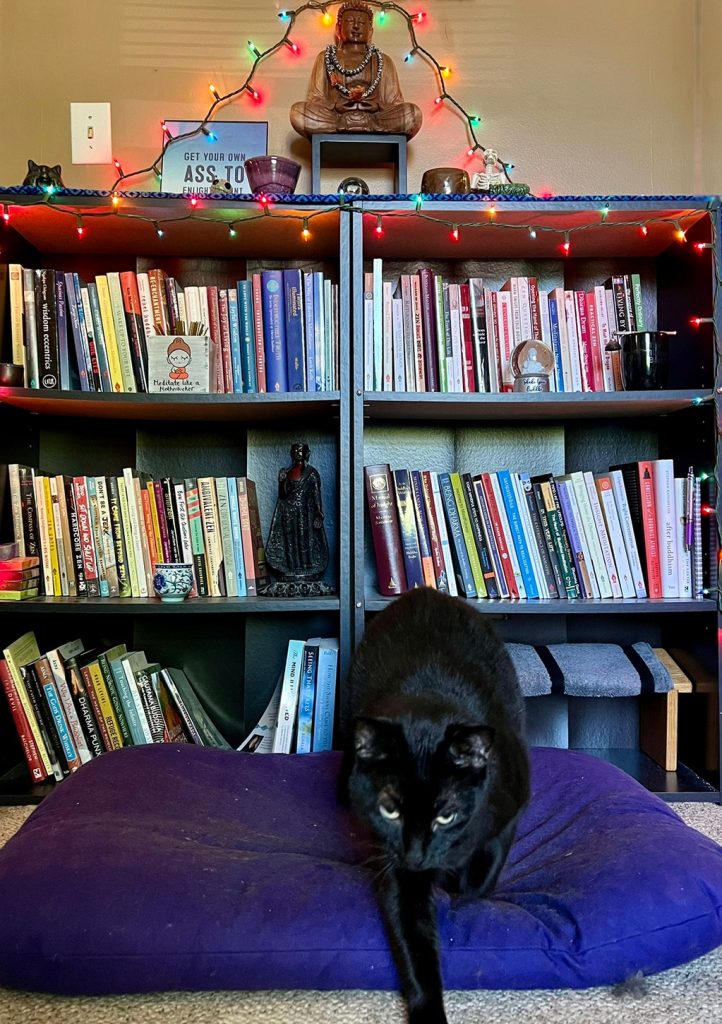
Trying to get people to meditate is like trying to make friends with a cat. If you chase them around the house yelling “Kitty kitty!” they’re gonna hide under the bed. Then you won’t have anything to pet but yourself. However, if you sit quietly on the floor with some treats in your hand, whispering “pspspsps,” you’ll have much better luck.
I used to badger everyone nonstop about meditation and mindfulness. It took me way too long to accept that constant pursuit and pressure were gross. Eventually, I learned that if people knew I taught meditation, I could chill out and let them come to me.
Even after I realized I was a pest, I just couldn’t rein in my enthusiasm. For years, I harassed countless friends, family, and near-strangers to let me teach them. Being poor was a big part of it. If I convinced someone to become a client, they’d give me money, and I could buy cool shit like food and electricity. This stank of desperation, which is never enticing.
But I also just loved exalting meditation’s virtues, whether my audience seemed receptive or not. I thought it was the bee’s knees, and whoever was on the other end of my tirade was lucky to get all the fine points. My born-again style fervor was seriously obnoxious.
And woe to the fool who interrupted me to voice reservations, no matter how well founded. I aggressively pooh-poohed any comments about being too busy to meditate or having an especially clamorous mind.
The biggest issue was the delusion that my teaching style was perfect for everyone, regardless of their circumstances. Fit is vital in this relationship. My approach is rooted in specific views, principles, and methods, which might not suit a potential client. Plus, it’s all wrapped up in my personality and attitude, which are definitely not for everyone.
I ignored all that and came in hot. If anyone near me said, “I get anxious in social settings,” or “I’ve had chronic back pain for years,” or “Man, I suck at pickleball,” I’d pop up like a meerkat and yell, “Have you tried meditation?”
No matter what the answer was, I’d proceed as if they’d said, “No, tell me everything about it.” I was sure that if they just heard me out and understood the benefits, they’d be as thrilled as I was.
I plowed forward with the bulletproof assumption that meditation would be life-changing. I’d pontificate as long as they’d let me, going deeper into the minutiae of practice: how it did what it did, why this would help them, when we could get started, where they were going, please don’t leave!
This is essentially coaching without consent, and it sucks. Partygoers will avoid you at the bar. You’ll be put in a separate room at Thanksgiving with your unhinged uncle who raves about stolen elections. Friends will carefully avoid any topic that might launch you into full berserk mode.
My reverence for meditation was tangled in attachment to its possible results, and I didn’t notice the contamination. Truth is, the general population just doesn’t really care about this stuff. They seem to dig the idea of it, this semimysterious, quasi-scientific thing floating around that’s easily accessible through apps and TikTok. It’s always there if they want it, but right now they have two jobs, the kids have to get to Social Influencers Club, and The White Lotus isn’t going to watch itself. Maybe next year.
Some people are legit into it, though. This was easier to notice once I dialed back my exuberance. When I examined my desire to spread the good news about meditation and understood how bonkers it’d become, I was finally able to relax. It was a relief to clearly see this unhealthy habit and let it go. People seemed more inclined to talk with a guy who was passionate and knowledgeable but wasn’t draped over them like he’d taken Molly.
These days, I’m fully capable of acting normal when the topic of meditation comes up casually. “What do you do?” is still pretty popular in interpersonal interactions. My response is, “I teach meditation,” but what I don’t do after that is totally freak out on their face with a breathless rant. In fact, I don’t follow up at all. If they’re indifferent, we move on. If they want to know more, they ask questions, and maybe we have a nice little chat.
I’ve gotten good at gauging someone’s level of interest, and I let them lead. The more they seem into it, the more detailed I’ll get, although I make sure to stay engaged with them. I maintain focus on their unique situation so we can decide if what I do and how I do it would be pertinent.
With responsive folks, this often leads to far-ranging discussions. Instead of pushing hard for their business, I’m coming from a place of genuine curiosity. I really enjoy getting to know them and discovering what’s happening in their life. Meditation becomes a framework for the dialogue, not its sole purpose. I’m not focused on acquiring them as a client, so we can be free and natural.
A no-pressure exchange like this also lets the other person get a feel for me and see if we have a connection. This whole thing falls flat if we don’t vibe, and this is where we start figuring that out.
It all starts with respecting personal agency. Trusting that someone can make this decision for themselves without my twisting their arm and whispering frantic nothings in their ear.
These conversations can happen spontaneously at gatherings or events. People also find me on social media, through my writing, or word of mouth. Maybe we set up a free consultation, which is the same sort of free-range colloquy. We’ll talk for an hour, maybe two. I see a lot of coaches offering twenty-minute introductory calls, and that limit seems crippling to me. I know it’s supposed to be all about clock management, snagging clients, and maximizing profits, but I can’t hang with that. This work is intimate. It requires honesty, time, and rapport.
And it all starts with respecting personal agency. Trusting that someone can make this decision for themselves without my twisting their arm and whispering frantic nothings in their ear. No need for me to act like a carnival barker trying to reel in marks from the midway. I’m confident that people can explore ideas and compatibility with me and make an appropriate choice about moving forward.
These days, when potential clients drop me an email, I don’t blow up their inbox like a psycho. We usually just have a laid-back confab and get to know each other. But I do ask if they’ll introduce me to their cat.

Thank you for subscribing to Tricycle! As a nonprofit, we depend on readers like you to keep Buddhist teachings and practices widely available.