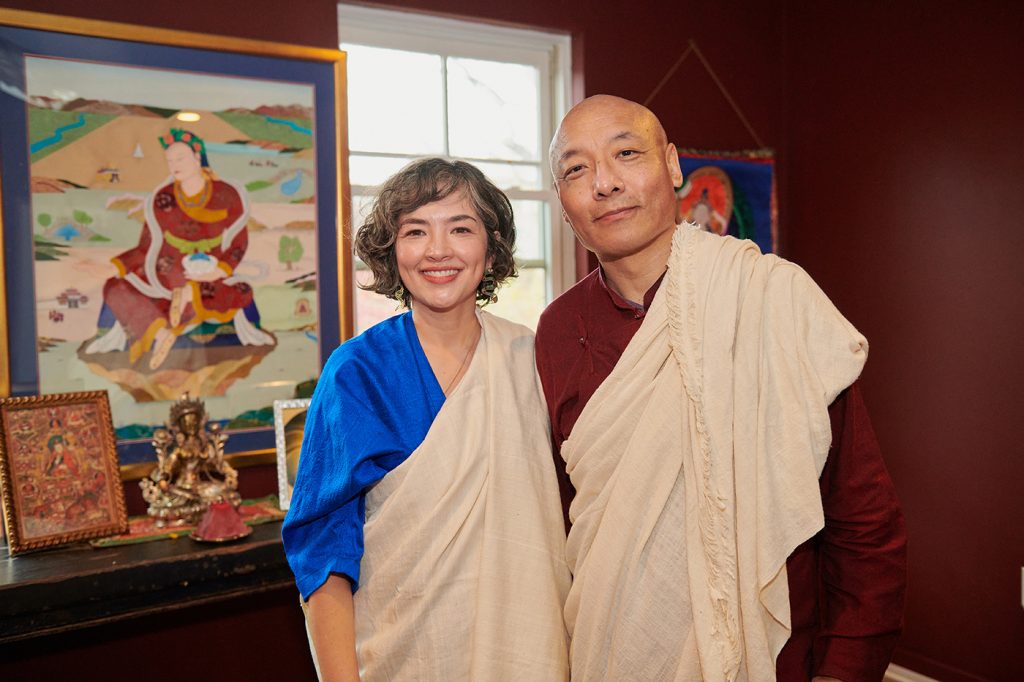
“I consider myself both a native Buddhist and a convert Buddhist,” says the Thai American writer and teacher Sunisa Manning. Born and raised in Bangkok to a devout Theravada family, Sunisa spent much of her childhood in the temple, simply “because it’s free.” There, she learned how to meditate and cultivated her connection with the dharma at a young age. But she began to question her place within the gender distinctions of Thai Buddhism, feeling confused at having to stay distant from the monks and ashamed when not following the rules.
During her college years at Brown University, Sunisa found her way to Tibetan Buddhism, having met Khenpo Tsewang Dongyal Rinpoche and Khenchen Palden Sherab Rinpoche at Padma Samye Ling Meditation Center in upstate New York. She recalled feeling a bodily connection to the tradition, which had dissolved the orthodoxies of gender in her mind. “A lot of people are convert Buddhists in the West. I think it’s so healthy. Choosing something deliberately as an adult, as a fully grown human being, is an important thing.” For the next five years, she searched for a teacher and eventually connected with Anam Thubten, who, thirteen years later, in August of 2024, would ordain her as a lay teacher in the Nyingma school of Tibetan Buddhism.
Though she had previous teaching experience in creative writing and literature, Sunisa was at first reluctant to teach the dharma. She didn’t set out to become a teacher but committed herself to it through the encouragement and confidence of her teacher. For over a decade she was one of the youngest people in Anam Thubten’s community, the Dharmata Foundation. But rather than letting Sunisa lead the Philadelphia branch of his sangha, where she is now based, he instructed her to create a group of her own—and so began Heart Sangha. The name “heart” came to her in meditation, as a reference to bodhicitta and the numerous phrases for “heart-mind” in Thai, Sunisa’s mother tongue.
“It’s kind of wild to give a woman under 50 lineage,” Sunisa said. “And I’m very humbled that he did. I think that dharma should come to people in all forms”—her form being that of a married mother of two young boys.
As a householder primarily teaching other householders, Sunisa places emphasis on finding the dharma amidst the chaos of daily life—that there needn’t be a trade-off between devoting oneself to one’s practice and to one’s family. After years of turning down retreats in order to be a fully present mother, she’s learned how the two are interconnected.
“I take parenting as the bodhisattva’s path, and [I try] to teach with a lot of humility from within that place,” she said. “For me, Buddhism has been helpful as a mother. I think having kids is a study in patience, tolerance, and a tremendous field of love and sacrifice.” Along with teaching their own sons the dharma, Sunisa and her husband run a monthly kids sangha, to give children ages 5 and up an introduction to meditation and spiritual community—her way of passing on the gift that she grew up with as a child.
At Heart Sangha, Sunisa also leads retreats and teaches chöd (the Tibetan practice of ego-severing) healing, offering hybrid options and Q&A sessions for all of their meetings. Self-described as “informal for a teacher,” Sunisa speaks from personal experience and works to emotionally connect with her students, many of whom come to the cushion from a place of pain. The members of Heart Sangha skew younger and more diverse than the typical sangha, partly due to Sunisa’s being a younger teacher herself. She emphasizes the importance of the discipline that comes from following a spiritual tradition and the commitment that comes from having a sangha—things that spiritual seekers in the West often skip over. “We’re going to need a container,” she said, “a relational human container for us to pursue the path after Covid and its fragmentations, and then the further fragmentations of AI. We need actual human connection.”
Formerly a novelist, Sunisa now authors the free Substack Dharma Bites, where she shares insights that arise from her experience teaching. She also hopes to soon write a Buddhist book, with the ongoing goal of making the dharma, which she calls “every person’s birthright,” widely available.
♦
Enlightened Archetypes
There are many twists and turns on the spiritual journey, and depending on what we come in with, practitioners apply different methods to work with what’s going on. For some of us, there comes a point in the spiritual journey when things can feel overwhelming. The pain is too big, the fear too strong. Letting yourself experience what you might have been avoiding for decades feels impossible, like you will definitely explode and die. That’s when it’s helpful to develop a relationship with an enlightened archetype: a character that represents love, healing, wholeness, and boundless compassion. They can bring a bigger sense of being held than what we are typically capable of generating ourselves.
Our minds work with narrative, and narrative lends itself to an enlightened archetype. If people are newer to Buddhism, it makes sense that they might not feel a connection to the iconography of a naked woman made of light, the sky-dancer dakinis that Machig Lapdron drew on when formulating her dharma of chöd (the Tibetan practice of ego-severing) in the 11th century. That might feel too foreign. Other people will equally resonate with dakinis right off the bat. It depends on our karma.
I like to give people the option to visualize Green Tara or use an archetype from their childhood, whether it is religious or not. What’s important is the enveloping sense of safety and warmth, and whether you can feel the enlightened archetype’s love. Only you can choose whom to work with. If she’s Gramma Tala, who dances like water in Moana, wonderful.
For people with a history of trauma, my advice is to find this sense of safety first. Invoke it every time you do inner work, like therapy and meditation. Experiencing the warmth of an enlightened archetype in our body is important before we spend too much time in silence on the cushion. Meditation shouldn’t have the quality of feeling cold, echoing, or alone.
With enlightened archetypes, we’re using our mind’s tendency to grab on to a story, and putting that in service of liberating our mind. It is a skillful means. We’re not saying that these archetypes are real or that they’re coming to save us. Eventually, we realize that the safety we’re calling in is nothing other than our ultimate face, our own sublime nature, but first, to summon that amount of love, we begin by imagining it coming from outside ourselves.
–Sunisa Manning

Thank you for subscribing to Tricycle! As a nonprofit, we depend on readers like you to keep Buddhist teachings and practices widely available.