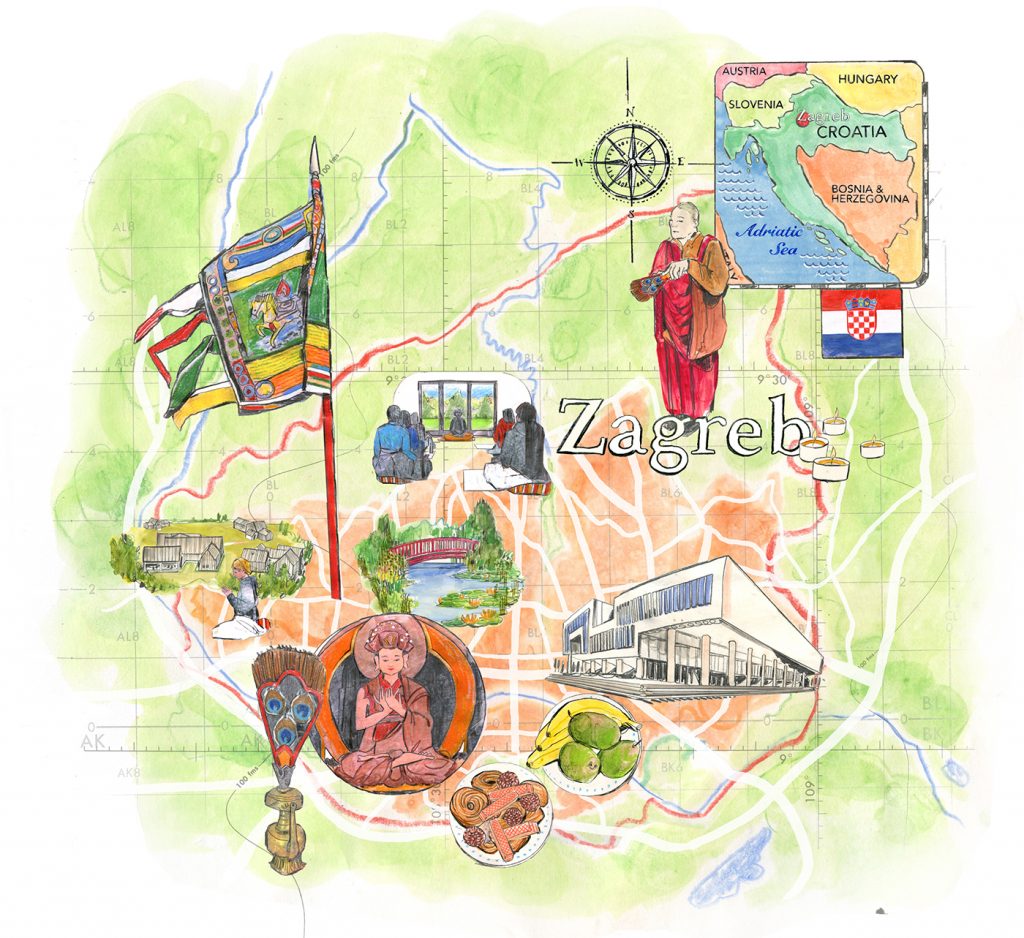
Zagreb, Croatia’s capital since the 16th century, remains a deeply Catholic society where Buddhism persists as a tiny minority. Buddhist ideas and images first reached the region via medieval Christian legends and reports of Jesuits, but organized practice took root only in the 1970s. The nascent movement gained significant momentum following Croatia’s independence, and was supercharged by the Dalai Lama’s landmark 2002 visit to Zagreb and Split, which drew 12,000 attendees and inspired the formation of several new Buddhist communities. Despite facing challenges from recent earthquakes and the pandemic, Croatia and Zagreb have become global tourist destinations, and as the nation is further integrated into the EU, its Buddhist groups are slowly developing into spaces for local and international exchange and practice.
Nestled in the scenic surroundings of Zumberak Nature Park, about sixty kilometers west of central Zagreb, the Chan Center first opened its doors in 2019. The center covers 2.6 hectares of land and serves as the home of the Dharmaloka Buddhist Community, whose roots date back to 1977. It is the only officially registered Buddhist religious community in Croatia.
The center is noted for its contemporary architecture—it was a finalist for Croatia’s National Architecture Award in 2020. The resident teacher is Chan master Zarko Andricevic (b. 1955), a pioneer of organized Buddhist teaching and practice in Croatia and one of the few Western dharma heirs of Chan master Sheng Yen (1931–2009). A distinctive offering of the center is the teaching of Zen yoga, or meditation in movement. It also offers residential stays for experienced practitioners. All programs are bilingual (Croatian with English translation).
2| Drikung Croatia
Situated in the western part of Zagreb, the Drikung Croatia Society is a newly established center that follows the Drikung Kagyu lineage of Garchen Rinpoche (b. 1936). The center is led by Ivan Stublic, PhD, who is a certified MBSR (Mindfulness-Based Stress Reduction) instructor. The regular program is held twice a month on Sunday mornings, and consists of a discussion group that explores Buddhist basics through study and discussion of foundational texts; ngondro practice from the lineage of Garchen Rinpoche; and White Tara Practice from the same lineage. Several times a year, the society hosts online teachings by Dorzin Rinpoche (b. 1969), who, together with Garchen Rinpoche, serves as the society’s principal lama.
3| Padmasana
Just outside Zagreb lies Tarini Dvori, the center where the Croatian Buddhist Society Padmasana conducts its activities. Founded in 1998, the society is led by Dragutin Smalcelj (Upasaka Lobsang Norbu, b. 1950), who offers a Rime (nonsectarian) approach to Tibetan Buddhism. Dragutin has played an important role in presenting Tibetan spiritual heritage to the Croatian public. Padmasana is a driving force behind public sand mandala ceremonies and touring exhibitions of Tibetan relics. The center holds a weekly class on Buddhist philosophy. Meditation and tantric practice sessions (for those who have received proper initiations) are held twice a month.
4| Vipassana — Meditations with Mislav
In western Zagreb, a vipassana meditation group in the Malaysian Theravada tradition has been active for the past ten years. Its simple title, Meditations with Mislav, bears the name of its founder and teacher, Mislav Brecic (b. 1970), a theater and radio drama director who graduated from the Academy of Theatre in Utrecht, Netherlands. Mislav received teaching authorization from the vipassana master Bhante Sujiva (b. 1951). Meetings are held once a week for in-person and online group meditations. Multiday meditation retreats are held several times a year in Vrata, an hour and a half west of Zagreb. The website offers recordings of Mislav’s dharma talks in Croatian.
Founded in 1954, the Museum of Contemporary Art moved to a new building in 2009. Its permanent display features works by the avant-garde art collective Gorgona. Active during the 1960s, the group consisted of painters, art historians, a sculptor, and an architect. Wrestling with feelings of alienation, unrest, and the anxieties of the modern age, Gorgona transformed daily activities—meetings, walks, and excursions—into art forms. While much of Gorgona’s work is resonant with Buddhist thought, one member, Josip Vanista, was explicitly influenced by dharmic ideas. His expressions of absence and restraint draw heavily on the concept of emptiness, and often display a spare Zen aesthetic.
In the center of Zagreb, the Botanical Garden was established in the late 19th century and forms part of the horseshoe of urban green space designed by the Croatian urbanist Milan Lenuci. The garden is maintained by the Department of Biology of the University of Zagreb. Accessible to all forms of transit, it is open to the public from April to October. It features an arboretum, rock garden, greenhouses full of tropical (and carnivorous!) plants, lily ponds, and pavilions. The twelve-acre park hosts a collection of 5,000 plant species, and offers many peaceful spots for quiet contemplation and retreat from the bustle of the city.

Thank you for subscribing to Tricycle! As a nonprofit, we depend on readers like you to keep Buddhist teachings and practices widely available.