
Shinto and Buddhism are Japan’s best-known sources of spirituality. But the third tradition, Shugendo, much less talked about but no less influential, is a form of spirituality rooted in the mountains, nourished by all of their beauty and awe, reared in their peaks and valleys, fueled by their hazards and dangers, reveling in their light and shadows. It borrows liberally from Shinto and Buddhism but isn’t beholden to either. One can be a practitioner of Shugendo and of Shinto or Buddhism, or both, or neither. This makes it incredibly difficult to explain to outsiders.
Perhaps this is because “Buddhism and Shinto represented the ‘front,’ while Shugendo magic dealt with the rear, the reversed, the backward, and so forth,” as the Shinto scholar Helen Hardacre put it. Practitioners weren’t ordained priests or monks but rather outsiders and iconoclasts, living with one foot in the sacred and the other in the profane material world. They eschewed all the comforts and perks of mainstream religion, embracing a rougher path, taking sustenance from hardship and trials. This led to a lot of misconceptions; when Jesuit missionaries first encountered Shugendo in the 16th century, they mistook it for devil worship. They were wrong, of course. But it’s true that Shugendo practitioners worship deities different from those typically pacified by shrines or temples. Theirs are untamed and unpredictable. Theirs are the wild gods.
The lives of ancient Japanese were yoked to the whims and rhythms of the wild. To them, mountains were more than terrain. Previous generations had tamed the flatlands. But the peaks were beyond human control. They were both the source of the waters that nourished life and the portals to realms unknown to mere mortals. This aura of mysticism and danger attracted spiritual seekers. They saw the hazards of the highlands as things not to be avoided but to be embraced in service of transcending the limits of human body and mind. Training is how one obtains (shu) spiritual powers (gen). This is the Way (do). Thus, Shugendo.
Practitioners call themselves “yamabushi”—“those who surrender to the mountains.” Yamabushi might climb savage peaks, subsisting on nothing but herbs and nuts; recite mantras for long periods in the inky depths of caves; or chant sutras beneath the icy hammer of an alpine waterfall. This isn’t idle machismo; their goals are catharsis and purification, proving themselves worthy of contact with the divine, and through that contact, borrowing some of its holy power. For the yamabushi, going into the mountains is a trip in literal and metaphoric senses—a pilgrimage into the wilds, a sacrament in a visionary journey to another plane of existence.
A man named Ryojun Shionuma is one of only a few yamabushi known to have completed the harshest trial of all, called the Thousand Days of Training. The reason so few commit to this ritual is that it means putting their life on the line: Once one begins a walk, it is said, they cannot stop for any reason—not weather, not injury, not sickness. In a 2007 book, he described a regimen of awakening before midnight, standing beneath a waterfall to purify body and soul, then traveling on foot from Kinpusenji to Omine and back. That’s thirty-one miles through the mountains in a single day, fortified by only rice balls and water. He then repeated this process another 999 times over the course of nine years. He faced physical dangers such as rockfalls and dangerous animals such as snakes, boars, and bears. And he faced inner demons, such as the monsters he hallucinated were throwing rocks at him as he walked in a delirium of exhaustion. When Shionuma finished—walking 30,969 miles in all (Earth’s circumference is only 24,901!)—he spent nine days in deep prayer with no food, no drink, and no rest, chanting sutras over and over again. The experience was so intense that his fellow yamabushi held a “living funeral” ceremony for him before the final stretch of prayer.
This sort of thing is extreme even for yamabushi. But when they returned from their trials, whatever they were, the yamabushi traditionally put the skills learned on the “other side” to work here in the material world. History abounds with tales of yamabushi employed as medicinal and faith healers, and as fortune tellers. They performed exorcisms and purification rituals, and even adjudicated disputes. The abbots of mainstream Buddhist temples and the priests of Shinto shrines tended to inherit their positions along family lines. But there were no such requirements for yamabushi. They occupied a position outside the religious establishment, allowing them to slip into and through and between Shinto and Buddhist traditions with ease, living embodiments of Japan’s flexibility in matters of faith. That people of old so respected these outsiders is a sign of our connection to the mountain realms, and to our belief in them as other worlds.
For the yamabushi, going into the mountains is a trip in literal and metaphoric senses—a pilgrimage into the wilds, a sacrament in a visionary journey to another plane of existence.
When I studied for my Shinto Cultural Examinations in 2012, I was hoping to learn more about Shugendo. But the textbooks touched on the tradition in only the broadest of historical strokes. They gave me valuable context but still didn’t give me much of an idea of what Shugendo was, or what yamabushi actually did. Shugendo, “the way of acquiring power,” sounds as vague in Japanese as it does in English. And as for what the tradition was, well, that changed depending on what point in history you were talking about, what region you were talking about, even what person you were talking about. It was slippery stuff. I knew I was merely touching the surface, and every theory I posed to myself was almost immediately disputed by different information. It felt like the old parable about the blind men describing an elephant, unable to reconcile the limits of their localized experiences with one another.
So I decided I’d participate in a yamabushi training session myself. Maybe that way I might get some answers. I didn’t know what form this training would take, but of one thing I was certain: My path led into the mountains.
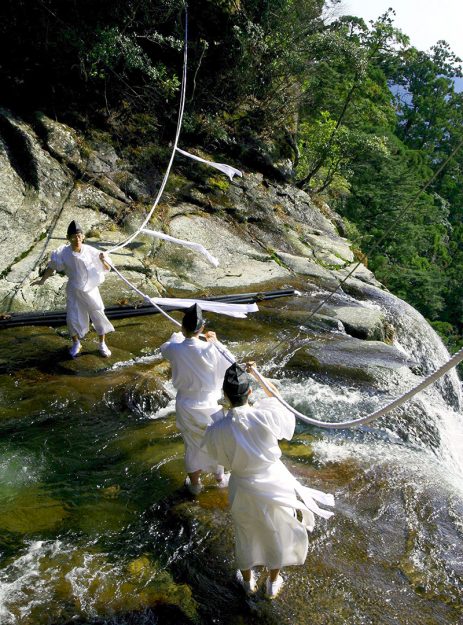
As with Buddhism, there are many schools of Shugendo. I chose the one centered at Kinpusenji Temple, of Nara Prefecture, in the town of Yoshino. I picked it because it represents one of Shugendo’s most sacred sites, as its background story is closely associated with the man who is venerated as the founder of Shugendo itself.
His name is En. En was born some 1,300 years ago, in a tiny village in rural Nara. He spent his youth studying Buddhism at a local temple. They say that he dreamed of more than just mastering the sutras, that true enlightenment could be found only by forging one’s body and mind in the harsh environment of untamed nature. He left behind the comfort of the temple, turning to caves and the wilderness, where he meditated regardless of season or weather. He dreamed of a rainbow-colored cloud descending to Earth, which might loft him through the skies to the mythical garden palace of the Great Sages, where he might drink of their knowledge and dine on the rarefied mists that sustained them, that he might acquire their holy powers to help all humankind. Some say his dream came true.
En lived through some truly trying times. At one point, Japan was racked by a horrific confluence of famine, earthquake, and plague. Nearly a third of the population perished, and Japan’s greatest minds wrestled with how to save their nation.
En took the task upon himself. He headed for the peak of Mount Sanjogatake, where he fasted, prayed, and conducted rituals for a thousand days straight. His singular purpose was to make contact with the most powerful deity he could, in the hopes it might assuage the natural horrors wreaking havoc in the land.
The first to appear before him were a real dream team: Shaka Nyorai, the Buddha himself; Senju Kannon, the thousand-armed female bodhisattva of compassion; and Miroku Bosatsu, an avatar of the Buddha’s projected return far in the future.
While En expressed much gratitude for their arrival, he also felt they were too gentle-hearted for the task at hand. So he continued to pray. Eventually, the skies darkened, the earth shook, and lightning ripped through the air. When En looked up, he saw a terrifying sight: Zao Daigongen, his monstrously titanic body topped by a ferociously scowling face that somehow radiated anger, compassion, and forgiveness all at the same time. This would do, thought En. A fearsome deity for a monstrous era racked by fearsome adversaries. He carved the image of what he had seen into the bark of a cherry tree, so that he might convey it to others.
After En’s death in 701 CE, those inspired by his example carried on, and transmitted his worldview and teachings to their disciples, and so on and so on. Many generations later, these traditions coalesced into what we now know as Shugendo.
At Kinpusenji, I’d found a guidebook for participating in a yamabushi training session. I bought it, took it home, read it, and, following its instructions, sent in a request. “Sent” as in physically mailed. No email, no phone: Only postcards were accepted. We had several back-and-forths by snail mail, ironing out the details of what to bring and wear. All of this culminated in a singular cryptic instruction: “Meet us at Muda Crossing. Look for the willow tree.”
Practitioners weren’t ordained priests or monks but rather outsiders and iconoclasts, living with one foot in the sacred and the other in the profane material world.
This, and the name of a nearby train station, was the only guidance I had. The journey took many hours and many changes of train lines from Tokyo. Eventually, I found myself in a little town an hour outside of Yoshino on a warm, late-spring morning. At the station, I’d asked an attendant about Muda Crossing, and they’d pointed the way down a two-lane country road paralleling the tracks. A ten-minute walk through a neighborhood of homes framed in the traditional style, with heavy clay-tiled roofs, brought me to the promised willow tree.
Participants began to arrive over the next hour. By the time of our scheduled departure, we numbered twenty-eight. We were a motley crew of people from all walks of life, the youngest a 14-year-old boy, and the eldest a woman of 70. Most were here for the first time; others, I gathered, were repeat visitors. Three men, obviously yamabushi, arrived to guide us on the trip. I say “obviously” because of how distinctly their regalia stood out against the sea of modern Gore-Tex fabric and hiking gear of the participants: white robes and vestments adorned by what looked like fuzzy pom-poms; deer pelts tied around their waists; traditional two-toed boots on their feet. Atop their heads they wore boxlike hexagonal tokin hats, fastened under their chins with braided cords. And each carried his own conch-shell trumpet, that audiovisual signature of Shugendo.
After welcoming us, the yamabushi arranged us in a line, with one of them taking up the front and two bringing up the rear. I was third from the front, wondering what I’d gotten myself into, when a blast from the trumpet sounded, deep and resonant. It echoed across the river and back, sounding more like the call of some strange animal than a human-made sound. The leader told us they call it the “lion’s roar.” It had the power to drive away evil spirits of all kinds, including the anxieties in the human heart. In spite of its shockingly loud volume, there was something warm and welcoming about the sound, perhaps because it resonated from the curves of that shell, made by nature rather than the human hand. So cleansed, we began our journey, marching downriver and across the bridge.
We trekked nine miles from our starting point to our destination, Kinpusenji. This was the beginning of a longer, roughly sixty-mile traditional pilgrimage route from Yoshino called “the inner path through the great peaks,” one of the steepest training routes in all of Shugendo. The segment we spent the day walking was largely paved, but beyond Kinpusenji, we were told, it grows rugged and isolated. A number of particularly demanding sections compelled travelers to navigate narrow paths cutting along steep slopes or scrabble their way up cliff faces. The rule was to follow the head yamabushi in contemplative silence. But during a water break, I couldn’t resist striking up a conversation with him. I asked what it took to become a yamabushi.
“We’re masochists,” he laughed. “Really upbeat masochists.” I laughed, too, but pressed for more. “Let me give you an example,” he continued. “If we reach a mountain hut and there aren’t enough camping mattresses for everyone, a veteran yamabushi will always let the less experienced ones take them. The more experience you have, the more likely you’ll be sleeping on the floor. And if there happen to be warmer and colder spots on the floor, the more experienced yamabushi will gravitate toward the colder ones.” He paused for a moment and chuckled. “Ten-to-one, we’d even be saying, ‘Thank you for giving me this cold, hard wooden floor,’ out of gratitude for having even that—anything beats sleeping out on the ground in the winter!”
It reminded me of what Ryojun Shionuma described as his trick for making it through his thousand-day trial: “Taking pleasure in the things you can’t control.” The vast majority of us will never experience a pilgrimage of the kinds that yamabushi subject themselves to. But we’ll all find ourselves in the metaphorical mountains at some point, and cultivating a roll-with-the-punches attitude is key to making it through.

This made sense logically, but it’s easier said than done. And soon, I’d be tested myself. Once our walk ended, I’d continued traveling in the region on my own. I planned to end the trip in a special way: at Mount Sanjogatake, the place where Shugendo was born thirteen centuries ago.
I wanted to see the spot where it happened. I wanted to see if I might feel any power for myself. I was ready. I’d come all this way. The gate stood before me. A pair of wooden posts six feet tall, with a board connecting the tops, a rudimentary door framing the wilderness beyond. Beside it stood a stone pillar, rough-hewn and squared, towering even taller than the gate. On it a series of characters were engraved into the surface: 女 人 結 界 (“WOMEN FORBIDDEN”).
Shugendo started here, just a few hundred yards from where I stood. I yearned to see it, with all my being. Yet here I was being told I could never tread that path. Not out of any fault of my own. Because of my gender.
There are many schools of Shugendo. Most accept female trainees, who can go on to become full-fledged yamabushi in their own right. And the Meiji government lifted the prohibition on women entering the mountains in 1872, as part of its efforts to modernize. But local men in a handful of places fought back, demanding that their mountains be allowed to retain the taboo, citing faith and tradition. This was one of them.
I stood in silence before the “door.” All around me towered enormous cedars, sturdy trunks lofting fragrant boughs to scrape the sky far above. A breeze tousled my hair as I stared down the path beyond the gate. There was nobody else around. I could have ignored the prohibition and walked through the gateway. I could have summited that peak and nobody would have been the wiser. But I didn’t. I came here to show respect, not to challenge taboos. I came because I wanted to get as close as I could, and I had.
The cedars continued to sway overhead. After a while I felt as though they were looking down at me, asking me questions. I could imagine their voices, deep with woody gravitas: What are you doing here? What do you want?
I’d been trying to learn something from Shugendo, and I had, from my experiences with the yamabushi. They had taken me in, allowed me to train with them. I could continue that training if I so desired. Shugendo wasn’t the problem. Sexism masquerading as tradition was. Shugendo had changed. This place hadn’t.
But at the same time, a poem popped into my head. It was written by Jikigyo Miroku, a spiritual seeker who founded a popular religious sect that worshipped Mount Fuji, early in the 18th century.
One climbs Mt. Fuji
and finds nothing there
whether that is good or bad
is in one’s mind
Summiting Mount Sanjogatake wouldn’t solve anything. It wouldn’t answer any questions. It would be as much “nothing there” as up on Fuji, or anywhere. The only real answers lay within.
I am not a yamabushi. But I love the mountains. And the fact is, climbing a peak isn’t the only way to appreciate its beauty. Japan is so mountainous that it’s rare to be far from the sight of one. Mount Fuji, our tallest, is a perfect example.
When I was 11, my parents took me on a trip to climb Mount Fuji. On the way up, I came down with a terrible case of altitude sickness, and we had to turn back. But even though I never made it to the top, Mount Fuji lost nothing of its charm to me. Now I’d approached another peak I’d always wanted to climb, and found myself turned back again. I recalled another story about En the Ascetic. Late in life, they say, he encountered a pair of oni—ferocious ogres—deep in the mountains. Normal people would have run in terror, and probably been devoured for their troubles. But not En. Through his mastery of the mystical arts, he compelled them to renounce their evil ways and become his disciples. Virtually every portrayal of En in art shows him flanked by these two fearsome monsters. “Should they disobey him,” says Shoku Nihongi, an official history of Japan commissioned by the emperor in the 8th century, “he would bind them with spells. But he used them to gather his firewood and fetch his water.”
The idea of En harnessing these frightening monsters for the purposes of housekeeping, rather than for taking power or causing mayhem, seems amusing, even a little cute. But I think it teaches us something important: that our monsters can’t be erased or banished; they will always be with us. Yet if we face them with the right mindset, they can be tamed. They can even help us in our daily lives.
“You will face different trials every time you train,” says the yamabushi Kokai Shimazu. “But the most difficult trial of them all is facing yourself.” I wasn’t even standing on the mountain’s training ground at that moment. Yet I felt the mountain taught me something nonetheless. When I faced Sanjogatake, it sparked an awareness of my true feelings: negative, even angry ones. These were my inner demons, monsters who menaced my thinking. But I did not run from them. I did not get eaten. I faced them, and, like En, embraced them and tamed them. Whether I could use them the way he could, I didn’t know. But it was a start. I am a woman. Whether I see that as a hindrance or a strength is up to me. And if that is my choice, I choose strength.
♦
From Eight Million Ways to Happiness: Wisdom for Inspiration and Healing from the Heart of Japan by Hiroko Yoda, published by Tiny Reparations Books, an imprint of Penguin Publishing Group, a division of Penguin Random House, LLC. Copyright © 2025 by Hiroko Yoda.
To learn more about Shugendo, read a recent interview with Hiroko Yoda.

Thank you for subscribing to Tricycle! As a nonprofit, we depend on readers like you to keep Buddhist teachings and practices widely available.