When Soviet revolutionaries took control of Mongolia in 1924, Urga, the country’s capital, was the seat of an ancient and thriving Buddhist culture. The Eighth Jebtsundamba Khutugtu, an authoritative Tibetan lama (outranked only by the Dalai Lama and Panchen Lama), presided over a massive ecclesiastical structure that formed the bedrock of Mongolia’s society. With a historically nomadic populace, Mongolia first developed permanent cities around its monasteries, with Urga being the largest. In the early 1920s, over one-third of the population lived in territories administered by monasteries. But the 1924 regime change brought a near end to the entire system. Soviet antireligious sentiments saw the destruction of more than 1,000 monasteries and the massacre of the vast majority of Buddhist monks. Urga, or “Big Monastery,” became Ulaanbaatar, or “Red Hero.” Those who survived the decades-long campaign to eradicate the influence of Buddhism turned to the arts to preserve a semblance of Mongolia’s national identity. Thus, the painting style Mongol zurag was born.
Her delicately detailed paintings, installations, and fiber works evoke ever-fading traditions while satirizing globalization and state control.
The art form originally combined elements of traditional Tibetan thangka painting and European forms flowing in from Moscow, but following Mongolia’s liberation from communism in the 1990s, modern Mongol zurag artists began to address the country’s newest challenges: capitalism and consumerism. Nomin Bold, a 42-year-old artist from Ulaanbaatar, is one of contemporary Mongolia’s pioneering zurag artists. Her delicately detailed paintings, installations, and fiber works evoke ever-fading traditions while satirizing globalization and state control. Both beautiful and biting, her work is the art of resistance.

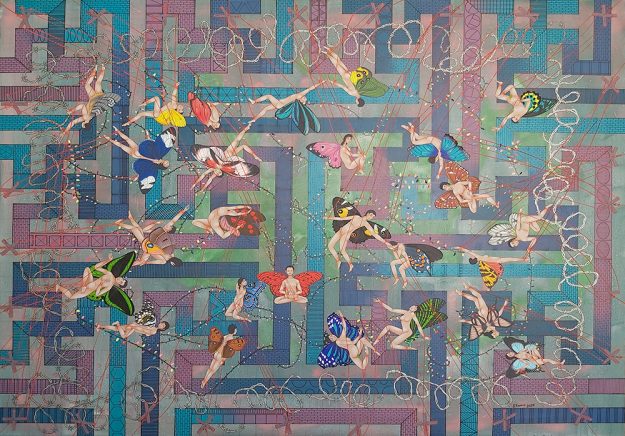
Bold’s early zurag paintings contain the trademarks of the style: bright colors, busy landscapes, Buddhist motifs reminiscent of thangka art, and the merging of tradition and modernity. Bold also adds her own signature flair in the form of marionette dolls, as seen in +, Negative. Upon first glance, the marionette strings stretching across the canvas and twisting about one another may appear as intricate line work—until the eye lands on the controllers. Across Bold’s portfolio, figures like beautiful women, ornately dressed children, and playful fairies are bound by the strings, opening a query for the viewer. Are they being restrained, held back by omnipresent political puppeteers as if on a leash? Or perhaps pushed onward, performing an orchestrated act as the puppeteers’ proxies? Bold leaves these questions open, encouraging viewers to find answers on their own. “Not everyone is gifted with artistic abilities or a creative mind,” she said in an interview with Beautiful Humans. “So when we are, our art must be original to first catch people’s attention, then, later on, people will start becoming interested in its meaning.”
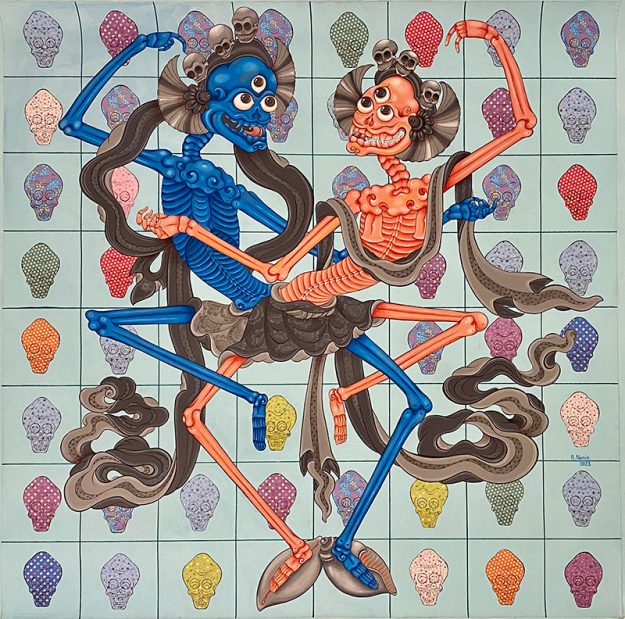
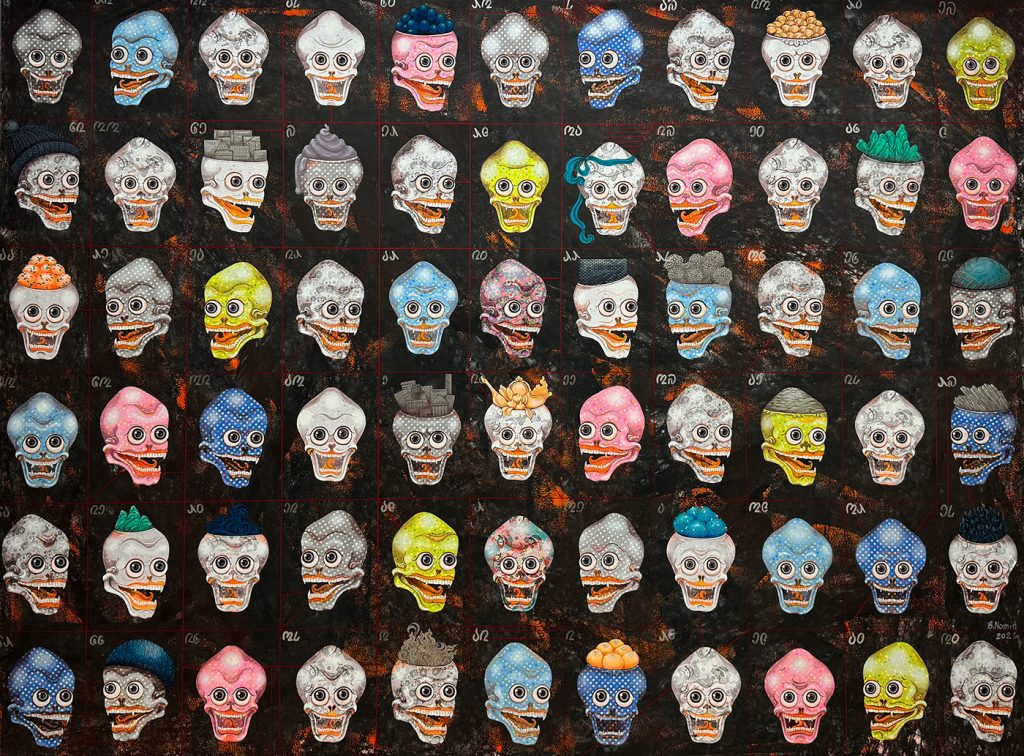
Other attention-catching figures that dance along Bold’s canvases are the Citipati (Skt.: “lords of the charnel ground”), a pair of skeletons in joyous movement with each other, often smiling widely, with fangs to boot, and bulging, ecstatic eyes. This macabre duo, seen in SpaceShip (1) and Monogamy, is a staple of traditional Vajrayana Buddhist imagery. They are regarded as enlightened beings and protectors of funeral grounds, and their wild dancing and flailing skeletal limbs evoke a dynamic tension between life and death. In true zurag fashion, Bold adds modern elements to her Citipati, namely in the form of bright, bold colors and textures. She told Beautiful Humans that “the singularity that makes Mongolian-style drawings so spectacular is their ability to make everything possible by representing any time and space on one canvas.” This rings true for Being Mortal Being Immortal, featuring six rows of disembodied Citipati heads, with each one different from the next. Some sparkle, some glow, some have their skulls sliced in half and are overflowing with buildings, gems, food, and fabric, and one lucky Citipati even has its cranium warmed by a Western-style fisherman beanie. With these additions, Bold takes the already playful nature of the Citipati even further, toying with the idea of modernity subverting and transforming tradition and blurring the boundaries between life and death.
Both beautiful and biting, her work is the art of resistance.
Zurag painting is not the only artistic medium through which Bold pokes at societal issues. She also creates multimedia pieces, such as the hand-crocheted gas mask in Pupa 26. The colorful mask seen here—one of many in the Pupa series—evokes the Mongolian ceremonial masks historically used in Buddhist rituals, such as Tsam, a dance held at the start of every calendar year to exorcise evil. But instead of wrathful facial expressions, Bold’s headpieces include the long tubes of the gas mask. Originally debuting in 2021, the Pupa series confronts us with the global concern of air contamination, whether from pollution, bioweapons, or infectious disease.
The Pupa series, along with other fiber pieces, establishes Bold’s talent in artistry that speaks to issues applicable outside of Mongolia’s bounds. Fittingly, this year her work is being presented at one of the largest international stages for artwork. She is one of four Mongolian artists featured in the 2026 Venice Biennale Mongolia Pavilion exhibition entitled “Entanglements: Connectivities Across Borders,” on view until November 22, 2026. As Bold grows her audience and her thematic voice, only time will tell what shape her art of resistance will take next.


Thank you for subscribing to Tricycle! As a nonprofit, we depend on readers like you to keep Buddhist teachings and practices widely available.