It isn’t just that the Buddha had deep insight into the nature of life, but that he was also able to imagine a new form of life. This reflects the creativity at the heart of his genius.
It’s worth noting that the form of life the Buddha envisioned was rooted in the context of fifth century BCE, India, a time of enormous social, political, economic, and religious upheaval. The Buddha’s teachings aimed to support those around him in meeting the challenges that such times present. What he imagined was consequently a way of seeing beyond the instability and tumult of his world, a way of living that went against this turbulent stream.
Thus, he didn’t just recycle established traditions. He created a new way of understanding and of going about life in the world. A stock passage in early Buddhist texts declares, “‘this is a teaching which has never been heard before’.” We might dismiss this as religious rhetoric, but perhaps it’s true. The example of the Buddha’s teaching itself thus shows that the path beyond what frustrates us, paralyses us, or otherwise holds us back—and that leads towards our personal and collective flourishing—follows not only from practicing mindfulness and resolve, but from applying our creative imagination.
In this light, suffering is not a problem to be solved—to be “eradicated,” as tradition has it. Rather, it’s a source of transformative power. It’s to be embraced, and in the process, creatively transformed into a path, a way of life.
Art as a Way of Engaging with Suffering
In our Western cultural tradition, the arts have long been a locus for creative engagement with suffering. We find examples at least as far back as the ancient Greeks. In our Western, post-Ancient Greek culture, the Christian artistic tradition has perhaps most powerfully engaged with suffering.
The role of the crucifix in this tradition epitomises this. Some of the greatest works of Western art involve a man nailed to a cross– hyperrealistically, in some depictions. If you go into a church in Mexico or Spain, it’s all about blood, gore, and misery. It’s very much in-your-face dukkha (Pali: suffering). In northern Europe, we’re a little more coy. Protestant churches, by comparison, are generally rather sanitized. Nonetheless, wherever one may stand in relation to Christianity as a whole, its elevation of pain and suffering into devotional art is striking.
I’ve long been inspired by an understanding expressed by J. W. N. Sullivan, a popular writer on science and culture in England about a hundred years ago. Perhaps Sullivan’s most famous book, a small volume published in 1927, was Beethoven: His Spiritual Development. It opens with the sentence:
Few men have the capacity fully to realize suffering as one of the great structural lines of human life.
In Sullivan’s framing, suffering is not just misery to be overcome. Rather, it constitutes one of the core elements that define us, that structure us as human beings. Sullivan believed that this understanding was central to Beethoven’s outlook. And Beethoven furthermore viewed suffering not only as a necessary condition of life, but also as possessing an illuminating power.
This may sound strange to a Buddhist ear. Traditional Buddhism tends to address suffering not in regard to its positive aspects, but rather as something to free ourselves from. In contrast, Sullivan’s Beethoven shared my secular approach, whereby we choose to embrace suffering, not push it away. Nor do we choose to embrace it in order to push it away. We accept suffering for what it is, unconditionally—by which I mean unconditioned by greed, by hatred, or by confusion.
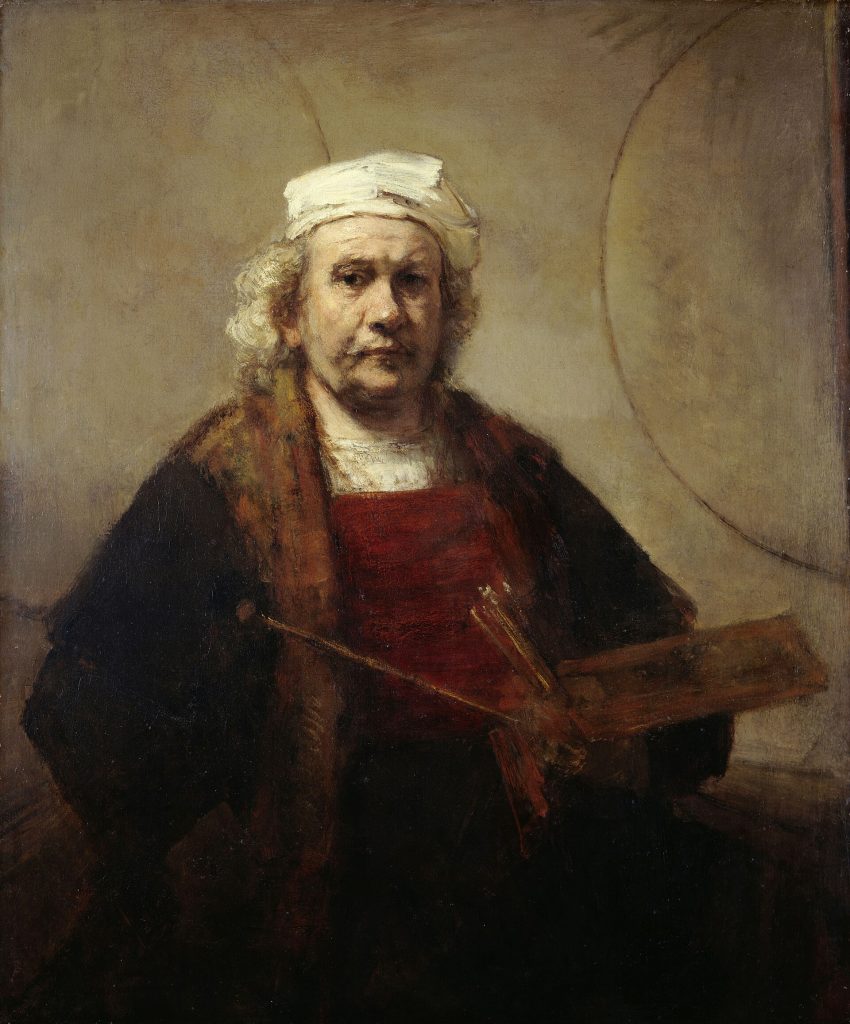
Great art offers myriad examples of such unflinching acceptance. Each of us can find examples of special personal significance. For me, these would include the late self-portraits of Rembrandt, in which he paints what he sees in the mirror as he gets older: an aging man who, as we now know, has gone bankrupt. Rembrandt had needed to leave his fancy studio in Amsterdam. He was struggling. He was in a terrible state. In response to the challenges he faced, he just stares at the mirror and paints. A very beautiful Rembrandt self-portrait in this vein hangs in Kenwood House on Hampstead Heath in the north of London, as do several others in the National Gallery. They represent an extraordinary contemplation, a meditation on human suffering.
Another self-portrait I really love is by Hakuin Ekaku (1686–1769), a Japanese Zen master who composed in rapid brushstrokes. Like Rembrandt, Hakuin displays a poignant sense of grief and sorrow, along with puzzlement and confusion, all captured in his very quick lines. So we do find this contemplative practice in Buddhist tradition as well.
Some of us may be more moved by music—by the slow movements of a Schubert symphony, for instance, or of Beethoven’s late string quartets and piano sonatas. Of the latter, Sullivan writes:
These works have a serenity which contains within itself the deepest and most unforgettable sorrow. And yet a sorrow which is transformed by its inclusion in that serenity.
Such works are infused with a sense of tragedy, of loss, of grief. But what’s striking in these examples is the beauty inspired by pain that they all share. Beauty and suffering are not at odds in these works. They come together.
An Aesthetic Practice
It’s through embracing suffering, rather than evading, denying, or ignoring it, that the door to beauty opens. The serenity, equanimity, quietude, and tranquillity that we cultivate in meditation aims not at fostering a narrow, self-indulgent wellbeing, but rather at providing the kind of space we need to embrace suffering. Dwelling in stillness, we can regard what might otherwise shock or horrify us, and say, “Yes, this is the state of our existence.”
Once we’ve set aside some of that reactivity, what opens up is a sense of the miraculousness of the world, the wonder, the beauty. You may have noticed that when you are on retreat, when the mind gets still, the world comes alive. It becomes radiant. You’ve slowed down. You’ve stopped. You just look, listen, and hear. As you wander around the retreat center, you may be struck by the sheer beauty of the color of leaves. Contemplative practice has renewed your awareness of the trees, flowers, and perhaps rabbits, which you may otherwise take for granted. Your stillness of mind has opened you to the sublime, in the original sense of something that inspires both wonder and unease. Indeed, there’s something slightly terrifying about it.
Thus, contemplative or meditative experience is not just cognitive. It’s not just about understanding things better. Nor is it just affective—about developing feelings of love, compassion, and joy. It’s also aesthetic. It has to do with beauty. This haiku by the Japanese Zen monk Bashō captures this aspect of meditative experience:
Departing spring
Birds crying
Tears in the eyes of fish
For me this brings to mind T.S. Eliot’s notion of the sublime, as captured in his impression, in the Four Quartets, of “an infinitely gentle, infinitely suffering thing.”
The Metaphor of the Goldsmith
When we dig into some of the early texts of the Buddhist tradition, we find this sensibility to the aesthetic to be an aspect of the path. One discourse relates an encounter between Gotama, the Buddha, and a seeker named Pukkhusāti, in which the Buddha employs a metaphor that is relevant here. The metaphor illustrates the role of the aesthetic, and creativity more broadly, in spiritual development. Gotama says to Pukkhusāti:
Imagine a goldsmith who has prepared a furnace of fire. He’s heated his crucible, his little porcelain or enamel cup, and he’s taken a piece of gold with his tongs and placed it inside the crucible. Sometimes he blows on it, sometimes he sprinkles water on the fire, and sometimes he just stands back and observes what’s going on. In this way, … the gold becomes refined, rid of impurities, malleable and radiant, so that he can fashion from it whatever kind of ornament he likes.
With this metaphor of the goldsmith—a creative artisan—at work, the Buddha equips Pukkhusāti to engage creatively with the situations we meet in life. The Buddha points to a practice of awakening—a practice of human flourishing—that is far from a rote endeavor of resorting to mindfulness. It entails doing something with our minds and lives, and doing it skillfully. Like a master goldsmith employing her tools, materials, and know-how at the furnace, we can work at coordinating our equanimity, focus, and energy to transform the raw materials of our practice—the five aggregates of bodies, feelings, perceptions, inclinations, and consciousness. Through this creative practice of the dharma, we can imagine and then become the kind of person that we aspire to be—just as the goldsmith shapes purified gold into whatever kind of ornament she wishes.
♦
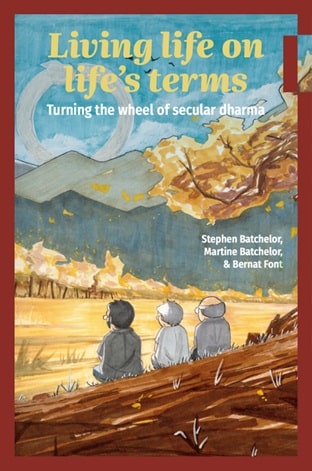
From Living Life on Life’s Terms: Turning the Wheel of Secular Dharma by Stephen Batchelor, Martine Batchelor and Bernat Font (Tuwhiri, 2026)

Thank you for subscribing to Tricycle! As a nonprofit, we depend on readers like you to keep Buddhist teachings and practices widely available.