March 2020—I remember the way that time had stretched out ahead of me, seemingly elongated. Indie act Waxahatchee had just released a new single, “Fire,” earlier that January, and I remember listening to the band’s singer and songwriter, Katie Crutchfield, croon “That’s what I wanted,” as I spent long hours staring out my window at the community garden below. I remember the way the garden beds were barren, when, by some small miracle, something happened: Spring arrived.
I remember watching buds bulge from branches, growing day by day, sprouting into leaves. I remember noticing, for the first time, the magnolia tree adjacent to my apartment building; its pink petals exploding into view. I had lived in New York City for almost a decade at this point, was several years deep into a meditation practice, and yet had never slowed down enough to appreciate the way that the earth reintroduces herself to us each and every year.

Such is the way that the pandemic unveiled my relationship to nature, revealed through the intimacy that comes with close looking. It is an experience I have had mirrored back to me in so many conversations about that time, most recently with journalist and Zen practitioner Jo Confino, in discussing his new book Between Earth and Sky: 100 Days of Deep Looking in the Place of the Dead. The book chronicles Confino’s time in Mitla, Mexico, when what was meant to be a quick sojourn—a quick respite before he and his wife, Paz, transitioned from their lives in New York City to join the rural monastic community of the late Thien master Thich Nhat Hanh in Plum Village, France—became a durational contemplation of death and rebirth in the desert foothills of the Sierra Norte mountains.
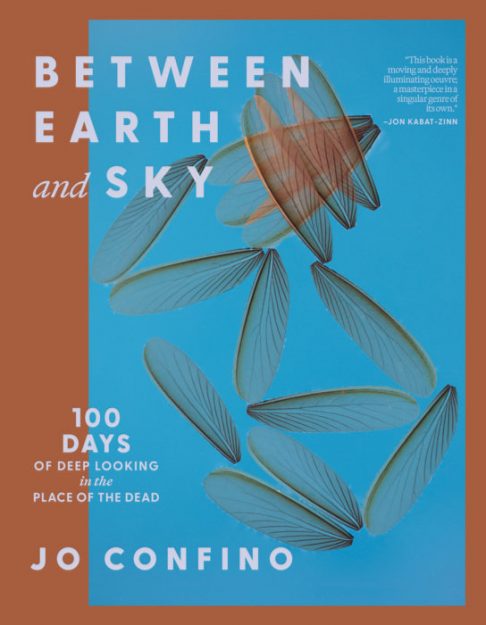
Between Earth and Sky: 100 Days of Deep Looking in the Place of the Dead
By Jo Confino Parallax Press, Jun 16, 2026, $21.95, 176 pp., paperback
When Confino and Paz first arrived in Oaxaca City, Mexico, on March 1, 2020, the pandemic had already quickly descended across the globe. With little information about the spread of the Covid-19 virus, the two made the swift decision to hunker down in a quiet location for what they thought would be a short stay. They booked a room at Casa Lyobaa, or, as the Indigenous Zapotec people call it, “The Place of the Dead.” They didn’t leave Mitla for the next 100 days.
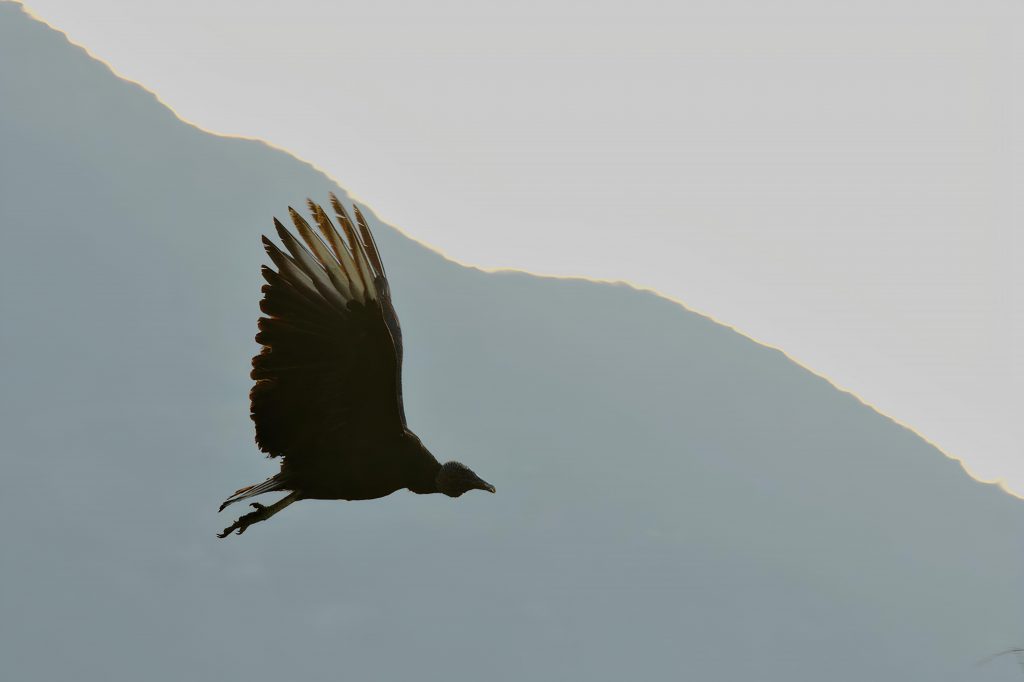
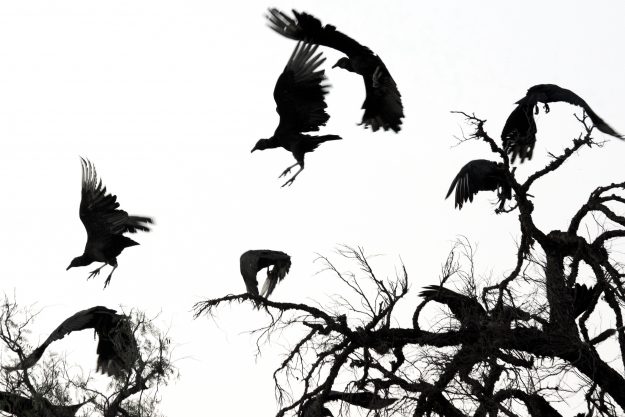
“There were just so many omens that didn’t look good,” Confino tells me. “And then there were all the vultures circling the property every morning. It was the height of the dry season, and everything looked pretty dead—just everything was pointing to death.”
With their looming mortality circling above them, Thich Nhat Hanh’s words “nowhere to go, nothing to do” became the maxim for Confino’s sequestration, and a daily mantra for solo morning walks in the desert, accompanied by just his mind, his Canon 5D camera, and his macro lens.
At the outset of these walks, setting foot into the crispen scrubland and scanning a monochromatic colorscape, Confino found little to photograph. “I can’t go anywhere, I can’t do anything. I can walk in only one direction, just for a short amount of time, and then come back,” he tells me, remembering how he felt during the experience. “It feels awful, because you feel that your life has shrunk and you have to face this spaciousness, which very easily feels like boredom, because you don’t know what to do with it. I think most of us are looking for more space in life, but then when we get it, we don’t know what to do with it.”
I think most of us are looking for more space in life, but then when we get it, we don’t know what to do with it.
The unrelenting landscape acted as a mirror, not only reflecting Covid’s increasing death toll in Mitla and across the globe but also the conditions that set forth the book’s journey. Confino spent more than forty years working as an environmental journalist, aiming to illuminate and bring urgency to the climate emergency and destruction of ecosystems. Yet, over the years, while gaining increasing responsibility and working at larger scales, his personal kinship with nature began to slip away. Despite decades of asking others to evaluate their relationship to the natural world and practicing within the Plum Village sangha, Confino realized he had allowed himself to fall into the anthropocentric view: of nature being without, not within; a separate entity from which to extract.
The initial photographs of Between Earth and Sky reflect as much. One image, set full-bleed across two pages, intimates the barren earth, awash in tones of beige and sparsely dappled with green vegetation. Stare too long at the image and the sandy shades of monochromatic terrain almost begin to blur together, bringing the viewer into the psychotropic desert heat. In another, a donkey is backlit in an orange glow of light, its features indistinguishable. Striking though the images may be, there is a certain sense of remove, as though the camera (and the person behind it) is still searching for its subject. The photographs speak the language of Confino’s internal state: chasing emptiness, attempting to own the present moment through the act of capture, approaching nature as hunter, his spear replaced with lens and viewfinder.

Let go from his job in journalism, removed from the frenetic pace of life in New York City, and confronted with a vast expanse of the desert, Confino reflects on past conversations with his teacher, Thich Nhat Hanh (or “Thầy”, teacher), whose insights on interbeing became embodied throughout his days of contemplation in the desert.
“Thầy described interbeing and the way that everything is in us. That is relatively easy to understand intellectually, but I think very few people, myself included at that point, had a lived experience of that; that truly felt interbeing, in body, mind, and spirit.”
Isn’t this so often the paradox of deep dharma practice? The daily meditation practice becomes an act of maintenance rather than devotion. Retreats become spent striving for experience rather than relaxing into what is naturally arising. Years spent reading the Buddha’s words, the teachings work to penetrate the mind but not the heart.
And then there are moments that crack open our practice, the causes and conditions coming together to move us from a theoretical view of the dharma into a deeper embodied understanding, beyond words, beyond what can be tangibly grasped.
“I had a deepening and a ripening of what I knew,” Confino tells me of his time in the desert. “And I think so much of the benefit of the practice is to move from an intellectual understanding to a lived experience. If it’s just in the mind, that can easily be swept away, but when it becomes part of our lived experience, it becomes foundational to our life, and it can’t then be dislodged.”
It is at this point in the book—when Confino begins to train his awareness on the mystery of having nothing to grasp—that we can see the dharma begin to manifest in photographic form, deep looking demonstrated through close-up photos of the flora and fauna of the desert.
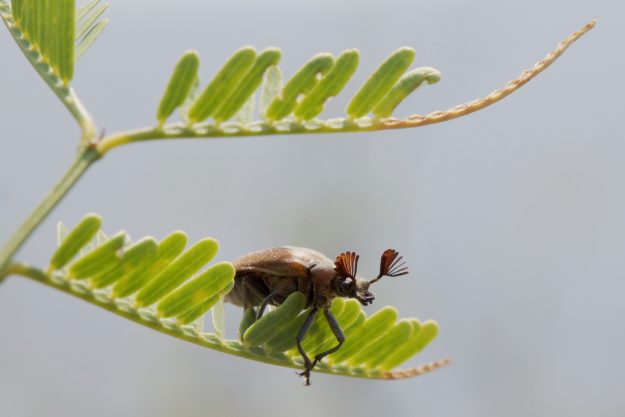
Wasps, moths, beetles, and bees impaled on cactus spikes provide lessons on the suffering caused by greed and attachment, the rapid pace of life obscuring our path and clouding our ability to apply right view. Spiders provoke impressions of patience, perseverance, and the interplay between life and death. Ants evoke community, sangha, and the abundance of what can be created within a matter of hours with many hands (or legs) working together. The cacti and their thick skins bring to mind the Buddha’s simile of the skinless cow (Samyutta Nikaya 12.63), who, without its protective layer, becomes an easy target for infection. How alike are we to the cacti, our outer defenses protecting all the water, nutrients, and tender goodness of our flesh? And, of course, the vultures, feeding on dead things, a reminder of the impermanence of life, a visual cue toward the Five Remembrances:
1. I am of the nature to grow old, I cannot escape old age.
2. I am of the nature to get sick, I cannot escape sickness.
3. I am of the nature to die, I cannot escape death.
4. All that is dear to me and everyone I love are of the nature to change. There is no way to escape being separated from them.
5. I inherit the results of my actions of body, speech, and mind. My actions are my continuation.
“I’d see a bush or a stone that I knew well, and I would say hello to it. I developed this intimacy,” Confino recounts. “As I slowed down, as I stopped, as I became aware, as I looked deeply—I began to realize that actually life was everywhere; that it was talking to and experiencing me. When I said hello to a plant, there was a sense that the plant knew I was there. Or I was looking at the mountain, and I felt the mountain looking back at me.”
A reconciliation with the land, aided by the daily devotional practice of the walk and the one-pointed focus of the macro lens, revealed the teeming life naked to the visible eye. “When I got close-up with the lens, I started to see the fullness of it. The macro lens brought me close to things; the closer I got to something, the more proximate I was to it, the more I felt connected to it,” Confino tells me.
After two months into Confino’s fate-imposed retreat, something else happened. Mirroring the transformation I experienced during my fire escape vigils, Mitla’s spring thunderstorms transformed the desert landscape from barren to wild and teeming. This happening marks my favorite photographic series in the book, a daylong termite swarm, who leave their discarded wings on the surface of the pool at Casa Lyobaa. These images are surreal—the tiled pool bottom so intensely cerulean blue that, at first look, I thought these images were computer-generated. Just as quickly as they appeared, the next day, the termites and their wings were gone without a trace.
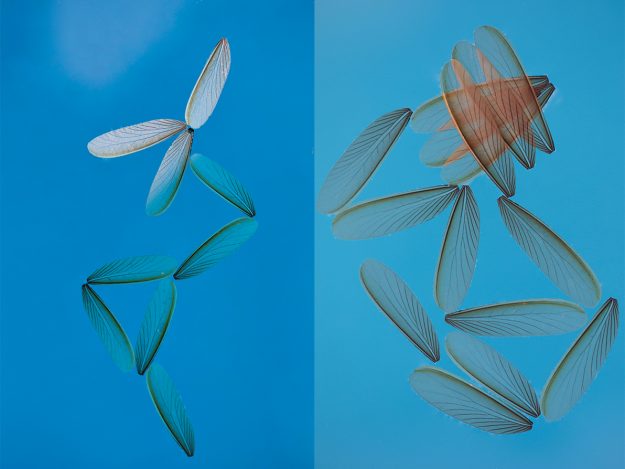
This is the way of life and death, the swift arising and dissipation that makes all things impermanent. As life returns to the Oaxacan valley, seeds burst into wildflowers and rains restore waterways, and Confino’s time in Mitla comes to an end. The French borders reopen, and he and Paz take the opportunity to continue their stunted journey to Plum Village.
Between Earth and Sky ends with a reminder: Mother Earth will always return. My conversation with Confino ends here, too, as we both wonder aloud how to balance our despair for the continued destruction of the natural world with our understanding that nature will persevere. In the book, Confino once more evokes the words of Thầy:
“We have to accept that the worst can happen; most of us will die as a species, and many other species will die also. Mother will be capable, after maybe a few million years, of bringing us out again—this time wiser.”
Confino leaves me with a similar sentiment:
“For us, it is very alarming and urgent, but for Mother Earth, if she suffers, she knows she has the power to heal herself, even if it takes 100 million years. We have no idea why things need to happen the way they do in order for something else to emerge. Returning to how we started this conversation, collapse and pain can lead to renewal. It’s a way of seeing that can help us to approach what’s happening in the world with equanimity. Our love can find a way to be engaged.”
This interview has been edited for length and clarity.

Thank you for subscribing to Tricycle! As a nonprofit, we depend on readers like you to keep Buddhist teachings and practices widely available.