Simply being there.
There is neither past nor future, only the present.
This moment, severed from all events and distinctions.
From emptiness, all things come into being.
An immeasurably deep darkness is filled with infinite possibility.
As the self falls silent, truth begins to emerge.
—Daichi Takagi
The ornate texture of a stone. An ancient tree, or a succulent leaf. Raindrops making circles on water. These are the subjects that animate the practice of Japanese painter Daichi Takagi. Drawing from his everyday surroundings in the coastal province of Kanagawa, where he lives and works, the artist creates compositions that are both rigorously observed and charged with mystery. His paintings hover between hyperreal and illusory, demonstrating a commitment to looking carefully while also evoking the sacred, the sublime, the subconscious—all that lies beyond the frame.
On the occasion of his first solo exhibition in the UK, “Daichi Takagi: Suchness,” the artist, born in 1982, has made a new body of work for the intimate Upper Room at David Zwirner’s London outpost. The title of the exhibition encapsulates the philosophical underpinnings of Takagi’s practice. In Buddhist terminology, “suchness” (shinnyo, 真如) is often used to refer to “ultimate reality,” or “things as they truly are.” It speaks to a vivid, direct encounter with the world, before judgment or categorization or reflection, before the lines between subject and object or self and other are drawn. Takagi’s paintings attempt to freeze this state of being and, for the viewer, give rise to the very feeling of “suchness.”
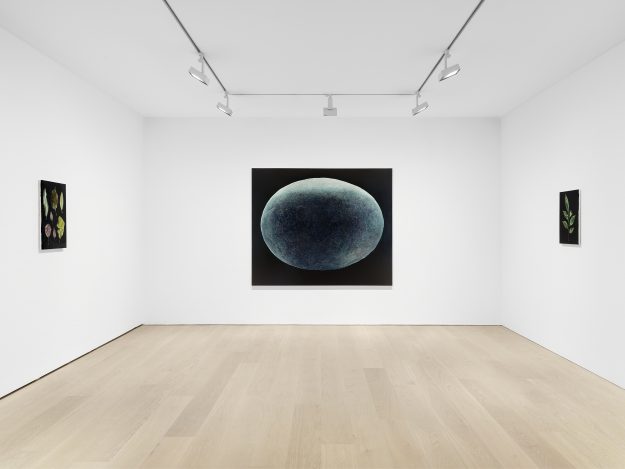
Several pieces in the exhibition feature organic motifs rendered in meticulous detail but stripped of their particular environmental context. Filling one of the gallery walls, for instance, is a large painting of an ovoid stone that appears suspended in a field of glossy black. The surface of the stone is pocked and speckled, shifting from midnight blue to the color of a pale sky, and its edges glow, creating a feeling of aliveness and dimensionality. It’s a precise depiction of an ordinary stone, but its luminosity and scale also conjure a planet careening through space, as though a single stone might contain a whole universe.
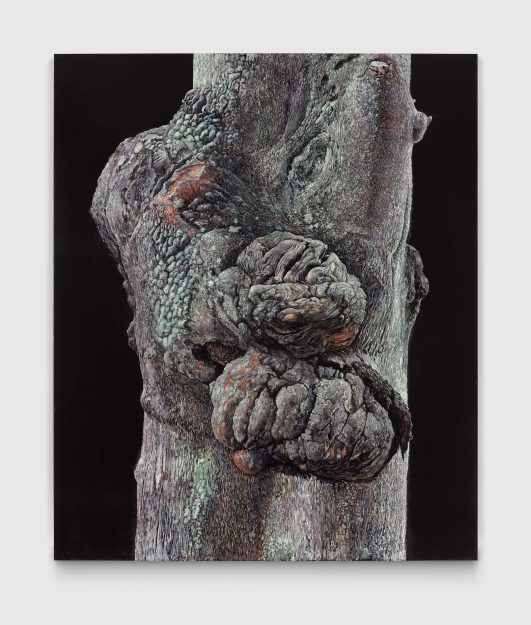
The gnarled trunk of an old tree receives a similar treatment. Takagi paints the complex textures and kaleidoscopic hues of the bark with forensic attention, capturing striated layers, scaly patches, and swelling burls that protrude from the trunk like a pair of boxing gloves. The effect is at once hyperreal and abstract, reminiscent of an undulating topographical map, the terrain of a canyon, or even the body’s fleshy innards. Leaves, as well, are a recurring preoccupation for Takagi. One work depicts an assortment of leaf specimens with a botanical illustrator’s accuracy, capturing their papery fragility, or mottled gleam, or delicate veining; another features a fresh green sprig being feasted upon by plump black ants. Masterfully detailed, yet emerging from primordial darkness, these natural forms transcend specificity and take on a kind of archetypal presence.
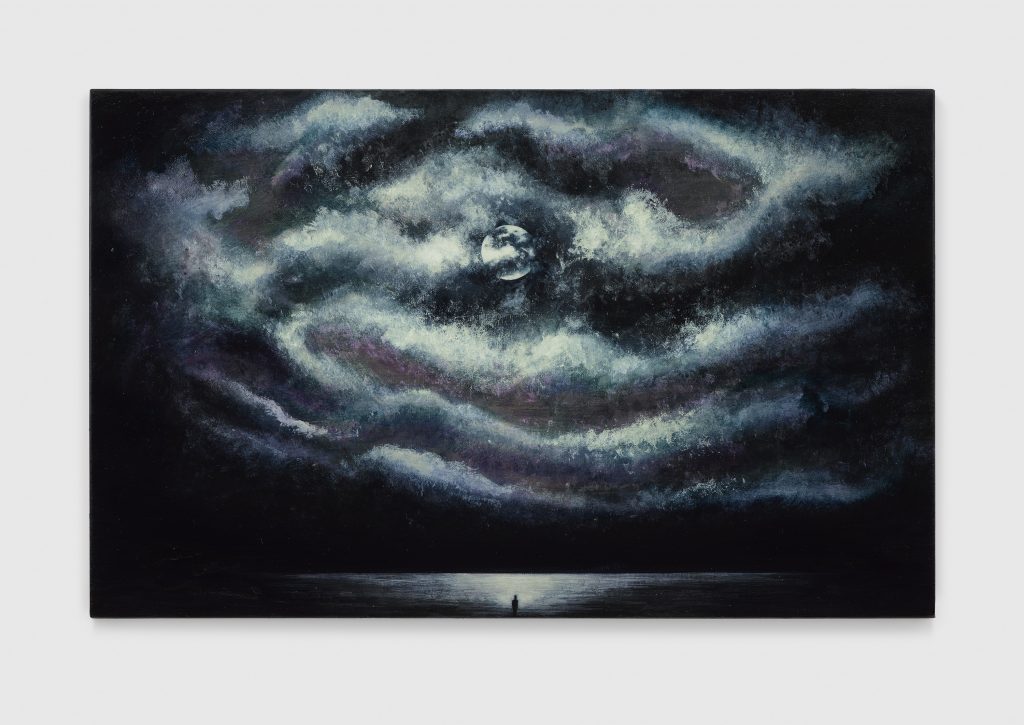
Takagi brings this same attention to his landscapes, where he places people into conversation with their environments. Wanderer (2026) depicts a solitary, minuscule figure standing at the water’s edge, under a dramatic, overwhelming night sky; the light of the moon tints the water silver and streaks the clouds with deep purple, teal, and burnt orange. In the black-and-white work also titled Wanderer (2026), a lone walker drifts along a path in a moonlit forest, beneath towering trees rendered in delicate, repetitive brushwork or scratched out with fine tools. In both of these paintings, the figure becomes a proxy for the viewer, facing outward, surrounded by beauty, vastness, and unknowability. Are they lost in a terrifying, Dante-esque wood, or are they simply enjoying a midnight stroll? Do they gaze out at the sea in desperation, or tranquility? “I want the viewer to feel as though they are wandering through questions that have no answers,” the artist said in a recent interview.
Takagi’s practice begins with witnessing. His research involves walking in the forests and parks near his home and elsewhere in Japan, with a particular interest in ordinary places—sites that might otherwise seem unimpressive or forgettable. He approaches these explorations with lightness and immediacy; his intention is to try to perceive the world around him simply as it is, without projection or intellectualization. Takagi might then photograph a landscape, or collect objects like stones and leaves and take them back to the studio. Through his brushstrokes, these memories and relics become elemental, rather than evidence of a particular time or place—hence the bottomless black backgrounds, the exaggerated scales. “I attempt to capture on the canvas the presence of the thing itself, the space that arises around it, and the experience of encountering it,” he explains.

Takagi has linked this inclination to the 20th-century Japanese philosopher Kitaro Nishida’s concept of “pure experience.” In his work, Nishida contests the modern epistemological notion that experience is necessarily subjective and individualized, arguing instead that before the conscious mind encounters the external world and divides it up into the perceiver and the perceived, there exists a prior state, one of total, unmediated unity: in his words, “the state of experience just as it is without the least addition of deliberative discrimination.” If you hear a sound or see a color, for instance, “pure experience” takes in just the sound or the color itself, before it is assessed and deemed “birdsong” or “blue.”
The philosopher himself was inspired by Buddhist concepts like mushin, or “no-mind,” an egoless state where the boundaries between the self and the external world dissolve, giving way to clarity and true presence, and mu, meaning “absolute nothingness,” which he understood not as a barren void but rather as a space of pure potential, where an immediate encounter with the world is possible.
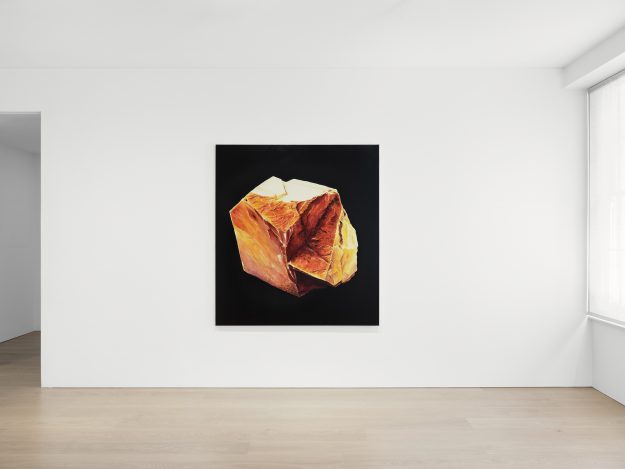
Takagi also cites the influence of the related Buddhist concept of ku, a state of generative emptiness, which calls to mind his primordial black backgrounds, from which organic forms seem to spring to life. Or mujo, referring to impermanence or constant flux, evinced by the shifting, dancing textures of his objects and landscapes. He has translated an intuitive awareness of these ideas, absorbed from his devoutly Buddhist upbringing, into an artistic practice that strives to live them out in the studio every day. It’s something akin to meditation.
Though his subject matter is ostensibly simple, Takagi is attuned to the endless possibilities contained within something as quotidian as a stone or a leaf or a tree. No two are exactly alike, and the more you look at them, the richer and more complex they become. Standing before his paintings, one has the feeling that the objects and landscapes are at once ecstatically themselves, and also something ineffably more. Says the artist: “By looking deeply into reality, another world, almost like a dream, begins to emerge from it.”

There is a fundamental tension between Takagi’s inclination toward “pure experience” and his chosen vocation. Painting is, of course, a medium through which images, thoughts, and ideas are filtered. Artmaking is inescapably representational. Takagi is attempting to reconstruct the fleeting moment of encountering the world as it is, before interpretation takes over, and yet his paintings are interpretations of those very moments.
This is an unresolvable contradiction, and yet it lends the paintings a particular potency. They depict the familiar while also defying comprehension. They reward slow, quiet looking. They facilitate in the viewer what Susan Sontag famously called an “erotics of art,” which is perhaps another way of saying “pure experience” or “mu”—direct, visceral resonance over meaning and analysis. So an ant trails the serrated edge of a leaf. The sky blooms with moonlight. That is all. And also so much more than the rational mind can fathom.

Thank you for subscribing to Tricycle! As a nonprofit, we depend on readers like you to keep Buddhist teachings and practices widely available.