
For too long, Mongolian Buddhism has been dismissed as a provincial and derivative footnote to the Tibetan tradition. That began to change in 1995, when the blockbuster exhibition “Mongolia: The Legacy of Chinggis Khan” at the Asian Art Museum of San Francisco made unmistakably clear that Mongolian Buddhist art was not only on par with—or superior to—its Tibetan counterpart but also that this aesthetic mastery was embedded in a world of complex intellectual and ritual innovation.
Over the next thirty years, scholars have revealed not only how Mongol Buddhists drove artistic and intellectual developments across the late imperial tantric world that stretched from St. Petersburg to Manchuria but also how, within this dynamic, they created their own culturally distinctive traditions. Mongol Buddhists created rituals tailored to their own needs and desires; they engaged in philosophical debates with scholars from Beijing to Lhasa, and they were important teachers who spread the dharma far and wide. Indeed, one of the more famous examples of this phenomenon is the case of the two pioneering scholars of Tibetan Buddhism in America, Jeffrey Hopkins and Robert Thurman, who were both students of Geshe Wangyal, a Kalmyk Mongol who had fled Stalin’s purges and ended up in New Jersey.

Image and Imagination in Mongolian Buddhism: Art, Text, and Rituals, by Vesna A. Wallace and Uranchimeg Tsultemin. Shambhala Publications, February 2020, $16.95, 160 pp., paperback.
Two scholars at the forefront of this reappraisal, Vesna Wallace, a specialist in Buddhist tantric studies, and Uranchimeg Tsultemin, a historian of Mongolian art, have combined their expertise in a new collaborative work. In Image and Imagination in Mongolian Buddhism, they examine the explosion of creative production that Mongolian Buddhist scholars and artists unleashed in the late 19th and early 20th centuries, as their world was collapsing around them.
By exploring both the textual and visual material produced in this fraught moment, the authors show not only the importance of bridging these academic disciplines but also how this interdisciplinary dialogue can be maintained through the innovative theoretical lens of imagination. In so doing, they reveal how imagination functions in Buddhist thought and practice, and how these creative actions of resistance and world-building helped forge new identities and communities in the face of imperial collapse and the encroachment of Western modernity.
Of most pressing concern in the face of these twin crises was how best to preserve the religio-political model of soteriological salvation that the Manchu Qing dynasty had previously maintained through its support of the Dalai Lama’s Geluk order. The Khalkha Mongols—who resided in what was then known as “Outer Mongolia”—created their own theocracy focused on their spiritual leader, the Jebtsundampa Khutugtu, in 1911. Yet this erstwhile Buddhist utopia was quickly challenged by warlords from the Chinese Republic and White Russians fleeing the Bolsheviks, and ultimately fell to Soviet-backed Communist forces in 1921. Three years later, when the Jebtsundampa Khutugtu passed away, the Mongolian People’s Revolutionary Party outlawed the search for his reincarnation, and a decade later, the Stalin-inspired purges of Buddhism began.
It is the creative Buddhist responses to these upheavals that Wallace and Tsultemin elucidate in this work. They investigate the explosion of new texts, rituals, and artworks that the Mongols produced in an effort to both make sense of—and respond to—these cataclysmic developments. In this way, Image and Imagination builds upon Matthew King’s earlier work on this same period and the Mongol creation of what he called a “counter-modern Buddhism.” Unlike elsewhere, where modernity stripped the dharma down to “mindfulness,” Buddhists in Mongolia tried valiantly to resist these same forces through new narratives, rituals, and visual productions.
The first half of Image and Imagination focuses on the Mongol appropriation of the Shambhala myth during this period. This myth is first found in the early 11th-century Kalacakratantra, which prophesied a world in which the dharma was under relentless assault. In particular, it claims that Buddhism will be threatened in the future by Muslims, and the final eschatological battle will take place between the twenty-fifth (and final) ruler of Shambhala, Kulika Rudracakrin, who will ride forth with his Buddhist army from the hidden realm of Shambhala, annihilate the Muslims, and usher in a new golden age of the dharma.
Although this myth was written in the context of Muslim advances into South Asia in the first millennium, its apocalyptic framing has been used by Buddhists throughout the centuries whenever they felt threatened. Such was clearly the case in early-20th-century Mongolia, which was facing enemies on all sides: Chinese, Russians, Communists, and Japanese imperialists. Mongol Buddhists thus wrote an array of new texts about Shambhala—histories, pilgrimage manuals, and aspirational prayers. And while these works built on the original Indo-Tibetan corpus, the Mongols took the material in new directions: speculating about Shambhala’s earthly location and how to get there, or whether it was akin to the Sukhavati pure land and thus accessible only through prayer.
Eventually, these debates settled down, quite possibly due to the introduction of modern geography and the appearance of Baron Roman Nikolai Maximilian von Ungern-Sternberg (1885–1921), the “Bloody Baron.” He was a White Russian general who had fought the Bolsheviks and was invited to Mongolia in 1921 as a Shambhala-like savior from the north who would, it was hoped, drive out both the Chinese and the Communists. Yet he soon turned his violence against the Mongols, and any dreams of salvation came to an end.
Prior to these developments, however, Shambhala had already become, in the Mongol imagination, not a place but an enlightened state of mind. The discussion thus turns to new tantric ritual texts—with elaborate visualization practices—that would enable one to transfer one’s consciousness (Tib.: pho ba) directly to Shambhala upon death. In elaborating the requirements for performing these rituals, Wallace expands the theoretical scope of imagination as not simply a creative response to crisis but also an engagement with philosophical speculations on the role of imagination in tantric visualization practice and its implications.
Unlike elsewhere, where modernity stripped the dharma down to “mindfulness,” Buddhists in Mongolia tried valiantly to resist these same forces through new narratives, rituals, and visual productions.
Also in Part I, Wallace examines a Shambhala-based ritual text aimed at repelling enemies of the dharma. As such, it, too, involves elaborate altar preparations and visualizations, as well as bodily postures, hand gestures, and chanting to achieve the goal of all Buddhist war magic: “Let some be instantaneously annihilated with the hundred thousand sparks of guns moving fast in the ten directions! Let some be taken away by the wind! May some collapse unconscious in places permeated by poisonous smoke! Eliminate and destroy all of them!”
The second half of Image and Imagination moves away from the external threats facing the dharma and explores, instead, the question of what the Mongols themselves should do. To this end, it investigates the meaning of two thangka paintings produced around the death of the Eighth Jebtsundampa Khutugtu, in 1924. By this time, the Communists were in power, and the future of Mongolian Buddhism was very much at stake. How should the Buddhists respond? What was the answer?
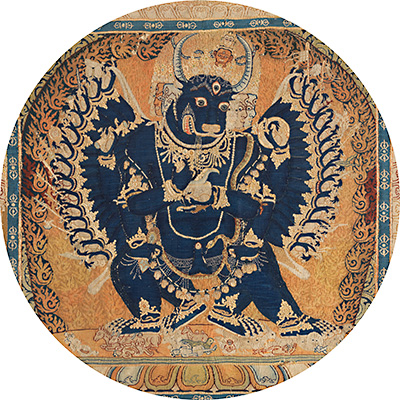
As elucidated in Tsultemin’s sophisticated reading of these two paintings—each of which is centered on the Vajrabhairava mandala but encircled by numerous images from the lives of the Jebtsundampa Khutugtu—the answer was the institution of the Jebtsundampa Khutugtu. He was the spiritual leader who had been the anchor of the Khalkha Buddhist community ever since the 17th century, and through the guru yoga ritual manifested in these thangkas, he could continue to be so into the future. In fact, by visualizing the Jebtsundampa Khutugtu and his deeds, the Khalkha could foster what Tsultemin calls a new “communal imagination” to sustain both their community and Buddhist practices through these turbulent times.
Such insights make this a fascinating read; however, it is not for the faint of heart. This is an academic monograph that demands much of the reader, from understanding the relationship between Prasangika Madhyamaka epistemology and tantric visualization practices to more contemporary theoretical distinctions between “constructive imagining” and “imagistic imagining” in terms of mental projections. But for those willing to venture forth into the rich textual and visual material of the Mongolian imagination, there is much to be learned and reflected upon.
Indeed, with the Tenth Jebtsundampa Khutugtu recently enthroned and Mongolian Buddhism blossoming again, these imaginative feats of the early 20th century have now borne fruit. As this book makes abundantly clear, the creativity and imagination of Mongol Buddhists should never be underestimated.

Thank you for subscribing to Tricycle! As a nonprofit, we depend on readers like you to keep Buddhist teachings and practices widely available.