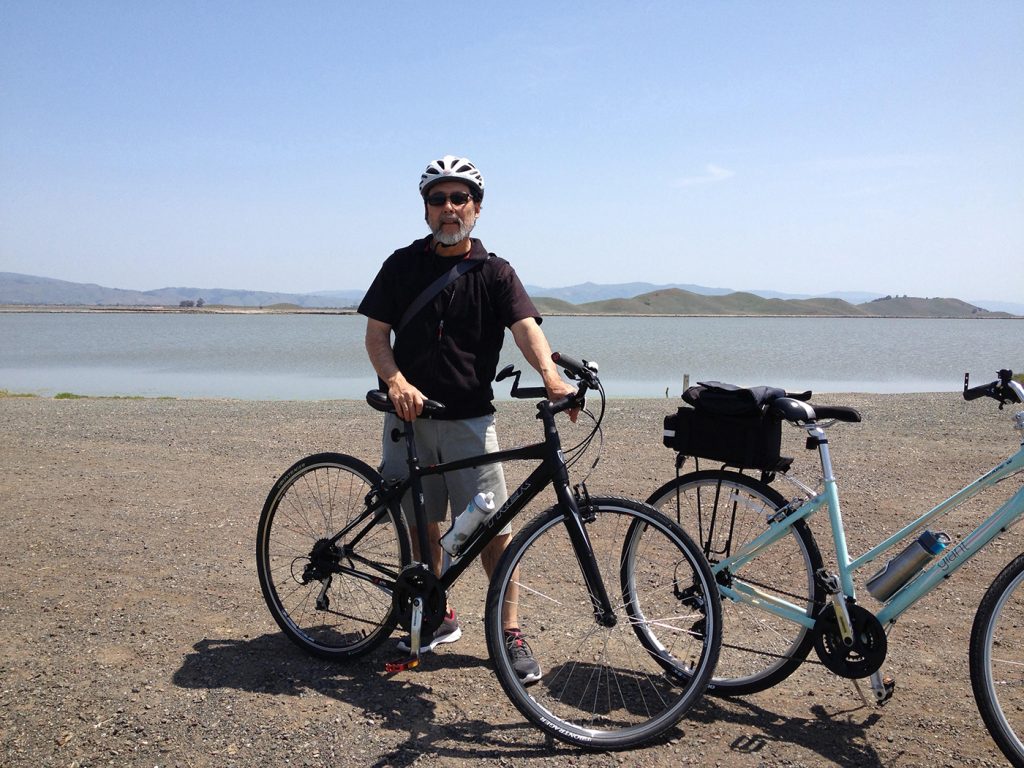
I met my friend Ed Oasa about three years ago. He showed up at my Introduction to Buddhism class at the Berkeley Adult School carrying an oxygen machine with a plastic tube wrapped around his nose. Although not much older than I am, his illness was apparent. He grew up in Hawaii in the 1950s and remembered attending Buddhist temple services, but not much else about Buddhism. His illness now motivated him to revisit the teachings.
Ed was enjoying his life—he was intelligent, had a good career and a happy home life. Then, as he said, “cancer happened.” A doctor gave him three years to live if his particular form of blood cancer wasn’t treated. He said, “I crumbled and wept upon hearing those words.”
Ed was a studious person with a PhD in political science and had been a researcher at the University of Kentucky and in Germany. But pursuing an academic career was tough, so he switched gears and became a private investigator, earning a good living working on legal cases for many years.
Then came his diagnosis. His career, health, and life came to a screeching halt. He easily became short of breath and had to rely on a portable oxygen machine. His thoughts grew fuzzy, and he couldn’t concentrate. His life became a series of doctors’ appointments, medical tests, and treatments. At one point, he spent a week in a medically induced coma and woke up with a ventilator in his mouth. Out of desperation, he wanted to forgo all treatment and enter hospice, but his wife talked him out of it. He said he felt “humiliated.”
He hated this new life. In his words, his life had been a life of accomplishments, self-definition, and independence. He had enjoyed taking long walks, hiking, gardening, bike riding, and traveling. Now, he couldn’t do any of it. He could never again fly back to Hawaii to visit family. He felt naked and vulnerable because he was so dependent on others. He could not control his future.
Friends tried to encourage him. They told him to “Stay positive,” “Be a fighter,” “You can beat this thing.” Somebody even gave him a pair of boxing gloves. Though he knew they meant well, he really didn’t appreciate these gestures. “What did they know about my suffering? No way could they relate,” he thought.
In a cancer support magazine, he learned the expression “Suffering is holding on to something that has already changed.” He sometimes repeated this phrase to himself word for word. But no matter how hard he tried, his mind sank deeper into negativity. He knew he had to do something.
He decided to take a “positive” approach, using this new life to “grow” mentally and intellectually. He began reading books about history, philosophy, politics, and the classics of American and Russian literature. But he grew tired of reading and studying, and he wondered, “For whom am I doing this? Who am I trying to impress? What’s the point of being cultivated and learned?” His wife told him not to be so hard on himself, saying trying to “grow” was a “natural human” response.
Ed turned to Buddhism. He began attending my class at the Berkeley Adult School and services at the Berkeley Higashi Honganji Temple, listening to Rev. Ryoko Osa’s dharma talks. He also attended lectures by Nobuo Haneda, the founder of the Maida Center of Buddhism.
When the temple and center closed during the pandemic, he continued participating online, reading books, listening to Buddhist lectures on YouTube, and studying writings on the internet. Eventually, we began to meet regularly in person at the temple, at coffee shops, and at my home to discuss his thoughts and what he was studying.
Through his study, Ed realized that he had confused humiliation with humility. He said that he felt humbled. He had thought life was his to control as he desired. He had thought, “I live life,” but now he realized “Life lives me,” a phrase reminiscent of Higashi Honganji’s slogan: “Now, Life is Living You.”
Ed also began to understand the meaning of impermanence. He didn’t like it and had a hard time accepting it, but through his illness, he came to understand its truth. Ed had despised his illness, thinking it was an enemy that had unfairly targeted and attacked him. After all, this was an illness he was supposed to fight and conquer. Instead, he realized that illness taught him much about life. He appreciated the words of Buddhist scholar Taitetsu Unno, who wrote in River of Fire, River of Water, “Illness, too, is my good friend.”
Aturning point came when he was at his lowest, mired in dark thoughts about losing control of his life, about all the things being taken away from him, about all the things that he could no longer do. Then, he heard that his sister couldn’t bear to speak to him because it made her too sad. Ed realized he had been thinking only about himself, and hardly about others.
“I’m grateful for my sister’s words,” he said. “They taught me to go beyond my entitled self. I am grateful to her and my brother. Even though they don’t live nearby, I have felt their constant presence, reminding me that life is precious.”
Above all, Ed was grateful to his wife, Shellye—his constant caregiver, companion, supporter, and source of strength. He frequently mentioned her in our conversations. “It may be a cliché to say,” he told me, “but there are no words to say thank you to Shellye. My gratitude is beyond words.”
In time, Ed got better. His medical readings vastly improved, and he no longer needed oxygen during the day. His illness seemed to magically disappear. But then, worrisome signs appeared that the dreaded cancer had returned. Ed knew his prognosis was terminal and that death lay just over the horizon. “Having no hope is not a bad thing,” he wrote, “because it also means I have no fear of the illness. The duality between hope and fear has disappeared. With this loss comes the freedom to appreciate what life brings.”
A few months later, Ed invited me to his home. We sat on his balcony on a sunny day, chatting about his new favorite subject, Jodo Shinshu. He was vibrant and talkative, discussing Shinran Shonin (1173–1263), the Buddhist reformer Kiyozawa Manshi (1863–1903), and Nobuo Haneda’s lectures. You wouldn’t have guessed he was sick. When I left, he mentioned an article he wanted to write for the Higashi Honganji USA website.
Two weeks later, Ed was hospitalized with a high fever. A few days after that, with Hawaiian music softly playing and Shellye at his side, he peacefully passed away.
I share this story because it tells of a journey about somebody who thought he knew what life was all about. He thought it was about choices, control, and independence—about what he wanted and what he chose to accomplish. But illness took away that world. In its place, he found a world where his connection to others was most important. In a few short years, he traveled a great distance that some might never cover in a lifetime.
I’m reminded of Shinran Shonin, the founder of Jodo Shinshu. When he learned of the death of a devout sangha member named Kakushin, he dictated a letter. A disciple later wrote:
I read this letter [back] to [Shinran] in order to see if there were any errors; he told me that there was nothing to be added, and that it was fine. He was especially moved and wept when I came to the part about Kakushin, for he is deeply grieved by his death.
I also wept when I heard of Ed’s passing. But I’m thankful I got to know him, even briefly. He was a dear friend and someone I have learned from.
Gratitude and appreciation are the greatest ways we can “return” the kindness and compassion we’ve received. Such gratitude surpasses any material gift, because it’s rooted in wisdom—the understanding that our lives are the result of countless connections to others. This flow of connections is what Shinran called “Great Compassion.”
Shinran lived to be almost 90. Near the end of his life, frail, forgetful, and losing his sight, he wrote:
How joyous I am, my heart and mind grounded by the Buddha’s teachings, my thoughts and my feelings flowing from the dharma ocean. I’m deeply aware of Great Compassion and sincerely revere and appreciate what I came to understand from the teachers before me. My joy grows ever deeper, my gratitude and indebtedness ever stronger.
Shinran encourages us to deeply understand ourselves and to appreciate our lives and those of others. Thanks to him, we have our temple, where we can hear the dharma, we have these words of truth, and we have our sangha, our community, which gives us support and encouragement.
Adapted from an article published by Higashi Honganji USA, 2021, and reprinted with permission from the author.

Thank you for subscribing to Tricycle! As a nonprofit, we depend on readers like you to keep Buddhist teachings and practices widely available.