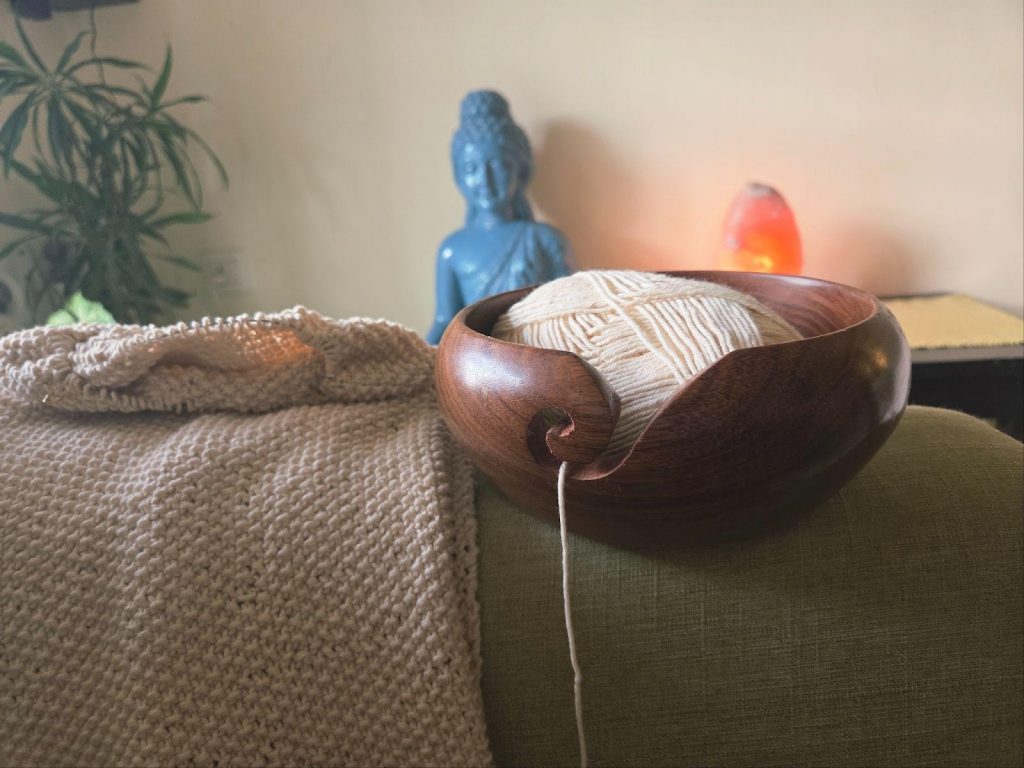
The wooden bowl stands still as I gently tug at the soft cotton yarn it holds. The cream-colored ball spins around, unraveling little by little under my watchful gaze; picking up the string from the end attached to the knitting needle, I thread it between my fingers and check the string tension—it feels off, the tension is too low.
Removing my hand from the yarn, I pick it up from a point closer to the needle, wrap it alternately above and beneath my fingers, and recheck—the goal is to have moderate tension; too tight and the knitted fabric will be too stiff and unpleasant, too loose and the stitches will be flimsy and unstructured. Aah, this time the tension is just right. I resume knitting, reminded of the Buddha’s advice to Sona on skillful effort (AN 6.55):
“Just like an arched harp (Skt.: vina) with strings which are too taught or too loose is not in tune or playable, over-aroused persistence leads to restlessness, overly slack persistence leads to laziness. Thus, you should determine the right pitch for your persistence.”
*
The sandalwood smoke lazily wafts in the stillness, the tealight burns quietly at the altar—I look up from my knitting needles for a moment to savor the calm. Sliding one needle through the loop on the other, I wrap the yarn around it and take a deep sigh. My hands start working in rhythm to “seed stitch,” the pattern of my blanket—knit one stitch, purl one stitch, knit one stitch, purl one stitch. . . .
Pausing mid-row to confirm that the tiny bumps are alternating in the correct manner on the freshly knitted fabric, it comes to my attention that this pattern resembles samsara as depicted in the bhavachakra, with its unwavering pairs of worldly opposites—pleasure and pain, praise and blame, gain and loss, fame and disrepute.
I contemplate:
Opposing stitches, when knitted correctly and consistently, have resulted in a pleasing ribbed texture, whereas in places where the same stitch got repeated by mistake (knit, knit or purl, purl)—as though I was temporarily attached to the stitch—there are unsightly glitches in the fabric. If we can keep walking the middle path with equanimity—neither attached nor averse to the oscillating conditions that arise and cease—the fabric of our lives, held together by stitches of right action, can be free from unnecessary suffering.
*
The firm ample ball of yarn I attached to my needles a few days ago has reduced to a small messy bundle in my bowl. I glance at it and look back at the eight inches of knitted fabric hanging from my needles. Satisfaction and awe fill my heart. The transformation is striking. In a few hours the bowl will be empty and I will have to join a new ball of yarn. Impermanence. All conditioned phenomena arise, exist for a time, and then pass away.
*
It is midafternoon. As I am resting on my bed, I become aware of my shallow breathing, rapidly beating heart, and constricted throat. Having struggled with anxiety on and off for the past few years, I have learned the hard way that it is better not to wrestle with it or try to forcibly quell it. Any aversion-driven action has always led to a rapid downward spiral.
If we can keep walking the middle path with equanimity—neither attached nor averse to the oscillating conditions that arise and cease—the fabric of our lives, held together by stitches of right action, can be free from unnecessary suffering.
I sit up—without interfering with the uncomfortable sensations or putting my therapy cap on to psychoanalyze my negative thoughts—quietly gathering my yarn bowl with the work-in-progress blanket folded atop and make my way to the couch in a well-lit corner of the living room. Putting my feet up on the coffee table, I rest my head on a cushion and pick up my knitting needles.
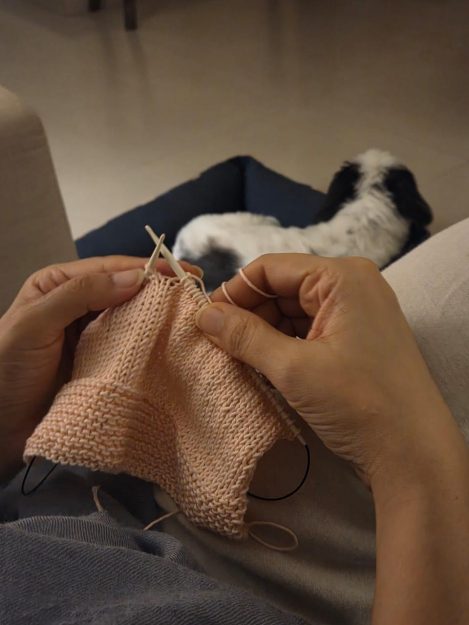
Knit one, purl one, knit one, purl one. . . . I concentrate intently on making right effort with my hands. Thoughts drop away loop by loop until I am fully present with the needles, the yarn, and the motion of knitting—aware only of the yarn gliding through my fingers, the repetitive movement of my hands, and the occasional clicking of one needle against the other.
Soon, I hear a deep exhale leaving my lungs. Feeling at ease, I reflect gratefully on the Buddha’s wise words:
“In the case of painful feelings, the underlying tendency to resistance (aversion) should be given up . . . one who has given up the tendency to resistance in regard to painful feelings . . . has made an end of suffering.” —Pahana Sutta (SN 36.3)
*
Opening the pouch that stores my knitted swatches (small samples usually knitted prior to starting a project), I pull out all the rectangular pieces and lay them flat side by side—a vibrant milieu of colors, textures, and patterns leaps up from the coffee table.
The variety is striking, especially since only two basic stitches have been used to knit the pattern for each swatch. Garter, stockinette, double rib, and seed stitch swatches are all simply bundles of individual knit and purl stitches combined in a particular manner.
I notice how each swatch is unique in character and contemplate how different causes and conditions—such as the knitting pattern, the type of yarn fiber, the yarn weight, the yarn color, the size of knitting needles, the material of needles, my knitting skill at the time—have all come together and contributed to the look and feel of the fabric.
The swatches strike me as a woven treatise on dependent origination—mirroring how all phenomena lack independent existence, and arise not from a single cause but from a confluence of causes and conditions.
“When this exists, that comes to be; with the arising of this, that arises. When this does not exist, that does not come to be; with the cessation of this, that ceases.” —Samyutta Nikaya (12.61)
*
My dog has curled up next to me after our evening walk—it is our downtime; the yarn bowl on the side table looks inviting. After hesitating momentarily, since I am unsure whether I have enough energy to concentrate properly, I lift the bowl and pick up my knitting needles to continue working on the extra-long muffler I am knitting for my husband.
The needles gently weave the bright yellow yarn through each loop as I watch aimlessly.
Oops, I cannot recall the last time I paused to examine the freshly knitted fabric for any errors. Putting my needles down, I look over the recent rows and columns—looks like I unknowingly dropped a stitch a couple of inches ago.
A stitch count confirms that there is indeed one live stitch less on the needles. Now, a dropped stitch is like a pet dog whose leash somehow slips off on a walk—the alarmed human parent must quickly refasten the leash before they bolt and disappear.
I quickly secure the loose stitch with a pin, lest it travel all the way down to the first row, damaging countless hours of work. I reflect on the ramifications of one careless action and am reminded of Shantideva’s words:
“One moment’s anger shatters all good acts accumulated in a thousand eons . . . .”—The Way of the Bodhisattva, Shantideva
*
With a heavy sigh, I admit it is pointless to carry on and push all 227 stitches off my knitting needles—with several inches of a potential blanket, hanging from them.
Zzzzip . . . zzzzip . . . zzzzip. . . . I rip off one row of fabric after another until there is only a chaotic pile of wavy yarn left lying in my lap.
Sudden emptiness. The becoming has ceased to become. I feel numb.
As I slowly wind the unraveled yarn back onto the ball, I contemplate how this bears resemblance to the spiritual goal: unbinding the interconnected fabrications one by one until there is complete cessation and an end of becoming.
“There is, monks, an unborn—unbecome—unmade—unfabricated. If there were not that unborn—unbecome—unmade—unfabricated, there would not be the case that escape from the born—become—made—fabricated would be discerned. But precisely because there is an unborn—unbecome—unmade — unfabricated, escape from the born—become—made—fabricated is discerned.” —Nibbana Sutta (Udana 8.3)
*
Some knitting projects turn out well, some not so well, while others have to be modified or abandoned altogether—quite like the dreams and aspirations of our younger selves. I feel nostalgic remembering the pale-yellow doll I had knitted and seamed together for a school project, with thick black woollen braids. Even at that young age, knitting’s repetitive motion had been a gateway to calm abiding for me.
A few months ago, when I picked up the knitting needles after a hiatus of more than three decades, I felt very grateful for my needlework teacher—my muscle memory kicked in quickly, reconnecting me to the same inner quietude. Much to my delight, I also discovered an effortless way to spontaneously contemplate and experience the dhamma through yarn.

Thank you for subscribing to Tricycle! As a nonprofit, we depend on readers like you to keep Buddhist teachings and practices widely available.