A twenty-seven-foot-tall Buddha stands atop New York City’s High Line, the iconic elevated park built on abandoned freight rails. With The Light That Shines Through the Universe, the Vietnamese American artist Tuan Andrew Nguyen reimagines one of the two Buddhas of Bamiyan—colossal 6th-century statues destroyed by the Taliban in 2001—by placing before the sculpture separate brass hands cast out of salvaged ballistic shell casings from Afghanistan.
Nguyen has won multiple awards for his sculpture and films, including a 2025 MacArthur Fellowship. His artwork has appeared in the Smithsonian American Art Museum, the Guggenheim, the Whitney, the San Francisco Museum of Modern Art, and many more museums around the world. He also cofounded the Propeller Group, an art collective and advertising company, in 2006. By contemplating memory through material, Nguyen’s art tells the untold yet universally resonating stories of colonial legacies and political resistance.
Born in Saigon in 1976, Nguyen fled with his family to the United States by boat when he was 3 years old. After growing up in Oklahoma and California, he attended the University of California, Irvine, and completed an MFA at California Institute of the Arts. He moved back to Ho Chi Minh City upon graduating, where he continues to live and work. His return to Vietnam disrupted a dichotomy held by many Vietnamese people between the home country and the diaspora, or those who left and those who stayed. “I wanted to return to Vietnam to liberate myself from this idea of home that I could never grasp while I was growing up in the US. Now, I think there is no home,” he said in an artist segment from Art21. “I don’t think that being in between worlds is something that limits us. That liminality actually empowers people. I think learning to understand different worlds is going to be a skill that helps us to navigate a very precarious future.”
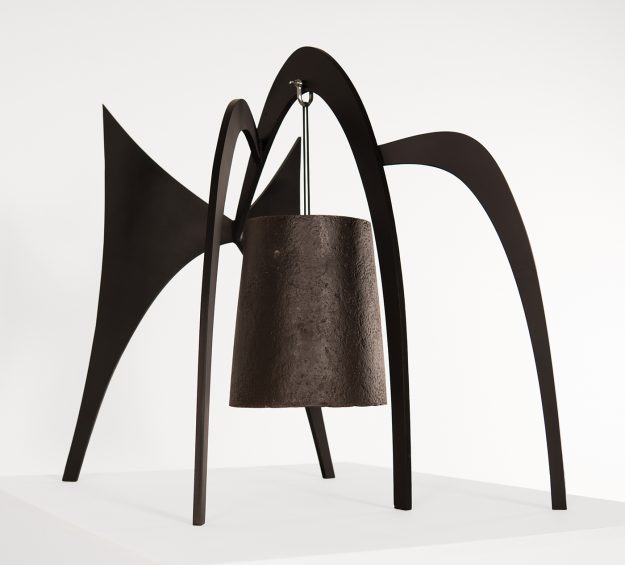
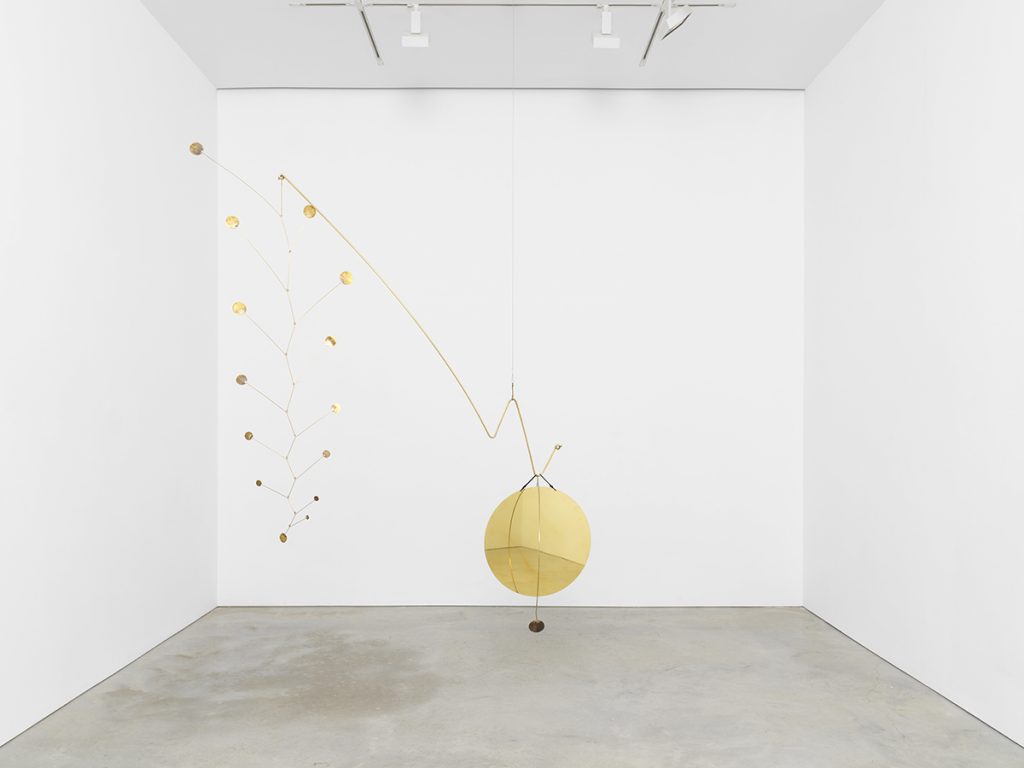
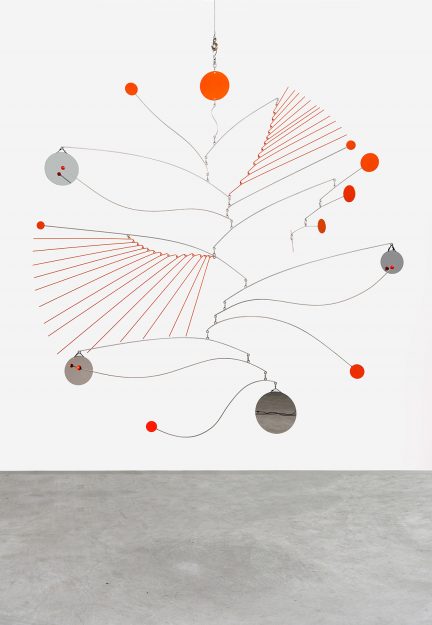
No matter where his work takes him, Nguyen always makes it a point to collaborate with local artisans and actors. In Quang Tri, one of Vietnam’s most heavily bombed areas during the Vietnam War, he works with community members to collect artillery shells and unexploded ordnance, the primary medium used in his sculpture work. He shapes and tunes many of his sculptures to ring at therapeutic frequencies like 432 Hz, repurposing weapons to be instruments of healing and human interaction. In 2023, Nguyen’s first major US solo exhibition, “Radiant Remembrance,” showcased many of these sculptures, particularly his hanging mobiles. Its opening at the New Museum in New York City featured an hour-long puja blessing by exiled Tibetan monks and a performance by the musician An Binh Tat, who played Nguyen’s sculptures in order to “activate” the exhibit.
By contemplating memory through material, Nguyen’s art tells the untold yet universally resonating stories of colonial legacies and political resistance.
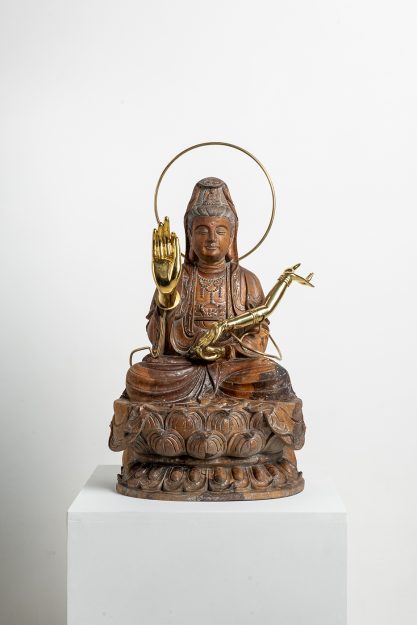
In true fashion of a multimedia artist, Nguyen’s sculptures also often appear in his videos. For instance, the film The Unburied Sounds of a Troubled Horizon (2022) features his series of singing bowls and mobiles. In the film, a mother from Quang Tri suffers from PTSD, while her daughter Nguyet creates sculptures. After consulting with monks, Nguyet believes herself to be the reincarnation of the 20th-century American sculptor Alexander Calder, who was notably outspoken against the war. Quan Yin’s brass arm in Shattered Arms is also reused in this film as a prosthesis for Nguyet’s cousin, who was maimed as a child by unexploded ground munitions.
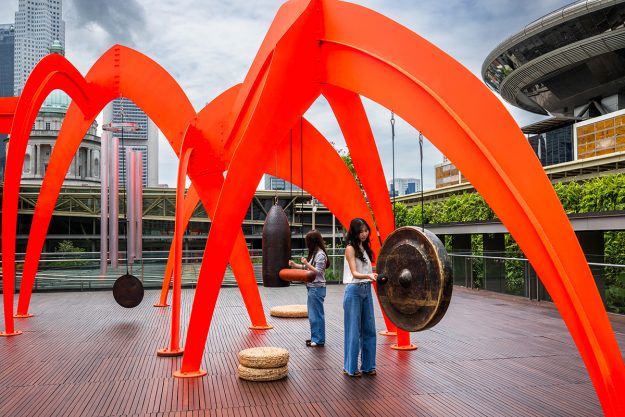
Other works of Nguyen’s include Temple, which is currently on display at the National Gallery Singapore. From the arching red structure hang gongs, bells, chimes, and mallets. It is surrounded by cushions woven from water hyacinth—an invitation for viewers to play, sit, listen, and meditate in the soundscape they’ve just created.
No matter where his work takes him, Nguyen always makes it a point to collaborate with local artisans and actors.
His videos also include Because No One Living Will Listen (2023), a short film in the form of a letter from a Vietnamese Moroccan woman to her deceased father, a Moroccan soldier who defected from the French army. City of Ghosts (2023) guides viewers through the opulent and sprawling An Bang Cemetery in the city of Hue. And My Ailing Beliefs Can Cure Your Wretched Desires (2017) places observers in the point of view of the last Javan rhino that was poached in Vietnam.
But even as his art explores themes of war, displacement, and relationships between the living and the dead, Nguyen isn’t trying to provide complete solutions or resolve traumas. “I think artworks are most effective when they can destabilize a person’s point of view,” he continues in his Art21 artist segment. “I don’t want people to leave thinking they know the answer to something. I want people to leave moved by what they’ve seen but also questioning what they’ve seen and everything else.”

Thank you for subscribing to Tricycle! As a nonprofit, we depend on readers like you to keep Buddhist teachings and practices widely available.